

Alberto Giacometti’s lamps, vases, andirons, wall lights, and tables can look like a side story beside the sculptures that made him famous.
A current Paris exhibition argues almost the opposite.
Surrealist Giacometti: Objects like Sculptures, at the Institut Giacometti from June 5 through November 1, 2026, brings his decorative objects directly beside the Surrealist sculpture he produced between 1929 and 1935. Curated by Laura Braverman, the exhibition asks viewers to reconsider a division that art history has often treated as obvious: sculpture belonged to serious art, while lamps and furniture belonged to decoration.
For Giacometti, that border was unstable.
The Institut Giacometti exhibition shows how his work for the Parisian interior designer Jean-Michel Frank shared materials, textures, shapes, and imaginative principles with pieces such as Suspended Ball, Disagreeable Object, and the remarkable Table of 1933.
Giacometti was not simply earning money by designing attractive household objects.
He was discovering that a vase could raise the same artistic questions as a sculpture.
Giacometti Entered Surrealism As Objects Became Dangerous
Giacometti’s Surrealist period was relatively brief but extraordinarily productive.
He became closely involved with André Breton’s group around 1930–31, just as Surrealists were becoming increasingly interested in the psychological possibilities of physical objects.
A normal object has a function.
A cup holds liquid.
A lamp produces light.
A table supports things.
Surrealism wanted to disrupt that certainty.
Objects could be displaced, transformed, eroticized, made threatening, or stripped of their practical meaning. The familiar could become psychologically charged simply because it stopped behaving normally.
Giacometti approached this problem differently from artists who altered existing manufactured objects.
The Fondation Giacometti explains that he often modeled new forms inspired by objects, creating autonomous physical presences rather than repurposing ordinary things.
His sculptures therefore looked as if they might perform a function without revealing exactly what that function was.
Suspended Ball Made Sculpture Behave Like A Device
Suspended Ball, created around 1930–31, became one of Giacometti’s defining Surrealist works.
A rounded form hangs inside a cage-like construction above another curved shape.
The arrangement suggests motion.
It also suggests erotic contact.
Yet the viewer cannot complete the action.
The Fondation describes Suspended Ball as one of the works that helped bridge sculpture and object.
Salvador Dalí regarded it as crucial to his own idea of the Surrealist object with a symbolic function.
That phrase is useful when looking at Giacometti’s decorative work.
A lamp has an obvious practical function.
A Surrealist sculpture has a psychological one.
Giacometti discovered that the same object could begin sliding between those categories.
Jean-Michel Frank Gave Giacometti A Second Laboratory
Giacometti began producing decorative objects around 1929–30, initially partly for financial reasons.
His most important collaboration developed with Jean-Michel Frank, one of the leading interior designers of interwar Paris.
Frank favored restrained interiors, luxurious materials, pale surfaces, and carefully selected sculptural objects.
Giacometti fit that environment remarkably well.
According to the Fondation Giacometti’s detailed history of his decorative arts, he ultimately designed around 100 models for Frank.
They included lamps, floor lamps, wall lights, chandeliers, vases, andirons, fireplaces, mirrors, pedestal tables, door handles, and other objects.
More than half of this decorative production involved lighting.
Yet Giacometti did not treat these works as aesthetically inferior to sculpture.
He later wrote that objects interested him almost as much as sculpture and that there was a point where the two touched.
The 2026 exhibition is built around that point of contact.
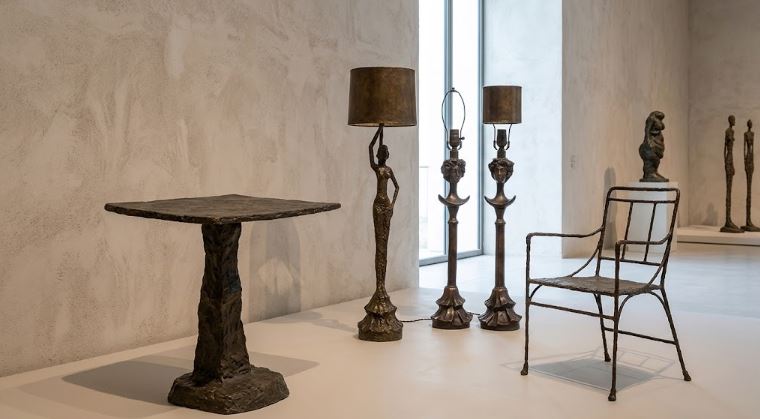
A Lamp Could Still Look Like A Body
Consider Giacometti’s floor lamps from around 1933–34.
The Fondation’s Ossicle floor lamp rises on a thin stem toward an abstracted head-and-shoulders form.
It works as lighting.
It also looks disturbingly close to a standing figure.
The object therefore occupies two identities.
Furniture.
Body.
Utility.
Sculpture.
Giacometti’s lamps can resemble beings that have been stretched until anatomy becomes architecture.
That ambiguity is deeply Surrealist.
The psychological disturbance does not depend on making the object unusable.
It depends on letting function and imagination occupy the same form.
His Surfaces Prevented Luxury From Looking Perfect
Frank designed sophisticated interiors for wealthy clients.
Giacometti’s objects could have been polished into conventional luxury goods.
Instead, they often retained uneven, scratched, irregular surfaces.
The Fondation notes that his decorative objects frequently used the same materials as his sculptures, especially plaster and bronze.
Even apparently symmetrical pieces could remain physically rough.
That roughness mattered.
A perfectly polished lamp disappears easily into interior decoration.
A Giacometti lamp retains evidence of making.
Its surface feels handled, aged, excavated, or imperfect.
Some objects appear almost as if they came from an imaginary ancient civilization rather than a fashionable Paris workshop.
The room becomes subtly archaeological.
Table Makes The Art-Furniture Distinction Collapse
No work demonstrates the problem more clearly than Table (1933).
The Centre Pompidou has lent the important plaster version to the current exhibition.
Giacometti called it a table, but describing it as furniture immediately becomes difficult.
Its tall structure supports an extraordinary collection of sculptural elements: a female head, an arm, geometric forms, and a draped body-like presence.
The Institut Giacometti even devoted a September 23, 2026 talk to the work because of its ambiguous status.
Is it a sculpture that resembles furniture?
A piece of furniture transformed into sculpture?
A stage?
A still life?
A psychological construction?
Giacometti refused to settle the question.
In correspondence from 1933, he connected the polyhedral form within the table to Albrecht Dürer’s Melencolia I and to thoughts about death and stasis.
A supposedly practical form had become metaphysical.
The table supports ideas rather than dinner plates.
Decorative Art Also Fed Back Into Sculpture
The relationship did not move in only one direction.
It would be too simple to say that Giacometti made serious sculptures first and then borrowed their appearance for commercial work.
The Fondation stresses that influence moved between the two practices.
A faceted vase from around 1934, for example, shares formal qualities with his sculpture Cube (1933–34).
The decorative object may echo the sculpture.
The sculpture may also absorb discoveries made while designing the object.
The distinction becomes difficult to reconstruct.
That is precisely what the 2026 exhibition wants viewers to notice.
Giacometti was working on these things at the same time.
The boundaries mattered less in the studio than they later did in museum classification.
Surrealism Was Already Attacking Useful Objects
Giacometti’s experiment belongs to a larger Surrealist fascination with the moment when an ordinary thing stops being ordinary.
That interest eventually produced some of the movement’s most recognizable objects, from Dalí’s lobster telephone to Meret Oppenheim’s fur-covered cup.
But Giacometti reached the problem from another direction.
He did not always remove function.
Sometimes he left it intact.
A lamp could still illuminate a room while resembling a figure.
A vase could still hold something while sharing the language of sculpture.
Furniture could remain usable while becoming psychologically strange.
The boundary between artwork and object was being attacked from both sides.
A similar collapse occurred when Surrealists turned printed volumes into physical artworks, as explored in thesurrealists.org’s recent feature on how Surrealism changed when the book became art.
In both cases, usefulness did not prevent an object from becoming conceptually unstable.
Frank Helped Put Surrealism Inside Elite Interiors
The Giacometti-Frank collaboration also changed where Surrealist forms could appear.
Frank used Giacometti’s objects in sophisticated private interiors rather than Surrealist exhibitions alone.
Later projects included the New York apartment of Nelson Rockefeller and the enormous Buenos Aires-area villa commissioned by Jorge and Matilde Born.
For the Born residence, Giacometti designed substantial elements including consoles and bas-reliefs. The Fondation’s research on the Born commission shows how Frank reused existing Giacometti designs while commissioning additional pieces specifically for the project.
Surrealist visual language could therefore enter a wealthy dining room through a lamp, fireplace, vase, or console.
The avant-garde object became domestic without becoming visually ordinary.
Ancient Objects Were Another Source
Giacometti’s decorative designs were also shaped by his interest in ancient and non-European art.
The Fondation connects his Egyptian lamp to forms associated with objects discovered in Tutankhamun’s tomb in 1922.
Another floor-lamp design incorporated a form related to a Polynesian offering-bearer.
Such borrowing needs historical context. European modernists often encountered non-European objects through museums and colonial collecting systems that separated works from their original cultural meanings.
Giacometti was nevertheless interested in something those objects demonstrated clearly: an object could be practical, ritual, symbolic, and sculptural at the same time.
Modern European art had created strong categories between fine art and utility.
Many historical traditions had not.
His decorative practice exposed how artificial that distinction could be.
The Hand Wall Light Makes A Body Part Functional
The 2026 exhibition includes Giacometti’s Hand Wall Light (1931).
The piece reduces the distance between anatomy and design almost comically.
A hand becomes part of a lighting fixture.
Something associated with touching becomes attached to architecture.
A body fragment gains a practical function.
This is precisely the kind of category confusion Surrealism valued.
The viewer recognizes the object immediately.
That recognition makes its new function stranger.
Furniture no longer simply surrounds the body.
It begins to resemble one.
Diego Giacometti Was Essential To Making The Objects Possible
Alberto’s decorative production also depended heavily on his brother Diego Giacometti.
Diego assisted with casting, fabrication, and the practical realization of many designs.
Alberto later acknowledged that this collaboration enabled him to produce objects while maintaining his sculptural practice.
That detail matters because decorative objects require another kind of artistic thinking.
A unique sculpture can remain fragile or impractical.
A lamp has to stand.
A wall light must attach securely.
A vase must occupy a room convincingly.
Design therefore forced Giacometti to confront the real physical behavior of objects.
Surrealist imagination had to coexist with engineering and craft.
The tension made the results more interesting.
Leaving Surrealism Did Not End His Interest In Objects
Giacometti’s formal relationship with Breton’s group ended in 1935 as he returned increasingly to working from observation and the human figure.
His decorative production did not disappear.
Frank continued commissioning work, and Giacometti created objects later in his career as well.
That continuity exposes another weakness in rigid movement labels.
“Surrealist Giacometti” may refer primarily to 1929–35.
But the questions he explored during those years did not suddenly vanish.
What separates sculpture from object?
When does function become image?
Can a useful thing still create psychological uncertainty?
Those questions survived the formal break with Surrealism.
Why Giacometti’s Furniture Was Never Just Furniture
Surrealist Giacometti: Objects like Sculptures remains at the Institut Giacometti through November 1, 2026.
Its strongest argument lies in refusing a hierarchy that once seemed obvious.
Sculpture was not necessarily the serious work while decorative design paid the bills.
The two practices developed together.
Giacometti’s lamps borrowed bodies.
His vases shared sculptural surfaces.
His wall lights turned anatomy into architecture.
His furniture acquired symbolic and psychological weight.
His sculptures, meanwhile, increasingly behaved like objects that might be touched, manipulated, activated, or used.
That exchange changes how his Surrealist period looks.
Giacometti was not simply making strange sculptures while designing conventional interiors on the side.
He was investigating what an object could become once art, function, desire, material, and physical presence stopped respecting separate categories.
A lamp could illuminate a room.
It could also make the room strange.
For Giacometti, that was where furniture stopped being merely furniture and began behaving like Surrealism.