
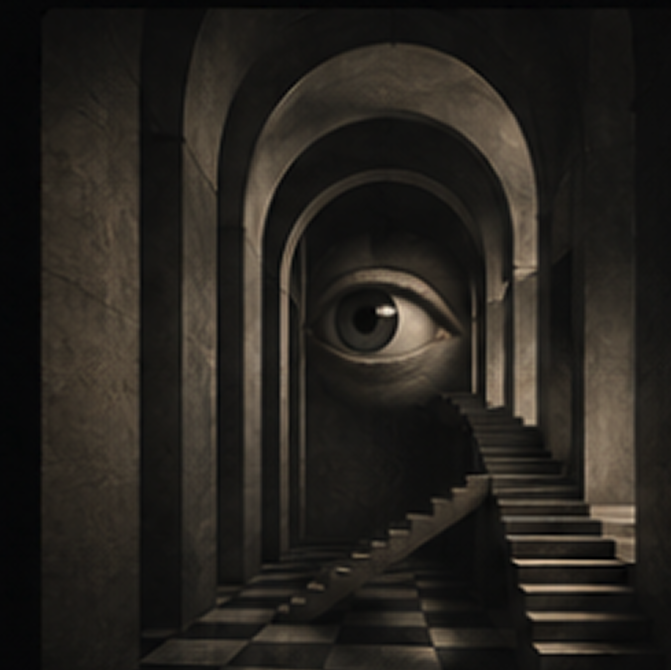
Surrealism is often remembered through paint, photography, collage, film, and objects.
Aurèlia Muñoz pushed a related imaginative logic into something softer, larger, and more physical: thread, rope, knots, embroidery, macramé, handmade paper, and suspended textile structures that seem less like conventional sculpture than strange organisms occupying architectural space.
That is why the upcoming exhibition Aurèlia Muñoz: Beings at MACBA Museu d’Art Contemporani de Barcelona matters beyond textile history.
Opening November 5, 2026, and running through March 29, 2027, the exhibition surveys more than five decades of Muñoz’s work, moving from early collages and assemblages through pictorial embroidery, monumental macramé structures, kite-sculptures, drawings, models, and late installations made with handmade paper.
MACBA explicitly describes Muñoz’s early work as carrying Surrealist and Gothic influences. The official exhibition then follows what happened when those influences escaped the flat image and became structures that could hang, expand, cast shadows, and transform the spaces around them.
Muñoz was not a historical member of André Breton’s Surrealist movement.
That distinction matters.
Her importance lies instead in showing how Surrealist habits of metamorphosis, ambiguity, unexpected materials, and unstable bodies could survive after Surrealism ceased to function as a unified movement.
Muñoz Began With Surrealist And Gothic Imagery
Aurèlia Muñoz was born in Barcelona in 1926.
She studied at the School of Applied Arts and at Escola Massana, eventually developing a practice that rejected the assumption that textiles belonged only to decoration, craft, or domestic use.
MACBA identifies her early collages and assemblages as strongly marked by Surrealist and Gothic influences.
That starting point is significant.
Surrealism had already demonstrated that ordinary materials could become psychologically strange once removed from their expected functions.
A found object could become sculpture.
A photograph could become a dream mechanism.
A page could become a field of irrational association.
Muñoz eventually applied a similar freedom to fibre.
Thread no longer needed merely to decorate cloth.
A knot could become structure.
Embroidery could operate like painting.
Macramé could become architecture.
A textile could behave like a living thing.
Around 1960, Fabric Became A Turning Point
MACBA’s exhibition history identifies a crucial development around 1960, when Muñoz began painting on burlap.
From there, she developed large embroidered works using wool she often dyed herself.
Her sources were unusually broad.
MACBA points to the symbolic directness of Romanesque art and the rhythmic visual language of Paul Klee among important influences.
These references helped Muñoz move away from textile as ornamental surface.
Her embroidery became pictorial.
Thread functioned like line.
Texture replaced conventional brushwork.
Fabric developed its own spatial depth.
The work could still hang on a wall, yet it was already moving away from painting.
The surface wanted to become an object.
The Surrealist Connection Is About Metamorphosis
The most useful way to connect Muñoz with Surrealism is not through iconography.
She did not spend her career painting melting watches, dream interiors, or Freudian symbols.
The connection is structural.
Surrealism repeatedly asked what happens when one thing begins behaving like another.
A lobster becomes a telephone.
A shoe becomes a hat.
A book becomes sculpture.
A body becomes furniture.
Muñoz posed comparable questions through fibre.
What if cloth becomes architecture?
What if a knot behaves like bone?
What if macramé becomes a suspended organism?
What if sculpture moves with air rather than standing rigidly on a pedestal?
The answer was not a revival of historical Surrealism.
It was one of its afterlives.
Macramé Freed Her Work From The Wall
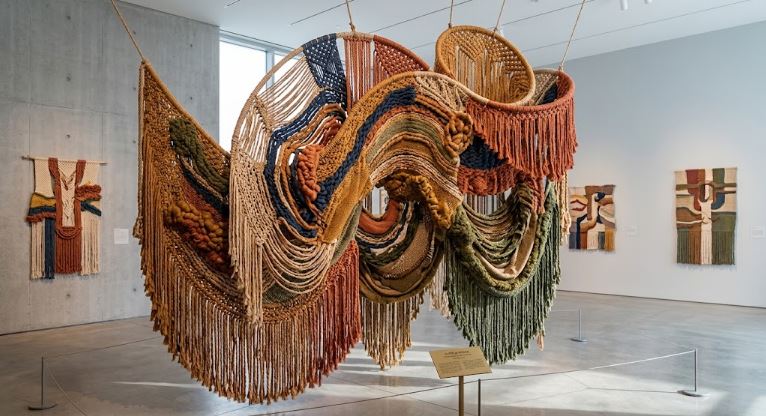
By the mid-1970s, Muñoz had become deeply interested in macramé and historical knotting techniques.
MACBA notes that some of these techniques connected with methods used by fishermen in Blanes, on the Catalan coast.
That encounter helped transform her practice.
Knots could support weight.
Rope could produce volume.
Textile could stand independently of a wall.
The shift allowed Muñoz to create increasingly large structures that hung in space.
They stretched.
Folded.
Opened.
Hovered.
Their softness distinguished them from conventional bronze, stone, or steel sculpture.
Yet their scale gave them architectural presence.
The result can look uncannily biological.
Some forms suggest wings.
Others resemble cocoons, skeletons, membranes, shells, nests, or unknown organisms.
None needs to be interpreted literally.
Their power comes from remaining between categories.
“Beings” Is The Right Word
MACBA’s English title, Beings, captures this ambiguity.
These objects can feel alive without representing recognizable living creatures.
The museum describes Muñoz’s flexible and suspended sculptures as works that transform exhibition space and create new relationships between artworks, bodies, and environment.
That language moves the exhibition beyond textile technique.
A Muñoz sculpture does not merely occupy space.
It changes how a viewer moves through it.
You may walk underneath it.
Around it.
Alongside it.
Its scale shifts according to your position.
Light and shadow alter its appearance.
The structure can seem simultaneously fragile and monumental.
The viewer stops confronting an object from a distance and begins sharing its environment.
Her Textile Creatures Destabilize Sculpture
Traditional sculpture is often imagined as hard, permanent, and self-contained.
Muñoz’s work undermines all three assumptions.
Textile bends.
Rope responds to gravity.
Suspended work can move slightly.
Fibres age differently from bronze.
Knots reveal the manual process holding the entire structure together.
Instead of hiding construction, Muñoz makes construction visible.
That creates another connection with experimental Surrealist practice.
Surrealism often valued procedures capable of producing unforeseen forms.
Frottage, decalcomania, collage, automatic drawing, and assemblage all allowed materials to participate in composition.
Muñoz’s knotting is more deliberate than classic automatism, but the finished form still emerges through repeated physical decisions that accumulate into something larger than any individual knot.
Material becomes active.
Textile Also Complicates The Old Art-Craft Divide
Muñoz’s career belongs to a period when textile art increasingly challenged the hierarchy separating “fine art” from craft.
That hierarchy had often been gendered.
Painting and monumental sculpture received institutional prestige while weaving, sewing, embroidery, and fibre were more easily associated with domestic or decorative labor.
Muñoz did not solve that problem by abandoning textile.
She enlarged it.
Embroidery became monumental.
Macramé became sculptural.
Handmade paper became installation.
Techniques with long histories in domestic, ceremonial, or practical production entered contemporary museum space without losing their material identity.
That transformation resembles another Surrealist habit: refusing to accept the cultural category assigned to an object or material.
Readers interested in how Surrealists destabilized another supposedly secondary medium can explore thesurrealists.org’s feature on why Surrealism needed paper more than canvas.
Muñoz demonstrates a comparable expansion through fibre.
The Kite-Sculptures Made Textile Almost Weightless
Among Muñoz’s most recognizable later works are her bird-kites, or kite-sculptures.
MACBA’s current exhibition materials prominently feature Ocell-estel B2 (1982).
The form hovers between several identities.
Bird.
Kite.
Sculpture.
Textile.
Object designed for air.
The categories overlap without resolving.
That is precisely what makes the work feel connected to Surrealism’s longer afterlife.
A conventional sculpture occupies the ground.
A kite belongs to the sky.
Muñoz brings those conditions together.
The object appears capable of flight even inside a museum.
Gravity remains present, but psychologically it feels temporarily negotiable.
Her Work Became Increasingly Environmental
The upcoming retrospective also includes large macramé structures from institutional collections in Spain, Europe, the United States, and elsewhere.
Their scale makes Muñoz’s relationship with architecture especially important.
A small textile can be inspected as an object.
A suspended structure may reorganize an entire room.
This shift moves her closer to installation art.
The textile is no longer something simply viewed.
It becomes an environment through which perception operates.
MACBA’s educational program for the exhibition explicitly emphasizes how these sculptures hang, unfold, and transform space, encouraging viewers to move around them with their whole bodies.
That bodily experience separates Muñoz’s creatures from imagery alone.
They are not pictures of impossible beings.
They behave like presences.
Handmade Paper Became Another Kind Of Skin
Late in her career, Muñoz expanded into installations using handmade paper.
Again, the material seems to occupy multiple identities.
Paper can be written upon.
Folded.
Layered.
Suspended.
Torn.
Made translucent.
Used architecturally.
In Muñoz’s hands, it could also behave like membrane or skin.
The transition from embroidery to macramé to paper therefore looks less like a sequence of unrelated phases than a continuous investigation of flexible matter.
She repeatedly chose materials that could change shape without losing their identity.
The resulting works remain vulnerable, tactile, and transformable.
That flexibility is the opposite of monumental sculpture’s traditional promise of permanence.
Muñoz Makes Surrealism’s Afterlife Less Visual And More Material
This is ultimately why Aurèlia Muñoz belongs in a discussion of Surrealism’s afterlife.
She does not imitate Surrealist painting.
She extends several of its deeper impulses into different materials and another generation.
Metamorphosis matters.
Hybridity matters.
Unexpected categories matter.
The transformation of ordinary materials matters.
Bodies and objects refuse stable identities.
The museum itself becomes a space where strange encounters can happen.
The difference is that Muñoz relocates those questions from dream imagery to material construction.
The uncanny moves into the knot.
The 2026 Retrospective Makes That Continuity Visible
Aurèlia Muñoz: Beings opens at MACBA on November 5, 2026, and runs through March 29, 2027.
The exhibition is organized by MACBA and Museo Nacional Centro de Arte Reina Sofía, with EINA and the Aurèlia Muñoz Archive involved in the wider project. MACBA describes the retrospective as a comprehensive journey through more than five decades of work and positions Muñoz as a central figure in understanding contemporary textile art inside and beyond Catalonia.
Its sequence is especially revealing.
Early Surrealist- and Gothic-influenced collage.
Pictorial embroidery.
Macramé.
Monumental suspended structures.
Kite-sculptures.
Handmade paper installations.
What begins as influence eventually becomes something independent.
Muñoz did not remain inside Surrealism.
She carried some of its most productive questions into places historical Surrealism had barely explored.
Textile became creature.
Craft became sculpture.
Sculpture became environment.
Material became almost alive.
That is why her strange suspended beings belong in the Surrealist afterlife.
They show that Surrealism did not have to survive by repeating its famous images.
Sometimes it survived by changing material completely.