
Andy Warhol helped erase the old boundary between fine art and mass culture.
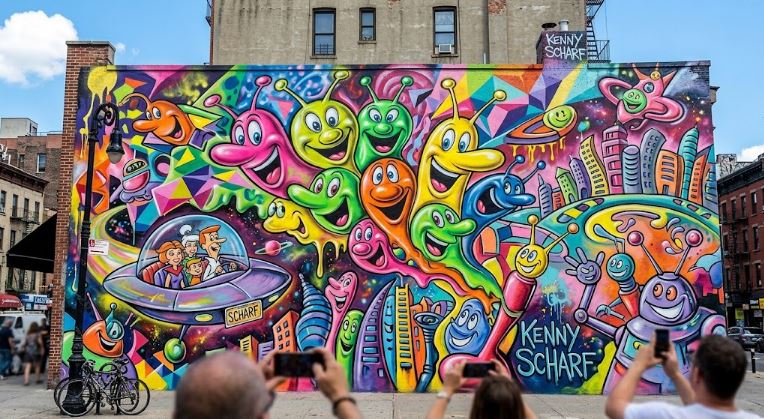
Kenny Scharf asked what happened after mass culture had already invaded the unconscious.
That distinction sits at the center of Scharf’s self-described “Pop Surrealism,” a term he formulated in a 1981 manifesto to describe an art shaped simultaneously by Surrealist irrationality and a childhood saturated with television, advertising, cartoons, science fiction, and commercial imagery.
The idea feels especially timely on September 29, 2026, as the Museo Nacional Thyssen-Bornemisza in Madrid opens a new exhibition devoted to Scharf. Running through January 17, 2027, the Kenny Scharf exhibition places him within the explosive East Village art culture of the 1980s alongside Jean-Michel Basquiat and Keith Haring, while describing Andy Warhol as a mentor.
The museum also foregrounds something that complicates an easy Pop Art classification: Scharf’s persistent references to Surrealism, his fantastical anthropomorphic figures, immersive installations, murals, sculpture, performance, and fashion.
Scharf did not simply continue Warhol’s Pop.
He made Pop imagery behave like psychic material.
Scharf Grew Up With Pop Culture Already Inside His Head
Kenny Scharf was born in Los Angeles in 1958.
By the time he reached adulthood, television was no longer a technological novelty. Advertising, animation, product packaging, science fiction, Hollywood imagery, and consumer branding had become part of everyday American visual experience.
That historical difference separates Scharf from the first generation of Surrealists.
André Breton’s Surrealism had looked toward dreams, automatic writing, unexpected encounters, and the unconscious as ways to disrupt conventional reality.
Scharf’s unconscious had already been colonized by television.
In a Whitney Museum discussion of his monumental 1984 painting When the Worlds Collide, Scharf explained that his 1981 formulation of “Pop Surrealism” grew from realizing that constant exposure to advertising and television had filled his subconscious with Pop imagery.
The implication is radical.
By the 1980s, Surrealist dream material no longer needed to emerge from mysterious symbols untouched by consumer culture.
Fred Flintstone, spaceships, animated faces, automobiles, advertisements, and television could already be waiting inside the dream.
Warhol Changed The Conditions Scharf Inherited
Warhol had made that transformation possible.
The Whitney describes Andy Warhol as an artist who understood how photographic and commercial images shape modern perception. His use of repetition, celebrity imagery, consumer products, film, photography, and mass reproduction helped dismantle the assumption that serious art had to remain distant from commercial culture.
Scharf inherited that collapse.
He did not need to prove that popular imagery belonged in an art gallery.
Warhol had already fought that battle.
The problem for Scharf was what to do next.
His answer was to make mass culture mutate.
Cartoon aesthetics could become biological.
Consumer imagery could melt into invented organisms.
Pop color could carry ecological anxiety and nuclear dread.
The polished commercial image could become manic, excessive, and psychologically unstable.
Pop moved from the surface of culture into the unconscious.
New York Gave Pop Surrealism Its Social Environment
Scharf moved from California to New York in 1978 and enrolled at the School of Visual Arts, earning his BFA in 1980.
He met Keith Haring, who had also arrived at SVA in 1978, and became part of an East Village network in which art, nightlife, performance, fashion, graffiti, film, and music continually overlapped.
MoMA’s history of Club 57 describes the venue at 57 St. Marks Place as a center of experimental downtown culture between 1978 and 1983.
Scharf was deeply embedded in that scene.
His environments, performances, customized appliances, paintings, and installations rejected the idea that art belonged only on a clean gallery wall.
That attitude also connects him to historical Surrealism.
Surrealists had experimented with books, exhibitions, objects, photography, poetry, performance, and unusual environments decades earlier. Readers interested in that expansion beyond conventional painting can explore thesurrealists.org’s article on how Surrealism changed when the book became art.
Scharf inherited the same refusal of medium boundaries under radically different cultural conditions.
The “Cosmic” Spaces Were More Than Decoration
One of Scharf’s best-known early strategies was transforming rooms into immersive environments.
His Cosmic Caverns and related installations covered walls, objects, furniture, and discarded materials with fluorescent colors and invented imagery.
MoMA later reconstructed his Cosmic Closet for its Club 57 exhibition.
These spaces matter because they complicate the idea that Scharf is simply a painter using cartoon imagery.
He wanted viewers inside the image.
The environment itself became psychedelic, crowded, playful, artificial, and unstable.
Historical Surrealist exhibitions had similarly experimented with immersive effects rather than presenting paintings as isolated objects.
Scharf’s version replaced the atmosphere of Freudian dream chambers with something closer to television, nightclub culture, science fiction, consumer debris, and radioactive cartoon mutation.
The subconscious had acquired neon.
Cartoons Became Modern Mythology
Scharf’s attraction to cartoons is sometimes mistaken for simple nostalgia.
It is more complicated.
Characters and visual languages derived from shows such as The Flintstones and The Jetsons belonged to the mass cultural environment of his childhood.
The past and future were both already commercial entertainment.
The Flintstones turned prehistory into suburban America.
The Jetsons turned the future into another consumer household.
Scharf recognized their strangeness.
His own figures often resemble cartoon creatures without belonging to an established narrative. Eyes bulge. Teeth proliferate. Faces collide. Machines acquire personalities. Plants and unidentified species occupy the same pictorial ecosystem.
The familiar cartoon vocabulary becomes mutation rather than quotation.
That is where Pop begins drifting back toward Surrealism.
When The Worlds Collide Makes The Combination Explicit
Scharf’s When the Worlds Collide (1984) provides one of the clearest demonstrations.
The Whitney Museum painting measures approximately 310.7 by 531.7 centimeters, making it an enormous visual field.
Scharf painted it in Keith Haring’s studio while Haring was away.
The composition is packed with activity.
Peace and chaos, humor and anxiety, Pop imagery and science-fiction fantasy coexist rather than resolving into one stable world.
Scharf has connected this imagery to his long fascination with science-fiction films and the fear of nuclear catastrophe that haunted Cold War culture.
That context changes how his brightness should be read.
The color can look celebratory.
The world underneath it can be catastrophic.
This tension becomes one of Scharf’s most distinctive contributions.
His art often refuses to choose between optimism and dread.
Nuclear Fear Gives The Cartoons A Darker Edge
Warhol’s relationship with catastrophe often involved repetition and emotional distance.
Car crashes, electric chairs, celebrity deaths, and other disturbing images could become eerily impersonal through mechanical reproduction.
Scharf uses another strategy.
Catastrophe becomes cartoon mutation.
Science-fiction imagery, radiation anxiety, ecological instability, and exaggerated life forms enter paintings that can initially appear exuberant.
The combination feels deliberately contradictory.
Something can be funny and terrifying.
Artificial and alive.
Childlike and apocalyptic.
That contradiction brings Scharf closer to Surrealism than a simple “Neo-Pop” label suggests.
Surrealism had always understood that humor and terror could occupy the same object.
Scharf updated that instability for a media-saturated nuclear age.
“Pop Surrealism” Is Not The Same As Historical Surrealism
Scharf’s term should still be handled carefully.
He was not claiming to be a member of Breton’s historical Surrealist group.
By 1981, that movement belonged to another generation.
His artistic context was East Village New York, post-Pop painting, street culture, club life, television, commercial animation, punk, graffiti, and the shadow of the Cold War.
Calling his work Pop Surrealism therefore describes a hybrid rather than a continuation.
Historical Surrealism asked what might emerge when rational control weakened.
Scharf asks what emerges when the unconscious itself has been built partly from mass media.
That is a very different psychological situation.
Warhol Became A Starting Point Rather Than An Endpoint
The Thyssen’s decision to describe Warhol as Scharf’s mentor is revealing.
Scharf moved to New York partly because he was fascinated by the world Warhol represented: a place where art, fame, music, nightlife, fashion, film, and commerce could occupy the same cultural space.
But Scharf’s generation did not simply repeat Warhol.
He, Haring, and Basquiat pushed art back into streets, clubs, improvised spaces, bodies, and temporary environments.
Scharf added another dimension through fantasy.
Warhol showed that consumer imagery could become art.
Scharf showed that consumer imagery could become dream material.
The difference is subtle but significant.
The 1985 Whitney Biennial Confirmed The Shift
Scharf’s inclusion in the 1985 Whitney Biennial marked a major expansion of his international reputation.
By then, the East Village scene was no longer simply a downtown subculture.
Its artists were entering museums, galleries, collections, and international art history.
The transition created its own contradictions.
An art culture that had challenged conventional hierarchies was rapidly becoming institutionalized.
Scharf never fully abandoned the desire to move among different settings.
The Thyssen emphasizes that his practice still extends across painting, sculpture, installation, murals, performance, and fashion.
That variety keeps the Pop-Surrealist idea mobile.
It can occupy a museum.
It can also occupy a wall.
Why The Thyssen Exhibition Matters Now
The Madrid exhibition runs from September 29, 2026, through January 17, 2027, in the museum’s Postpop rooms.
Its timing makes Scharf’s terminology especially provocative.
Contemporary visual culture is even more saturated than the television environment that led him to formulate “Pop Surrealism” in 1981.
Today the subconscious absorbs memes, advertising, animation, video games, social platforms, logos, synthetic imagery, algorithmic feeds, and endlessly recycled cultural references.
Scharf’s early observation looks less eccentric under those conditions.
What happens to Surrealism when the unconscious is filled with commercial images?
That question no longer belongs only to 1980s New York.
Scharf Complicates What Came After Warhol
Kenny Scharf does not replace Warhol in the story of Pop.
Nor does his “Pop Surrealism” simply revive Breton.
Its importance lies between those histories.
Warhol demonstrated that mass-produced imagery could become serious artistic material.
Scharf recognized what happened after generations grew up surrounded by that imagery.
Pop culture stopped being merely something artists observed.
It entered memory.
Desire.
Fear.
Humor.
Dreams.
The subconscious.
Scharf’s paintings and environments therefore make a surprising art-historical argument.
Surrealism did not necessarily disappear when Pop Art arrived.
After Warhol, it could return transformed by the very consumer culture that once seemed opposed to dreams and irrationality.
The melting watches had become cartoons.
The dreamscape had become television.
The unconscious had gone Pop.