
Ted Joans never accepted the idea that Surrealism belonged to Paris, white Europeans, or museums.
For him, it could live in jazz improvisation, Black liberation, poetry, collage, travel, political agitation, friendship, performance, and the unpredictable encounter between people who might otherwise never meet.
That expansive vision will receive major new attention when the Musée cantonal des Beaux-Arts (MCBA) in Lausanne opens Ted Joans: Black Flower on October 9, 2026. Running through February 28, 2027, the exhibition is billed by the museum as the first solo exhibition devoted to Joans, bringing together drawings, collages, experimental films, poetry, and archival material developed through research with his estate.
The MCBA exhibition describes an artist whose work moved among Surrealism, jazz, Black Power, Pan-Africanism, and transatlantic cultural exchange.
That combination makes Joans especially important now.
He does not simply add a Black artist to an existing history of Surrealism.
He makes the history itself look different.
Joans Found Surrealism Inside Segregated America
Ted Joans was born in 1928 and grew up between Louisville, Kentucky, and Fort Wayne, Indiana, within the racial segregation of the United States.
According to MCBA, one of his earliest encounters with Surrealism came through magazines his aunt was allowed to bring home from white households where she worked as a domestic servant.
The detail is revealing.
Surrealism reached Joans through the racial structures of American domestic labor, not through an elite European academy.
He later attended Indiana University, where he studied art, before moving to New York in the early 1950s.
There he entered a cultural world shaped by jazz musicians, poets, artists, Beats, and Black intellectual life.
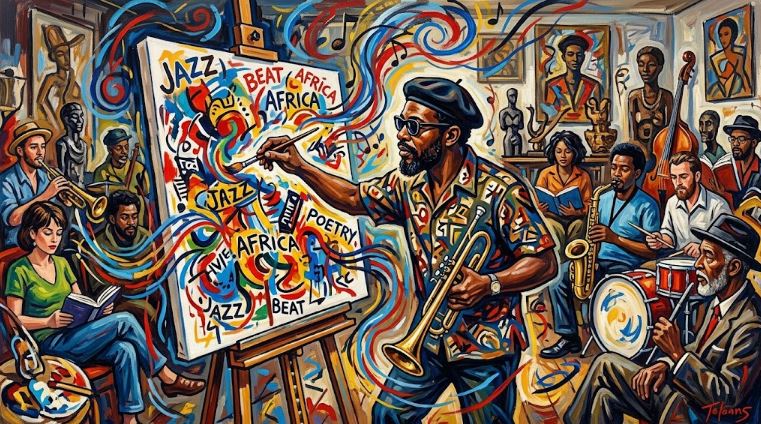
Joans would eventually describe his orientation memorably: jazz was his religion and Surrealism his point of view.
The two were not separate influences.
They became a single working method.
Jazz Changed What Surrealism Could Sound Like
Joans treated jazz as more than subject matter.
Improvisation gave him a model for artistic freedom.
Musicians such as Charlie Parker, Thelonious Monk, Dizzy Gillespie, Miles Davis, John Coltrane, and Cecil Taylor represented a creative intelligence built through variation, risk, timing, collective response, and surprise.
A major 2026 reassessment in the Poetry Foundation stresses how deeply Joans combined Black vernacular culture with Surrealist strategies throughout his six-decade career.
He painted, wrote poetry, made collages, created experimental films, played trumpet, organized happenings, and produced what he called poem-objects.
This interdisciplinarity matters.
Historical accounts of Surrealism often begin with painting and literature.
Joans makes jazz equally central.
Improvisation becomes a form of automatism.
Rhythm becomes composition.
The unexpected artistic response becomes the equivalent of the unexpected Surrealist image.
André Breton Recognized Joans, But Joans Exceeded Breton’s Map
Joans traveled to Europe in 1960 and became connected to the Paris Surrealist milieu.
He met André Breton, whose ideas had influenced him for years.
MCBA notes that Breton described Joans as the “only black Surrealist.”
Today, that description is historically revealing but inadequate.
Joans was certainly unusual within Breton’s immediate circle. Yet Black engagement with Surrealism extended far beyond one person, including figures connected to Caribbean anti-colonialism, Négritude, Black American poetry, and later artists and writers such as Bob Kaufman and Jayne Cortez.
More importantly, Joans did not want Black creativity validated only because Breton recognized it.
His work increasingly connected Surrealism to histories Breton’s original Paris circle could not contain.
Racial segregation.
Jazz.
Black Power.
African travel.
Pan-Africanism.
Colonialism.
Exile.
Black internationalism.
Surrealism had become mobile.
For Joans, Surrealism Was A Weapon
Joans’s commitment was political as well as aesthetic.
A 2025 Poetry Foundation study of his work quotes a letter to Breton in which Joans explained that Surrealism had become the weapon he chose against the racism and violence imposed on Black Americans.
The Poetry Foundation’s Ted Joans essay shows how closely he linked irrational imagery, liberation, revolutionary metaphor, and racial politics.
This shifts the meaning of Black Surrealism.
Surrealism was not simply a European visual style that Black artists adapted.
Joans used it as an instrument for refusing realities presented as inevitable.
Segregation claimed racial hierarchy was normal.
Colonialism claimed European domination was normal.
Joans embraced a philosophy built on disrupting the normal.
That made Surrealist revolt immediately useful.
Africa Changed The Geography Of His Surrealism
Joans eventually lived and traveled across several continents.
MCBA documents extended periods in Tangier, Morocco, and later Timbuktu, Mali, alongside time in Paris, Copenhagen, Amsterdam, West Berlin, and other cultural centers.
He reportedly crossed the Sahara many times.
He called Africa the “Surrealist continent,” language that should be read carefully because Africa is not one culture or a fantasy landscape.
What matters historically is how Joans sought to reverse Eurocentric assumptions.
European Surrealists had frequently been fascinated by African objects while removing them from their cultural contexts.
Joans approached the relationship from a different position: as an African American artist seeking connections to African history, contemporary culture, and Black diasporic identity.
His travel therefore complicated the old Surrealist fascination with the supposedly exotic.
Africa was not merely visual material.
It became part of his lived intellectual geography.
Black Power Entered His Surrealism Without Replacing It
During the 1960s, Joans engaged increasingly with Black liberation politics.
His poetry collections included Black Pow-Wow and Afrodisia, works in which racial politics, erotic liberation, humor, jazz, and Surrealist imagery collide.
In material republished by the Poetry Foundation in September 2026, Joans directly connected André Breton’s ideal of human emancipation with the need for revolutionary Black liberation in the United States.
That connection matters because it resists a simple choice between Black political art and Surrealist experimentation.
Joans wanted both.
Surrealism gave him techniques for breaking language and expectation.
Black Power gave those ruptures another political urgency.
The work could be humorous and militant.
Erotic and revolutionary.
Absurd and historically specific.
He did not treat those combinations as contradictions.
Long Distance Turned Surrealism Into A Global Network
Joans’s most extraordinary visual project may be Long Distance.
He began the work in the 1970s using folded computer paper and transformed the Surrealist game of the exquisite corpse into a decades-long international collaboration.
MoMA’s record of Long Distance explains that Joans carried the work across continents and invited 132 “dream people” to contribute.
Participants added drawings without seeing the full sequence that came before them.
The resulting network is astonishing.
Contributors include artists, writers, musicians, and intellectuals associated with numerous countries and movements, among them Joyce Mansour, Jayne Cortez, Ornette Coleman, Romare Bearden, Dorothea Tanning, Amiri Baraka, Betye Saar, Roberto Matta, David Hammons, Wole Soyinka, Octavio Paz, and many others.
The work stretches the exquisite corpse far beyond its Paris café origins.
A Surrealist game becomes an archive of international cultural encounter.
Black Surrealism Becomes A Network Rather Than A Category
Long Distance helps explain why Joans could change how Black Surrealism is understood.
If Black Surrealism is treated simply as Surrealism made by Black artists, the category remains dependent on a European original.
Joans proposes something less hierarchical.
Surrealism becomes a network.
Jazz musicians enter it.
African artists enter it.
Black poets enter it.
European Surrealists remain present, but they no longer occupy the automatic center.
The work travels physically among people.
Authorship becomes collective.
Chance determines who meets whom across the folded paper.
This structure reflects Joans’s larger life.
His art was continually made through encounters.
His Experimental Films Extended The Same Logic
MCBA’s exhibition will also foreground a lesser-known part of Joans’s practice: experimental film.
During a 1983–84 West Berlin residency, he produced a group of silent 8 mm films known as the Silent Poems.
The museum explains that Joans intended these films to be shown with jazz accompaniment and constructed them through striking visual juxtapositions.
The method again crosses forms.
Film becomes poem.
Silence waits for improvisational sound.
Montage behaves like collage.
Jazz does not merely accompany an image; it changes the conditions under which the image is experienced.
The work reinforces why Joans is difficult to place cleanly inside one art-historical category.
That difficulty is precisely what makes him valuable.
“Black Flower” Recovers The Visual Artist Behind The Poet
Joans is still better known for poetry than visual art.
Ted Joans: Black Flower attempts to change that balance.
Curated by Pierre-Henri Foulon, MCBA’s curator of contemporary art, the exhibition has been developed in close collaboration with Joans’s estate.
The museum emphasizes drawings, collages, films, and visual experiments that have remained far less visible than his published poetry.
One example is Some Sum Portrait of a Little Girl in Blue (1990), a collage acquired by MCBA in 2023.
Another is Bird & Basquiat Lives! (1998), whose title collapses jazz history, contemporary Black art, memory, and survival into one statement.
“Bird” invokes Charlie Parker.
Basquiat invokes another Black artist who refused stable cultural categories.
For Joans, the dead could remain creatively present.
Joans Also Complicates The Beat Generation Story
Joans frequently appears in histories of the Beat Generation, particularly because of his Greenwich Village years.
Yet even that label becomes restrictive.
He participated in Beat culture while criticizing its commercialization.
The Poetry Foundation describes him more accurately as a Surrealist moving through Beat environments.
That distinction prevents Joans from becoming another supporting character in a predominantly white Beat narrative.
Jazz, Black culture, and Surrealism were not decorative influences around his Beat identity.
They were central to his artistic worldview.
The same caution applies to Black Arts history.
Joans intersected with it without being contained by it.
His career crossed too many borders.
Why Ted Joans Could Rewrite Black Surrealism
Ted Joans: Black Flower opens at MCBA in Lausanne on October 9, 2026, following a public opening on October 8, and remains on view through February 28, 2027.
Its importance lies in more than rediscovering an overlooked artist.
Joans destabilizes the map.
He takes Surrealism from Paris to Harlem, Tangier, Copenhagen, Timbuktu, Berlin, and beyond.
He makes jazz part of Surrealist method.
He connects automatism with improvisation.
He connects psychic liberation with Black political liberation.
He takes the exquisite corpse and stretches it across continents.
He treats poetry, painting, collage, film, performance, and everyday life as parts of one practice.
For readers interested in how deeply language shaped Surrealism from its beginnings, thesurrealists.org’s overview of Surrealist poetry and literature provides useful context.
Joans matters because he challenges the idea that Black artists merely entered an already completed Surrealist tradition.
His career suggests something more radical.
Black culture, jazz, Pan-African thought, travel, and liberation politics could transform what Surrealism meant.
That does not place Joans outside Surrealism.
It reveals how much larger Surrealism becomes once Paris is no longer treated as the only place capable of defining it.