
Odilon Redon: Otherworldly Visions at the Getty Center turns darkness into a dream engine by showing how the French Symbolist artist used blackness, eyes, skeletons, floating heads, hybrid creatures, flowers, myth, literature, and science to make the invisible feel strangely alive. On view from July 14 to October 18, 2026, the exhibition brings together charcoal drawings, lithographs, and pastels from Getty’s collection, along with selected loans, to trace Redon’s movement from haunting monochrome imagery to luminous color.
For thesurrealists.org, the exhibition matters because Redon sits at one of the most important thresholds in modern visual culture. He was not a Surrealist in the historical sense; he died in 1916, before André Breton’s 1924 Surrealist Manifesto. Yet Redon’s art helped prepare the ground for Surrealism by making dreams, fantasy, subjective vision, and inner life feel serious enough to structure an image. His darkness does not simply hide things. It generates them.
Getty’s official exhibition page describes Redon’s work as a fantastical world of haunting darkness and luminous color, shaped by sources that include religion, mythology, literature, and modern science. That framing gives the exhibition its strongest cultural hook. Redon’s dark images are not just gothic moods. They are laboratories where the imagination learns to produce creatures, symbols, and psychic atmospheres.
Why Getty’s Redon Exhibition Matters Now
The timing of Otherworldly Visions is useful because Redon feels newly relevant in an image culture obsessed with the fantastic, the uncanny, the speculative, and the subconscious. Contemporary audiences often encounter dream imagery through film, game worlds, AI-generated visuals, fantasy design, and digital surrealism. Redon offers a much older and more disciplined model: a handmade art of uncertainty built from charcoal, lithography, pastel, and the slow pressure of looking.
The exhibition’s Getty Center setting also matters. Redon’s work depends on close attention to material. A charcoal drawing is not merely a black-and-white image. It is dust, erasure, pressure, smudging, stumping, and removal. A lithograph is not just an illustration. It is a printed atmosphere. A pastel is not only color. It is powdery light held on paper.
This material focus helps explain why the exhibition belongs to a Surrealist site. Surrealism did not appear from nowhere. It grew from earlier artists who had already challenged realism’s confidence in the visible world. Redon’s art asks a question Surrealism later amplified: what if the most important reality is not the one seen directly, but the one felt behind sight?
That question gives Odilon Redon: Otherworldly Visions its force. The show is not simply a historical survey. It is a reminder that darkness can be productive, not empty. In Redon’s hands, black becomes a space where the dream starts working.
How Redon’s “Noirs” Made Darkness Active
Redon called his charcoal drawings and dark lithographs noirs, a word that ties the images to blackness as both color and condition. These works made his reputation before he turned more fully toward oils and pastels. They often feature floating heads, eyes, monsters, skeletal forms, strange plants, hybrid beings, and figures suspended in uncertain space.
MoMA’s Eye-Balloon collection entry explains the power of this approach clearly. The work shows a hot-air balloon in the form of an eye, carrying a severed head above a marshy landscape. MoMA notes that Redon used charcoal’s suggestive qualities to evoke the unknown and fantastic, with diffuse pigment creating an atmosphere beyond what is merely represented.
That description captures why Redon’s darkness feels like an engine. The black field does not sit behind the image. It produces the image. Forms emerge from it, hover inside it, and threaten to dissolve back into it. The viewer senses that the visible creature is only one temporary appearance inside a larger unseen world.
This connects naturally with thesurrealists.org’s earlier writing on symbolism in Surrealist art, because Redon’s symbols rarely behave like simple codes. An eye, skeleton, flower, fish-man, or floating head does not translate into one message. It gathers meanings and keeps them unstable.
Why “The Battle Of Bones” Feels Playful And Macabre
Getty’s exhibition foregrounds The Battle of Bones, made around 1881, a recent Getty acquisition that appears in both the exhibition listing and Getty’s 2026 article on Redon’s darker worlds. The work shows skeletons against a black ground, but its tone is stranger than simple horror. It is macabre, comic, theatrical, and oddly alive.
Getty’s article Odilon Redon’s Dark Humor and Darker Worlds quotes curator Danielle Canter explaining that Redon drew inspiration for the image from a poem by Maurice Bouchor. In the poem, two dead men fight over their lover, return from the grave, eat her food, make a mess, and continue battling. Redon chose a late moment in the absurd afterlife struggle, where the skeletons remain active inside the darkness.
This is important because it complicates the idea of Redon as merely gloomy. His darkness can be funny. It can contain theatrical movement and dark play. The skeletons are dead, yet they keep acting. The image becomes a miniature theater of absurd persistence.
That quality anticipates later Surrealist humor. Surrealism often made death, desire, and absurdity collide inside a single image. Redon does something similar decades earlier, but with Symbolist restraint. His skeletons do not become cartoons. They remain uncanny because they are both ridiculous and existential.
How Eyes Became Redon’s Instruments Of Vision
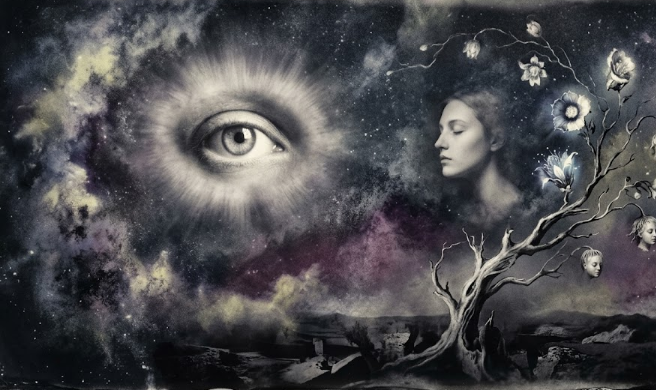
The eye is one of Redon’s most important motifs. It appears in works such as Eye-Balloon and Everywhere Eyeballs Are Aflame, and Getty’s exhibition highlights this recurring fascination. An eye, for Redon, is not only an organ of sight. It is a symbolic machine that looks beyond ordinary perception.
Getty’s 2026 article notes Canter’s explanation that Redon was interested in both anatomical vision and spiritual vision. The eye could stand for close observation of the world, but also for a more mysterious kind of seeing that moves toward the mystical, menacing, or unknowable. That double function makes the motif powerful.
An eye separated from the body becomes uncanny because it no longer belongs to a stable person. It floats, watches, rises, burns, or becomes a vehicle. It suggests perception without identity. In Eye-Balloon, the eye is also a balloon, a device for ascent, a dream machine that carries a severed head toward infinity.
This is where Redon’s Symbolism looks forward to Surrealism. Later Surrealist art would repeatedly fragment the body, detach organs, animate objects, and make vision strange. Redon’s eye already performs that work. It makes seeing itself feel unstable.
Why Literature Fed Redon’s Dream Worlds
Redon’s images often grow from literature without becoming straightforward illustrations. Getty identifies literature as one of the key sources behind his work, and the exhibition’s selected objects include images connected to Gustave Flaubert’s The Temptation of Saint Anthony. MoMA’s entry for The Eye like a Strange Balloon Mounts toward Infinity also notes Redon’s inspiration from writers such as Edgar Allan Poe and Flaubert.
This matters because Redon’s art frequently transforms reading into vision. He does not simply depict a scene from a text. He turns a literary atmosphere into a symbolic image. A strange being with a man’s head and fish body is not only a Flaubert reference. It becomes a visual problem: how can the impossible be made to feel internally convincing?
Redon once described his originality as bringing improbable beings to life “in a human way” and placing the logic of the visible at the service of the invisible. That idea defines his dream engine. The impossible must not look random. It must feel as though it obeys its own hidden law.
For readers of thesurrealists.org, this is one of Redon’s most important lessons. A dream image works when it does not simply announce weirdness. It must create a world where weirdness feels necessary.
How Science Made Redon’s Imagination Stranger
Redon’s art did not come only from religion, mythology, poetry, and fantasy. Getty’s exhibition materials also emphasize modern science, and Canter’s comments in Getty’s article connect Redon to botany, microscopy, and the influence of his botanist friend Armand Clavaud. That scientific context helps explain why some of Redon’s works feel both natural and alien.
This is a crucial point. Redon’s creatures often seem to emerge from the border between observation and invention. They may look botanical, microscopic, anatomical, spiritual, or monstrous. The viewer is not always sure whether a form belongs to a plant, a cell, a sea creature, a myth, or a dream.
That ambiguity makes the work feel modern. Nineteenth-century science was expanding the visible world through microscopes, evolutionary theory, geology, medicine, and new forms of classification. Redon absorbed that expanded field of sight, then pushed it toward the psychic and poetic.
The result is not anti-scientific fantasy. It is science made dreamlike. Redon uses modern seeing to make reality feel stranger, not less mysterious. The microscope does not banish the dream. It gives the dream new shapes.
Why The Turn To Color Did Not End The Dream
Redon’s later work in pastels and oils is often discussed as a shift away from the darkness of the noirs toward luminosity, flowers, mythic figures, and decorative color. That shift is real, but it should not be misunderstood as a simple move from nightmare to happiness. The dream engine keeps running. It simply changes fuel.
The National Gallery in London notes that Ophelia among the Flowers, made around 1905–08, belongs to a period when Redon moved away from monochrome drawings and prints with grotesque and macabre subjects toward a more lyrical exploration of color in pastels and oils. Its Ophelia among the Flowers entry describes the work as a dreamlike response to Shakespeare rather than a literal illustration.
That distinction matters. Redon’s color is not merely decorative. It remains ambiguous. Flowers glow, but they can surround death. Ophelia may be sleeping or dead. Color does not clarify the image; it intensifies uncertainty.
This is why Getty’s exhibition title works so well. Otherworldly Visions includes both haunting darkness and luminous color because Redon’s otherworldliness is not tied to one palette. Black can dream. Color can haunt.
How Redon Became A Precursor To Surrealism
Redon’s relationship to Surrealism should be handled carefully. He was a Symbolist, not a Surrealist. His work belongs to the late nineteenth and early twentieth centuries, not to the official Surrealist movement. Yet his influence on modern dream imagery is hard to ignore.
MoMA’s 2005 exhibition Beyond the Visible: The Art of Odilon Redon described his work as caught between description and dream, the observed and the imagined. It also emphasized his hybrid creatures, literary and mythological interpretations, strange natural forms, and universe of dark visions and bizarre fantasies.
Those qualities made Redon important for later artists and writers interested in the unconscious. He showed that a modern image could be precise and irrational at the same time. He made dream worlds feel structured rather than vague. He also gave symbolic weight to fragments: eyes, heads, flowers, skeletons, windows, halos, fish bodies, floating forms.
This is why Redon matters for thesurrealists.org. He demonstrates that Surrealism’s sources include more than Freud, Dada, Breton, and the postwar avant-garde. The movement also inherited a nineteenth-century visual culture of Symbolist dreams, occult suggestion, literary obsession, and strange science.
Why Darkness Works Differently In Redon
Darkness in Redon does not work like ordinary shadow. It is not only the absence of light or a realistic nighttime setting. It is a medium of transformation. His dark grounds make forms appear as if summoned, not simply drawn.
That is why the noirs remain so powerful. They give the viewer the sense that the image is still emerging. A head, eye, skeleton, plant, or creature may be visible, but it has not fully escaped the black space around it. The darkness remains active, almost alive.
This gives Redon’s art a psychological force that differs from narrative horror. He does not need to show a dramatic event. He can present a floating head, an eye, a dark window, or a strange plant, and the viewer feels that something unseen has entered the image.
For a modern audience, this makes Redon feel surprisingly current. In a culture saturated with bright, polished images, his darkness slows vision down. It asks the viewer to wait. It makes looking feel uncertain again.
How “Otherworldly Visions” Reframes Redon For Today
The Getty exhibition reframes Redon by emphasizing the full range of his imagination. It does not isolate the dark noirs from the later color works. Instead, it presents them as parts of one larger artistic vision. That matters because Redon’s career can look split too neatly between black and color, nightmare and flower, gloom and radiance.
A stronger reading sees continuity. Redon’s entire career explores how the visible world can open onto invisible pressure. In the noirs, that pressure emerges through charcoal darkness. In the later pastels, it emerges through color, floral forms, mythic subjects, and luminous ambiguity. The dream changes costume, but it does not disappear.
Getty’s selection of works such as Light, Everywhere Eyeballs Are Aflame, Apparition, Head within an Aureole, The Battle of Bones, and Orpheus supports that continuity. These images move between vision, death, myth, music, spirituality, and imagination. They do not form a single story. They form a symbolic atmosphere.
That atmosphere is exactly why Redon still feels important. He teaches viewers how to read images that do not explain themselves. He makes uncertainty feel intentional.
Why Redon’s Dream Engine Still Runs
Odilon Redon’s dream engine still runs because his images do not depend on shock alone. They depend on suggestion. A skeleton battle can be comic and grim. An eye can become a balloon. A flower can become a field of inner light. A head can float inside a halo. A fish can carry a human face. A window can open onto another state of being.
These images work because they stay suspended between categories. They are natural and unnatural, literary and private, scientific and mystical, beautiful and grotesque. That suspension is the source of their energy.
For thesurrealists.org, Otherworldly Visions offers a timely way to talk about Redon as a precursor to modern dream culture without forcing him into a movement he did not join. His art shows how darkness can become productive, how color can remain haunted, and how the imagination can build worlds from the smallest symbolic charge.
The exhibition’s title is accurate, but the deeper point is sharper: Redon does not simply show other worlds. He shows how other worlds are made. They begin in blackness, in reading, in science, in music, in myth, in grief, in jokes, in flowers, in the eye, and in the mind’s refusal to accept that the visible is all there is.
That is why Odilon Redon: Otherworldly Visions turns darkness into a dream engine. In Redon’s art, the dark does not close the image. It starts it.