
Surrealism is still most commonly remembered through dreams.
Melting objects, fragmented bodies, impossible rooms, strange animals, automatic drawings, and psychologically unstable landscapes dominate popular accounts of the movement. That version is not wrong, but it leaves out a defining part of Surrealism’s history: many of its artists and writers understood attacks on rational convention as inseparable from attacks on authoritarian politics, colonial domination, nationalism, and fascism.
A major exhibition at the Museum of Modern Art in Warsaw is putting that political history back at the center.
In the Very Bowels of Changes: Surrealism and Antifascism opened on June 26, 2026, and runs through January 10, 2027. Curated by Dorota Jarecka and Magda Lipska, in collaboration with Stephanie Weber, Adrian Djukić, Karin Althaus, and Paweł Polit, the exhibition brings together an unusually broad international group including André Breton, Claude Cahun, Marcel Moore, Leonora Carrington, Max Ernst, Wifredo Lam, Toyen, Lee Miller, Dora Maar, André Masson, Victor Brauner, Hannah Höch, John Heartfield, René Magritte, Joan Miró, Roberto Matta, and Eugenio Fernández Granell.
The museum’s official Surrealism and antifascism exhibition argues that Surrealism cannot be understood only as an aesthetic for representing fantasies and dreams. Its members repeatedly treated imagination as a political territory.
That does not mean every Surrealist maintained identical politics, or that the movement’s record was free from contradictions.
It means anti-fascism was far less peripheral to Surrealism than its most famous paintings suggest.
Warsaw Is Replacing The Dream-World Myth With A Political History
The Warsaw exhibition expands an earlier project staged at Munich’s Lenbachhaus from October 15, 2024, through March 30, 2025, under the title But Live Here? No Thanks: Surrealism + Anti-fascism.
The Polish presentation adds local and Eastern European histories to that framework.
Its location matters.
Poland’s avant-garde faced both far-right hostility before the Second World War and catastrophic destruction under Nazi occupation. The Warsaw exhibition recalls that during the 1930s, conservative critics could attack experimental art as cultural disorder while fascist rhetoric increasingly identified modernism with political and racial enemies.
That hostility became state policy in Nazi Germany.
Modern art was attacked as “degenerate,” artists were removed from institutions, collections were purged, exhibitions were banned, and many artists faced exile, imprisonment, or worse.
For Surrealists, opposition to fascism was therefore not merely an abstract ideological preference.
The political movements rising around them were directly attacking the kinds of freedom their art depended upon.
The Warsaw museum’s own essay on the ethical choices of Surrealists frames the conflict as a struggle between two radically different ways of mobilizing imagination.
Fascism sought hierarchy, conformity, mythologized national identity, obedience, and the cult of authority.
Surrealism wanted desire, contradiction, ambiguity, individual liberation, and the destruction of inherited boundaries.
Both understood that politics works through emotions and images.
They wanted those forces to produce opposite worlds.
The Political Surrealists Were Already Visible Before Hitler Took Power
The idea that Surrealism began as apolitical dream art and only became political when fascism arrived is too simple.
Breton’s group began moving toward revolutionary politics during the 1920s.
The movement’s publications increasingly connected liberation of the imagination with social transformation. Several important Surrealists joined or worked alongside communist organizations, although their relationship with the French Communist Party was frequently tense.
Breton wanted artistic revolution and social revolution to reinforce one another.
Party discipline did not always tolerate the movement’s insistence on erotic freedom, psychic experimentation, or intellectual independence.
The resulting arguments were constant.
Yet the political commitment itself was real.
Museum Boijmans Van Beuningen preserves a particularly revealing group of Surrealist pamphlets. Its research on Surrealist publications identifies both the fiercely anti-colonial Ne visitez pas l’Exposition Coloniale from 1931 and the anti-fascist Appel à la lutte from 1934.
These were not private statements hidden in notebooks.
They were interventions designed for circulation.
Surrealism had already become a political network.
The 1931 Colonial Exhibition Revealed How Far That Politics Could Go
Anti-fascism cannot be separated cleanly from another element of Surrealist political history: anti-colonialism.
In 1931, France staged the enormous Exposition coloniale internationale in Paris. The exhibition presented colonial empire as evidence of civilization, progress, and French national greatness.
Surrealists attacked that narrative directly.
Their pamphlet “Do Not Visit the Colonial Exhibition!” was signed by figures including Louis Aragon, André Breton, René Char, and Paul Éluard.
The Palais de la Porte Dorée’s history of the 1931 exhibition notes that the Surrealists were among the most radical critics because they rejected the principle of colonization itself rather than merely criticizing its abuses.
Later that year, Surrealists and communist allies helped organize the counter-exhibition La Vérité sur les colonies — The Truth about the Colonies.
Its displays exposed forced labor, racial violence, economic exploitation, and anti-colonial struggles.
That history matters to the Warsaw exhibition because Surrealists increasingly interpreted fascism and colonial domination as connected systems built upon hierarchy, racial fantasy, violence, and dehumanization.
Their analysis was imperfect.
Surrealists themselves sometimes collected and displayed Indigenous objects in ways that removed them from their original cultural contexts. The Metropolitan Museum of Art has emphasized this contradiction in its Surrealism Beyond Borders research.
An anti-colonial declaration did not automatically free the movement from European exoticism.
The contradiction belongs in the story.
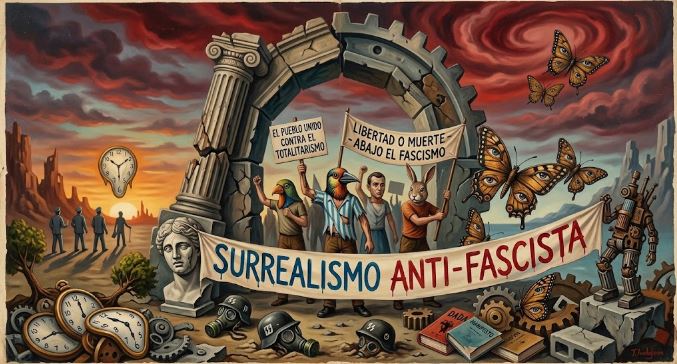
1934 Made Anti-Fascism Impossible To Treat As An Abstraction
Political conflict intensified dramatically after Hitler became German chancellor in 1933.
France also experienced a surge in confrontations between left-wing and far-right groups.
The violent Paris demonstrations of February 6, 1934 became a particularly important moment for French anti-fascism.
Surrealists responded through political organization and publications, including Appel à la lutte.
The movement’s political language became sharper because fascism was no longer simply an Italian or German development observed from a distance.
It represented a growing European possibility.
This history complicates the popular image of the Surrealist studio as an isolated laboratory of dreams.
Automatic writing and political pamphlets existed within the same movement.
So did dream imagery and demonstrations.
The Surrealists did not see those activities as inherently contradictory.
For them, rational bourgeois order was responsible for repression in both private and public life. Attacking conventional morality, nationalism, colonial authority, sexual restrictions, and fascism could therefore belong to the same liberation project.
That ambition sometimes produced unstable alliances.
It also explains why Surrealism could attract writers and artists whose political commitments extended far beyond painting.
The Spanish Civil War Forced The Question Into The Open
The Spanish Civil War, beginning in 1936, made Europe’s political division far harder for artists to avoid.
Fascist Italy and Nazi Germany supported Francisco Franco’s Nationalist forces, while international volunteers and left-wing organizations rallied around the Spanish Republic.
Surrealists responded in different ways.
Some became politically active.
Some produced explicitly anti-fascist imagery.
Others found Surrealist methods transformed by the experience of violence and exile.
Wifredo Lam, who had lived in Spain from 1923, supported the Republican cause before eventually moving to Paris in 1938. His encounter with Picasso, Breton, and the Surrealists took place against the background of a European political crisis rather than an isolated art-world exchange.
Lam later became one of the artists whose work demonstrated how anti-colonial and anti-fascist questions could intersect.
The Metropolitan Museum of Art describes Surrealism internationally as a tool repeatedly used in struggles for political, social, and personal freedom.
That is a much broader history than dream painting.
Claude Cahun And Marcel Moore Turned Surrealist Subversion Into Resistance
Few biographies make the relationship between Surrealist experimentation and anti-fascist action clearer than those of Claude Cahun and Marcel Moore.
The couple had become connected with Breton’s Surrealist circle in Paris during the early 1930s.
They later moved to Jersey in 1937.
Germany occupied the Channel Islands in 1940.
Cahun and Moore responded by creating one of the strangest resistance campaigns of the occupation.
They produced anti-Nazi messages in German designed to make soldiers believe dissent was spreading inside their own ranks. They signed some material as “The Soldier Without a Name” and secretly placed notes where German personnel might encounter them.
Jersey Heritage’s surviving Cahun and Moore resistance records document how two artists effectively invented a fictional internal German resistance organization.
The strategy feels distinctly Surrealist.
Identity became unstable.
Authorship became fictional.
Language was displaced from its expected speaker.
Psychological uncertainty became a weapon.
Their resistance eventually led to their arrest in July 1944.
A German military court sentenced both to death in November.
They survived imprisonment and were freed following the liberation of Jersey in May 1945.
Their story makes it impossible to treat Surrealist subversion as only an artistic pose.
Toyen Hid Jindřich Heisler During The Nazi Occupation
Toyen offers another striking example.
A cofounder of the Czech Surrealist Group, Toyen had already developed a visual language in which eroticism, ambiguity, fragmented bodies, and psychological violence challenged conservative social structures.
After Nazi Germany occupied Czechoslovakia, Toyen’s position became dangerous.
The Jewish poet and fellow Surrealist Jindřich Heisler was threatened with deportation.
Toyen hid Heisler in their Prague apartment for much of the occupation.
At the same time, Toyen’s wartime drawings developed images of mutilated toys, abandoned objects, damaged bodies, and emptied landscapes.
They do not behave like straightforward propaganda posters.
Their politics work through psychological atmosphere.
That distinction helps explain the Warsaw exhibition’s argument.
Surrealist anti-fascism cannot be measured only by counting paintings containing swastikas or dictators.
The movement also asked what authoritarian violence does to imagination, sexuality, individuality, and psychic life.
An artwork could oppose fascist reality without illustrating a political slogan.
Villa Air-Bel Turned Surrealism Into A Refugee Network
By 1940, the political struggle had become a matter of physical survival for many Surrealists.
After France fell to Nazi Germany, artists and intellectuals gathered around Marseille while trying to escape Europe.
One important refuge was Villa Air-Bel.
American journalist Varian Fry, working with the Emergency Rescue Committee, helped create escape networks for anti-Nazi refugees threatened by German and Vichy authorities.
The United States Holocaust Memorial Museum records that Fry and his colleagues ultimately helped approximately 2,000 people escape southern France. Those aided included André Breton, André Masson, and Max Ernst.
A surviving USHMM photograph of Villa Air-Bel shows figures including Breton, Jacqueline Lamba, Jacques Hérold, and Wifredo Lam.
The image looks almost casual.
Its circumstances were not.
These artists were waiting for visas, escape routes, documents, and ships while Nazi power spread across Europe.
Surrealism had literally become a culture in exile.
Max Ernst Was Targeted From Both Directions
Max Ernst illustrates the absurd dangers faced by political refugees during the war.
Ernst was German and an outspoken modernist whose work fell squarely within what Nazi cultural authorities labeled “degenerate art.”
He had already left Germany.
When war began, France nevertheless interned him because he was legally a German national.
He was treated first as an enemy alien by the country in which he had taken refuge and then faced far greater danger after German occupation expanded across France.
Fry’s network eventually helped Ernst escape Europe.
His biography exposes the inadequacy of treating Surrealism as separate from politics.
Nationality became dangerous.
Modernist art became politically suspect.
Exile became part of artistic life.
For artists living through these conditions, irrationality was no longer something confined to dreams.
European political reality had become irrational enough on its own.
Lee Miller Made The War Impossible To Romanticize
The Warsaw exhibition also includes Lee Miller, whose career moved from Surrealist photography into wartime photojournalism.
Miller had worked closely with Man Ray in Paris and participated in the photographic experimentation surrounding Surrealism.
During the Second World War, she became an accredited war correspondent for Vogue.
She photographed the liberation of Paris, military operations, and eventually the concentration camps at Buchenwald and Dachau in 1945.
Her wartime photographs are not simply “Surrealist photographs.”
Their documentary responsibility is different.
Yet her career demonstrates how an artist formed within the Surrealist environment could carry an eye trained to notice disturbing juxtapositions into the political catastrophe of Europe.
For readers interested in the movement’s photographic experiments before the war, thesurrealists.org’s overview of Man Ray’s photographic innovations provides useful context for the visual culture in which Miller developed.
The transition from experimental Paris photography to documenting liberated camps is one of the starkest trajectories in modern art.
Anti-Fascism Did Not Make Every Surrealist Politically Consistent
A responsible account should resist replacing one myth with another.
Surrealism was not a unified anti-fascist party.
Its artists disagreed.
Some moved toward communism.
Others became disillusioned with Stalinism.
Some emphasized anarchism.
Some avoided direct political commitment.
Several Surrealist men promoted liberation while reproducing sexist assumptions.
The movement’s anti-colonialism could coexist with exoticizing attitudes toward Indigenous and non-European cultures.
Its calls for freedom did not prevent internal expulsions, personal feuds, or Breton’s own reputation for policing membership.
Even the alliance between Surrealism and communist organizations repeatedly fractured.
Those contradictions do not make the anti-fascist record imaginary.
They make it historical.
Surrealism was a changing network of people trying to reconcile artistic freedom with revolutionary politics during some of the most violent decades of the 20th century.
They often failed to agree on how.
They rarely agreed that authoritarianism was compatible with the freedom they wanted.
Surrealism’s Politics Continued After Fascism’s Military Defeat
The Warsaw exhibition does not stop neatly in 1945.
That is important because anti-fascism did not cease to matter when Nazi Germany was defeated.
Surrealist methods continued feeding later movements concerned with authoritarianism, colonial rule, race, sexuality, and social liberation.
The exhibition links that afterlife to May 1968, when slogans associated with student revolt frequently echoed the Surrealist demand that imagination should alter everyday life.
It also includes work connected to Roberto Matta, whose political engagement stretched into the later 20th century.
The museum frames these developments as evidence that Surrealism operated less like a closed style and more like a political imagination capable of reappearing in different movements.
That interpretation needs limits.
Not every radical movement after 1945 was Surrealist.
Influence is not ownership.
Yet the movement helped normalize an idea that became powerful far beyond Breton’s circle:
Changing society also requires changing what people can imagine.
Anti-Fascism Was Connected To Surrealism’s Definition Of Freedom
The deepest link between Surrealism and anti-fascism was not party membership.
It was the movement’s conception of freedom.
Surrealists wanted individuals freed from imposed identities, conventional morality, nationalist obedience, bourgeois respectability, colonial authority, and excessive rational control.
Fascist systems demanded almost the opposite.
They hardened identity.
They elevated national and racial belonging.
They disciplined bodies.
They mythologized authority.
They organized difference hierarchically.
They turned collective fear and desire toward obedience.
This is why the Warsaw exhibition’s thesis is stronger than saying that “many Surrealists opposed Hitler.”
Of course many did.
The larger point is that much of Surrealism’s cultural project was incompatible with the authoritarian regulation of imagination.
The conflict ran through politics, sexuality, art, identity, language, and daily life.
Surrealism Looks Different Once Politics Returns To The Picture
In the Very Bowels of Changes: Surrealism and Antifascism remains on view in Warsaw through January 10, 2027.
Its most valuable intervention is not turning every Surrealist artwork into a political statement.
It is restoring the political conditions around the artworks.
Claude Cahun and Marcel Moore risked execution while producing resistance propaganda.
Toyen hid Jindřich Heisler during Nazi occupation.
Wifredo Lam moved through Republican Spain, Paris, Marseille, Martinique, and Cuba while developing an increasingly anti-colonial modernism.
Max Ernst became an exile twice over.
Breton escaped through Varian Fry’s rescue network.
Lee Miller followed the Allied advance into concentration camps.
Surrealists had already denounced colonialism before the Nazi seizure of power and publicly confronted fascist politics during the 1930s.
Those facts make the familiar museum version of Surrealism look incomplete.
Dreams still matter.
Automatism still matters.
Desire, irrationality, eroticism, chance, and the unconscious still matter.
But for many Surrealists, those ideas were valuable precisely because they challenged systems that demanded conformity.
The movement did not oppose fascism despite its obsession with imagination.
It often opposed fascism through that obsession.
Art history remembers the bizarre images because they are easy to recognize.
Warsaw’s exhibition asks us to remember what those artists believed the freedom to imagine was for.