

Surrealism loved the idea of woman as mystery.
Leonor Fini made that mystery answer back.
Throughout the 1930s and 1940s, male Surrealists repeatedly imagined women as muses, erotic catalysts, femmes-enfants, supernatural beings, objects of desire, or portals to the unconscious. Fini entered the same cultural world but built a very different mythology. Her women do not wait to inspire male creativity. They govern rooms, initiate rituals, control sleeping men, become priestesses, transform into hybrid creatures, and repeatedly assume the form of the sphinx.
That difference will receive renewed attention this autumn when SCHIRN Kunsthalle Frankfurt opens Leonor Fini: Magically Surreal on October 23, 2026. Running through February 21, 2027, the exhibition is the first major retrospective devoted to Fini in Germany and brings together around 100 paintings, drawings, photographs, objects, costumes, masks, and books spanning approximately seven decades.
The SCHIRN Leonor Fini retrospective emphasizes precisely what makes her imagery feel so disruptive: priestesses, sphinxes, and hybrid figures repeatedly reverse established gender roles.
Fini was close to Surrealism.
She never allowed Surrealism to completely define her.
That independence is essential to understanding why her sphinxes still look so radical.
Fini Entered Surrealism Without Becoming Breton’s Disciple
Leonor Fini was born in Buenos Aires in 1907 and raised in Trieste, then a cosmopolitan city where Central European, Italian, Slavic, literary, and psychoanalytic currents overlapped.
She was largely self-taught.
Her influences stretched far beyond Surrealism, including Renaissance painting, Symbolism, German Romanticism, Magic Realism, Hieronymus Bosch, Agnolo Bronzino, Gustav Klimt, Egon Schiele, and Giorgio de Chirico.
Fini moved to Paris in 1931, entering the artistic environment surrounding figures such as André Breton, Max Ernst, Salvador Dalí, Man Ray, Paul Éluard, and René Magritte.
Yet SCHIRN is careful about terminology.
Its current exhibition materials stress that despite Fini’s proximity to Surrealism, she maintained her artistic independence throughout her life. She never simply became a subordinate member of Breton’s movement.
That distinction matters because historical Surrealism could be liberating and restrictive at the same time.
The movement challenged bourgeois morality, conventional sexuality, rationalism, religion, and traditional social roles. Yet many of its male artists continued to imagine women through familiar fantasies: muse, child-woman, erotic apparition, femme fatale, or mysterious source of male inspiration.
Fini understood those fantasies well enough to reverse them.
The Surrealist Muse Was Powerful And Powerless At Once
The muse occupied an unusual place within Surrealist culture.
She could be described as magical, disruptive, erotic, intuitive, or visionary.
Yet those flattering descriptions often preserved a familiar hierarchy.
The man created.
The woman inspired.
The man interpreted dreams.
The woman embodied the dream.
The artist acted.
The muse was looked at.
Women associated with Surrealism increasingly resisted that division. Leonora Carrington, Remedios Varo, Claude Cahun, Dora Maar, Meret Oppenheim, and Fini all developed artistic identities that exceeded the roles assigned to them through relationships with male artists.
The Metropolitan Museum of Art’s discussion of Leonora Carrington’s self-portrait highlights Carrington’s famously dismissive response to being remembered primarily as Max Ernst’s muse: she insisted that she had been too occupied becoming an artist to accept such a role.
Fini’s answer was less verbal and more pictorial.
She redesigned the hierarchy itself.
Her women became the creatures holding power.
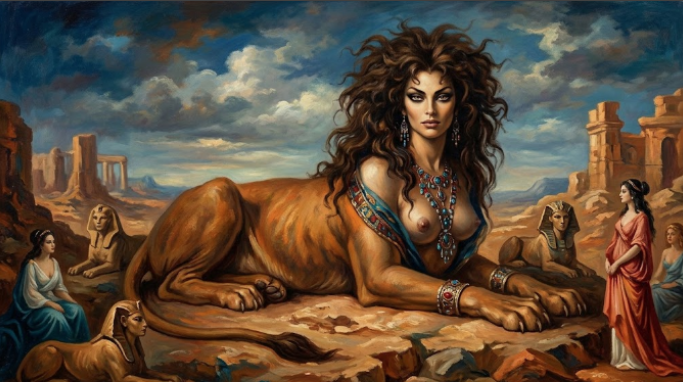
Why The Sphinx Was Perfect For Leonor Fini
The sphinx offered Fini an unusually rich symbol.
In Greek mythology, the sphinx is typically imagined as a hybrid creature combining a woman’s head and torso with the body of a lion. She blocks the road to Thebes and challenges travelers with a riddle. Those who cannot answer are destroyed.
The best-known version of the myth centers on Oedipus, who solves the riddle and defeats the sphinx.
Traditional storytelling therefore tends to make the male hero the final center of the narrative.
Fini changed the balance.
Her sphinx is rarely a puzzle waiting for a clever man to overcome.
She is sovereign.
She watches.
She protects.
She desires.
She presides.
She may be threatening, erotic, maternal, predatory, wise, or unknowable, sometimes simultaneously.
Art historian Alyce Mahon, writing for SCHIRN ahead of the Frankfurt exhibition, argues that Fini used the sphinx to create a new social order populated by dominant women and hybrid beings. The SCHIRN essay on Fini’s women identifies the sphinx as central to her reversal of traditional male and female positions.
The myth was no longer about conquering female mystery.
Female mystery remained in command.
The Shepherdess Of The Sphinxes Reverses The Old Story
One of Fini’s key works is The Shepherdess of the Sphinxes (1941).
The title already changes the relationship.
There is not one sphinx confronting a heroic man.
There is a group of sphinxes.
A woman commands them.
SCHIRN’s analysis describes the central figure as an authoritative woman wearing a minimal form of armor and carrying a staff. Rather than existing as an ornament within a male fantasy, she presides over an entire environment.
The sphinxes become her community.
The shepherdess is neither passive nor waiting to be rescued.
She possesses authority.
Fini takes a creature historically associated with dangerous femininity and refuses to neutralize it.
Instead, she multiplies its power.
The result is quite different from the familiar Surrealist fantasy of woman as an unknowable object observed by a man.
Here, the viewer enters a world where female figures already control the terms.
Fini Made Men Beautiful, Vulnerable, And Passive
Perhaps the most striking reversal in Fini’s paintings concerns the male nude.
Western art history contains countless passive female bodies offered for viewing.
Fini repeatedly turned that arrangement around.
Her male figures can be beautiful, youthful, exposed, asleep, waiting, or psychologically dependent upon women who remain awake and authoritative.
Chthonian Deity Watching over the Sleep of a Young Man (1946) makes this structure explicit.
A supernatural female presence watches over a sleeping male.
He becomes the vulnerable body.
She becomes consciousness, authority, and mystery.
SCHIRN’s current interpretation of Fini notes that several of her male figures were based on her lover Sforzino Sforza and that sleeping men allowed her to dismantle conventional expectations that men must always be active while women remain passive.
This does not simply reverse sexism by replacing one objectified body with another.
Fini’s scenes are stranger than that.
The sleeping male often seems suspended between erotic vulnerability, initiation, dependence, and transformation.
Woman is no longer the unconscious object of male fantasy.
She controls access to the unconscious world.
Her Sphinx Was Also A Hybrid Gender
The sphinx mattered to Fini for another reason.
It refuses clean classification.
Woman and lion.
Human and animal.
Erotic and dangerous.
Feminine and physically powerful.
Civilized and wild.
For Fini, that hybridity could also undermine rigid ideas about gender.
SCHIRN describes her work as repeatedly concerned with emancipation, gender fluidity, eroticism, occultism, death, masks, transformation, and androgyny.
Fini spoke of imagining a world with sexes that were less rigidly differentiated.
That idea becomes visible throughout her paintings.
Women can carry traditionally masculine authority.
Men can occupy positions historically coded as feminine.
Bodies become theatrical.
Costumes change identities.
Masks obscure stable selves.
Sphinxes combine apparently incompatible characteristics without needing to resolve them.
This is one reason her imagery remains relevant beyond its 1930s and 1940s context.
The sphinx is not merely a strong woman.
It is a refusal of the categories that determine what strength, femininity, masculinity, and desire are supposed to look like.
Self-Portrait With Scorpion Turns The Artist Into Her Own Myth
Fini did not reserve this transformation for fictional characters.
She repeatedly constructed herself as an image.
The Frankfurt retrospective includes Self-Portrait with Scorpion (1938).
In her self-portraits, photographs, costumes, masks, and public appearances, Fini frequently blurred the boundary between the person and the artwork.
SCHIRN describes her as someone who consciously fashioned herself as a glamorous, libertarian figure.
That self-fashioning was important in a culture where women around famous male artists could easily become photographs, lovers, biographies, anecdotes, or muses rather than recognized creators.
Fini reversed the gaze by becoming the director of her own spectacle.
She could appear feline.
Androgynous.
Aristocratic.
Witch-like.
Theatrical.
Erotic.
None of those identities was required to become permanent.
Costume did not conceal the “real” Fini.
Transformation was part of what the real Fini meant.
Masks Let Fini Treat Identity As Performance
The upcoming SCHIRN exhibition includes not only paintings but also photographs, costumes, masks, objects, and books.
That range is important because Fini’s challenge to gender expectations did not remain on canvas.
She loved theatrical performance and costume.
Masks recur throughout her work because a mask creates an unstable relationship between surface and identity.
Does it hide someone?
Reveal them?
Allow them to become something else?
Surrealism had long been fascinated by transformation, fetish objects, masquerade, and theatrical identities.
Fini made those concepts unusually personal.
She treated the self as something that could be staged rather than discovered once and permanently defined.
That distinguishes her from the passive muse myth again.
A muse receives the identity projected onto her.
Fini repeatedly constructed identities for herself.
Fini’s Women Are Not Simply “Strong Female Characters”
It would be easy to modernize Fini too neatly.
Calling her women “empowered” can flatten what makes them strange.
They are often unsettling.
Some are cruel.
Some appear indifferent.
Some possess predatory sexuality.
Some belong to occult or ritual worlds.
Some are associated with death.
Fini was interested in the Marquis de Sade, and in 1944 she produced 22 etchings for an edition of Sade’s Juliette.
Her attraction to Sadean sexuality complicates any straightforward reading of her art as an uplifting feminist allegory.
The important change is not that every woman becomes morally good.
It is that women are allowed access to the full imaginative range historically granted to male figures.
Power.
Violence.
Sexual appetite.
Authority.
Ambiguity.
Intelligence.
Danger.
Cruelty.
Spiritual knowledge.
The female figure no longer has to symbolize purity, maternity, innocence, or inspiration.
She can become almost anything.
Dans La Tour Turns The Woman Into Initiator
The forthcoming exhibition also includes Dans la tour (Self-Portrait with Constantin Jelenski) (1952).
The composition presents Fini with a male figure inside an architectural setting.
SCHIRN identifies the male model as Konstanty “Kot” Jeleński, one of the important figures in Fini’s unconventional personal world.
The power relationship again resists familiar art-historical patterns.
Fini appears less like a decorative companion than an initiatory presence.
The male figure becomes the subject moving through a mysterious process.
By the 1950s, Fini increasingly developed imagery involving sorceresses, priestesses, guardians, eggs, ritual figures, and transformation.
Works such as Guardian with a Red Egg (1955) and The Victim Is Queen (1963) continued to give women authority over thresholds between life, death, sexuality, ritual, and rebirth.
The sphinx had developed into an entire social order.
Her Independence From Breton Was Part Of The Radicalism
Fini’s refusal to formally submit to André Breton’s authority deserves attention.
Breton played an essential role in Surrealism, but he also became famous for defining who belonged to the movement and who did not.
Fini participated in Surrealist circles and exhibitions, shared friendships with major figures, and clearly engaged many of the movement’s central concerns.
Yet she resisted being absorbed into an official doctrine.
That autonomy allowed her to draw simultaneously from Surrealism, Renaissance portraiture, Symbolism, Romanticism, mythology, psychoanalysis, fashion, theatre, occult traditions, and literature.
Her work therefore feels connected to Surrealism without behaving as an illustration of Breton’s program.
This independence is especially useful when comparing Fini with women who historically entered Surrealist narratives through men.
She did not need to reject everything Surrealism offered.
She rejected the idea that it had the authority to contain her.
Fini And Remedios Varo Show Different Ways Beyond The Muse
Fini’s sphinxes belong to a broader reassessment of women associated with Surrealism.
Remedios Varo, Leonora Carrington, Dorothea Tanning, Meret Oppenheim, and others similarly created worlds in which women were not merely the visual raw material of male desire.
Yet their solutions were different.
Varo constructed mysterious laboratories, journeys, towers, machines, alchemical transformations, and self-directed female figures. Fini created a more theatrical universe of sphinxes, priestesses, sleeping men, masks, erotic guardians, and ritual authority.
Readers interested in another version of this transformation can explore thesurrealists.org’s feature on Remedios Varo’s science, magic, and enigmatic worlds.
The comparison matters because there was never one “female Surrealist” response.
Women did not simply correct the movement from a unified position.
They invented competing mythologies of their own.
Germany’s 2026 Retrospective Arrives At The Right Moment
Leonor Fini: Magically Surreal opens at SCHIRN on October 23, 2026, and runs through February 21, 2027.
Curated by Ingrid Pfeiffer, with curatorial assistance from Cornelia Eisendle, the exhibition is organized by SCHIRN in cooperation with the Musée d’Art Moderne de Paris – Paris Musées.
Around 100 works will trace a career lasting roughly 70 years.
That scope matters because Fini is too often reduced to a handful of seductive 1930s and 1940s images.
The exhibition instead follows the durability of her ideas.
Sphinxes.
Masks.
Costume.
Androgyny.
Strong women.
Passive men.
Ritual.
Eroticism.
Death.
Transformation.
The combination makes clear that her challenge to gender hierarchy was not an isolated Surrealist experiment.
It became one of the organizing systems of her artistic life.
Why The Sphinx Still Feels More Radical Than The Muse
The Surrealist muse appears powerful because men describe her as mysterious.
Fini’s sphinx does not require that description.
She already holds power.
That difference is fundamental.
The muse inspires someone else’s creation.
The sphinx creates the terms of encounter.
The muse is interpreted.
The sphinx asks the question.
The muse becomes an object of desire.
The sphinx can desire.
The muse waits inside someone else’s mythology.
Fini builds the mythology around the sphinx herself.
This is why her paintings still resist the easiest version of Surrealist gender history.
She did not merely demand that women be recognized as artists rather than muses.
Her paintings imagine worlds where the hierarchy separating artist, muse, viewer, lover, ruler, initiator, masculine, feminine, human, and animal has already begun to collapse.
The sphinx was the perfect creature for that project.
Half woman.
Half lion.
Neither passive nor easily classified.
An ancient monster transformed into a modern authority figure.
When Fini placed sphinxes at the center of her paintings, she was not simply adding stronger women to Surrealism.
She was changing the rules of who was permitted to possess mystery.
That is why, decades after her death in 1996, her sphinxes can still feel more disruptive than the old Surrealist fantasy of woman as muse.
The muse waits to be imagined.
Leonor Fini’s sphinx is already imagining a world of her own.