
Nic Nicosia: Everyday Surreal makes ordinary life feel slightly wrong because it understands the everyday as a staged environment, a psychological set, and a place where reality never quite behaves naturally. On view at the Nasher Sculpture Center in Dallas from May 16 to August 16, 2026, the exhibition surveys the last 25 years of Nicosia’s five-decade career, focusing on his shift from staged photography toward sculpture, drawing, film, and the strange material logic of handmade worlds.
For thesurrealists.org, the exhibition matters because Nicosia’s work occupies a fascinating space between postmodern image-making and the everyday uncanny. His pictures, sculptures, drawings, and films do not usually depend on spectacular fantasy. Instead, they make kitchens, rooms, bodies, gestures, objects, props, and domestic interiors feel subtly unstable. The effect is not that life becomes impossible. It is that life becomes suspicious.
The official Nasher Sculpture Center exhibition page describes Everyday Surreal as a survey of the last 25 years of Nicosia’s career, featuring more than 70 three-dimensional works, drawings, photographs, and films made since his 1999–2000 mid-career survey. It also highlights his move toward sculpture in the 2010s, his exploration of time and memory, and what the museum calls the “psychological bends at the edges of everyday reality.”
That phrase gives the exhibition its strongest hook. Nicosia does not need to escape ordinary life to make it strange. He bends the edge of it.
Why “Everyday Surreal” Feels Timely In Dallas
The 2026 timing of Everyday Surreal gives the exhibition a sharper cultural frame. The Nasher’s press release notes that the exhibition holds special significance during a summer when the Dallas region hosts nine games for the 2026 FIFA World Cup and serves as the location for the tournament’s broadcast center. That global sports context may seem distant from Nicosia’s art, but it actually makes the show more visible as a Dallas cultural event during a season of international attention.
Nicosia was born in Dallas, Texas, in 1951, and the Nasher identifies him as one of the city’s most important living artists. That local grounding matters. Everyday Surreal is not only a museum survey; it is also a city looking back at an artist who made ordinary environments feel staged long before daily life became saturated with images, screens, selfies, streaming cameras, and constructed versions of reality.
The exhibition arrives at a moment when the boundary between real life and performed life feels increasingly thin. People stage homes for social media, rehearse identity through images, and encounter reality through lenses before they experience it directly. Nicosia’s art anticipated that condition by treating everyday scenes as things already built, arranged, lit, and performed.
This is why the topic belongs on thesurrealists.org. Nicosia’s work reminds us that Surrealism does not only live in dreams. Sometimes it appears in the room next door, in the awkward pose, in the fake prop, in the slightly wrong object, or in the scene that feels too arranged to trust.
How Nicosia Turned Staged Photography Into A Strange Reality Test
Nicosia came to prominence in the 1980s as part of the broader Pictures Generation context, a group of artists associated with questioning image authenticity, media culture, and how pictures shape perception. The Nasher places him in conversation with artists such as Cindy Sherman, Laurie Simmons, and Jeff Wall, all of whom helped make staged photography central to late twentieth-century art.
Nicosia’s early photographs often used costumed actors, handmade objects, constructed sets, painted images, and artificial environments. These were not “straight” photographs of spontaneous life. They were deliberately made scenes that looked close enough to everyday reality to unsettle the viewer.
The Erin Cluley Gallery biography of Nic Nicosia notes that he earned a BS in Radio-TV-Film from the University of North Texas in 1974 and applied a cinematic mindset to the still image. That background helps explain why his photographs often feel like fragments from a movie whose plot has gone missing.
A Nicosia scene can look ordinary at first: people gathered in a room, figures paused in action, bodies caught mid-performance. But the longer the viewer looks, the more the image begins to misbehave. The room feels too theatrical. The props feel too intentional. The people seem less like natural inhabitants than actors trapped inside a social experiment.
That is how Nicosia makes ordinary life feel slightly wrong. He does not destroy realism. He reveals how much of realism is already constructed.
Why The 1999–2000 Survey Became A Turning Point
The Nasher exhibition focuses on the period after Nicosia’s major mid-career survey, Real Pictures: 1979–1999, organized by the Contemporary Arts Museum Houston in 1999 and later traveling to other U.S. museums including the Dallas Museum of Art and the Cleveland Museum of Contemporary Art. That earlier survey effectively summarized the first phase of his career, especially his staged photographic work.
What makes Everyday Surreal interesting is that it asks what happened after that summary. According to the Nasher, Nicosia began looking differently at his own trajectory after the survey, while a series of prolonged health issues prompted new observations on life. This biographical context matters because the post-2000 work becomes more reflective, more solitary, and more philosophical.
The museum describes a significant broadening of Nicosia’s practice after the mid-career survey, including sculpture and drawing. That shift is not simply a change of medium. It changes the emotional logic of the work. Instead of staging large photographic productions with actors and crews, Nicosia increasingly works through smaller models, handmade figures, sculptures, repeated drawings, and domestic interiors.
The scale changes, but the core question remains: what is reality made from when the objects, rooms, people, and memories around us are already unstable?
How Sculpture Changed Nicosia’s Surreal Language
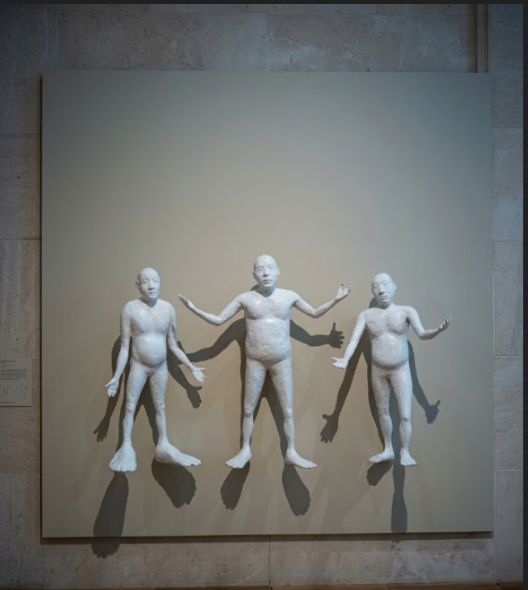
One of the most important parts of Everyday Surreal is its focus on Nicosia’s turn to sculpture. The Nasher notes that in 2001, Nicosia began making smaller settings for photographs, constructing room models, collaging them with images from elsewhere, and populating them with small sculpted installations. In 2009, he began making sculpture consistently, using materials such as paper clay and hydrocal to create eccentric personages, wire portraits, and anonymous male figures.
This transition matters because sculpture makes Nicosia’s staged reality tangible. In early photographs, the set existed partly to serve the picture. Later, the handmade objects and figures begin to claim their own presence. They are no longer only props. They become characters, evidence, and thought-forms.
The exhibition’s title, Everyday Surreal, gains power here. These sculptures are not grand monuments. They often seem awkward, comic, fragile, or provisional. Their oddity comes from closeness rather than distance. They feel like strange beings that might already have been hiding in the everyday.
The Nasher also notes that Nicosia eventually expanded into cast metal sculptures, including bighands, first made in 2010 and later enlarged in 2020 as an eight-foot-tall steel sculpture for the Nasher’s permanent collection. That movement from small handmade studio object to large institutional sculpture shows how Nicosia’s private surreal language entered public scale.
The strange prop became a sculpture. The sculpture became a presence. The presence made daily life feel staged again.
Why “Bighands” Turns The Body Into An Absurd Monument
The work bighands is important because it captures Nicosia’s interest in bodily distortion without becoming a simple joke. Hands are ordinary, useful, expressive, and familiar. Enlarged into an eight-foot-tall steel sculpture, they become absurd, comic, awkward, and slightly threatening.
Hands are also tools of making. In an exhibition about an artist who moved from staged photography into handmade sculpture, enlarged hands carry an extra charge. They point back to the labor of construction: building sets, shaping figures, manipulating images, drawing lines, handling materials, and turning daily life into art.
The hand is both body part and studio instrument. By making it oversized, Nicosia makes ordinary agency feel strange. What usually works invisibly becomes a monument.
This is the kind of surrealism the Nasher exhibition brings forward. It is not a dream monster or a mythic creature. It is a familiar body fragment pushed into the wrong scale. That wrongness is enough to disturb the everyday.
For a Surrealist reader, this connects with a long history of body fragments in modern art. But Nicosia’s humor keeps the image from becoming solemn. The hands are funny because they are too much. They are unsettling for the same reason.
How Drawings Turn Time Into A Physical Problem
Nicosia’s drawings are crucial to the exhibition because they show how the everyday can become surreal through repetition, measurement, and duration. The Nasher describes one 2015 drawing that traces the route from Santa Fe to Dallas 77 times, creating a meditation on distance, time, repetition, and movement. Other drawings mark the seconds in a day, the first 65 years of a life, or the random flow of thoughts over several months.
These works are less theatrical than the staged photographs, but they may be even more existential. They make time visible as labor. A repeated route becomes a ritual. Seconds become marks. A life becomes a counting system. Thought becomes doodle, block, accumulation, and drift.
That approach makes ordinary time feel slightly wrong because it reveals how impossible it is to truly grasp duration. We live inside time constantly, but when it is drawn, repeated, counted, and marked, it becomes strange. It stops being background and becomes material.
This is why Nicosia’s later work feels more philosophical. The surreal is no longer only in the staged room. It is in the fact that a day contains thousands of seconds, a journey can be repeated into abstraction, and a life can be partly represented as accumulated marks.
Everyday reality bends because time itself bends under attention.
Why Domestic Space Keeps Returning
Domestic space runs through Nicosia’s work as a site of performance, memory, and unease. The Nasher explains that his sculptural figures and installations eventually populated not only models for staged photographs but also real domestic interiors, producing hand-collaged and rephotographed images that confuse reality and artifice.
That confusion is central to the exhibition’s meaning. A domestic interior is supposed to feel familiar. It is the place of routine, privacy, comfort, and ordinary gestures. But in Nicosia’s art, the interior becomes unreliable. Handmade figures enter it. Collage interrupts it. Objects seem artificial. Space becomes a set again.
This connects naturally with thesurrealists.org’s earlier article on Surrealism in film and photography, where lens-based media become tools for making visible what ordinary perception suppresses. Nicosia’s photographs and rephotographed interiors do something similar. They reveal that home itself can be a constructed image.
That is why his work does not need exotic dream settings. The living room is enough. The studio is enough. The small model is enough. Reality feels wrong because the ordinary has been shown as fabricated.
How The Pictures Generation Context Still Matters
Nicosia’s relationship to the Pictures Generation is essential because it helps explain why his work is surreal without being historically Surrealist in the strict sense. The Pictures Generation artists came of age in a media-saturated culture. They questioned originality, authenticity, performance, representation, and the way images teach people how to see.
Nicosia brought a distinctive version of that inquiry to staged photography. His scenes did not simply mimic media images. They constructed moments that felt like social behavior under pressure. The artificiality was visible, but never entirely separate from reality.
That is where his work becomes useful for readers interested in Surrealism. Classic Surrealism often used dreams and automatism to challenge rational order. Nicosia uses constructed images to challenge photographic trust. In both cases, the ordinary world loses its authority.
MoMA’s Nic Nicosia artist page identifies him as an American artist born in 1951 and lists his work Real Pictures #11 from 1988 among MoMA’s online collection, along with exhibitions including Pleasures and Terrors of Domestic Comfort in 1991. That exhibition title alone feels relevant to Nicosia’s larger world: domestic comfort is never entirely comfortable.
In Nicosia’s art, the picture is not evidence that reality is stable. It is evidence that reality has already been arranged.
Why Humor Makes The Work More Disturbing
A key strength of Nicosia’s work is that it often carries humor. The Nasher describes his practice as maintaining a “buoyant whimsy,” even as it becomes more philosophical. That combination is important. Humor keeps the work open, but it also makes the unease harder to dismiss.
The slightly wrong everyday is often funny before it is frightening. A body pose looks awkward. A figure seems too stiff. A prop feels absurd. A sculpture has a strange personality. A gesture becomes over-performed. The viewer smiles, then realizes the smile came from recognizing something uncomfortable.
This kind of humor is different from punchline comedy. It is closer to comic unease. It reveals that daily life is full of small theatrical failures: the failed pose, the strange habit, the awkward social ritual, the object that looks fake even when it is real.
Surrealism has always had a strong relationship with humor, especially the kind that breaks logic without fully destroying meaning. Nicosia’s humor is quieter, more domestic, and more postmodern, but it works in a similar way. It opens a crack in the normal scene.
Through that crack, ordinary life starts looking staged.
Why “Everyday Surreal” Is Not Just A Catchy Title
The phrase Everyday Surreal could easily sound like a broad label, but in Nicosia’s case it is precise. His work does not present the surreal as a rare event. It treats the surreal as something embedded in ordinary routines, familiar spaces, and the basic problem of perception.
The everyday is surreal because it is mediated by images. It is surreal because memory edits it. It is surreal because bodies perform roles. It is surreal because rooms are arranged to communicate identity. It is surreal because time passes in ways we cannot represent cleanly. It is surreal because objects become props the moment they are photographed.
Nicosia’s later work makes these ideas material. The sculptures, drawings, photographs, and films in the Nasher survey give the viewer different ways to experience the same instability. A drawing tracks duration. A sculpture turns the figure into an odd presence. A photograph confuses real and fake space. A film adds time back into the staged scene.
Together, they show why “everyday surreal” is not a contradiction. It is the condition of modern life.
How Museum Recognition Shapes Nicosia’s Legacy
Nicosia’s museum history gives Everyday Surreal additional weight. The Erin Cluley Gallery biography notes that his work has been acquired by major institutions including the Guggenheim Museum, The Museum of Modern Art, Whitney Museum of American Art, Los Angeles County Museum of Art, San Francisco Museum of Modern Art, Museum of Contemporary Art Chicago, Dallas Museum of Art, and Museum of Fine Arts, Houston.
The Whitney Museum’s collection entry for Untitled #5 identifies the work as a 1991 oil on gelatin silver print from an untitled series of 10 images. That medium matters because it reflects Nicosia’s interest in the boundary between photograph and handmade intervention. The photograph is not left untouched. It is worked on, altered, and made stranger.
This institutional context helps explain why the Nasher survey is not a rediscovery of an unknown figure. It is a reorientation. Nicosia is already part of major museum collections, but Everyday Surreal asks viewers to look at the second half of his career with new seriousness.
The exhibition’s focus on sculpture and drawing helps correct any overly narrow understanding of him as only a staged photographer. It shows an artist who kept testing how reality could be made, remade, counted, modeled, performed, and rephotographed.
Why The Slightly Wrong Everyday Still Matters
The strength of Nicosia’s art lies in its refusal to exaggerate. He does not need ordinary life to collapse into nightmare. He only needs it to tilt. That small tilt is enough to change everything.
A room becomes a set. A figure becomes a performer. A drawing becomes a record of time’s pressure. A sculpture becomes a prop that escaped the photograph. A body part becomes a monument. A domestic scene becomes a philosophical puzzle.
That is why Everyday Surreal feels so relevant in 2026. Contemporary audiences already live inside staged realities, artificial images, domestic performances, and mediated versions of selfhood. Nicosia’s work gives that condition a physical, humorous, and unsettling form.
For thesurrealists.org, the exhibition offers a useful expansion of Surrealist thinking. It shows that the surreal is not only the dream, the monster, the myth, or the subconscious eruption. It can also be the everyday object made suspicious by attention.
Nic Nicosia’s world feels slightly wrong because our world already is. His achievement is not that he makes reality strange from the outside. It is that he reveals the strangeness that has been built into it all along.