

Architects of Liberation: Modernism in Western Africa at The Museum of Modern Art turns modern architecture into a record of political imagination. On view at MoMA in New York from July 5, 2026, through January 2, 2027, the exhibition examines modern architecture from the late 1950s through the early 1980s in relation to political independence across Senegal, Côte d’Ivoire, Ghana, Togo, Benin, Nigeria, and Cameroon. MoMA’s official exhibition page describes the show as the first major museum exhibition to examine the role of architecture in shaping this historic change.
For thesurrealists.org, the exhibition matters because modern architecture in newly independent Western Africa was never only about concrete, steel, glass, shade, campuses, civic centers, libraries, banks, or housing. It was about imagining a future that had not yet fully arrived. Architects of Liberation makes modernism feel like a dream of decolonized space because it shows how buildings, plans, models, photographs, and public institutions helped newly independent nations picture themselves beyond colonial rule.
Why MoMA’s Exhibition Treats Architecture As Political Imagination
Architecture can look practical from a distance. It gives people schools, roads, housing, offices, libraries, markets, ministries, campuses, and ceremonial spaces. Yet in the decades after independence, architecture also had a symbolic job. It had to make new political identities visible. It had to show citizens, neighboring countries, former colonial powers, and the wider world that a different future could be built.
MoMA’s press release states that the exhibition highlights the independence period as a prolific era of architectural production, when leaders of newly founded African nations sought to redefine their countries in contrast to colonial rule. The museum places this new architectural identity in relation to Pan-Africanism and Africanization, two political ideas that shaped how space, culture, and national identity were imagined after independence.
That framing changes the meaning of modernism. In Europe and North America, modernist architecture is often discussed through industrial materials, functional planning, abstraction, and the rejection of historical ornament. In Western Africa’s independence era, modernism became more charged. It could signal technological ambition, international confidence, educational expansion, state power, cultural renewal, and the promise of self-determination.
This is where the exhibition connects with thesurrealists.org’s earlier writing on Surrealism in architecture. The architectural histories are different, but the shared question is spatial imagination: how can buildings change what people believe reality can become?
How Decolonized Space Became A Modernist Dream
The phrase “decolonized space” should not be treated as decoration. It points to a real political and architectural struggle. Newly independent countries inherited colonial infrastructures, administrative centers, educational systems, and urban plans that often reflected extraction, hierarchy, and foreign control. Post-independence architecture had to work inside that inheritance while trying to project something new.
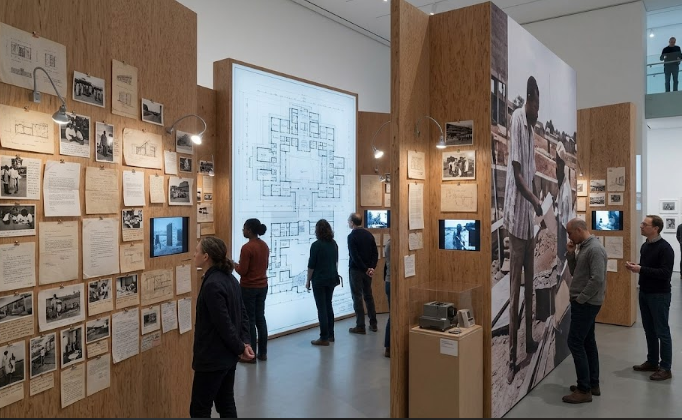
MoMA says the exhibition includes architectural drawings, models, archival images, newly commissioned site-specific photographs, and videos among approximately 400 objects, with nearly all shown publicly for the first time. The museum also notes that the exhibition spans seven countries and looks at a region reimagining its future. That mix of documents and images matters because it shows modernism before, during, and after construction: as plan, object, archive, and memory.
A decolonized modernism was not a single style. It could appear in universities, libraries, trade-fair sites, ministries, housing projects, civic plazas, transportation infrastructure, and cultural complexes. It could use international modernist forms while adapting them to climate, politics, materials, local expertise, and national symbolism.
That is why the exhibition’s dream is not escapist. It is practical and speculative at the same time. A building had to stand, shade, circulate air, serve students, host ceremonies, or organize work. Yet it also had to project belief. It had to say that independence was not only a flag or a constitution. It was a space people could enter.
Why Seven Countries Change The Modernist Story
The exhibition’s geographic range is crucial. By spanning Senegal, Côte d’Ivoire, Ghana, Togo, Benin, Nigeria, and Cameroon, MoMA avoids treating African modernism as a single national case or a side note to European architecture. The region becomes a field of experimentation shaped by different leaders, institutions, climates, economies, and design networks.
ArchDaily’s July 2026 coverage notes that the display is organized around anchor projects that serve as entry points into categories such as cityscapes, education, and housing. Its African modern architecture report also highlights the exhibition’s attention to the first generation of trained African architects and the role of practitioners from both inside and outside the continent.
That mix complicates the story. Independence-era architecture was not made by one group alone. African architects, state agencies, foreign architects, engineers, planners, political leaders, educators, photographers, and international networks all shaped the built environment. Some projects carried the optimism of self-determination. Some revealed dependency on foreign expertise or funding. Some became iconic. Others aged into neglect, adaptation, reuse, or partial disappearance.
The exhibition’s value lies in refusing a flat version of progress. Modernism in Western Africa can be visionary and conflicted at the same time. It can hold the dream of freedom while exposing the pressure of postcolonial state-building.
How Architecture Turns Nationhood Into A Public Image
A newly independent nation must be imagined before it can be fully lived. Architecture helped that imagination become public. A university campus could suggest intellectual sovereignty. A trade-fair complex could signal economic confidence. A national plaza could turn independence into ceremony. A library could make literacy and public knowledge part of the state’s visible identity.
MoMA’s press materials say the show is organized around anchor projects connected to cityscapes, education, and housing. Those categories are not neutral. They show how nation-building touches daily life. A political speech may announce independence, but a school, house, or civic center asks citizens to inhabit its promise.
This is why Architects of Liberation feels dreamlike in the strongest sense. Dreams are not always irrational images. They can be shared projections. They can be collective rehearsals of a future. Independence-era architecture often worked that way: it offered visual proof that a different social order could be built.
Modernism’s clean lines, structural clarity, open plans, and new materials could become a language of arrival. Yet the exhibition also asks viewers to consider what happens after arrival. Buildings age. Governments change. economies shift. Maintenance fails. Symbolic spaces can become ordinary, contested, or abandoned. A dream of decolonized space has to survive the pressures of time.
Why Ghana, Senegal, Nigeria, And Côte d’Ivoire Matter To The Show’s Imagination
The projects highlighted in current reporting show how varied this architectural imagination became. ArchDaily identifies examples including the Africa Pavilion at the Accra Trade Fair in Ghana, designed by Vic Adegbite, Jacek Chyrosz, and Stanisław Rymaszewski and led by the Ghana National Construction Corporation between 1962 and 1967; La Pyramide in Abidjan, Côte d’Ivoire, designed by Rinaldo Olivieri and completed in 1973; CICES in Dakar, Senegal, designed by Jean-François Lamoureux and Jean Louis Marin; and the University of Ife in Nigeria, with a masterplan by Arieh Sharon.
These examples show that architecture carried national and regional meaning in different ways. Ghana’s trade-fair architecture could perform unity, commerce, and international visibility. Abidjan’s La Pyramide could reshape a skyline through a striking high-rise form. Senegal’s CICES could turn exhibition space into cultural and economic theater. Nigeria’s University of Ife could make higher education part of post-independence spatial ambition.
Those projects matter for a Surrealism-focused site because they show architecture operating as image, not only infrastructure. The building is useful, but it is also a sign. It can look like a future before that future stabilizes. It can make the city feel newly symbolic.
That symbolic pressure gives Architects of Liberation its dreamlike force. These were not fantasies detached from reality. They were real projects that carried the burden of projection.
Why The Archive Makes Modernism Feel Unfinished
The exhibition includes drawings, models, archival photographs, original and commissioned architectural models, new films, and commissioned photographs. MoMA’s press release says the materials come from over 50 lenders in 17 countries, and the exhibition is the result of four years of extensive research in the region. The museum states that most objects have never been presented publicly and that many architects included have not previously been featured in any exhibition or scholarly publication.
That archival dimension matters because architecture history often depends on what survives, what is cataloged, and what institutions decide to study. Many independence-era buildings were used, altered, neglected, photographed, misremembered, or left outside dominant architectural canons. Bringing these materials into MoMA changes their visibility.
Yet the archive also makes modernism feel unfinished. A drawing is a promise. A model is a speculative object. A photograph may show a building in its first life, before later weathering, political change, or urban transformation. A film can return viewers to a site that has changed since its moment of symbolic optimism.
The exhibition’s archive does not simply preserve the past. It reactivates it. It lets viewers ask what modernism meant in Western Africa, why these projects were under-discussed, and how architecture can carry both liberation and contradiction.
How Curators Martino Stierli And Ikem Stanley Okoye Reframe The Canon
Architects of Liberation is organized by Martino Stierli, The Philip Johnson Chief Curator of Architecture and Design at MoMA, and Ikem Stanley Okoye, guest curator and associate professor at the University of Delaware, with Mallory Cohen, Curatorial Associate in MoMA’s Department of Architecture and Design. That curatorial structure matters because the show is not only adding new examples to an old modernist canon. It is questioning how that canon was organized.
Architectural Record’s July 2026 report describes the show as the final installment in a MoMA triptych of architecture exhibitions centered on political emancipation, following Toward a Concrete Utopia: Architecture in Yugoslavia, 1948–1980 and The Project of Independence: Architectures of Decolonization in South Asia, 1947–1985. Its MoMA architecture exhibition coverage places the Western Africa exhibition inside a broader institutional effort to rethink modernism through self-determination.
That context helps explain the stakes. If modernism is told only through Europe and North America, it becomes a narrow story of style, technology, and formal innovation. If modernism is read through decolonization, it becomes a story about political futures, public identity, institutional ambition, and cultural self-definition.
The exhibition does not ask viewers to abandon modernism. It asks them to see modernism differently.
Why The Dream Of Liberation Needed Buildings
The title Architects of Liberation can sound grand, but the exhibition’s subject justifies the scale. Liberation is often pictured through political leaders, flags, rallies, documents, speeches, and independence ceremonies. Architecture adds another layer. It asks what liberation looked like on Monday morning, in schools, offices, housing estates, libraries, roads, and campuses.
A dream of liberation needs places where people can study, gather, govern, work, celebrate, and imagine themselves collectively. Architecture gave that dream structure. It translated policy and aspiration into space.
This is why modernism could feel so appealing after independence. It seemed to offer a language that was future-facing, international, efficient, and adaptable. Yet it could also carry traces of colonial planning, foreign expertise, and technocratic ambition. The dream of decolonized space was never pure. It had to be negotiated in real materials and real politics.
That tension is what makes the exhibition culturally rich. It does not present Western African modernism as a simple triumph. It presents it as a field where liberation, design, climate, bureaucracy, education, global influence, and local agency met.
Why “Architects Of Liberation” Matters For Surrealist Readers
At first glance, a MoMA architecture exhibition about Western African modernism may seem distant from Surrealism. Yet thesurrealists.org is concerned with dream logic, image-making, altered perception, and the politics of imagination. Architects of Liberation belongs in that conversation because it shows modernism as a dream made public through space.
Surrealism often turned private dreams into images. Independence-era architecture turned political dreams into buildings. Both forms ask viewers to take imagination seriously. Both show that what appears solid may begin as a drawing, model, desire, slogan, or collective projection.
The difference is equally important. Surrealist dream imagery often unsettled reality by making the familiar strange. Architects of Liberation shows a different kind of strangeness: a newly independent nation trying to make the future appear before the future is secure. A university, pavilion, library, or plaza becomes a spatial wager.
That is why the exhibition’s architecture can feel dreamlike without becoming fantasy. The dream was concrete, built, photographed, used, and archived. It had budgets, sites, materials, and political agendas. Yet it still carried the emotional force of a future imagined against colonial history.
How Modernism Becomes A Memory Of The Future
The deepest paradox in Architects of Liberation is that it presents yesterday’s future. Many projects in the exhibition were built to announce modernity, progress, sovereignty, and collective confidence. Now they return as archival images, models, drawings, films, and case studies. The future they projected has become history.
That shift gives the exhibition its haunting quality. Viewers are not simply looking at buildings. They are looking at visions of what a newly independent region hoped space could do. Some hopes were realized. Some were compromised. Some buildings remain active. Some survive as documents or altered urban landmarks. The dream is both present and past.
For a visual-culture audience, that is the most powerful reason to study the show. Modern architecture is often judged by form, function, and style. Architects of Liberation asks viewers to judge it as memory, too. It shows how buildings can hold the emotional charge of national beginnings long after the political moment has changed.
The exhibition makes modernism feel like a dream of decolonized space because it reveals architecture as a tool for imagining public life after empire. It shows that independence needed images, plans, buildings, and shared places. It shows that liberation was not only declared. It was drawn, modeled, photographed, built, inhabited, and remembered.