

Alex Prager: Matinee turns movie memory into a surreal crowd scene because it treats Los Angeles as more than a city, more than a film location, and more than a nostalgic image machine. On view at Lehmann Maupin New York from June 11 to August 21, 2026, the exhibition brings together four new large-scale photographs by Alex Prager, the Los Angeles-born artist and filmmaker whose staged images transform cinematic memory into uncanny social theater.
For thesurrealists.org, the exhibition matters because Prager’s art sits at a vivid intersection of photography, film, performance, artificial memory, public spectacle, and the unsettling psychology of crowds. Her pictures feel familiar before they feel strange. They seem to come from old Hollywood, disaster cinema, noir melodrama, television dreams, advertising stills, and half-remembered movie scenes. Yet the longer the viewer looks, the less stable they become.
The official Lehmann Maupin exhibition page describes Matinee as a solo exhibition of new work that positions Los Angeles as both subject and muse, examining distorted memory and myth-making through the city’s enduring allure and ephemerality. That is the key to the exhibition. Prager is not simply photographing Los Angeles. She is photographing the way Los Angeles becomes an image inside collective memory.
Why “Matinee” Feels Like A Movie You Half Remember
The word matinee carries a specific emotional charge. It suggests daytime cinema, escape before evening, a half-empty theater, a story entered while the outside world continues in bright ordinary light. A matinee is entertainment, but it can also feel haunted because it belongs to a temporary pocket of time. You enter the dark, watch another world, and leave before night has properly arrived.
Prager uses that idea as a structure for memory. Her new photographs do not look like documentary views of Los Angeles. They look like fragments from a film that the viewer almost recognizes, even when no such film exists. That false familiarity is one of her strongest tools. She makes the viewer feel as if the image has been stored somewhere in the mind before being seen.
Lehmann Maupin says the exhibition follows a landmark year for Prager, marked by the premiere of her feature film Dreamquil. That matters because Matinee appears at a moment when Prager’s film and photography practices are visibly converging. Her photographs already behave like cinema. Her films often feel like photographs that have learned to move. The gallery exhibition takes place inside that feedback loop.
The result is a show about how images become memories and how memories become staged. Prager’s Los Angeles is not just a place. It is a projection surface.
How Los Angeles Becomes A Surreal Memory Machine
Prager was born in Los Angeles in 1979, and she continues to live and work there. Her connection to the city is not incidental. Los Angeles gives her art its architecture of contradiction: glamour and disaster, sunlight and anxiety, performance and loneliness, fantasy and industry, abundance and collapse.
Lehmann Maupin’s Alex Prager artist page identifies her practice through carefully constructed photographs and films, while the 2026 exhibition text describes Los Angeles as an environment suspended in transformation and contradiction. That framing is important because Prager does not treat the city as a stable backdrop. She treats it as an unstable cultural script.
In Matinee, Los Angeles becomes both subject and mechanism. The city produces movie memory; the photographs then return that memory in distorted form. Overlooks, rituals, rehearsals, invitations, hills, hotels, airports, and staged gatherings become signs of a city that is always performing itself.
This is why Prager’s work belongs in a Surrealist conversation. The Surrealist city is never simply geographic. It is psychic. It contains thresholds, chance meetings, strange repetitions, theatrical streets, dream architecture, and objects that seem to remember more than they should. Prager’s Los Angeles works in a similar way. It is a city built from real places and artificial recollections, where the movie image becomes part of lived reality.
Why The Crowd Is Never Just A Crowd
The topic of the crowd has followed Prager for more than a decade. Her Face in the Crowd project, first shown in 2013 and 2014, established her interest in the crowd as both spectacle and emotional problem. The Smithsonian American Art Museum’s Face in the Crowd collection entry describes the 2013 three-channel video installation as a work about narrative tension, anxiety, suspense, voyeurism, exhibitionism, the spectator’s gaze, and the difficulty of maintaining a sense of self while being swept up by the masses.
That history matters for Matinee because Prager’s new exhibition continues to think about how public life becomes theatrical. A crowd is never just a group of people in her images. It is a social organism, a film set, a chorus, a threat, a ritual, and a mirror for the viewer.
Even when a photograph centers one main figure, Prager’s world is crowded with unseen pressures: the audience, the industry, the city, the camera, the memory of cinema, and the cultural expectation that everyone must perform. The crowd may be visible or implied, but its force remains.
This is what makes Matinee feel surreal. The individual does not disappear into the crowd; the crowd seems to become part of the individual’s inner life. Public spectacle and private anxiety are fused inside one cinematic image.
How “Ceremony” Turns Hollywood Ritual Into Social Theater
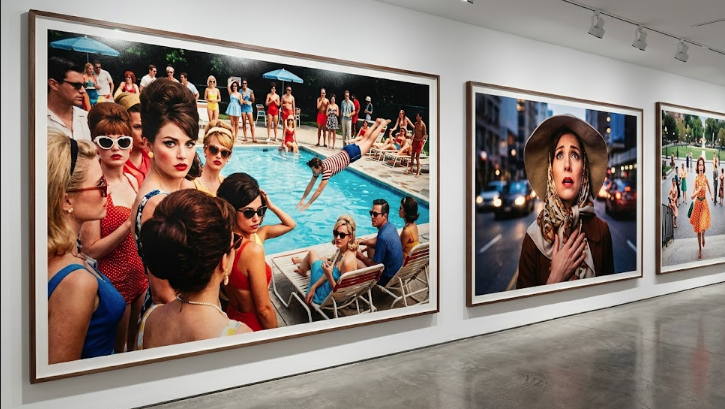
One of the key works in Matinee is Ceremony, a 2026 photograph measuring 59.5 x 72.37 inches, listed on the artist’s selected work page. Lehmann Maupin describes the work as a celebration of Hollywood theatricality, with Prager using distinct characters and carefully planned color to create a contemporary Renaissance-style tableau with multiple viewpoints.
That description reveals why the image is so important to the exhibition’s argument. A ceremony is already a performance. It organizes bodies, clothing, posture, timing, audience, and symbolic meaning. In Los Angeles, where public events and image production often overlap, a ceremony can become a form of mass self-staging.
Prager’s Ceremony turns that social ritual into a visual puzzle. The crowd is not merely present; it is choreographed. Each person appears caught inside a role, a glance, or a fragment of narrative. The image becomes less like a snapshot and more like a stage where everyone is both actor and spectator.
This is where Prager’s crowd scenes become emotionally precise. She understands that public images are never only public. Each figure inside the crowd carries a private world. The surreal charge comes from seeing all those private worlds compressed into one artificial scene.
Why “Bonnie Hill (Overlook)” Makes The View Feel Unstable
Another highlighted work is Bonnie Hill (Overlook), a 2026 photograph measuring 59.5 x 89.25 inches, also listed by Alex Prager Studio. The overlook is an important Los Angeles motif because it turns the city into an image. From above, Los Angeles becomes glittering surface, spread-out myth, real estate fantasy, cinematic backdrop, and emotional distance.
Lehmann Maupin connects Bonnie Hill (Overlook) to psychologically charged cinematic scenes and to artists and writers such as Joan Didion and Ed Ruscha, both of whom used Los Angeles as a way to examine American myth, surface, and cultural unease. Prager’s version of the overlook is not only about looking at the city. It is about the city looking back through the images it has already produced.
An overlook promises clarity. It suggests that distance will make the landscape understandable. In Prager’s art, that promise breaks down. The view becomes suspended, ambiguous, and uncanny. The city does not resolve into truth; it becomes another layer of myth.
That is why Bonnie Hill (Overlook) fits the exhibition’s title. A matinee image is clear enough to watch but strange enough to fade into dream. The overlook offers the city as spectacle, but the spectacle refuses to become stable knowledge.
How Prager Builds Images Physically Instead Of Faking Them Digitally
One of the most important facts about Prager’s process is that her scenes are constructed practically and captured physically. Lehmann Maupin notes that every element within the frame is created practically and captured entirely in-camera. This matters in 2026, when audiences are increasingly conditioned to suspect digital manipulation, synthetic imagery, and AI-generated spectacle.
Prager’s work is artificial, but not because it is frictionlessly generated. It is artificial because it is built. Sets, costumes, makeup, lighting, staging, extras, props, color, and vantage points are all part of the handmade illusion. Her photographs are not casual captures of reality. They are physical productions that use the grammar of cinema to create an image that feels both real and impossible.
This gives the work a particular kind of tension. The viewer senses that the image is fabricated, but also that the fabrication has weight. People stood there. Costumes were chosen. Lights were placed. The camera recorded a real construction.
That process connects Prager to older cinematic and photographic traditions. MoMA’s New Photography 2010 exhibition page described Prager as an artist who takes cues from pulp fiction and fashion imagery to construct filmic narratives, exploring the relationship between straight and constructed photography. Sixteen years later, Matinee shows how far that constructed-photography language has evolved.
Why Movie Memory Feels More Real Than Reality
Prager’s images work because many viewers carry movie memory inside their own perception. We do not look at Los Angeles innocently. We look through decades of film, television, advertising, celebrity photography, disaster scenes, freeway images, noir shadows, beach fantasies, and Hollywood ceremonies. The city is already mediated before the camera arrives.
Matinee uses that condition as raw material. The photographs feel like remembered movie scenes because cultural memory has already taught viewers how such scenes should look. A hillside overlook, a formal gathering, a rehearsal, an invitation, an airport, or a hotel can become instantly cinematic.
But Prager does not simply flatter that recognition. She makes it unstable. Her scenes often feel too colorful, too composed, too still, too aware of themselves. They produce the discomfort of recognizing a memory that may not belong to you.
This is one reason the exhibition is so useful for thesurrealists.org. Surrealism often begins when familiar reality becomes estranged. Prager achieves that estrangement through cinema’s residue. She shows how collective movie memory can become a dream system.
How “Matinee” Connects To “Dreamquil”
The exhibition follows the world premiere of Prager’s feature film Dreamquil at the 2026 SXSW Film & TV Festival. The official SXSW schedule page lists Dreamquil as a 2025 U.S. Narrative Spotlight feature directed by Alex Prager, with a world premiere at SXSW and a cast including Elizabeth Banks, John C. Reilly, Juliette Lewis, Sofia Boutella, Kathryn Newton, and Lamorne Morris.
That film context matters because Dreamquil and Matinee both examine artificial life, performance, identity, and the constructed image. The SXSW description presents Dreamquil as a near-future story about poor air quality, virtual living, a digital wellness retreat, and a robot double sent into a family home. Those themes echo Prager’s long-standing interest in doubles, performance, theatrical surfaces, and the fragile boundary between reality and image.
In Matinee, the double is not necessarily a robot. It may be the cinematic version of the city, the staged version of memory, the public version of the self, or the photograph’s artificial version of experience. The exhibition’s crowd scenes and ritual images suggest that modern life is already filled with doubles: social roles, audience selves, public poses, and remembered movie identities.
This makes Matinee feel less like a side project after a film and more like a companion to Prager’s larger inquiry. What happens when the image begins to live beside us, perform us, and remember us incorrectly?
Why Prager’s Use Of Color Feels Emotional, Not Decorative
Prager’s color is often described as bold, saturated, retro, or cinematic, but those words can make it sound merely stylish. In Matinee, color is more than surface pleasure. It is emotional architecture. It tells the viewer how to feel before the scene can be rationally understood.
A carefully planned palette can turn a crowd into choreography. It can make a figure stand out or disappear. It can push a scene toward comedy, dread, nostalgia, or melodrama. It can make the image feel older than it is, as though it belongs to a film archive from a decade that never existed.
This is one reason Prager’s work often feels like a fabricated memory. Memory is rarely neutral in color. It exaggerates, fades, warms, sharpens, and reorganizes. Prager’s colors behave like memory under theatrical pressure.
That emotional use of color also connects her to filmmakers and photographers who understand image-making as atmosphere rather than mere description. In Prager’s work, color is not added after meaning. It helps create meaning. It makes the crowd feel charged before any story is known.
Why “Matinee” Turns The Audience Into A Character
A matinee requires an audience. Even when the theater is not pictured, the concept implies spectatorship. That is one of the most interesting parts of Prager’s exhibition. The viewer is not outside the image. The viewer becomes part of the social structure the image examines.
Prager’s photographs often position the viewer at a strange distance: above a crowd, across a set, near a ritual, or slightly outside the action. This distance is not neutral. It makes the viewer aware of looking. In crowd scenes, that awareness becomes even sharper because looking is part of the crowd’s problem.
Are we watching the performers, or are we another performer? Are we outside the ceremony, or implicated in it? Is the image showing a crowd, or showing our desire to read strangers as characters?
The Smithsonian’s description of Face in the Crowd emphasizes the spectator’s gaze and the tension between the individual and the mass. Matinee updates that tension through Los Angeles myth and movie memory. The audience is no longer only watching cinema. It is living inside cinematic culture.
How Prager Makes The Future Feel Like A Rehearsed Past
Lehmann Maupin’s exhibition text says Matinee uses time and memory as critical devices, collapsing boundaries between reality and artifice, the sinister and the frivolous. This may be the exhibition’s most important theoretical point. Prager’s images rarely feel like the present. They feel like a present haunted by earlier visual eras and a future already rehearsed by movies.
That temporal confusion is central to the surreal effect. Her characters may dress as though from another decade, stand in a scene that resembles a classic film, and inhabit a world that feels contemporary in its anxiety. Time folds. The past becomes costume. The future becomes déjà vu.
This matters because Los Angeles is a city where time is often manufactured through style. A building, costume, car, hairstyle, set, or lighting scheme can make the present feel like the 1950s, 1970s, 1980s, or some invented cinematic decade. Prager uses that instability to show how memory is built from visual cues.
The future in Matinee does not feel new. It feels rehearsed. That is the exhibition’s unsettling power. It suggests that culture may already be acting out scenes it inherited from its own image history.
Why “Matinee” Belongs In A Surrealist Conversation
Matinee belongs in a Surrealist conversation because it turns mass culture into dream material. Prager does not paint irrational dreamscapes or imitate historical Surrealist motifs. Instead, she uses photography’s staged realism and cinema’s emotional memory to produce a world that is familiar, artificial, theatrical, and unstable.
This connects naturally with thesurrealists.org’s earlier writing on Surrealism in film and photography, where camera-based media become tools for accessing what ordinary vision cannot fully explain. Prager’s work expands that idea into contemporary image culture. The camera does not merely record the surreal. It constructs the conditions in which the surreal can appear.
Her surrealism is not based on sleep, automatism, or monsters. It is based on recognition gone wrong. A crowd looks like a movie scene. A movie scene looks like a memory. A memory looks like Los Angeles. Los Angeles looks like a set. The set looks more emotionally true than the city.
That chain of substitutions is exactly why Matinee feels so compelling. It shows how modern visual culture turns reality into a crowd scene and then asks us to find ourselves inside it.
How “Matinee” Reimagines The Crowd Scene For 2026
In 2026, the crowd carries new meanings. Crowds are audiences, feeds, fan bases, publics, markets, voters, commuters, extras, online communities, and algorithmic groups. People gather physically, but they are also sorted, watched, addressed, and staged through digital systems. The crowd is no longer only a physical mass. It is also a condition of being visible among others.
Prager’s work speaks to that condition without turning into social-media commentary. Her images are more durable because they approach the problem through cinema, theatricality, and emotional composition. She asks what it feels like to be one person inside a system of spectacle.
Matinee makes the crowd scene feel newly strange by linking it to Los Angeles mythology. The city has always produced crowds: movie audiences, red carpets, extras, studio workers, tourists, commuters, fans, celebrities, and anonymous dreamers. Prager condenses those histories into images where everyone appears to be waiting for meaning.
That waiting is what makes the photographs powerful. Something is about to happen, or has already happened, or may never happen. The crowd holds the tension.
Why Alex Prager’s Movie Memory Still Feels Human
Prager’s images could become cold if they were only about style, artifice, or spectacle. They do not, because she remains deeply interested in human feeling. Lehmann Maupin’s exhibition text emphasizes intimacy and humanity, even as it describes constructed memory and myth-making. That balance matters.
The people in Prager’s images may be artificial characters, but they do not feel empty. They carry anxiety, longing, confusion, desire, curiosity, and suspense. The crowd is stylized, but it is made from individuals. The movie memory is fabricated, but it is powered by real emotional recognition.
That is why Matinee works as more than a glossy Los Angeles exhibition. It asks why people keep returning to movie images to understand themselves. It asks why crowds feel lonely. It asks why public rituals feel fragile. It asks why the city’s myths remain seductive even when they are visibly constructed.
For thesurrealists.org, the exhibition’s lasting value is clear. Matinee shows that the surreal is not separate from popular culture. It is embedded in the way movies teach us to remember, the way cities perform themselves, and the way crowds turn private emotion into public spectacle.
Alex Prager’s Matinee turns movie memory into a surreal crowd scene because it makes the viewer feel the instability of every staged world we inherit. Los Angeles becomes a dream factory, the crowd becomes a mirror, and the photograph becomes the place where reality and performance can no longer be pulled apart.