

Gleefully Askew: A Gladys Nilsson Retrospective gives everyday life the unstable logic of comic surrealism. Opened at the Crocker Art Museum in Sacramento on July 19, 2026, and running through November 29, 2026, the exhibition brings together more than 100 works made across roughly 60 years of Nilsson’s career. The current Vogue profile of Gladys Nilsson describes the show as the largest exhibition of her career and places it in relation to her long history with watercolor, acrylic painting, drawing, collage, and the Chicago Imagist circle known as the Hairy Who.
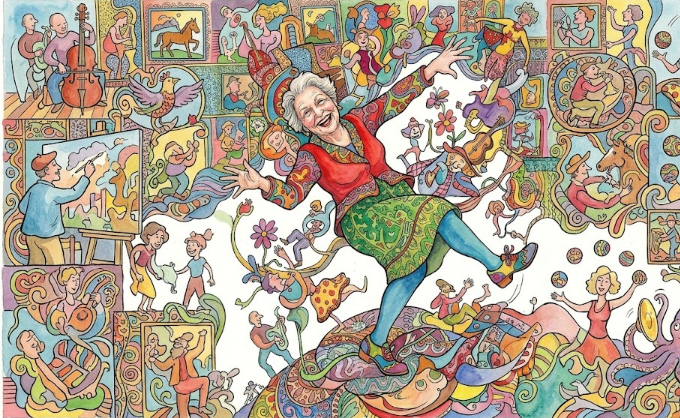
For thesurrealists.org, Nilsson’s retrospective matters because her work turns ordinary people-watching into a comic dream system. Her figures gather, flirt, gossip, wobble, stretch, sag, misbehave, and crowd the picture plane. At first glance, they often seem playful. Stay longer, and the comedy becomes stranger. Domestic scenes become tiny theaters of desire, embarrassment, aging, appetite, and social absurdity.
Nilsson does not need melting clocks, grand myth, or theatrical nightmare imagery to make reality feel unstable. Her surrealism grows from small human behavior. A gesture becomes too elastic. A crowd becomes too dense. A face becomes too lopsided. A party becomes a psychological maze. In Gleefully Askew, everyday life becomes surreal because Nilsson sees how odd people already are.
Why “Gleefully Askew” Matters Now
The timing of Gleefully Askew gives Nilsson’s work renewed force. At 86, she is receiving a major retrospective that reframes her beyond the regional label of Chicago Imagism. Vogue reports that curator Francesca Wilmott developed the exhibition over nearly a decade and aimed to show Nilsson as an internationally important artist rather than only a Chicago figure or a watercolor specialist.
That reframing matters because art history often sidelines humor, craft, paper, domestic observation, and deliberately eccentric figuration. Nilsson’s career challenges all of those habits. She made watercolor feel aggressive, cartoon language feel intelligent, and everyday scenes feel psychologically charged. She built a visual world where fun and seriousness do not cancel each other out.
Her art also speaks clearly to contemporary viewers. Current visual culture is saturated with self-performance, social awkwardness, image overload, and comic exaggeration. Nilsson reached that territory through drawing, paint, collage, and patient observation. Her figures look handmade, not digital, yet they understand the same truth that online culture keeps proving: people become surreal when watched closely enough.
This makes the retrospective more than a career survey. It becomes a fresh argument about comic surrealism as a serious mode of seeing.
How Nilsson Turns People-Watching Into Surrealism
Nilsson’s scenes often begin with familiar social behavior. People sit, stand, gather, eat, dance, celebrate, bend, chatter, or move through crowded compositions. The actions feel recognizable, but the bodies refuse natural order. Limbs swell or shrink. Faces tilt into caricature. Groups press against each other until space becomes almost impossible.
That pressure creates the comic surrealism of her work. The viewer sees real social life, but reality has gone slightly wrong. Instead of escaping the everyday, Nilsson intensifies it. She makes ordinary behavior look like a coded ritual.
This is why her work fits a Surrealist reading even though it does not simply imitate historical Surrealism. The Surrealists often broke reality by placing unrelated objects together or by turning dream images into visible scenes. Nilsson breaks reality through social exaggeration. Her characters are not symbols floating in a void. They are bodies caught in the messy theater of being human.
That approach connects naturally with thesurrealists.org’s writing on Surrealist methods and magical contrasts, because Nilsson also builds her images through collision. The comic meets the grotesque. The personal meets the public. The decorative meets the unruly. The domestic meets the absurd.
Why The Hairy Who Context Still Matters
Nilsson’s art grew partly from the rebellious energy of the Hairy Who, the Chicago group that included Gladys Nilsson, Jim Nutt, Suellen Rocca, Karl Wirsum, Art Green, and Jim Falconer. Their work emerged in the 1960s outside the dominant New York narratives of Pop, Minimalism, and Conceptualism. They embraced figuration, jokes, comics, bright color, grotesque bodies, and outsider visual languages.
A 2015 New Yorker review of What Nerve! Alternative Figures in American Art described the Hairy Who as a tight group of Art Institute of Chicago graduates whose outlandishness came from non-New York roots. That New Yorker essay on alternative figuration helps explain why Nilsson’s work still feels resistant. It does not ask permission from polished art-world taste.
The Hairy Who context matters because it shows Nilsson working inside a world where humor had critical force. Cartoonish figuration was not childish escape. It was a refusal of respectable seriousness. Grotesque bodies, strange patterns, puns, and visual crowding gave artists another way to challenge social norms.
Yet Gleefully Askew also separates Nilsson from a group identity. Vogue notes that her Sacramento years were important because they helped her assert herself as an independent artist beyond the Hairy Who label. That distinction is essential. The group explains part of her language, but it does not contain her career.
How Watercolor Became A Tool Of Defiance
Nilsson’s use of watercolor carries special importance. Watercolor has often been treated as delicate, polite, feminine, or secondary to oil painting. Nilsson turned that assumption against itself. She used watercolor with density, wit, and force, making paper a site of visual attack rather than softness alone.
Vogue reports that Nilsson turned to watercolor after leaving oil paint behind during pregnancy, partly because of concerns around turpentine. That practical shift became a major artistic path. Instead of accepting watercolor’s conventional limits, she pushed the medium through layering, saturation, awkward bodies, and packed compositions.
This matters because comic surrealism depends on material tension. Nilsson’s figures look funny, but they do not feel casual. Their distortions come from discipline. Their chaos has structure. Their humor arrives through carefully built surfaces, not careless doodling.
That is why her work resists the old hierarchy that dismisses funny art as unserious or paper-based work as minor. Nilsson’s images show how a supposedly modest medium can hold psychological force. Watercolor becomes a weapon of comic instability.
Why Everyday Life Looks Grotesque In Nilsson’s World
The grotesque in Nilsson’s art is rarely horror in a simple sense. It is social, bodily, and comic. Her figures seem overexposed to the awkward facts of being alive. They sag, stretch, grin, lean, clutch, flirt, and crowd one another. The body becomes both joke and truth.
This grotesque quality makes her everyday scenes feel surreal. A party may look cheerful, but the bodies seem too close. A face may look silly, but the expression turns uneasy. A crowd may look festive, but the composition becomes claustrophobic. Nilsson’s humor does not soften the image. It sharpens it.
That is where her work differs from simple whimsy. Whimsy reassures. Nilsson unsettles. Her figures are charming because they misbehave, but their misbehavior also reveals social pressure. They perform gender, age, confidence, desire, embarrassment, and vanity in exaggerated form.
Comic surrealism thrives in that overlap. It does not choose between laughter and discomfort. It understands that laughter often begins when reality becomes too strange to process calmly.
How Collage Expands Nilsson’s Dream Logic
Nilsson’s later use of collage gives her comic surrealism another register. Vogue notes that she began experimenting more deeply with collage in the 1990s, using personal snapshots, fashion magazines, and eventually art-history books. That shift allowed her to cut, rearrange, and recombine imagery in ways that heightened the psychological quality of her work.
Collage is naturally surreal because it breaks the original context of images. A body part, face, garment, interior, or art-historical fragment can enter a new scene and behave differently. Nilsson’s collages continue her fascination with skewed figures, but they also turn memory, fashion, and art history into unstable material.
This is important for a Surrealist site because collage links Nilsson to a long tradition of cutting reality apart to expose hidden meanings. Historical Surrealists used collage to create uncanny encounters between unrelated images. Nilsson uses it to produce social and psychological mischief. Her collages can feel like private jokes, dream puzzles, or visual Rorschach tests.
The result is not cold appropriation. It feels intimate. Nilsson’s collage practice suggests that everyday images already carry absurd charge. They only need to be cut loose from their original roles.
Why The Retrospective Reframes Women’s Humor In Art
Gleefully Askew also invites a larger question: why has women’s humor in art so often received less critical weight than men’s aggression, irony, or formal ambition? Nilsson’s career makes that question difficult to avoid. Her work is funny, but its humor carries discipline, memory, social critique, and bodily intelligence.
Vogue’s profile notes that Nilsson faced dismissive attitudes toward watercolor, paper, and funny subject matter. Those dismissals reveal a familiar pattern. The art world often treats humor as a minor tone unless it arrives through approved forms of irony or market-friendly spectacle. Nilsson’s humor comes from awkward bodies, domestic observation, women’s experience, and handmade excess.
That makes her comedy quietly radical. She does not ask the viewer to laugh from a distance. She places everyone inside the absurdity. Her characters may look peculiar, but their strangeness feels uncomfortably recognizable. The joke points back at the viewer’s own social body.
This is one reason younger artists continue to find Nilsson important. She shows that comic art can stay rigorous without becoming cold. It can stay personal without becoming sentimental. It can stay visually pleasurable without becoming decorative.
How “Gleefully Askew” Changes The Story Of American Surrealism
American surrealism is often discussed through European influence, postwar abstraction’s rejection of the dream image, or later Pop culture’s relationship to mass media. Nilsson offers a different path. Her work shows how surreal energy moved through regional figuration, cartoons, domestic scenes, feminist pressure, and everyday life.
This connects to a broader museum trend. The Whitney’s Sixties Surreal recently revisited American art from 1958 to 1972 through psychosexual, fantastical, and revolutionary tendencies. That Whitney exhibition on Sixties Surreal helps place Nilsson’s world within a larger reconsideration of how strange the American 1960s and 1970s really were.
Nilsson’s contribution is distinctive because she makes the surreal comic without making it light. Her bodies do not float in grand metaphysical space. They squeeze into rooms, parties, paper surfaces, and social situations. Her dream logic is not far away. It lives in the ordinary scene after the artist has tilted it just enough.
That tilt gives Gleefully Askew its meaning. The title does not merely describe a playful style. It describes a worldview. Reality is already askew. Nilsson simply gives it color, line, rhythm, and a crowd of strange witnesses.
Why Comic Surrealism Still Feels Urgent
Nilsson’s comic surrealism feels urgent because the present also struggles with distorted everyday life. People perform themselves constantly. Public and private space blur. Bodies age under social scrutiny. Images circulate until they lose their original context. Humor becomes a survival tool. Nilsson’s art reached those themes long before they became daily digital conditions.
Her work suggests that the everyday is never neutral. A casual gathering can reveal power. A funny face can expose anxiety. A decorative surface can hide emotional pressure. A crowded composition can feel like social life itself: joyful, absurd, exhausting, and impossible to fully control.
That is why Gleefully Askew deserves attention beyond Chicago art history. It shows how an artist can transform observation into a world. Nilsson’s people-watching becomes a surreal method. Her humor becomes an art-historical argument. Her crowded scenes become proof that everyday life has always been stranger than realism admits.
For thesurrealists.org, this is the heart of the story. Gladys Nilsson turns everyday life into comic surrealism because she sees the dream inside ordinary behavior. She does not need to escape the real. She bends it, crowds it, colors it, and lets it grin back.