
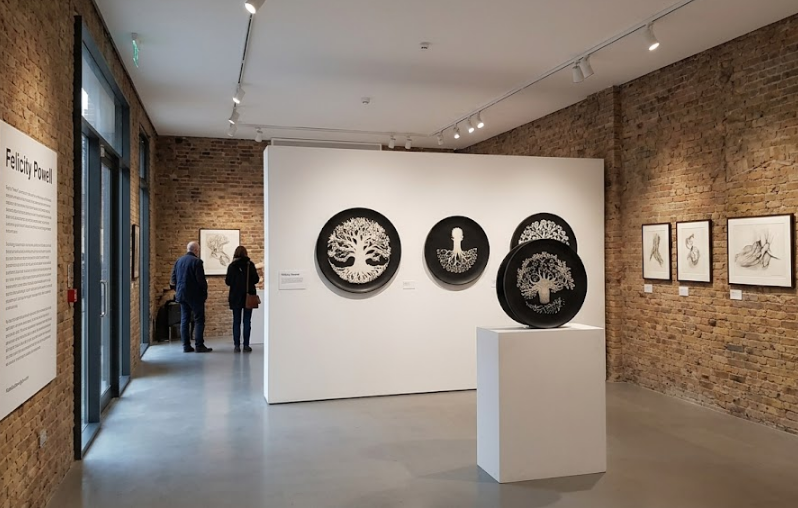
The Studio of Felicity Powell at Richard Saltoun Gallery in London turns an artist’s working life into a dream archive of touch, illness, memory, and transformation. On view from July 24 to October 3, 2026, the exhibition is the first dedicated presentation of Felicity Powell’s work since her death in 2015. It brings together key works from three decades, including previously unseen material, and looks across sculpture, drawing, photography, and video.
For thesurrealists.org, Powell’s studio matters because her art makes the small object feel psychologically vast. Wax, bronze, glass, paper, medals, hands, eyes, tears, trees, doubled bodies, and mirror-like surfaces become signs in a private symbolic system. Her work does not use Surrealism’s loudest vocabulary. It works more quietly, through touch, scale, bodily vulnerability, and the sense that objects can hold secret emotional charge.
Richard Saltoun Gallery’s official exhibition page frames Powell’s practice through selfhood, motherhood, corporeality, and, late in her life, illness and mortality. That makes the exhibition more than a posthumous survey. It becomes an archive of how an artist used fragile materials to think about what a body carries, what memory protects, and how small forms can behave like dream relics.
Why Felicity Powell’s Studio Feels Like An Archive Of Touch
A studio is usually imagined as a place of production. In Powell’s case, it also becomes a field of evidence. The exhibition’s title, The Studio of Felicity Powell, suggests more than a display of finished works. It points toward the lived conditions of making: the kitchen table, the hand, the experiment, the model, the intimate scale, the object held before it is fully named.
That matters because Powell’s work often begins with contact. Her materials ask to be imagined through the hand as much as the eye. Wax can look skin-like, ghostly, soft, translucent, and vulnerable. Bronze can carry weight, pressure, and permanence. Glass can feel like an eye, a vessel, or a protective surface. Paper can hold a partial figure, a smudged line, or a thought before it becomes fully formed.
This emphasis on touch gives the exhibition its dreamlike force. Dream images often feel close and distant at once. Powell’s objects do the same. They look intimate, but they also resist complete explanation. They feel like things remembered from inside the body rather than simply observed from outside.
That is why her studio becomes an archive. Not an archive of documents alone, but an archive of gestures, materials, repetitions, and motifs. In Powell’s world, memory is not abstract. It is modeled, drawn, pressed, cast, polished, and handled.
How Wax Becomes A Surreal Material
Wax is one of the reasons Powell’s work feels close to Surrealist visual culture. The material has a long association with bodies, death masks, votives, anatomical models, candles, seals, charms, and devotional objects. It can suggest flesh, preservation, ritual, and disappearance at the same time. Powell uses that instability without forcing it into theatrical horror.
Her wax works often appear delicate and exact, yet they carry unease. A small figure, head, tree, hand, or organic form can look like a specimen, a charm, a thought, or a relic. Wax makes the object feel temporary even when it is carefully made. It seems always at risk of softening, melting, breaking, or absorbing touch.
That material tension is central to the exhibition’s emotional logic. Powell’s art turns wax into a language for fragile embodiment. It allows the body to appear indirectly, through traces, symbols, and surfaces. The viewer is not asked to decode a single fixed meaning. The object becomes a threshold between the physical and the psychological.
This connects naturally with thesurrealists.org’s writing on symbolism in Surrealist art, because Powell’s motifs behave like symbolic fragments. They are not illustrations of one idea. They are charged signs that gather memory, touch, desire, fear, and transformation.
Why Illness And Mortality Change The Meaning Of The Studio
The exhibition’s most sensitive theme is Powell’s late reflection on illness and mortality. Richard Saltoun Gallery notes that toward the end of her life, these themes became part of her material exploration. That framing requires care. Powell’s illness should not be used to simplify her art or turn the studio into a biographical key that unlocks everything.
The stronger reading is more respectful: illness changes the pressure around materials that were already concerned with embodiment, vulnerability, and transformation. Powell’s work had long been interested in small forms, touch, doubling, mirroring, and the body’s symbolic life. In the later work, those interests gain a sharper edge.
Illness can make the body feel strange to itself. It can alter time, attention, memory, and the scale of daily life. Powell’s art does not need to narrate that experience directly to hold its pressure. A hand, an eye, a tear, a tree, or a wax figure can carry the sense of a body thinking through its own limits.
That is where the exhibition becomes a dream archive. The works do not document illness in a clinical way. They preserve the imaginative atmosphere around living with bodily uncertainty. They turn mortality into touch, not spectacle.
How Powell Turned Small Objects Into Psychological Worlds
Powell’s interest in small objects links her practice to amulets, medals, coins, intaglios, charms, and votive forms. These are objects designed to be held, worn, exchanged, kept, or believed in. They carry memory because they live close to the body. They can be public symbols and private talismans at the same time.
Her 2011 exhibition Charmed Life: The Solace of Objects at the Wellcome Collection gives crucial context. Wellcome describes that show as the result of Powell’s engagement with 1,400 amulets assembled by the Edwardian folklorist Edward Lovett. The Wellcome Collection exhibition page helps explain why Powell’s art feels so alert to objects that promise protection, memory, luck, and emotional survival.
That history matters for The Studio of Felicity Powell because it shows how her dream archive was never only personal. Powell understood that people have long placed fear, hope, grief, love, superstition, and desire into things. A charm is small, but it carries a large psychological burden. A medal is compact, but it can hold public memory. A wax form is delicate, but it can suggest a whole inner world.
Powell’s art gives these object traditions a contemporary intimacy. She does not simply copy old talismans. She asks why people still need forms that can hold what language cannot.
Why Medal Making Matters To Powell’s Dream Archive
Medal making was a major part of Powell’s practice, and it deepens the exhibition’s connection between memory and material. Richard Saltoun Gallery notes that in 2000, Powell won the competition to design the Millennium Medal for The Royal Mint, a commission that opened an influential direction in her work. The British Art Medal Society also records Powell’s involvement with the organization and notes her roles in medal culture, including her co-curation of Medals of Dishonour at the British Museum in 2009. The society’s Felicity Powell notice places her within a network of artists who treated medals as serious sculptural forms.
The medal is important because it sits between object and image. It is touched, turned, weighed, and read. It can commemorate public events, but it can also feel private and talismanic. Powell approached the form not as flat decoration, but as sculpture in miniature.
This is one reason her work feels dreamlike. Dreams often compress large emotional situations into small symbols. A medal does something similar. It can reduce time, power, memory, loss, and ceremony into a form small enough to fit in the hand.
Powell’s dream archive is built from that compression. The small object becomes a dense container. The viewer has to slow down, lean closer, and treat scale as a form of intensity.
How Drawings Make The Archive More Intimate
The Richard Saltoun press release notes that Powell produced more than 300 works on paper across varied materials. Many are small, delicate, and incomplete in ways that sustain an atmosphere of introspection. The drawings often include single female figures, nude or nearly nude, sensual but self-contained, mysterious and playful.
These drawings matter because they show Powell’s practice beyond finished sculptural objects. Drawing lets the viewer see thought in motion. A smudged line, partial body, or unfinished form can feel like a memory surfacing and retreating. The paper becomes less like a window and more like a threshold.
In a Surrealist context, this is important. Surrealism has always valued marks that seem to come from somewhere below ordinary control: automatic drawing, dream notation, chance, fragments, and irrational association. Powell’s drawings do not need to be labeled automatic to share some of that atmosphere. They feel close to the moment when an image is still becoming itself.
The female figures also complicate the archive. They are not simply bodies on display. They appear self-contained, inward, and resistant to easy possession. Their intimacy does not make them available. It makes them harder to fix.
Why Sleight Of Hand Turns Making Into Magic
One of the exhibition’s most revealing components is Sleight of Hand, Powell’s compilation of seven short videos, each one minute long, accompanied by music by William Basinski. Richard Saltoun Gallery describes the videos as an act of legerdemain in which the revelation of making becomes the magic trick itself.
That idea is central to Powell’s art. Many artists protect the mystery of the finished object by hiding process. Powell lets process become mysterious in its own right. The viewer watches the “how,” but the how does not cancel wonder. It creates a different kind of wonder: the transformation of matter through gesture.
This is why the studio format matters so much. The studio is where transformation happens before it becomes art history. Wax, glass, paper, bronze, line, and hand are all caught in states of becoming. Sleight of Hand turns that becoming into performance.
The Surrealist connection is subtle but strong. Magic, illusion, metamorphosis, and material transformation all belong to Surrealism’s expanded field. Powell does not present herself as a magician in a theatrical sense. She shows that making itself can produce the feeling of enchantment.
How Hands, Eyes, Tears, And Trees Become A Private Symbolic System
Richard Saltoun Gallery identifies recurring motifs in Powell’s work: hands, eyes, tears, trees, along with doubling and mirroring. These motifs give the exhibition its internal rhythm. They return across media and scale, making the studio feel like a symbolic language unfolding over time.
Hands connect to making, care, touch, labor, and vulnerability. Eyes connect to vision, witnessing, self-awareness, and the object’s strange ability to look back. Tears suggest grief, tenderness, bodily overflow, and emotional release. Trees suggest growth, branching, rootedness, and metamorphosis.
None of these symbols are locked into one meaning. Their power comes from recurrence. A motif returns, shifts material, changes scale, and gathers new pressure. The dream archive does not explain itself once. It asks the viewer to notice patterns.
Doubling and mirroring deepen this effect. A doubled form can suggest reflection, memory, split identity, motherhood, haunting, or repetition. A mirror can show the self, but it can also unsettle the self. In Powell’s hands, the repeated motif becomes a way of thinking through change.
Why Powell’s Work Belongs In A Surrealist Conversation
Powell was not a historical Surrealist, and the article should not force her into that category. Her work belongs in a Surrealist conversation because it shares Surrealism’s interest in the charged object, the body as symbol, the unconscious life of materials, and the strange power of small things.
Her art does not depend on shock. It works through haptic intensity. It asks how an object can feel ancient and immediate, fragile and powerful, private and archetypal. That combination is exactly what makes it valuable for a site devoted to Surrealist visual culture.
The contemporary context is also important. A recent account of Richard Saltoun’s Unveiled Desires exhibition described a dedicated display of Powell’s wax works as psychologically charged, linking fragile translucent surfaces to memory, desire, and touch. That Unveiled Desires exhibition article placed Powell alongside feminist and post-Surrealist artists exploring eroticism, fetish, the body, and the unconscious.
That wider frame helps clarify Powell’s relevance. Her work shows how Surrealist concerns survived beyond the movement’s classic period, especially through feminist material practice. The object remains uncanny, but it is no longer only a theatrical prop. It becomes intimate, bodily, and ethically charged.
Why The Studio Becomes A Dream Archive
The Studio of Felicity Powell turns illness, wax, and memory into a dream archive because it gathers the materials of a life without flattening them into biography. It lets viewers see a practice built from repeated gestures, fragile surfaces, small forms, bodily motifs, and emotional pressure.
The archive is dreamlike because it is organized by recurrence rather than linear explanation. Hands return. Eyes return. Tears return. Trees return. Wax returns. The small object returns. The body returns, often indirectly, through the materials that remember it.
The exhibition also shows how memory can live outside language. A medal, charm, wax figure, drawing, or mirrored form can hold things that resist summary. That is why Powell’s work feels so close to dream logic. It does not simply tell the viewer what happened. It creates a place where feeling, material, and symbol meet.
For thesurrealists.org, Powell’s studio offers a powerful model of contemporary surreal feeling: not spectacle, not fantasy escape, but a quiet intensity where objects seem to know more than they say.
Why Felicity Powell’s Work Still Feels Alive In The Present
Powell’s art feels alive because it does not treat fragility as weakness. Her objects are delicate, but they are not slight. They hold pressure. They ask for attention. They turn smallness into concentration and touch into thought.
That is why the 2026 exhibition matters. It gives Powell’s work a new public context after years in which her practice risked being known through scattered institutional memories: the V&A, the British Museum, the Wellcome Collection, medal culture, and artists’ networks. The Studio of Felicity Powell brings those threads together and shows the coherence of a practice built around transformation.
Illness, wax, and memory are difficult subjects because they can invite sentimentality. Powell avoids that by making objects that are precise, strange, and formally alert. Her dream archive does not ask for simple pity. It asks the viewer to look closely at how bodies become symbols, how materials hold feeling, and how memory survives through touch.
In the end, Felicity Powell’s studio becomes a place where the visible world thins and another order appears. Wax becomes skin and spirit. A medal becomes a private moon. A drawing becomes an unfinished thought. A hand becomes both maker and sign. A tear becomes matter. The archive dreams because the objects refuse to stay silent.