
Surrealism is often told as a movement that rose in Paris, fractured around André Breton, and eventually became art history.
Prague complicates that story.
The Surrealist Group in Czechoslovakia was founded on March 21, 1934, ten years after Breton’s first Manifesto of Surrealism. It quickly became one of the movement’s most important centers outside France. More remarkably, the Czech group did not disappear when Breton died in 1966.
It survived Nazi occupation, Stalinism, censorship, political repression, the crushing of the Prague Spring, and decades in which much of its activity had to remain underground.
That extraordinary continuity is the subject of Against the Current: The Surrealist Group 1934–2024, opening at the National Gallery Prague’s Trade Fair Palace on November 25, 2026, and running through April 25, 2027.
The National Gallery Prague exhibition describes that continuity as exceptional on an international scale. Its central argument is powerful: illegality and repression did not merely preserve Czech Surrealism. They forced successive generations to rethink what Surrealism was for.
Prague Was Never A Minor Surrealist Outpost
The Czech group did not begin as a provincial copy of Paris.
Its founding members emerged from an already sophisticated avant-garde culture shaped by Devětsil, Poetism, experimental photography, typography, theatre, and the artistic partnership of Toyen and Jindřich Štyrský.
Toyen and Štyrský had spent time in Paris and developed their own movement, Artificialism, before joining Czech Surrealism.
The group also included poet Vítězslav Nezval, theorist Karel Teige, and sculptor Vincenc Makovský.
In early 1935, the Mánes Association of Fine Artists organized the first exhibition of the Surrealist Group in Czechoslovakia.
André Breton visited Prague.
The encounter helped produce the first Bulletin international du surréalisme.
Prague was therefore not receiving Surrealism after the fact.
It was already helping internationalize it.
Toyen And Štyrský Made Prague Essential To The Movement
Toyen and Štyrský became especially important links between the French and Czech groups.
The Museum of Modern Art’s research on Toyen and Prague’s interwar avant-garde notes that both artists maintained close relationships with Breton’s Paris circle and participated in major Surrealist exhibitions across Europe.
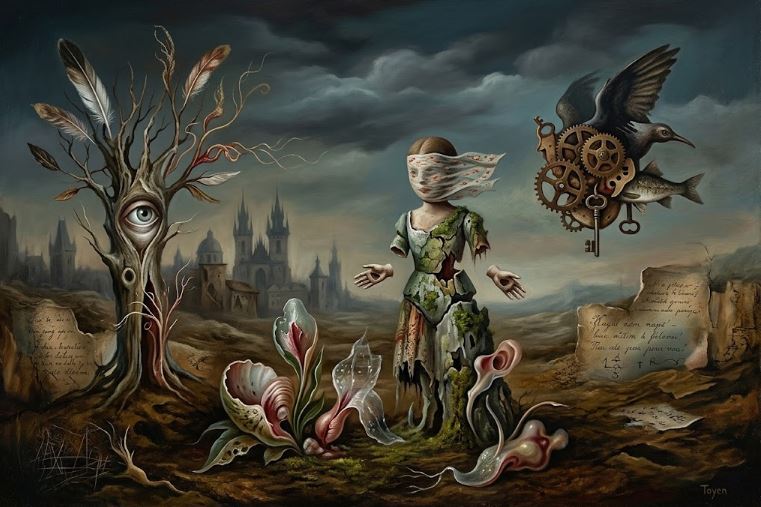
Toyen would become one of the movement’s most distinctive painters.
Štyrský developed unsettling photography, erotic publications, collage, painting, and dream-based imagery before his death in 1942.
Their work demonstrates why Czech Surrealism cannot be treated merely as an extension of Breton.
It had its own visual vocabulary before formal affiliation.
Paris provided a network.
Prague brought its own ideas.
Nazi Occupation Drove Surrealism Underground
The first major threat came before Breton’s death.
The 1938 Munich Agreement and subsequent Nazi occupation transformed Czechoslovakia’s political environment.
Avant-garde culture became dangerous.
Public Surrealist activity became increasingly difficult.
Toyen continued working while sheltering the Jewish poet Jindřich Heisler from Nazi persecution in Prague.
Their wartime collaboration produced works such as From the Strongholds of Sleep (1940), an experimental publication combining staged objects, photography, and poetry.
The period demonstrates an important feature of Czech Surrealism’s later survival.
The movement learned to function without public institutional support.
Private collaboration could matter more than exhibitions.
Books and photographs could circulate when organizations could not.
Surrealism became less dependent on being officially visible.
That habit would become essential after the war.
Communist Rule Created A Different Kind Of Repression
The end of Nazi occupation did not produce permanent freedom.
After the Communist takeover of Czechoslovakia in 1948, official cultural policy increasingly favored Socialist Realism and distrusted independent avant-garde movements.
Surrealism was ideologically inconvenient.
Its emphasis on psychic freedom, eroticism, irrationality, individual imagination, and experimental culture did not fit easily within state-approved artistic doctrine.
This did not mean every Czech Surrealist disappeared.
It meant their position became precarious.
Some emigrated.
Toyen settled permanently in Paris in 1947.
Others remained and developed new networks.
Public continuity fractured.
Intellectual continuity did not.
Vratislav Effenberger Became Crucial To The Next Generation
The poet and theorist Vratislav Effenberger became one of the key figures in Czech Surrealism after the war.
He helped sustain the movement intellectually through periods when open activity was restricted.
Rather than treating Breton’s prewar theories as sacred doctrine, Effenberger and those around him reconsidered Surrealism under new political and cultural conditions.
That rethinking is one reason the upcoming National Gallery Prague exhibition emphasizes intergenerational dialogue.
Czech Surrealism did not survive because younger artists reproduced the 1930s.
It survived because they kept asking whether the movement’s principles still worked.
What did psychic freedom mean under an authoritarian government?
Could Surrealism remain revolutionary after becoming internationally famous?
How should automatism change after Abstract Expressionism, Informel, film, psychoanalysis, and new political realities?
Underground survival turned Surrealism into an ongoing argument.
1966 Did Not End The Story
Breton died in 1966.
For many conventional histories, this marks the symbolic end of Surrealism as an organized movement.
In Prague, it did not.
The Czech group continued.
That difference is one of the strongest reasons the country’s Surrealist history matters.
Parisian Surrealism had been closely associated with Breton’s leadership and his authority over membership, theory, and collective declarations.
Czech Surrealism developed a structure less dependent on one charismatic founder.
Its continuity instead passed through networks of writers, artists, filmmakers, photographers, and theorists.
Breton remained important.
He was no longer necessary for Surrealism to exist.
The Prague Spring Briefly Opened The Door
The political liberalization of the 1960s created a temporary opportunity for renewed public activity.
The period culminated in the Prague Spring of 1968, when reformers attempted to create a more open form of socialism.
That opening ended when Warsaw Pact forces invaded Czechoslovakia in August 1968.
The subsequent period of “Normalization” restored censorship and political control.
For Surrealists, the result was another retreat from public cultural life.
Yet the movement again adapted rather than disappearing.
This ability to contract under pressure and re-emerge later became almost part of its identity.
Jan Švankmajer Gave Underground Surrealism A New Medium
One of the most internationally recognizable figures to emerge from this later Czech tradition was filmmaker and artist Jan Švankmajer.
Švankmajer joined the Surrealist group around 1970–71, alongside his wife, artist and writer Eva Švankmajerová.
His films combined animation, puppetry, food, objects, tactile experimentation, black humor, and disturbing transformations.
That practice extended Surrealist thinking into cinema without simply reproducing Buñuel or Dalí.
Objects acquired desires.
Food became threatening.
Childhood stories turned grotesque.
Bodies fragmented.
Ordinary domestic things became psychologically active.
Readers interested in how Surrealist objects and materials could destabilize familiar reality can also explore thesurrealists.org’s article on why Surrealism needed paper more than canvas.
Švankmajer demonstrates the same principle through moving images.
Analogon Became A Symbol Of Interrupted Continuity
The journal Analogon provides another example of the movement’s endurance.
Its first issue appeared in 1969, edited by Effenberger.
Political conditions quickly made sustained publication impossible.
The journal disappeared for years.
Yet after the collapse of Communist rule, it returned.
That interrupted history mirrors Czech Surrealism itself.
Publication.
Suppression.
Private survival.
Reappearance.
The movement did not maintain uninterrupted institutional visibility.
It maintained continuity of thought.
That distinction is crucial.
Underground Status Changed Surrealism
Working underground was not simply an unfortunate circumstance.
It altered the movement’s character.
The National Gallery Prague explicitly states that because much of the group’s activity occurred illegally, Czech Surrealists were repeatedly forced to reconsider Surrealism’s fundamental propositions and pose new questions.
That is a remarkable inversion.
Repression could have frozen the movement into nostalgia.
Instead, it encouraged revision.
Surrealism became less about preserving Breton’s exact historical formula and more about testing whether freedom of imagination could survive changing political conditions.
This helps explain why the group could include painters, poets, filmmakers, theorists, photographers, and later generations without demanding one uniform style.
The Velvet Revolution Changed Visibility, Not The Core Question
The Velvet Revolution of 1989 ended Communist rule in Czechoslovakia.
Czech Surrealists could finally work more openly.
Publications resumed.
Exhibitions became possible.
International exchange expanded.
Yet the movement did not suddenly need to reinvent itself from nothing.
The underground networks already existed.
What changed was their visibility.
The central question remained familiar:
Could Surrealism remain active rather than become historical style?
The Prague group continued to answer yes.
Why Czech Surrealism Survived When Other Groups Dissolved
There is no single explanation.
Its survival depended partly on strong local intellectual traditions.
It also benefited from intergenerational continuity.
Younger artists did not simply inherit a finished doctrine.
They entered an argument.
Political repression paradoxically reinforced this structure because Surrealism could not depend on galleries, official approval, or commercial success.
It had to survive through private meetings, publications, friendships, collaborative experiments, and shared intellectual commitments.
That made the movement unusually resilient.
When institutions disappeared, the network remained.
Against The Current Makes Continuity The Main Story
Against the Current: The Surrealist Group 1934–2024 opens on November 25, 2026, and runs through April 25, 2027 at Prague’s Trade Fair Palace.
The title captures the movement’s history unusually well.
Czech Surrealism worked against several currents at once.
Against fascism.
Against Stalinist cultural orthodoxy.
Against censorship.
Against the assumption that Surrealism ended with Breton.
Against the idea that a movement must retain one style to remain itself.
The group’s survival after 1966 is therefore more than a historical curiosity.
It challenges the standard chronology of Surrealism.
If a Czech Surrealist group could remain active through the late 20th century and into the 21st, then Surrealism cannot be understood only as a movement that flourished between the world wars.
In Prague, it became something closer to a durable intellectual position.
That may be the real reason Czech Surrealism survived underground.
It was never only a style to preserve.
It became a method for refusing the reality that authorities insisted was the only reality possible.