
Gertrude Abercrombie never belonged to André Breton’s Paris circle.
She did not sign Surrealist manifestos, join Breton’s group, or build her career around European avant-garde institutions. She worked mainly in Chicago, painted sparse Midwestern rooms and landscapes, hosted jazz musicians in her Hyde Park home, and developed a visual language filled with moons, cats, doors, barren trees, owls, shells, isolated women, and impossible little disturbances.
Yet her paintings can feel unmistakably close to Surrealism.
That tension is becoming newly relevant because Gertrude Abercrombie: The Whole World Is a Mystery opens at the Norton Museum of Art in West Palm Beach on October 31, 2026, and runs through March 14, 2027.
The Norton Museum retrospective is part of the first nationally touring presentation devoted to Abercrombie. It places her at the center of mid-20th-century Chicago art rather than treating her as an eccentric footnote to European Surrealism.
That change matters.
Abercrombie does not need to be retroactively declared a Surrealist.
Her importance lies in showing how Surrealist ways of thinking could emerge independently inside an American cultural world shaped by personal memory, jazz improvisation, Magic Realism, psychological isolation, and what she called “simple things that are a little strange.”
Abercrombie Made Ordinary Things Slightly Wrong
Abercrombie was born in Austin, Texas, in 1909, but Chicago became the center of her life and career.
She studied Romance languages at the University of Illinois, graduating in 1929, before pursuing commercial art training. During the 1930s, she began exhibiting seriously and worked for the Works Progress Administration’s Federal Art Project.
By the late 1930s, the visual language that would define her career was already recognizable.
Her pictures rarely require extravagant fantasy.
A room may contain only a chair, a table, a door, and a letter.
A landscape may offer a church, a bare tree, or a solitary woman.
A still life may contain dominoes, shells, leaves, ribbons, dice, or flowers.
Yet something is always slightly off.
The objects seem too deliberate.
The room feels psychologically charged.
A door may seem to lead somewhere impossible.
A moon may behave like an active participant.
The ordinary becomes uncanny without becoming spectacular.
That restraint separates Abercrombie from the popular stereotype of Surrealism as flamboyant dream imagery.
“Little Strange” Is A Better Description Than Dreamlike
Abercrombie’s own phrase—“simple things that are a little strange”—gets closer to her achievement.
Her work does not usually abandon reality.
It adjusts reality until its stability disappears.
A familiar house becomes eerie.
A domestic room begins feeling theatrical.
A woman standing alone in a landscape becomes part self-portrait, part archetype, part psychological projection.
The current retrospective emphasizes that Abercrombie drew repeatedly upon dreams, memories, autobiography, and personal symbols.
That approach connects her to Surrealism without requiring direct membership.
European Surrealists often tried to weaken rational control through automatism, dreams, chance, and unexpected associations.
Abercrombie worked more deliberately.
She arranged her symbols carefully.
The irrationality comes not from uncontrolled technique but from emotional concentration.
Everything appears chosen.
That makes the mystery stronger.
Her Paintings Were Deeply Autobiographical
Abercrombie repeatedly inserted versions of herself into her work.
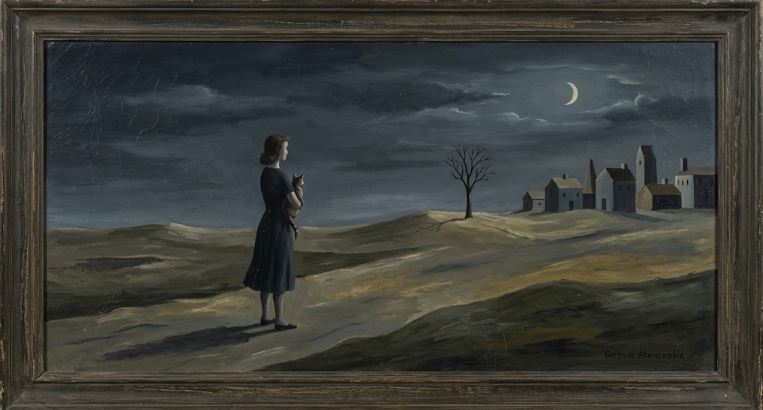
Enigmatic female figures appear alone in rooms, walking across sparse landscapes, standing near doors, sitting at tables, or encountering strangely charged objects.
The Carnegie Museum of Art describes the retrospective as revealing a highly personal visual language shaped by Surrealist and Magic Realist approaches. Its Abercrombie exhibition research notes that by the late 1930s she had developed tightly constructed paintings filled with recurring personal symbols.
These were not generic fantasy women.
They often functioned as versions of Abercrombie herself.
That autobiographical emphasis makes her particularly interesting beside artists such as Leonora Carrington, Remedios Varo, Dorothea Tanning, and Leonor Fini.
Their relationships with Surrealism differed, but each used strange imagery to create worlds in which female experience was not simply something observed from outside.
Abercrombie’s women inhabit the mystery.
They do not merely decorate it.
The Midwest Became As Strange As Paris
Abercrombie also complicates the geography of Surrealism.
Her paintings demonstrate that strange modernity did not require Parisian cafés, European ruins, or Mediterranean dreamscapes.
The American Midwest could become equally uncanny.
Her remembered connections to Aledo, Illinois, helped shape barren landscapes, churches, roads, trees, isolated architecture, and wide skies.
These environments can feel familiar to anyone who knows the Midwest.
Their emptiness is what makes them unsettling.
A Surrealist painting often creates an impossible world.
Abercrombie can create psychological disturbance from a world that looks almost possible.
That “almost” does enormous work.
A moon is too large.
A tree is too lonely.
A door stands where no door should be.
A woman appears to know something the viewer does not.
The ordinary landscape becomes an interior state.
Jazz Changed The Atmosphere Around Her Art
Abercrombie’s Chicago life was also inseparable from jazz.
Her Hyde Park home became an important social space where musicians, writers, artists, and performers gathered.
Her circle included figures such as Dizzy Gillespie, Charlie Parker, Sarah Vaughan, Max Roach, and other major musicians passing through Chicago.
Gillespie reportedly performed at Abercrombie’s 1948 wedding to music critic Frank Sandiford.
Jazz mattered because Abercrombie herself was an accomplished pianist and understood improvisation as a creative practice.
This provides another way to position her beside Surrealism.
Surrealists valued unexpected association and the liberation of imagination from predictable structures.
Jazz improvisation reaches freedom through another route: rhythm, variation, response, repetition, interruption, and spontaneous invention.
Abercrombie’s paintings are visually controlled, but the world around them belonged to improvisational culture.
She therefore represents a distinctly American path toward psychological modernism.
Jazz Makes Her Surrealism Less European
The jazz connection also prevents Abercrombie from being treated simply as an American imitation of European Surrealists.
Chicago had its own modernist networks.
Black musicians and experimental artists were generating cultural languages that did not need Paris to validate them.
Abercrombie’s home functioned as one meeting place within that environment.
This does not mean her paintings are visual translations of bebop.
The connection is subtler.
Both her art and the jazz culture around her valued variation within structure.
A small group of recurring symbols appears again and again.
Cats.
Moons.
Doors.
Trees.
Owls.
Shells.
Female figures.
Abercrombie keeps rearranging them.
The vocabulary stays limited.
The emotional combinations keep changing.
That resembles improvisation more than repetition.
A Picture In A Picture In A Picture Makes Reality Fold Inward
One work highlighted by the Norton retrospective is A Picture in a Picture in a Picture (1955).
Its structure is exactly what the title promises.
A room contains a picture of that room, which introduces another level of reality.
A closed door in one layer may be open in another.
The viewer can no longer determine which space has greater authority.
The painting creates a recursive structure decades before digital culture made such visual loops familiar.
This is where Abercrombie comes particularly close to Surrealist logic.
She takes an ordinary interior and quietly removes certainty.
No melting clock is necessary.
The room itself becomes unreliable.
Moored To The Moon Makes Poetry Out Of An Impossible Connection
Another work featured by Norton, Moored to the Moon (1963), reduces the image almost to an equation.
A marine post rises from water.
A rope extends toward the moon.
The impossible relationship is rendered with complete visual calm.
Nothing explodes.
No one reacts.
The strangeness comes from treating an impossible event as ordinary.
This restraint is one of Abercrombie’s great strengths.
She does not announce the dream.
She lets reality quietly contradict itself.
Her Symbolic Language Was Small But Deep
Abercrombie repeatedly returned to a limited vocabulary.
Doors can suggest passage, confinement, or withheld knowledge.
Cats can behave like companions, doubles, or witnesses.
Moons turn ordinary landscapes into psychological night spaces.
Bare trees suggest exposure or emotional isolation.
Letters imply communication without necessarily revealing their contents.
Dominoes and dice introduce systems of chance.
These symbols rarely have one fixed meaning.
Their significance depends on context.
That gives Abercrombie’s work a kind of private mythology.
Readers interested in another artist who turned recurring symbolic systems into entire imaginative worlds can explore thesurrealists.org’s article on Remedios Varo’s science, magic, and enigmatic worlds.
Varo and Abercrombie worked in very different environments, but both demonstrate how a personal symbolic language can become larger than any formal movement label.
Magic Realism May Be Just As Important As Surrealism
Abercrombie has been associated with Surrealism, Magic Realism, and the fantastic.
None of those labels completely contains her.
Magic Realism is particularly useful because her paintings often preserve recognizable reality while introducing subtle disturbances.
The world does not dissolve.
It becomes psychologically implausible.
That distinction explains why Abercrombie should be placed beside Surrealism rather than simply inside it.
Her art shares Surrealism’s interest in dreams, psychic reality, irrational conjunction, and unstable identity.
But her methods and cultural environment remain distinct.
The difference makes the comparison valuable.
The New Retrospective Expands American Modernism
The Whole World Is a Mystery was co-organized by the Carnegie Museum of Art and Colby College Museum of Art and curated by Eric Crosby and Sarah Humphreville, with Cynthia Stucki.
The exhibition began at Carnegie in January 2025, later traveled to Colby and Milwaukee, and arrives at Norton this autumn.
Norton describes it as the first nationally touring presentation of Abercrombie’s work.
That touring history signals a broader reassessment.
Abercrombie is no longer being treated merely as an eccentric Chicago personality who happened to paint strange pictures.
Her combination of self-portraiture, dreams, psychological symbolism, Midwestern landscape, social nonconformity, and jazz culture places her within larger debates about what American modernism actually looked like.
Abercrombie Expands Surrealism Without Needing The Label
Gertrude Abercrombie died in Chicago in 1977.
For years, her reputation remained much smaller than those of internationally canonized Surrealists.
The current retrospective helps correct that imbalance without forcing her into a movement she never formally joined.
That distinction should be preserved.
Abercrombie deserves a place beside Surrealism because her work demonstrates that Surrealist possibility existed beyond Surrealist membership.
She mined dreams.
She turned autobiography into symbolic space.
She made ordinary objects psychologically unstable.
She used isolated female figures as extensions of inner experience.
She treated American landscapes as states of mind.
And she did all of this inside a Chicago cultural world where jazz improvisation mattered as much as European avant-garde theory.
Her paintings are not loud.
They rarely need to be.
A moon, a door, a cat, a bare tree, or a woman alone in a room can become enough to destabilize an entire world.
Abercrombie called them simple things that were a little strange.
That “little” may be precisely why they remain so powerful.