

Ana Mendieta’s art resists the comfort of a single category. Her body-earth works can look like land art, performance, ritual, sculpture, photography, feminist art, exile testimony, and something stranger than any one of those labels can hold. That unstable quality is why Tate Modern’s Ana Mendieta exhibition, running from July 15, 2026, to January 17, 2027, arrives as more than a museum retrospective. It reopens the question of how an artist can make absence feel physically present. Tate describes Mendieta as a Cuban-born American multidisciplinary artist active in the 1970s and early 1980s, best known for her Silueta Series, which explored the presence and absence of the human body through natural materials such as fire, water, flowers, and earth. Tate’s official exhibition details frame the show around displacement, identity, nature, and the body’s trace in the landscape.
For thesurrealists.org readers, Mendieta matters in a particular way. She was not a Surrealist in the historical sense of André Breton’s Paris circle, yet her work often produces a surrealist effect: the body disappears, the earth remembers, and an outline becomes more forceful than a figure. Her art belongs near Surrealism without being swallowed by it. That tension is exactly what makes her body-earth works so difficult to classify.
Why Tate Modern’s Mendieta Exhibition Matters Now
Tate Modern’s 2026 exhibition is billed as the UK’s first major show dedicated to Mendieta in more than a decade. The museum’s press release describes her practice as one that challenged traditional ideas of sculpture, photography, and film, using her own term “earth-body” to describe works that outlined the body in the landscape with natural elements such as earth, fire, and flowers. Tate’s Ana Mendieta press release gives the exhibition its strongest factual base: Mendieta’s practice was never limited to one medium, and her best-known works depend on the body’s temporary contact with the natural world.
That matters now because Mendieta’s art can be flattened when it is described only through biography or only through tragedy. Born in Havana in 1948, she was sent to the United States as a child, and the experience of displacement shaped much of her later work. She died in New York in 1985, and the circumstances of her death have continued to affect the way institutions, critics, artists, and audiences discuss her legacy. A July 1, 2026 Guardian feature revisited that difficult history, including the protests and art-world arguments that followed after her husband, artist Carl Andre, was acquitted.
A responsible article has to hold both realities at once: Mendieta’s death remains part of the public record around her reception, yet her work cannot be reduced to the violence and controversy around her final night. Tate’s exhibition offers a chance to return to the works themselves: the films, photographs, installations, and earth-body actions where her body appears, vanishes, merges with terrain, and leaves signs behind.
That makes the show a strong companion to thesurrealists.org’s earlier writing on Latin American Surrealism, where exile, myth, gender, and dream imagery become central to how modern art moved beyond Europe.
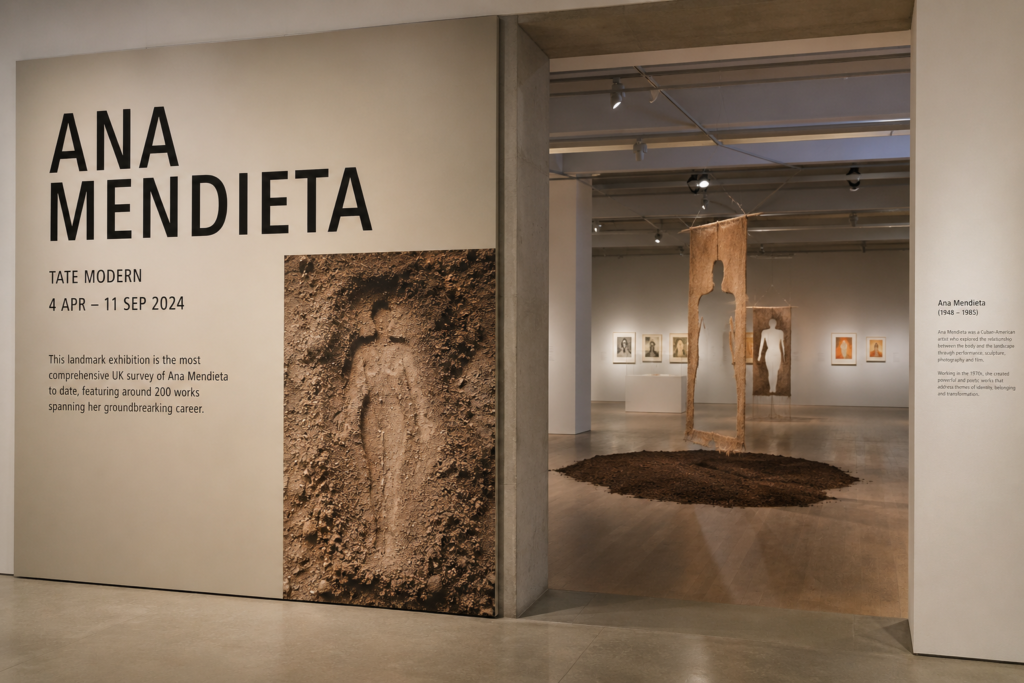
How The Silueta Series Turns Absence Into A Figure
Mendieta’s Silueta Series, made between 1973 and 1980, remains her most widely recognized body of work. In these pieces, she marked the shape of a human body into landscapes using earth, blood-like pigment, flowers, fire, water, grass, mud, leaves, and other organic materials. The figure is often gone before the viewer arrives. What remains is an impression, burn, stain, hollow, mound, or outline.
That is why the works still feel unsettling. They refuse the viewer’s desire for a stable subject. A body seems to have been there, yet the body is missing. A landscape looks natural, yet it has been touched by a ritual gesture. A photograph seems documentary, yet it records a scene that feels closer to dream, burial, apparition, or omen.
This is where Mendieta’s work brushes against Surrealism without becoming Surrealist illustration. Classic Surrealist images often destabilize the body through dream logic, fragmentation, metamorphosis, or irrational placement. Mendieta uses a different grammar. She does not need a melting clock, an impossible room, or a theatrical symbol. She lets earth, fire, water, and vegetation create the disturbance. The body is no longer a figure standing before nature. It is pressed into nature, consumed by it, marked through it, or recalled after it has gone.
Tate’s exhibition page notes that the Silueta works explored “presence and absence” through ephemeral actions recorded in photographs and films. That phrasing is key. The works were temporary, yet the documentation made them portable. The event vanished; the image remained. The trace became the artwork’s afterlife.
Why Mendieta’s Work Does Not Fit One Art-History Box
Mendieta is often placed among performance artists, land artists, feminist artists, conceptual artists, and Latin American artists. Each label is useful, and each label is incomplete. Her work uses performance, yet the performance is often private, solitary, or staged for the camera rather than a live audience. It uses land, yet it does not treat the landscape as neutral outdoor material. It belongs to feminist art, yet Mendieta’s relationship to feminism was not simple or slogan-like. It belongs to exile history, yet it avoids turning displacement into direct narration.
The word “unclassifiable” matters because Mendieta’s art sits at the crossing point of several pressures. Her body-earth works ask what a body means after migration. They ask how a person can belong to a place after forced separation. They ask how ritual can survive inside contemporary art without becoming decoration. They ask how a woman’s body can appear in art without being reduced to spectacle.
Ocula’s exhibition listing describes Mendieta’s earth-body works as a fusion of performance, sculpture, land art, film, and photography, tied to identity, exile, feminism, and the relationship between body and nature. That summary is useful precisely because it shows how many categories are needed before the work even begins to come into focus. Ocula’s exhibition overview reflects the broad institutional framing around the 2026 Tate show.
The classification problem is not a weakness in the work. It is part of the work’s force. Mendieta’s images make the viewer feel category failure. The outline in the ground might be a grave, a birth mark, a wound, a spirit, a memory, a ritual sign, or a body returning to soil. None of those readings cancels the others.
How Exile Gives The Body-Earth Works Their Emotional Pressure
Mendieta’s biography matters because displacement was not an abstract theme for her. She left Cuba as a child and grew up in the United States, separated from the landscape, language, family structure, and cultural ground that shaped her earliest life. Her art often reads like an attempt to reconnect the body to origin without pretending that return is simple.
The earth-body works do not show exile as a clean before-and-after story. They show it as a condition of unstable belonging. The body presses into a site, but it does not fully possess it. The landscape receives the body’s outline, but it does not become permanent shelter. The image records contact, then reminds the viewer that contact has already passed.
That is one reason Mendieta’s art still feels current. Contemporary audiences are accustomed to discussing migration, border politics, diasporic identity, environmental grief, and the body’s vulnerability in public space. Mendieta was asking related questions through physical action, elemental materials, and stark visual economy decades ago.
The Guardian’s 2026 feature notes that the Tate exhibition includes a new print of Bird Run from 1974, one of Mendieta’s Super 8 films, after digital restoration work began in 2014 under the care of her niece Raquel Cecilia. That detail matters because film restoration changes how present the work can feel to contemporary viewers. Mendieta’s body does not return as biography alone; it returns through moving image, color, grain, speed, and gesture.
Why The Work Feels Surreal Without Becoming Surrealism
Mendieta’s body-earth works feel surreal because they disturb the border between body and landscape. A human shape appears in the ground as if the earth has dreamed it. Fire turns an outline into a ritual flare. Flowers make absence tender and strange. Water pulls form toward disappearance. Mud, leaves, and stone make the body feel both ancient and temporary.
Yet calling Mendieta a Surrealist would miss the work’s historical specificity. Her art does not emerge from Breton’s theory of psychic automatism, Parisian Surrealist publishing culture, or the formal strategies of painters such as Salvador Dalí, Max Ernst, or René Magritte. Her work comes from performance, land-based action, feminist practice, Afro-Caribbean and Indigenous references, Cuban exile, experimental film, and the charged politics of the 1970s.
The surrealist connection is better understood as a visual and psychological affinity. Surrealism taught modern art that dreams, bodies, desire, violence, and the irrational could break the polished surface of everyday reality. Mendieta’s work pushes that break into the ground itself. Instead of staging the unconscious as a theatrical image, she makes the landscape act like a witness.
That distinction keeps the article honest. Mendieta’s work can speak to Surrealist readers without being forced into the Surrealist canon. Her art expands the conversation around the uncanny body, but it does so through materials, histories, and rituals that demand their own terms.
How The Materials Make The Images Hard To Forget
Earth, fire, flowers, blood-like color, feathers, stone, water, and vegetation are never neutral in Mendieta’s work. They carry sensory memory. They make the image feel touched, burned, buried, washed, grown, or wounded. That material intensity separates her body-earth works from purely symbolic art.
A drawn outline might remain graphic. Mendieta’s outlines feel bodily because the materials change. Fire consumes. Flowers wilt. Water moves. Soil collapses. Grass grows back. The work begins to disappear as soon as it exists. The photograph or film becomes a record of a transformation that cannot be repeated in exactly the same way.
That ephemerality is one reason the works still unsettle viewers. Museum culture often rewards preservation, permanence, ownership, and display. Mendieta’s art keeps pointing back to disappearance. Tate can gather the films, photographs, and restaged installations, but the original actions remain tied to time, place, weather, and bodily presence.
This makes the work especially powerful for contemporary art audiences trained to think about documentation. The photograph is not just proof that something happened. It is part of the work’s structure. Mendieta’s camera holds the trace after the land begins to erase it.
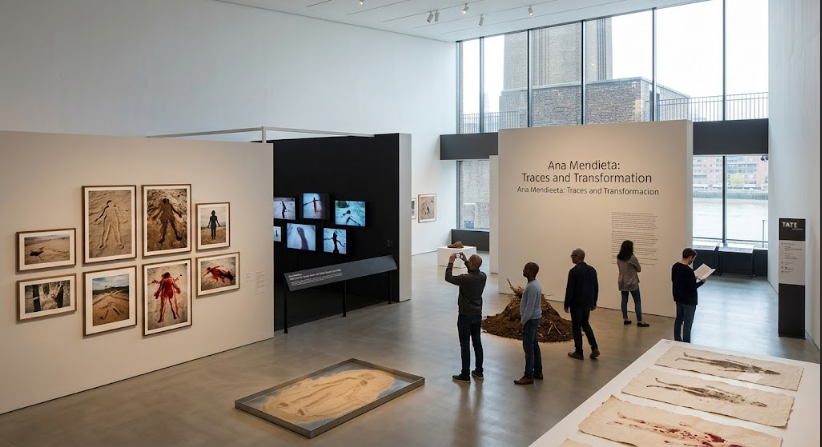
What Tate’s Exhibition Could Change About Mendieta’s Reception
The 2026 Tate Modern exhibition has the potential to shift Mendieta’s reception in the UK by presenting her practice at a fuller scale. Tate’s wider 2026 exhibition announcement stated that the show would bring together iconic film and photographic works alongside installations never before seen in the UK. That matters because Mendieta’s work loses power when reduced to a handful of famous Silueta images. Her practice moved across film, sculpture, photography, performance, and installation with an intensity that deserves sustained viewing.
A larger exhibition can reveal continuities that isolated images hide. The body outline is not a repeated gimmick. It is a method for testing presence. The landscape is not a backdrop. It is an active participant. The camera is not a neutral recorder. It becomes the means through which an ephemeral action enters history.
The show can also help viewers resist two common reductions. One reduction turns Mendieta into a tragic symbol. The other turns her into a simple pioneer of feminist land art. Both readings contain pieces of truth, yet both are too small. Mendieta’s work is more restless, more ritualized, more formally experimental, and more emotionally difficult than either label allows.
Why Mendieta’s Unclassifiable Art Still Feels Alive
Ana Mendieta’s body-earth works still feel unsettling because they do not let the viewer settle. They refuse one medium, one movement, one geography, one identity frame, and one emotional register. A single image can feel like mourning, return, protest, ritual, sculpture, performance, and disappearance at the same time.
That is why the 2026 Tate Modern exhibition matters for readers interested in Surrealism and its afterlives. Mendieta’s art does not ask to be absorbed into Surrealist history, but it sharpens the questions Surrealism left behind: What happens when the body becomes strange to itself? Can a trace carry more force than a figure? Can an image make absence feel alive? Can the natural world become a psychological space?
Mendieta’s answer was never clean. She made works that entered the earth, burned briefly, bloomed, dissolved, and returned through film and photography. Her body-earth art remains difficult to classify because it was built from instability. It belongs to the ground and to the image, to ritual and to criticism, to exile and to return, to disappearance and to presence.
That refusal to become one thing is the source of its power. Mendieta’s work still feels alive because it keeps asking the viewer to stand where categories fail.