

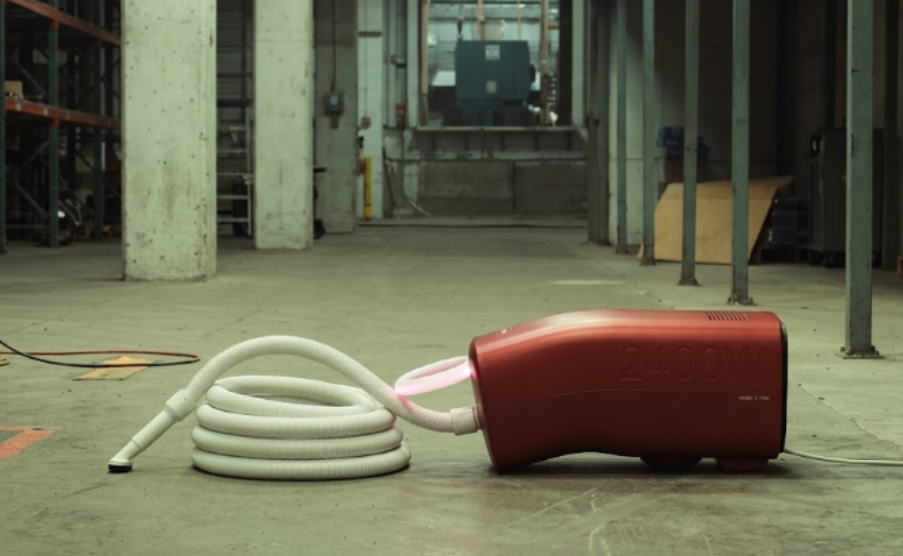
A Useful Ghost sounds, at first, like a joke that should collapse under its own premise. A grieving man discovers that his dead wife has returned as a vacuum cleaner. Yet Thai writer-director Ratchapoom Boonbunchachoke turns that absurd object into one of the year’s sharpest images of grief, pollution, repression, and political memory. The film won the Grand Prize at Cannes Critics’ Week in 2025, and its 2026 streaming and release cycle has made it newly visible to international audiences.
For thesurrealists.org, the film matters because it shows how surrealism can enter contemporary cinema through a household appliance rather than a dream palace. The haunted vacuum cleaner is funny, erotic, grotesque, domestic, and political all at once. It sucks up dust, but the dust refuses to disappear. It becomes a machine for remembering what a state, a family, a factory, and a culture would rather erase.
The official A Useful Ghost movie site gives the story’s deceptively simple hook: March is mourning Nat, who has died from dust pollution, when he learns that her spirit has returned by possessing a vacuum cleaner. That premise could become a novelty horror gag. Instead, Boonbunchachoke uses it to ask a darker question: what happens when the dead are made “useful” to the systems that harmed them?
Why A Haunted Vacuum Cleaner Works As Surrealist Cinema
Surrealist cinema has always understood that ordinary objects can become dangerous when they stop behaving properly. A razor, a hand, a dinner table, a mirror, a hallway, or a machine can suddenly expose the irrational structure beneath daily life. A Useful Ghost belongs to that lineage because it turns the vacuum cleaner into a political object.
The vacuum is not exotic. It belongs to the home, the workplace, the service economy, and the maintenance of cleanliness. It exists to remove dirt, dust, hair, residue, and visible disorder. Boonbunchachoke makes that function symbolic. If the machine is built to erase traces, then a ghost inside the machine turns erasure into haunting.
That is why the film’s central joke is so potent. A vacuum cleaner possessed by a dead woman is absurd, but the absurdity is exact. It literalizes the way modern societies ask machines, institutions, and families to tidy away the evidence of damage. Dust becomes a material sign of pollution, labor exploitation, political violence, and censored history.
This connects naturally with thesurrealists.org’s writing on surrealism in film and photography, where the camera becomes a tool for making unconscious pressure visible. In A Useful Ghost, the unconscious is not only private. It is national, industrial, and historical.
How Ratchapoom Boonbunchachoke Blends Serious And Silly
Boonbunchachoke’s method depends on tonal collision. The film moves through romance, ghost story, black comedy, political allegory, queer performance, factory horror, melodrama, and social satire without reducing one mode to another. That is risky, but it is also the film’s central strength.
La Semaine de la Critique’s interview with Ratchapoom Boonbunchachoke describes the film as a tale where fantasy, fairy tale, romance, comedy, horror, politics, social commentary, and queer themes intertwine. Boonbunchachoke explains that he likes to juxtapose the big and small, the serious and silly, collective history and personal matters, the composed and the campy.
That statement is a perfect key to the film. The haunted vacuum is small and silly. The historical grief behind it is large and serious. The machine sits in a home, but the dust it handles points toward factories, monuments, protests, and national repression. The love story is intimate, yet it opens into collective memory.
This is political surrealism at its most effective. It does not preach first and imagine later. It lets an impossible image carry the argument.
Why Dust Becomes The Film’s Political Substance
Dust is the film’s most important material. It is not just dirt. It is the residue of bodies, buildings, factories, monuments, and memory. It floats, settles, enters lungs, clogs machines, and returns after every attempt at cleaning. In a film about ghosts, dust behaves like the physical form of haunting.
The Guardian’s feature on A Useful Ghost and Thai politics reports that Boonbunchachoke links the film’s dust to Thailand’s air pollution crisis and to people who have been made powerless or voiceless. The article also notes that the director began writing the film in 2017, after Thailand’s 2014 military coup and during a period when public monuments tied to democratic memory were removed or altered.
That context changes the vacuum cleaner’s meaning. It is not simply a haunted object. It is a machine caught in a battle over residue. What should be removed? What should remain visible? Who decides which dust is dirt and which dust is evidence?
Surrealism often turns matter into memory. In A Useful Ghost, dust becomes political because it refuses to stay neutral. It carries the dead into the present.
How The Film Turns Grief Into A Machine
At the center of the story is March’s grief for Nat. The official synopsis emphasizes the romantic tragedy: Nat has died from dust pollution, and March encounters her again through a possessed vacuum cleaner. That emotional foundation keeps the film from becoming only an allegorical puzzle.
The object is ridiculous, but March’s longing is not. This is why the film’s surrealism works. The viewer does not need to “believe” in a haunted vacuum in a literal sense. The viewer needs to understand the emotional logic: grief makes people accept impossible returns. When someone dies, any trace can feel like a message. A voice, smell, object, room, or machine can become charged with presence.
Boonbunchachoke pushes that logic into the comic and uncanny. Nat’s ghost returns through a cleaning machine, which makes intimacy mechanical, awkward, and strange. Yet that awkwardness reveals something true about grief. The beloved does not return cleanly. Memory comes back through broken objects, bodily traces, routines, and spaces of domestic labor.
The film’s political turn makes that grief even sharper. Nat’s ghost does not remain only March’s lost love. She becomes part of a wider system that wants ghosts managed, redirected, and made useful.
Why “Useful” Is The Film’s Most Dangerous Word
The title A Useful Ghost is chilling because usefulness sounds practical and harmless. A useful thing has value. A useful worker serves a function. A useful memory supports the official story. A useful ghost can be turned into labor, comfort, propaganda, or erasure.
That is the film’s deepest critique. A ghost should disrupt the living. It should demand recognition. Yet institutions often try to domesticate the dead. They turn martyrs into slogans, victims into symbols, ancestors into legitimacy, and unresolved trauma into official ceremony. The ghost becomes acceptable only when it helps power continue.
The Guardian’s July 2026 film review describes the film as a supernatural black-comic fantasy about national grief and ghosts who refuse confinement after Thailand’s political catastrophes, including the 2010 military crackdown, the 2006 and 2014 coups, and the 1976 Thammasat University demonstrations.
That history gives the title its force. The dead are not useful because they help the living forget. They are useful only if they are allowed to haunt truthfully.
How The Film Uses Thai Ghost Traditions Without Becoming Folklore Tourism
Thailand has a rich cinematic tradition of ghost stories, horror comedies, spirit worlds, and supernatural melodrama. A Useful Ghost draws from that background, but it does not present Thai ghost culture as exotic decoration for global audiences. Instead, it uses haunting as a living political language.
MUBI’s A Useful Ghost page frames the film as a surreal comedy haunted by Thailand’s political past. Its synopsis begins with a man suspecting his vacuum cleaner may be haunted, then expands into a repairman’s story about a factory, a female worker’s ghost, and another former colleague’s vengeful haunting.
That layered storytelling matters. The film does not move in a straight line from premise to explanation. It behaves like a ghost story passed between people, objects, and institutions. Each narrative frame reveals another buried pressure.
This structure also keeps the film from becoming a simple metaphor. The ghosts are political, but they are also emotional, erotic, comic, and cinematic. They belong to genre as much as to history. Boonbunchachoke understands that ghost stories work because they let societies discuss what direct speech may not safely hold.
Why A Factory Haunting Expands The Film Beyond Domestic Grief
The vacuum cleaner begins in domestic space, but the film widens into the factory that produced it. That movement is essential. The haunted appliance does not come from nowhere. It belongs to a chain of labor, pollution, class hierarchy, family ownership, and industrial responsibility.
Metacritic’s A Useful Ghost listing classifies the film across comedy, drama, fantasy, horror, and thriller, and summarizes the premise around March, Nat, dust pollution, and the possessed vacuum. That genre spread reflects the film’s own movement between scales. A domestic romance opens into industrial haunting. A machine bought for cleaning becomes evidence of production, poisoning, and exploitation.
The factory setting changes the film’s ghost logic. The haunting is no longer simply a private return from death. It becomes a labor story. The dead are tied to workplace conditions, toxic environments, and the systems that profit from making bodies disposable.
That is where the film’s surrealism becomes political rather than merely quirky. The object is haunted because the production system is haunted. The vacuum cleaner carries the factory into the home.
How Queer Presence Complicates The Political Allegory
A Useful Ghost also includes queer themes and characters, which makes its political surrealism richer. The film does not treat queerness as a side decoration. It uses queer presence to challenge official order, gendered memory, and social legibility.
The Guardian’s review describes a queer academic figure connected to research on Bangkok’s Democracy Monument, while La Semaine de la Critique’s interview identifies queer themes as part of the film’s interwoven structure. That matters because the film’s politics are not only about state violence in the abstract. They are also about whose bodies, desires, relationships, and memories are permitted to remain visible.
Surrealism has often found power in figures who disturb classification: the hybrid body, the double, the masked person, the living-dead, the object that behaves like a body. A Useful Ghost places queer presence inside that same field of unstable identity, but it does so through contemporary Thai politics rather than old avant-garde symbolism.
The result is not a neat allegory. It is a haunted social system where sexuality, class, memory, and state power keep crossing. That messiness gives the film its emotional truth.
Why The Vacuum Cleaner Feels Funny And Terrifying
The haunted vacuum cleaner works because it never settles into one tone. It is funny because the image is ridiculous. It is tender because it carries Nat back to March. It is erotic because the film treats the machine as a site of bodily contact. It is terrifying because it can also become an instrument of control.
That tonal instability is deeply surreal. A surreal object often refuses the viewer’s first reaction. It invites laughter, then discomfort. It looks ordinary, then obscene. It becomes symbolic, then stubbornly literal again. The vacuum cleaner is still a vacuum cleaner, even when it is also a lover, ghost, worker, weapon, and political metaphor.
This is why the film has travelled well internationally. The object is instantly legible. Everyone understands a cleaning machine. Yet Boonbunchachoke attaches it to specifically Thai histories of pollution, repression, monarchy-related taboos, military coups, and suppressed public memory. The familiar object opens into unfamiliar political depth.
That balance lets the film avoid two common traps. It is not obscure art-house symbolism without emotional access. It is also not a simple genre joke. It is both accessible and strange.
Why Cannes Recognition Matters For Thai Political Cinema
The film’s Cannes recognition matters because it gives international visibility to a new Thai feature working through metaphor, comedy, and political unease. Cineuropa reported that the jury of the 64th Critics’ Week, part of the 78th Cannes Film Festival, awarded the 2025 Grand Prize to Boonbunchachoke’s feature debut, which was produced by Thailand’s 185 Films and co-produced by companies in France, Singapore, and Germany. The Cineuropa Cannes report placed the win within a wider Critics’ Week awards slate and identified A Useful Ghost as Boonbunchachoke’s debut feature.
That prize is not the reason the film matters artistically, but it helped frame A Useful Ghost as a major arrival. The award placed a strange Thai supernatural comedy inside global cinema conversation. It also showed how political cinema can survive through genre invention rather than direct realism alone.
For thesurrealists.org, the Cannes context matters because Surrealism has always depended on circulation across borders. A film rooted in Thai ghost traditions and political memory can speak to international audiences because it finds an image strong enough to travel: a haunted machine cleaning up a dirty history.
That image does not need to flatten its context. Its specificity is the source of its power.
Why “A Useful Ghost” Belongs On Thesurrealists.org
A Useful Ghost belongs on thesurrealists.org because it proves that contemporary surrealism is not limited to gallery art, European dream symbolism, or nostalgic avant-garde references. It lives in cinema that can make a vacuum cleaner carry grief, sexuality, pollution, state violence, class conflict, and historical erasure.
The film’s surrealism is not decorative. It is structural. The story is built around impossible returns, living machines, ghostly labor, dream invasion, political dust, and the failure of repression. Every absurd element has a social function.
That makes the film especially useful for readers interested in the relationship between Surrealism and politics. Surrealism’s strongest political art does not simply illustrate injustice. It changes the form of reality so injustice can be felt differently. Boonbunchachoke does this by making erasure physical. The past becomes dust. The dead become machines. Cleaning becomes violence. Memory becomes haunting.
A haunted vacuum cleaner may sound like a comic gimmick. In A Useful Ghost, it becomes one of the clearest recent images of how political memory survives inside the objects that try to remove it.
How Political Surrealism Turns The Everyday Into Evidence
The brilliance of A Useful Ghost lies in its confidence that the everyday object can hold national grief. Boonbunchachoke does not need a grand monument as his only symbol, though monuments matter in the film’s political background. He chooses a domestic appliance and lets it expose the larger system.
That choice makes the film feel urgent in 2026. Contemporary politics often works through erasure, distraction, symbolic cleanup, and the management of public memory. The film answers with a surreal object that refuses to clean properly. It coughs up what it should swallow. It returns what power wants buried. It turns dust into testimony.
For readers of thesurrealists.org, the lesson is clear: surrealism remains powerful when it makes the hidden structure of ordinary life visible. A Useful Ghost does that with humor, grief, and a haunted machine. It turns the vacuum cleaner into a political stage where the dead keep interrupting the living until someone finally listens.