
Guggenheim Abu Dhabi turns museum architecture into a desert dream machine because it treats the museum itself as part of the artwork. Announced to open on December 11, 2026, the long-awaited institution on Saadiyat Island will join Abu Dhabi’s expanding cultural district with a building designed by Frank Gehry, the architect whose Guggenheim Bilbao changed the global conversation around museums, cities, spectacle, and cultural identity.
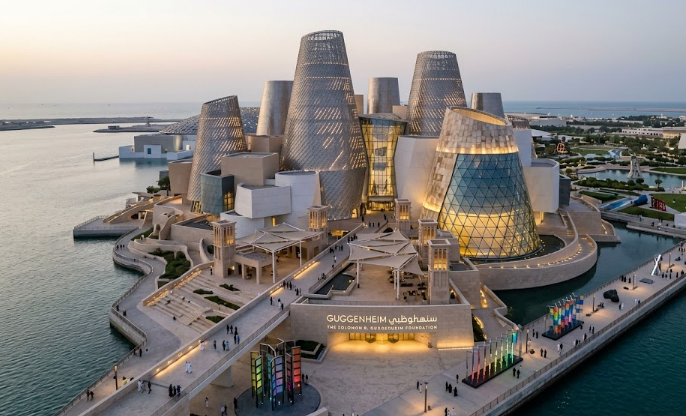
For thesurrealists.org, the story matters because Guggenheim Abu Dhabi is not only a museum opening. It is an architectural image event. Gehry’s design gathers cones, terraces, galleries, atriums, desert light, Gulf air, and monumental scale into a building that appears less like a conventional museum and more like a constructed mirage. It rises at the meeting point of land and sea, shaped by a city that wants culture to function as both civic infrastructure and global signal.
The Department of Culture and Tourism – Abu Dhabi announced the opening date on July 28, 2026, stating that the museum will serve modern and contemporary art from the 1960s to the present while positioning Abu Dhabi as a hub for artistic exchange. The official Guggenheim Abu Dhabi opening announcement gives the building’s key architectural facts: 30 galleries, a central atrium, 10 sculptural cones, cone heights reaching up to 88 metres, 11,600 square metres of interior gallery space, 23,000 square metres of outdoor exhibition areas, and 80,000 square metres of total built-up area.
Those numbers matter because they show that Guggenheim Abu Dhabi is not a modest branch museum. It is a large-scale architectural machine designed for a new kind of museum encounter: part gallery, part civic landmark, part climate-conscious shade structure, part desert-stage for global contemporary art.
Why The Opening Date Changes The Story
The December 2026 opening date gives Guggenheim Abu Dhabi a new urgency because the project has spent years in the zone between promise, delay, construction, and cultural speculation. Since its original announcement in the 2000s, the museum has been discussed as one of the most ambitious museum projects in the world, but also as a symbol of the risks attached to cultural megaprojects.
Now the story becomes more concrete. The museum is no longer only a future rendering or a speculative landmark. It has a date, a district, a built form, and an announced curatorial direction. That shift changes how critics, visitors, artists, and cultural writers can discuss it. The question is no longer simply whether Abu Dhabi can build a Guggenheim. The question becomes what kind of museum experience this building will produce.
The official announcement also places the museum inside the wider Saadiyat Cultural District, alongside Louvre Abu Dhabi, Zayed National Museum, Natural History Museum Abu Dhabi, and teamLab Phenomena Abu Dhabi. That cluster matters because Guggenheim Abu Dhabi will not open as an isolated monument. It will enter a concentrated cultural landscape designed to make Saadiyat Island a global museum destination.
For a Surrealist reading, that concentration has a dreamlike quality. A district of museums on an island already sounds like a constructed cultural vision. Guggenheim Abu Dhabi intensifies that vision with architecture that turns the desert museum into an immersive object.
How Frank Gehry Makes The Museum Feel Unstable
Frank Gehry’s architecture often turns mass into motion. His best-known museums do not sit quietly as boxes for art. They twist, unfold, reflect, collide, and produce a sense of visual event before the visitor enters. Guggenheim Abu Dhabi follows that lineage while adapting it to a different climate, geography, and cultural setting.
The Guggenheim Foundation’s architecture overview describes the Abu Dhabi museum as an experiment in inventive twenty-first-century museum design, with unconventional gallery layouts and sustainable elements appropriate to the region. It also notes that the design draws from the idea of traditional wind towers, using natural cooling and ventilation in covered courtyards.
That detail is important because the building’s strangeness is not only aesthetic. The cones, courtyards, and shaded spaces respond to climate as well as image. In a desert environment, architecture must work with heat, air, sun, and movement. Gehry’s museum uses sculptural form to make those conditions visible.
This is why the building can be understood as a “desert dream machine.” A dream machine transforms perception. Guggenheim Abu Dhabi uses architectural form to transform desert light, sea air, heat, shade, and contemporary art into an experience that will likely feel theatrical before it feels neutral.
Why The Sculptural Cones Matter
The museum’s 10 sculptural cones are the strongest visual element in the official description. Nine will be clad in stainless steel mesh, while one will use onyx and glass. These cones punctuate the skyline, provide shade and ventilation, and shape the visitor’s experience of the building from both outside and inside.
The cones matter because they blur several categories at once. They are architectural forms, environmental tools, spatial markers, and image-making devices. They suggest towers, funnels, chimneys, tents, industrial structures, and abstract sculptures. In a conventional museum, architecture often frames the artwork. Here, the building competes with the artwork as a form of spectacle.
That does not necessarily weaken the museum. It may be part of its purpose. Contemporary art since 1960 has often required larger, more flexible, more theatrical spaces than older museum rooms could provide. Installation, video, sculpture, performance, land-based works, immersive media, and new media can demand architecture that behaves differently.
Abu Dhabi Culture’s Guggenheim Abu Dhabi page says the museum will include exterior exhibition spaces and asymmetric cones that surround the main building, acting as entrances and outdoor exhibition zones. That makes the cones more than exterior decoration. They extend the museum into the open air.
For thesurrealists.org, that is the most compelling architectural idea: the building makes the threshold unstable. Inside and outside, gallery and desert, sculpture and shelter, museum and mirage all begin to overlap.
How The Desert Changes The Guggenheim Idea
Every Guggenheim museum is shaped by place. Frank Lloyd Wright’s New York museum created a spiral interior on Fifth Avenue. Peggy Guggenheim’s Venice collection sits inside an unfinished palazzo on the Grand Canal. Gehry’s Bilbao museum became part of a postindustrial riverfront transformation. Guggenheim Abu Dhabi enters a different setting: a Gulf island where desert, sea, tourism, heritage, urban planning, and global contemporary art meet.
This setting changes the Guggenheim idea. The museum is not simply exporting a brand into the UAE. It must answer to the climate, cultural geography, and political visibility of its site. The official announcement says the museum’s collection is “uniquely local and global,” centered in the region while including works from all continents. That phrase gives the museum its central challenge.
A desert museum cannot simply act like a neutral container for international art. Its architecture already makes a claim. Its scale, cones, Gulf-facing position, and Saadiyat location tell visitors that the building wants to be read as part of a new cultural map.
That is why the topic belongs on thesurrealists.org. Surrealism has always cared about places where reality feels rearranged: islands, arcades, dream cities, ruins, thresholds, uncanny rooms, and objects that seem to exceed their function. Guggenheim Abu Dhabi turns a museum into one of those charged spaces. It asks whether architecture can make a cultural ambition visible before a single artwork is encountered.
Why The Museum Is A Dream Machine, Not Just A Landmark
A landmark is something people recognize. A dream machine does more than that. It reorganizes the visitor’s sense of space, time, and expectation. Guggenheim Abu Dhabi may become a landmark, but its more interesting role is experiential. It is designed to move visitors through interconnected galleries, outdoor areas, atrium space, and narrative pathways that do not follow a simple chronological museum model.
The official announcement says visitors will shape individual pathways through galleries considering major vectors of art since 1960, including Abstractions, Popular Culture, Land, Language, and Storytelling. It also says the displays will explore art history through relationships and resonances rather than linear chronology.
That matters because the building’s architecture and curatorial plan appear to share a similar logic. Both resist straight lines. The galleries connect through narrative routes rather than a single timeline. The cones interrupt the skyline. The atrium creates a central spatial pull. The outdoor exhibition areas extend the museum beyond the enclosed gallery.
This is where the dream-machine idea becomes more than a metaphor. The building and collection strategy both seem designed to produce shifting relationships: between regions, periods, media, audiences, and forms of art. In that sense, the museum may operate less like a traditional art-history textbook and more like a spatial network.
How The Collection Direction Changes The Modern Art Map
Guggenheim Abu Dhabi’s collection focus is one of the most important parts of the opening announcement. Abu Dhabi Culture says the collection features work from around the world in varied media, produced since the turn of the 1960s, with special emphasis on West Asian, North African, and South Asian art. That focus gives the museum a chance to shift how modern and contemporary art history gets narrated.
Many major Western museums still tell post-1960 art history through New York, London, Paris, Berlin, and a handful of global biennial centers. Guggenheim Abu Dhabi has the opportunity to place West Asia, North Africa, South Asia, and other under-centered regions closer to the heart of the story.
That does not automatically happen because a museum announces a global mission. It will depend on acquisitions, commissions, scholarship, wall texts, programming, curatorial authority, and how artists from the region appear in relation to the Guggenheim’s existing international networks. Yet the stated emphasis is significant.
For a site focused on Surrealist and dream-image culture, this matters because the global rewriting of modern art also affects how movements like Surrealism are understood. Dream imagery, abstraction, myth, postcolonial memory, new media, and political imagination did not develop only in Europe and North America. A museum centered in Abu Dhabi could make those connections more visible.
This connects with thesurrealists.org’s earlier writing on Surrealism in architecture and contemporary building design, where buildings become more than functional structures. Guggenheim Abu Dhabi extends that idea at institutional scale: architecture becomes a tool for rewriting how art histories are experienced.
Why Saadiyat Island Makes The Building More Theatrical
Saadiyat Island gives Guggenheim Abu Dhabi an unusually theatrical setting. It is not a dense historic city center where a museum must squeeze itself into an existing urban fabric. It is a planned cultural district where each major institution plays a visible role in shaping the island’s identity.
That setting creates opportunity and tension. On one hand, the museum can work with scale, views, outdoor spaces, and environmental forms in ways that a dense city site might not allow. On the other hand, a planned cultural district can risk feeling like a stage set unless its institutions build meaningful public life around them.
The official announcement stresses encounter, exchange, education, and public programming. Those elements will matter as much as the architecture. A museum becomes culturally alive not because a famous architect designs it, but because artists, audiences, scholars, educators, and local communities use it in ways that exceed the opening spectacle.
Still, the architectural image matters. The museum’s cones and terraces will be seen against Gulf water and desert sky. That setting gives the building a cinematic quality. It will likely be photographed as an object of arrival: cranes gone, cones visible, sea light hitting metal mesh, visitors moving through shaded thresholds.
That is why “desert dream machine” works as a headline. The building is meant to produce images, and those images will shape the museum’s identity long before many audiences understand its collection.
Why Scale Can Be Both Powerful And Risky
The numbers attached to Guggenheim Abu Dhabi are impressive: 80,000 square metres of total built-up area, 30 galleries, cone heights up to 88 metres, and 23,000 square metres of outdoor exhibition space. Scale allows the museum to present large installations, experimental works, outdoor projects, and contemporary media in ways smaller museums cannot.
Yet scale also creates risk. Large museums can overwhelm art if architecture becomes the main subject. A spectacular building can attract visitors while making it harder for individual artworks to hold attention. The “Bilbao effect” proved that architecture can transform a city’s cultural image, but it also raised questions about museum branding, tourism, and the relationship between buildings and collections.
Guggenheim Abu Dhabi will have to negotiate that tension carefully. Its strongest promise lies in using scale to serve the art rather than only to advertise the building. The official language about experimental art since 1960 suggests that the museum understands this challenge. Contemporary artists often need space, but they also need context.
The best version of Guggenheim Abu Dhabi would let architecture and art challenge each other. The building can create wonder, but the galleries must sustain thought after the first impression fades.
Why The Long Delay Remains Part Of The Story
Any responsible article should acknowledge that Guggenheim Abu Dhabi carries a long public history of delay, scrutiny, and debate. Wallpaper’s recent Guggenheim Abu Dhabi opening-date report notes that the museum follows roughly two decades of delays and past scrutiny around labor practices, alongside economic and construction challenges.
This context does not erase the importance of the opening. It makes the opening more complicated. Cultural megaprojects are never only buildings. They involve contracts, workers, governments, foundations, tourism strategies, international prestige, critics, artists, and public expectations.
The New Yorker’s 2016 essay The Gulf Art War documented earlier debates about labor conditions and activist pressure around Saadiyat Island cultural projects. A 2026 article should not pretend that history vanished simply because an opening date has arrived.
That does not mean every discussion of Guggenheim Abu Dhabi must become only a labor article. It means the building should be read with awareness. A desert dream machine is still a machine. Its beauty, ambition, and symbolic power come from real systems of construction, governance, cultural diplomacy, and public accountability.
How The Museum Could Reshape Cultural Exchange
Guggenheim Abu Dhabi’s most promising role may be as a platform for cultural exchange beyond the usual Western museum circuit. The official announcement states that the museum will bring together diverse perspectives across geographies and generations, with media including painting, sculpture, installation, photography, moving image, and new media.
That broad scope is especially important in Abu Dhabi, a city positioned between regional histories and global networks. The museum could help artists from West Asia, North Africa, South Asia, and other regions enter international conversations without being framed as secondary to Euro-American narratives.
The success of that mission will depend on details still to come: opening exhibitions, acquisitions, artist commissions, curatorial voices, loans, education programs, and how multilingual interpretation serves different audiences. The museum’s public programming is already active across the UAE, but the building’s opening will test whether that activity can scale into a sustained museum culture.
If it succeeds, Guggenheim Abu Dhabi could become more than another spectacular branch. It could become a place where modern and contemporary art is understood through relationships rather than inherited centers and margins.
Why The Architecture Belongs In A Surrealist Conversation
Guggenheim Abu Dhabi belongs in a Surrealist conversation because its architecture creates a sense of the uncanny at institutional scale. It is familiar enough to read as a museum, but strange enough to unsettle that category. Its cones, mesh, atrium, outdoor spaces, and Gulf-facing site make it feel like a cluster of objects gathered by dream logic.
Surrealist architecture does not always mean buildings that literally imitate Surrealist artworks. More often, it means architecture that makes ordinary spatial expectations unstable. A museum becomes a landscape. A cone becomes both shade device and sculpture. A gallery route becomes a narrative maze. A desert island becomes a cultural constellation.
This is not about calling Gehry a Surrealist. It is about recognizing how his architecture often produces the same effect that Surrealist objects produce: it makes function behave strangely. The museum shelters art, but it also performs as art. It guides visitors, but it also disorients them. It belongs to a site, but it also looks like an apparition from another system of forms.
That tension is exactly what makes the building useful for thesurrealists.org. It turns architecture into a dream condition rather than a neutral container.
Why Guggenheim Abu Dhabi Still Has To Prove Its Promise
The opening date is important, but Guggenheim Abu Dhabi’s deeper meaning will be decided after the doors open. Architecture can create anticipation. A collection can create authority. Public programming can create access. Yet a museum becomes truly important through use over time.
Will the galleries make regional artists central rather than supplementary? Will the museum’s global story move beyond familiar Western anchors? Will the architecture serve challenging art rather than overwhelm it? Will public programs build real local engagement? Will the institution address difficult histories and debates with openness?
Those questions should stay with any serious article about the project. The building’s image is powerful, but the museum’s value will depend on how it operates as a living cultural institution.
That is why Guggenheim Abu Dhabi feels so compelling now. It is both an object and a test. It tests whether spectacular architecture can support a more plural art history. It tests whether a global museum can be rooted in place. It tests whether a desert landmark can become more than a symbol of cultural ambition.
How The Desert Dream Machine Reimagines The Museum
Guggenheim Abu Dhabi turns museum architecture into a desert dream machine because it gathers contradiction into form. It is local and global, sculptural and functional, monumental and climate-responsive, spectacular and scholarly, delayed and newly dated, a building for art and an artwork in itself.
Its cones will shape shade and skyline. Its atrium will pull visitors into a central spatial drama. Its galleries will organize art from the 1960s onward through themes and resonances rather than simple chronology. Its outdoor spaces will allow art to meet desert light and Gulf air. Its Saadiyat location will place it within one of the most visible cultural districts in the world.
For readers of thesurrealists.org, the most interesting point is not simply that the museum looks unusual. It is that the building makes the idea of a museum feel unstable again. It asks whether a museum can be a machine for encounter, a landscape for art, a civic symbol, a climate device, and a dream object at the same time.
Guggenheim Abu Dhabi will have to earn its promise after opening day. Yet its architectural premise is already clear. In the desert, Gehry’s museum turns modern and contemporary art into a spatial mirage: built from steel, glass, shadow, sea air, and the belief that a museum can still change how the world imagines culture.