
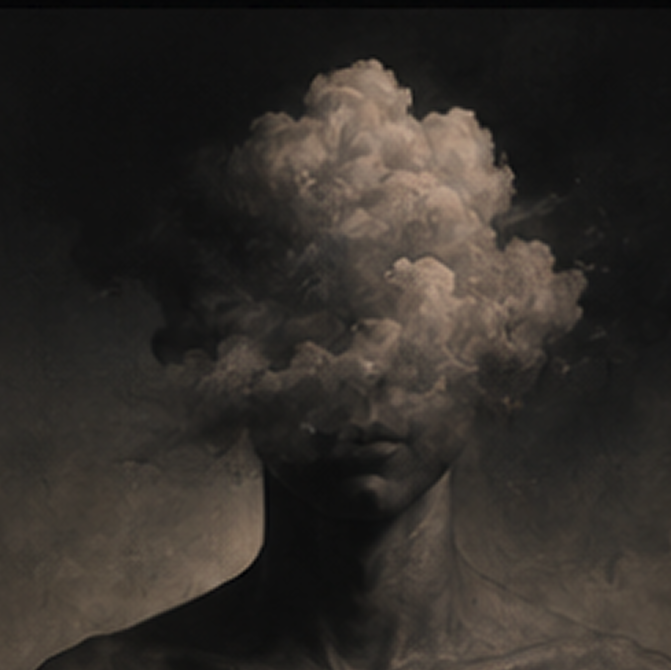
For most of her public life, Iris Murdoch belonged to literature and philosophy. The Dublin-born writer became one of the major British novelists of the 20th century, publishing 26 novels and winning the 1978 Booker Prize for The Sea, the Sea. A remarkable discovery at her former Oxford home now complicates that familiar picture. More than 80 previously unknown artworks have emerged from a concealed attic room, including surrealist landscapes, watercolors, nude studies, portraits and what researchers describe as Murdoch’s only known self-portrait. Created mainly between 1939 and 1941, the works reveal a 20-year-old Murdoch experimenting with images years before Under the Net established her as a novelist in 1954. The Guardian’s report on the Iris Murdoch artworks details the discovery and its significance.
The discovery matters far beyond literary biography. Murdoch’s early paintings suggest that some of the concerns later associated with her fiction—distorted perception, private obsession, unstable reality and the difficulty of seeing another person clearly—were already being tested visually. Her secret pictures make it possible to ask a new question: before Murdoch learned how to build psychologically strange worlds with sentences, was she trying to build them with paint?
More Than 80 Works Were Hidden Behind A Bookcase
The artworks were found in 2025 at 30 Charlbury Road in north Oxford, Murdoch’s former home, by Dr. Miles Leeson, director of the Iris Murdoch Research Centre at the University of Chichester. The room containing them had been concealed behind a large bookcase and may not have been entered for decades. According to reporting on the discovery, Murdoch and her husband, literary critic John Bayley, may have been the only people who knew the space existed.
The scale of the find changes the story immediately. Before the discovery, Murdoch was known to have produced only three paintings. Researchers now have more than 80 additional works to study. The cache reportedly includes four surrealist landscape paintings, around 20 surrealist watercolors, two pencil-and-watercolor portraits of Murdoch’s parents and more than 50 sketches contained in two sketchbooks. Several studies depict female nudes.
Twenty-five newly discovered works are now included in Iris Murdoch Amongst the Artists, an exhibition at the University of Chichester Library running from August 14 through December 10, 2026. The university’s official events calendar provides the institutional context for the exhibition and Murdoch-related programming.
That context is significant for thesurrealists.org. Rediscovered art can easily become a curiosity story: famous writer paints surprising pictures, pictures vanish, pictures return. Murdoch’s case offers something richer. The paintings were made during a formative historical and intellectual moment, and their visual instability connects directly with questions that would occupy her fiction for decades.
The Surrealist Landscapes Came From A Europe Entering War
Murdoch’s surrealist works date chiefly from 1939 to 1941, years that place them at the beginning of the Second World War and during her student period at Somerville College, Oxford. She was studying Classics, participating in political life and testing different creative forms.
Leeson has connected the mood of the paintings to the anxiety and destruction of the period. He has described images marked by social breakdown and the threatened collapse of European culture. The works appear, in his assessment, to carry visual echoes of Salvador Dalí and Pablo Picasso. That influence should be treated as scholarly interpretation rather than a fixed attribution of style, since detailed art-historical analysis of the newly revealed group is still developing.
Surrealism was well suited to such a historical moment. The movement had already made dream imagery, psychological disturbance, irrational juxtaposition and attacks on conventional reality central to modern art. MoMA’s Surrealism overview explains the movement’s challenge to rationalist culture and its interest in unconscious experience.
Murdoch’s paintings appear especially intriguing from that perspective. A surrealist landscape does not have to document a bombed city or political rally to register historical fear. Space itself can become unreliable. Proportion can collapse. Familiar objects can lose their ordinary function. Bodies and landscapes can become psychologically charged.
That principle would later become deeply Murdochian. Her fictional worlds frequently begin in recognizable social environments, then become stranger as jealousy, erotic fixation, vanity and self-deception reshape what characters believe they see.
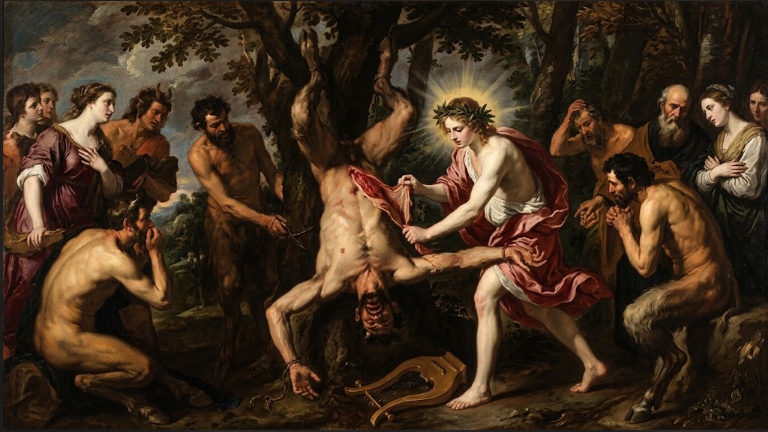
Murdoch Was Testing Images Before She Built Literary Worlds
The most revealing feature of the discovery may be its timing.
Murdoch published her first novel, Under the Net, in 1954. The newly found surrealist pictures precede it by more than a decade. They belong to a period when she had not yet committed herself publicly to the literary identity that later defined her.
Leeson interprets this period as one of creative experimentation: Murdoch was producing poetry, beginning fiction and trying visual art as she worked out the form her imagination might eventually take.
Seen in that light, the paintings are less like an abandoned hobby and more like evidence of artistic problem-solving.
A painter has to arrange space. A novelist has to arrange a scene.
A painter controls proximity, isolation, scale and visual tension. Murdoch’s fiction repeatedly performs similar work through entrances, rooms, houses, landscapes, mirrors, bodies and charged meetings between characters. She creates situations in which perception becomes ethically suspect: a character sees another person, yet what appears to be observation may really be desire, fear or projection.
That makes the paintings relevant to a larger history of Surrealist thinking. The movement’s fascination with unstable reality was never limited to dream imagery. It questioned the reliability of ordinary perception itself.
Murdoch would spend much of her mature career exploring an adjacent problem through fiction and philosophy: how difficult it is to perceive reality without turning it into a reflection of one’s own ego.
Readers interested in how women connected to Surrealism converted symbolic imagery into questions of identity and psychological transformation may find a useful parallel in thesurrealists.org’s earlier discussion of Leonora Carrington’s surreal transformations. Murdoch’s position is different—she did not become a professional Surrealist painter—but the newly discovered works place her much closer to the movement’s visual concerns than her established literary reputation suggested.
The Female Nude Studies Add A More Personal Layer
Among the newly discovered material are studies of the female nude. Researchers have linked those works to Murdoch’s early awareness of her bisexuality and to the emotional life visible in poetry from the same period. Leeson has argued that the drawings carry a sense of attraction and longing that corresponds with early poems directed toward women.
The timing gives these drawings unusual weight. They were made before Murdoch’s later fame and before the public image of the formidable philosopher-novelist had formed around her.
That does not mean every nude should be treated as autobiographical confession. Art history becomes distorted when a woman’s sexuality is used as a master key for every image she creates. The stronger interpretation is narrower: the discovery shows that Murdoch’s interest in desire, bodies and visual attention had already become part of her creative work in her early twenties.
Her later novels would return repeatedly to erotic fixation and the gap between loving another person and possessing an imagined version of that person.
The visual studies make that preoccupation feel less purely literary. They suggest that Murdoch was already examining the human figure as an object of attraction, observation and interpretation.
The distinction matters. Seeing is never neutral in Murdoch’s fiction. Her characters watch one another, idealize one another, misunderstand one another and convert people into private myths. A drawing session turns the act of looking into a physical practice. The newly discovered studies make it easier to see how visual attention could have fed the ethical and psychological questions that later dominated her writing.
Her 1941 Self-Portrait Makes The Discovery Stranger
One work carries particular biographical force: a self-portrait dated January 7, 1941, when Murdoch was 21.
A self-portrait made during this formative period creates a different relationship with the future novelist. Readers usually encounter Murdoch through photographs taken after her intellectual identity was established. This image belongs to a young artist looking at herself before that future was secure.
Leeson has described the portrait as showing someone who already appears deeply reflective.
Its importance may lie less in whether it predicts the famous philosopher and more in the act itself. Self-portraiture requires the artist to become observer and subject at once. The maker attempts to study a face that can never be encountered from the outside in the same way as another person’s.
That tension—between self-knowledge and self-deception—became one of Murdoch’s great fictional engines.
Her mature characters routinely construct stories about themselves. They become narrators of their own virtue, romantic destiny or suffering. Reality interferes with those stories, yet rarely as cleanly as they expect.
The self-portrait adds a concrete early object to that lifelong fascination with looking inward.
The Paintings Cast The Sea, The Sea In A New Light
Murdoch’s literary career provides its clearest bridge back to the visual material in The Sea, the Sea, published in 1978.
The novel won that year’s Booker Prize and follows retired theatre director Charles Arrowby as he retreats to an isolated coastal house intending to write his memoirs. His apparent withdrawal from society becomes an intense drama of obsession, memory, self-delusion and distorted interpretation. The Booker Prize’s account of The Sea, the Sea confirms its 1978 win and its place as Murdoch’s 19th novel.
The newly discovered paintings do not prove that Murdoch carried specific images from 1940 into a novel written almost four decades later.
They make a broader connection visible.
Her early surrealist pictures apparently distort landscapes in response to fear, instability and philosophical unease. The Sea, the Sea turns a coastal environment into a psychological field shaped by obsession. The landscape remains real, yet the character’s interpretation of reality grows increasingly unreliable.
That is close to one of Surrealism’s enduring imaginative operations: reality is not discarded; it is made strange enough to expose forces hidden beneath its ordinary appearance.
Murdoch eventually found language better suited to her ambitions than painting. The secret artworks suggest she may have discovered the underlying problem much earlier.
Why Iris Murdoch’s Paintings Change Her Creative Biography
The most valuable result of the discovery is not a campaign to reclassify Iris Murdoch as a forgotten major painter.
Nothing publicly available supports that claim, and the newly surfaced works still require sustained scholarly and curatorial study.
Their importance is different.
They show that Murdoch’s creative imagination developed across several forms before fiction became dominant. Painting, poetry, philosophy and early literary experiments were not necessarily isolated activities. Each offered a different method for examining perception, desire, anxiety and the unstable relationship between consciousness and reality.
The Iris Murdoch Research Centre at the University of Chichester is now central to the study of this newly visible artistic dimension. The university’s Iris Murdoch Research Centre supports continuing scholarship on her fiction, philosophy and archive.
That makes Iris Murdoch Amongst the Artists more than an exhibition of curiosities from a famous writer’s attic. It opens a new route into the formation of an imagination.
A young Murdoch encountered a Europe slipping into war and responded with strange landscapes. She studied bodies. She painted family members. She painted herself. She experimented with poetry and fiction. Years later, her novels would repeatedly ask what happens when human beings mistake their private pictures of reality for reality itself.
The hidden paintings make that question visible.
For a writer whose characters so often struggle to escape the images created by their own minds, there is something fitting in the fact that another version of Iris Murdoch remained concealed behind a bookcase for decades—waiting for the pictures themselves to be seen.