
The Horror Show at the Academy Museum of Motion Pictures treats horror cinema as more than a genre built from monsters, shocks, and late-night fear. Opening in Los Angeles on September 26, 2026, and running through July 25, 2027, the exhibition is staged on Level 4 in the Marilyn and Jeffrey Katzenberg Gallery. The Academy Museum’s official exhibition details describe it as a bold immersive show that bridges cinema and experience while asking why horror films matter so deeply to many viewers.
For thesurrealists.org, that question has a strong visual-culture answer. Horror cinema matters because it turns private fears into public architecture. A nightmare that would usually vanish at waking becomes a hallway, a sound installation, a prop, a poster, a room, and a body moving through space. The Horror Show makes cinema history feel like a museum of nightmares because it translates screen-based fear into an exhibition format where visitors do not only remember horror films. They walk through the structures that horror uses to make ordinary reality feel unstable.
Why Horror Belongs In A Museum Of Visual Culture
Horror has often been treated as entertainment’s disreputable side: cheap, excessive, bodily, sensational, or too close to exploitation. The Academy Museum’s decision to build a major immersive exhibition around the genre changes that framing. It places horror beside the larger histories of production design, sound, editing, costume, performance, makeup, props, lighting, and audience ritual.
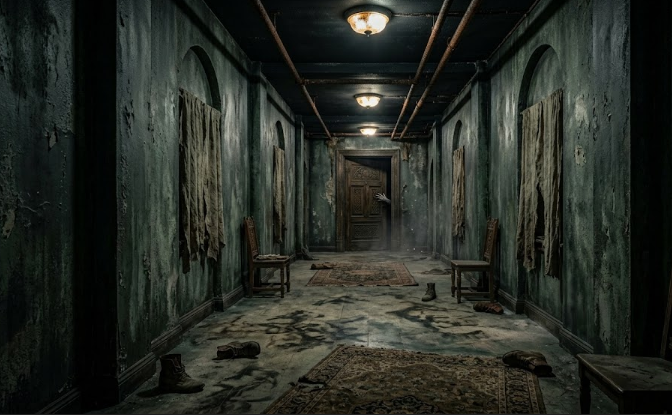
The museum says The Horror Show will begin with an introductory gallery sound installation, then move visitors into “The Hallway,” a space modeled after one of horror’s most familiar spatial tropes. From there, the exhibition leads into six themed galleries: Gothic, Psychological, Science, Slasher, Religion, and Ghosts. That structure matters because it treats horror as a system of recurring images and spaces, not a list of famous titles.
A museum of horror does something different from a retrospective screening series. A screening preserves the film as a time-based experience. An exhibition breaks the genre into objects, atmospheres, rooms, and repeated visual codes. The hallway becomes as important as the villain. The soundscape becomes as important as the image. The artifact becomes a trace of fear’s construction.
That approach fits naturally beside thesurrealists.org’s earlier writing on Luis Buñuel and Surrealist cinema, where film becomes a way to disturb ordinary logic, narrative expectation, and visual order. Horror and Surrealism are not the same tradition, but both know that a room, a cut, a body, or an object can make reality feel untrustworthy.
How “The Hallway” Turns A Film Trope Into Architecture
The hallway is one of horror cinema’s most efficient inventions. It creates delay. It narrows vision. It forces the body forward while suggesting that danger waits around a corner, behind a door, or beyond a patch of darkness. In a film, the hallway controls the viewer through framing, editing, and sound. In a museum, it becomes physical.
That shift is the exhibition’s smartest conceptual move. When the Academy Museum turns the hallway into an entry structure, it asks visitors to experience horror as spatial design. The visitor is no longer watching a character walk into uncertainty. The visitor becomes the body moving through uncertain space.
This is where the topic becomes useful for a surrealist audience. Surrealist art often treats architecture as a psychological condition. A room is not just a room. It can be a dream chamber, a trap, a theater of desire, or a place where the body loses ordinary coordinates. Horror cinema uses related spatial pressure. The hallway is a rational architectural feature that becomes irrational through timing, darkness, sound, and expectation.
The Academy Museum’s six-gallery structure strengthens that effect. Each chamber turns a type of fear into a curated environment. Gothic horror can bring castles, shadows, decay, and aristocratic dread into view. Psychological horror can make the mind itself feel like a haunted house. Science horror can transform the laboratory, spaceship, and body into unstable sites of mutation. Slasher horror can turn everyday domestic or suburban space into a stage for pursuit. Religion horror can connect the sacred, the possessed, and the forbidden. Ghosts can make memory feel architectural.
Why The Film List Reads Like A Map Of Modern Fear
The Academy Museum’s exhibition page names a wide range of films, including Alien from 1979, The Horror of Dracula from 1958, A Nightmare on Elm Street from 1984, Black Swan from 2010, Dracula from 1931, Frankenstein from 1931, Get Out from 2017, Halloween from 1978, Ju-on from 1998, Midsommar from 2019, Misery from 1990, Poltergeist from 1982, Ringu from 1998, The Blair Witch Project from 1999, The Exorcist from 1973, The Shining from 1980, The Silence of the Lambs from 1991, and The Texas Chainsaw Massacre from 1974.
That list matters because it refuses a narrow definition of horror. These films do not scare viewers in one way. Some rely on monsters. Some rely on haunted domestic space. Some turn the body into a site of invasion. Some use religious terror. Some create fear through racial power, gendered violence, family breakdown, isolation, or technological unease.
This is why a horror exhibition can become a museum of nightmares. The nightmare is not one image. It is a set of cultural anxieties given form across decades. Dracula and Frankenstein carry older Gothic and scientific fears into sound cinema. Alien makes the body and the spaceship feel equally unsafe. Get Out turns social politeness and racial violence into psychological captivity. Black Swan turns artistic perfection into bodily fracture. The Blair Witch Project and Ringu show how media itself can become cursed.
A horror museum helps visitors see these films as visual systems. The monster is only one element. Fear is created by editing rhythms, camera placement, production design, sound design, actor movement, costume, makeup, and the careful placement of objects. Horror survives because its images migrate easily from screen to memory.
Why The Exhibition Makes Horror Feel Close To Surrealism
Horror and Surrealism both understand that the familiar can become unbearable. A staircase, a dinner table, a mirror, a bedroom, a child’s toy, a mask, a hallway, or a body can shift from ordinary object to psychic disturbance. The difference lies in purpose. Surrealism often seeks liberation from rational control; horror often stages the cost of that breakdown.
The Horror Show can help readers see where the traditions overlap. Surrealism uses dream logic to scramble the real. Horror uses nightmare logic to threaten it. Surrealism turns desire into image. Horror turns dread into image. Surrealism lets objects behave strangely. Horror makes objects feel watched, cursed, infected, or alive.
The Academy Museum frames the exhibition around identity, sexuality, and ability in horror films as well as behind-the-scenes production processes. That matters because horror is not only about monsters outside the self. It often asks who is allowed to be seen as human, whose body is treated as vulnerable, whose difference becomes a source of fear, and whose survival matters inside the story.
That framing gives the exhibition more critical weight than a simple parade of props. A horror object in a glass case can be fun, but the richer question is why certain objects become frightening in the first place. A mask, knife, doll, television, doorway, laboratory, or bed becomes meaningful because the film has trained the audience to feel something hidden underneath it.
How Sound Turns The Gallery Into A Nervous System
The Academy Museum says the exhibition starts with a sound installation that introduces visitors to horror cinema before they enter the hallway and themed chambers. That detail should not be treated as decoration. Horror has always depended on sound as much as image: the scream, the drone, the breath, the creaking floor, the sudden silence, the repeated theme, the voice from another room.
In a gallery, sound changes the visitor’s body. It can make the museum feel less stable. A film viewer usually hears sound from a fixed seat. A museum visitor hears sound while walking, turning, approaching objects, and reacting to other visitors. The gallery becomes a nervous system, with audio cues shaping anticipation before any visible threat appears.
This is one reason horror cinema translates well into immersive exhibition design. Horror has always been spatial and sensory. A monster may be seen for only a few seconds, but the film builds dread through the unseen: a distant sound, an offscreen presence, a cutaway, a shadow, a voice, a rhythm.
Entertainment Weekly’s July 8, 2026 report says the exhibition includes props, photos, costumes, installation pieces, a poster-lined hallway, and a final Blood Room described as an immersion in cinematic blood textures and shades. The report notes that actor Willem Dafoe and director Osgood Perkins served on the advisory board, and that the exhibition urges parental guidance because some material may be disturbing. The report on the Academy Museum horror exhibition adds useful context on how the show turns horror’s sensory language into a gallery experience.
That advisory context matters for an arts article. Horror exhibitions can be playful, but they are still dealing with fear, violence, gore, trauma, and bodily threat. A responsible museum show needs to make the experience legible to visitors before they enter.
Why The “Blood Room” Makes The Museum Feel Unstable
A final Blood Room risks sounding like spectacle, but it carries a deeper curatorial problem. Blood in horror cinema is never just liquid. It can mean injury, birth, sacrifice, possession, sexuality, disease, violence, family, ritual, punishment, or proof that the body has been breached. A room devoted to cinematic blood turns an image category into an environment.
That environmental shift makes the museum unstable in a productive way. Museums usually protect objects from touch, decay, and bodily mess. Horror keeps returning to bodies that leak, mutate, bleed, rot, or refuse clean borders. A Blood Room places that unruly imagery inside an institution built around preservation and order.
This is exactly why horror can feel close to the surreal. Both traditions attack the clean surface. Surrealist painting often makes the body strange through metamorphosis, fragmentation, or dream symbolism. Horror makes the body strange through wounds, infection, possession, animality, and fear. The Blood Room, as reported by Entertainment Weekly, gives that bodily instability a final immersive form.
The risk is that gore can become empty shock. The opportunity is that it can teach visitors how horror cinema uses material effects to make the body politically and psychologically visible. Blood can be cheap spectacle, but it can also force attention to vulnerability, mortality, violation, and survival.
What Curators Reveal By Treating Horror As Design
The Horror Show is organized by Senior Exhibitions Curator Jessica Niebel, with Assistant Curator Nicholas Barlow and Curatorial Assistant Alexandra James Salichs. The Academy Museum’s naming of the curatorial team matters because horror cinema is often discussed through directors, stars, monsters, and franchises. An exhibition needs a different kind of authorship: someone has to decide which films, props, sounds, rooms, and themes create a meaningful path through genre history.
That curatorial work turns horror into design history. A film like The Shining can be discussed through performance and narrative, but its long corridors, patterned carpet, and impossible spatial logic are just as important. Alien depends on industrial corridors, biomechanical texture, and enclosed movement. Halloween depends on suburban space, windows, masks, and offscreen threat. The Exorcist depends on a bedroom that becomes a cosmic battleground.
A museum exhibition can make those design systems visible. It can show how horror builds fear through repetition, framing, props, light, and sound. This helps viewers move beyond the easy question of whether a film is scary and toward the stronger question of how fear is made.
That is where The Horror Show belongs in a surrealist-adjacent conversation. Horror cinema is one of modern culture’s most durable methods for making the ordinary world behave like a dream under pressure. The exhibition gives that method walls, rooms, and a route through space.
Why Horror’s Museum Moment Matters For Modern Audiences
The Academy Museum describes the exhibition as honoring horror’s enormous cultural impact and enduring popularity. That claim is easy to support through the genre’s long public life, but its deeper importance lies in how horror helps audiences process social pressure. Fear on screen is rarely only fear on screen. It often carries anxieties about family, gender, race, science, religion, technology, class, disability, sexuality, violence, and death.
The film list in The Horror Show makes that range visible. Get Out brings racial power and liberal politeness into horror form. Midsommar turns grief and community into ritual dread. Misery turns fandom, authorship, and captivity into domestic terror. The Silence of the Lambs uses investigation and performance to disturb the border between empathy and danger. Ringu and Ju-on link ghosts to media, memory, domestic space, and cultural fear.
A museum setting allows those connections to emerge without requiring every visitor to watch full films in sequence. The exhibition can show how recurring images travel: the haunted room, the cursed screen, the final girl, the possessed body, the laboratory creature, the masked figure, the alien organism, the ghostly child, the religious object, the severed trace.
For modern audiences, this is not nostalgia. Horror remains useful because society keeps producing new forms of dread. The monsters change, but the need to image fear remains.
How Cinema History Becomes A Walkable Nightmare
The Horror Show turns cinema history into a museum of nightmares because it recognizes that horror has always been more than a screen image. It is a spatial art, a sonic art, a bodily art, and a design language for fear. The Academy Museum’s hallway, themed chambers, sound installation, and immersive finale translate the grammar of horror into museum movement.
For thesurrealists.org readers, the exhibition offers a clear bridge between Surrealist visual culture and horror cinema without collapsing them into the same thing. Surrealism asked what happens when the unconscious breaks into reality. Horror asks what happens when reality fights back as nightmare. Both traditions make the familiar strange. Both turn objects into symptoms. Both use rooms, bodies, and images to show what rational life tries to hide.
The exhibition’s lasting value may be that it treats horror with the seriousness it deserves while preserving the genre’s sensory force. A museum of nightmares should not make horror safe. It should make horror legible: a history of images, rooms, sounds, bodies, fears, and cultural pressures that keep returning in new forms.
That is why The Horror Show feels like more than a seasonal attraction. It is a reminder that cinema’s nightmares are built with craft, memory, and cultural pressure. The monster may appear on screen, but the fear keeps living in architecture, sound, objects, and the viewer’s body after the lights come back on.