
Why does a melted clock seem more real than a ticking one? Welcome to a world where logic takes a break and dreams pay the bills.
In surrealism, change is the only constant—and it’s often wonderfully illogical. It’s not just about weird pictures. It’s about using distortion to understand deeper truths.
The surrealists used transformation art like a scalpel. They cut open reality to explore the symbolic organs beneath: identity, desire, and the subconscious.
Think of me as your sarcastic guide in this gallery of the bizarre. Every changing form reveals clues about being human.
We’re exploring how these artists didn’t just paint change. They weaponized it. They followed dream logic into places reason dares not go.
Art as Window to the Unconscious
What if art could show us the raw thoughts from our minds? That was the dream of the surrealist artists. They painted dreams, giving us a peek into the mental world. It’s like the first reality TV show from inside our heads.
The canvas acted as a one-way mirror. But, unlike a mirror, the unconscious mind is always changing. It’s a place where identities change and blend together. This is why metamorphosis symbolism is so important in their art.
A woman turning into a chest of drawers is more than just weird. It’s a message from our subconscious. It shows how our minds mix up things and change them.
Our minds are like a special effects department, always changing. This constant change is what metamorphosis symbolism is all about. It tells us that our true selves are always in motion.
To understand this, let’s look at the symbols used by the surrealists. They used images to show deep thoughts and feelings. Their art is like a visual language from our collective unconscious.
| Symbol | Artist Example | Psychological Interpretation |
|---|---|---|
| Melting Clocks | Salvador Dalí | Fluidity and subjective nature of time; anxiety about mortality. |
| Human-Animal Hybrids | Max Ernst | Unmasking primal instincts and the animalistic side of human nature. |
| Floating Rocks | René Magritte | Defiance of logical physics; representing the weightlessness of thought. |
| Anatomical Doubles | Frida Kahlo | Exploration of duality, pain, and the fractured self. |
| Labyrinths & Infinite Staircases | M.C. Escher (influenced) | The confusing, looping pathways of memory and desire. |
Each symbol tells us something about our minds. Together, they show us a mind that’s always moving. This isn’t just weird art. It’s a deep look into our chaotic thoughts. The surrealism art of the unconscious mind was a journey into our deepest selves.
So, when you see a lobster on a phone, think about it. It’s not just funny. It’s a sign of our minds working in strange ways. The art is just a record of these strange happenings.
Jung vs. Freud: Competing Psychological Influences
The clash between Freudian and Jungian psychology was more than just a debate. It was like two directors giving the same actors different scripts. The Surrealists, eager to explore the unseen mind, embraced both.
Sigmund Freud gave them tools to understand the personal psyche. He focused on the individual’s past, including repressed traumas and childhood fixations. For Surrealists, this meant their art could be a confessional. A melting clock, for example, wasn’t just odd; it showed time’s fluidity under personal pressure.
Carl Jung, on the other hand, introduced the collective unconscious. This was a shared psychic inheritance among all humans, filled with archetypes like the Hero and the Shadow. His symbols, like the phoenix, were universal, tapping into humanity’s oldest stories.

The Surrealists painted the argument between Freud and Jung. Their art explored both personal and universal themes. A figure that’s half-human, half-beast could represent the artist’s fears or a universal archetype. The beauty lies in its ambiguity.
This duality gave Surrealist art a unique visual language. We can view their work through two perspectives:
- The Freudian Lens: Looks at personal symbolism, eroticism, and dream logic. It sees the art as a window into the artist’s world. The change imagery is deeply personal.
- The Jungian Lens: Searches for universal patterns and mythic resonances. It finds symbols that feel familiar, even on first glance. The transformation is seen as ancestral.
The brilliance of Surrealist art lies in its ability to hold both perspectives. When you see a Surrealist painting, you might wonder if it’s a personal diary or a page from humanity’s oldest book. The answer is both, and it’s thrilling.
Automatic Drawing and Unconscious Creation Techniques
Surrealists didn’t just draw; they found a secret way to bypass their brain’s usual rules. They aimed to bring raw thoughts straight to the page. This method, called automatic drawing, is the true essence of transformation art. It happens right before your eyes, without any planning.
Imagine it like mental jazz. You start drawing, but your inner critic stays quiet. Your hand moves freely, guided by your subconscious. The line you draw might start simple, but then it changes. It could turn into an eye, a keyhole, or a winding road. The artist’s role is to watch and see what happens.
Why does this work? Our minds are great at editing and following rules. But automatic drawing turns off that editor. It’s like a controlled accident that lets the subconscious take over.
The results are like maps to a hidden world. You won’t see a pretty picture. Instead, you’ll get a record of a journey into the mind. A single line can show a hill, a thigh, and a river all together. This is art without a goal. The journey of the line is the art.
André Masson and Joan Miró were experts at this. Their art isn’t planned; it’s a deep dive into their minds. The beauty lies in the surprise and discovery.
So, how do you start? It’s surprisingly easy:
- Disable the planner: Don’t plan what you’re going to draw. No final image in mind.
- Embrace the drift: Let your hand move freely. If it wants to scribble, let it.
- Follow the weird: When a shape suggests something, don’t change it. Let it grow.
This method connects you directly to transformation art. The page becomes a record of your thoughts in their raw, unfiltered state.
In today’s world, where everything is optimized, automatic drawing is a bold statement. It shows that the most powerful transformation art isn’t about perfection. It’s about embracing the strange and beautiful things your brain thinks of when no one is watching.
The Collective Unconscious in Surrealist Group Works
Surrealism wasn’t just about personal struggles. It was about coming together in a big way. Group projects showed us our shared psychic depths, not just one person’s art.
The “exquisite corpse” game was a key part of this. Artists drew on a sheet, folded it, and passed it on. This created a unique, mixed-up creature from many minds.
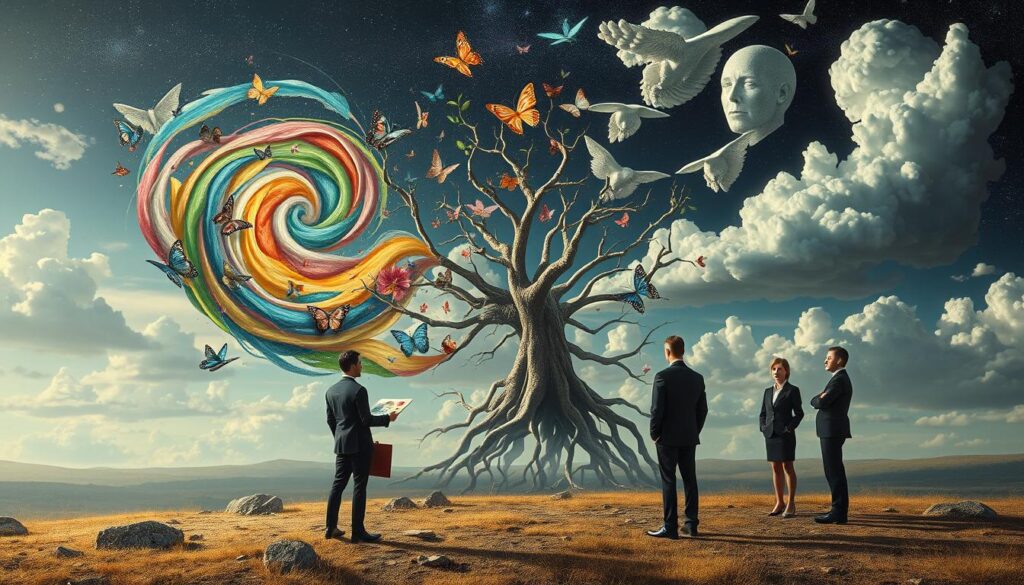
This shows how Carl Jung’s idea works. Despite not knowing what others drew, the art made sense. It felt like it was meant to be.
This suggests our dreams of change are shared. They come from a common source, not just our own minds. Group work shows transformation is a shared experience.
It’s like everyone at a party is singing the same song. These pieces showed we all speak a language of change. The unconscious is deeply connected to us all.
Analyzing Unconscious Elements: A Critic’s Approach
When you start to really look at a Surrealist work, you become a detective. You’re exploring a world where normal rules don’t apply. Your job is to uncover the secrets hidden in the dreamlike images.
Your main clue is the artist’s use of change imagery. This visual language shows how things can change. It’s not just about the weird images. It’s about understanding why they change in the way they do.
Look for patterns in the changes. Is something turning into something else, like a man into a clock? Or is it changing from solid to liquid, like a challenge to nature’s norms? Each pattern tells us about a different emotional struggle.
A melting watch might show anxiety about time. A petrified forest could hint at feeling stuck. This is like solving a mystery of the mind.
Think of the canvas as a crime scene. The changes in the image are like clues. Your task is to piece together what happened from these strange symbols.
What deep fear or hidden desire is behind these changes? Is it a sign of violence or freedom? The truth is not always clear-cut. It’s more about enjoying the strange questions raised by the change imagery.
Understanding this requires looking at Freud’s ideas. These ideas helped Surrealists explore this world, even if they sometimes got lost. A good critic translates the secret language of the unconscious into something we can all understand. The mystery stays, but it becomes something we can all share and find fascinating.
Therapeutic Applications of Surrealist Techniques
Who would have thought that the chaotic scribbles and dreamscapes of Surrealism would end up in therapy? It’s ironic. The Surrealists, aiming to disrupt rational thought, created a way to heal broken minds.
Art therapy now uses this method, automatic drawing. It’s not about making pretty pictures. It’s about silencing the critic and letting the hand create freely.
This is where healing starts. Emotions and conflicts, too hard to put into words, come out on paper. A mess of lines, a figure in a cage, a sky falling.
Seeing these images is the first step to healing. You’re not just feeling anxious. You’re looking at your anxiety as a storm cloud over a house. This creates distance and lets you observe and reconfigure it.
The canvas is a safe space for the soul. Here, you can practice transformation art in a personal way. Can you change that storm cloud into a gentle rain? Can you give the figure a key? It’s not about denying reality. It’s about practicing change in a safe space.
Art therapy is like cleaning out a junk drawer. It helps you see what’s there: things to fix, things to throw away, and treasures hidden. Creating becomes a way to diagnose and repair.
The Surrealists were right. Making these images is cathartic. It’s a way to release pressure that words can’t express. By doing this, patients are creating a self-repair manual, one sketch at a time.
Conclusion: The Ongoing Mystery of the Mind
So, what’s the final score in the game of mapping the self? Surrealism didn’t play for points. It played for the sheer, bewildering joy of the match.
The entire movement was a masterclass in metamorphosis surrealism. Think of it as the original brain-hack. Artists didn’t paint dreams; they painted the mind’s operating system, where logic is optional and transformation art is the default setting.
That melting clock? It’s more than a weird image. It’s pure metamorphosis symbolism, a direct wire into our anxiety about time itself. This is the real legacy: a toolkit for decoding our own internal change imagery.
Modern neuroscience, with its talk of synaptic plasticity, is just now writing the footnotes to what these artists sketched a century ago. The brain is wetware, but the surrealists saw its software.
The tour of your own unconscious doesn’t end here. Consider this your invitation to keep exploring. The canvas is yours.