

Your average dream is weird, but mostly harmless. You might be late for a test or flying low.
Surrealist art is different. It takes you to the dark corners of the mind. Here, the rules of society don’t apply. This is where the real, messy work happens.
Forget about fluffy bunnies on clouds. The pioneers of this movement used dreams for a darker purpose. They aimed to show the shock, pain, and psychological fractures of the human mind.
Think of it as “what the Freud was that?” I believe trauma art is at the heart of this style. It’s the dark, fascinating core.
Why did these artists choose to show the brutal side of life on canvas? Let’s dive in. We’ll explore how the most unsettling visions often reveal the most truthful stories.
Freudian Influence on Surrealist Symbol Systems
The Surrealist movement took a big leap into psychology, borrowing heavily from Freud. They used ideas like repression and the uncanny to unlock the mind. For them, The Interpretation of Dreams was a guide to artistic rebellion.
This approach created psychological surrealism. It turned art into a form of psychoanalysis. The goal was to challenge our rational views.
Freud’s idea of repression was key. It’s when the mind hides away uncomfortable thoughts. Surrealists used art to bring these hidden thoughts to light, often in distorted ways. This wasn’t just chaos; it was a controlled explosion.
The uncanny was another important concept. It’s when something familiar becomes strange and unsettling. Surrealists were masters at creating these unsettling images. A doll with a human eye or a street that looks like a body are examples. These images make us feel uneasy because they twist the familiar into something wrong.
Freud’s dreamwork was also a big influence. He said dreams hide true meanings behind symbols. Surrealists used this idea to create their own visual language.
Condensation combines different ideas into one image. Dalí’s melting clocks are a great example. They show the collapse of time and memory into one image.
Displacement shifts focus from important to trivial details. A Surrealist painting might focus on a small ant on a giant face. The real fear is in the face, not the ant. This makes the art even more powerful.
This table shows how Freud’s ideas were used in Surrealist art:
| Freudian Concept | Definition in Psychoanalysis | Surrealist Art Technique | Example in Art |
|---|---|---|---|
| Repression | The unconscious exclusion of distressing impulses from conscious awareness. | Forcing hidden desires/traumas into visible, often shocking, forms. | Francis Bacon’s screaming popes; twisted figures expressing suppressed agony. |
| The Uncanny | A feeling of familiarity that becomes eerily unfamiliar and threatening. | Rendering ordinary objects (chairs, limbs, fruit) in hyper-realistic yet impossible contexts. | René Magritte’s The Son of Man (apple obscuring a face). |
| Condensation (Dreamwork) | Combining several latent dream thoughts into one manifest image. | Creating composite, hybrid creatures or objects loaded with multiple meanings. | Salvador Dalí’s The Persistence of Memory (melting clocks as time/anxiety/decay). |
| Displacement (Dreamwork) | Shifting psychic intensity from a significant element to an insignificant one. | Focusing intense detail on a minor, symbolic object to imply a larger, unspoken drama. | Meret Oppenheim’s Object (fur-covered cup, saucer, spoon). |
Dalí was a master of psychological surrealism. He painted his fears using the “paranoiac-critical method.” His melting clocks show a world where time and matter are broken.
Looking at a Surrealist piece is not just seeing a nightmare. It’s witnessing a carefully planned attack on reality. The artist, armed with Freud’s ideas, has dissected the mind. The art shows the battle between what we see and what we feel. This is the power of psychological surrealism.
Common Dream Symbols: Clocks, Eyes, and Metamorphosis
Why do melting clocks and staring eyes haunt the surrealist canvas? It’s not random weirdness; it’s a coded lexicon of anxiety. Let’s put on our detective hats and examine these recurring motifs. They form a visual vocabulary of dread, each one a key to unlocking the psyche’s darkest corners.
Take the ubiquitous clock. In our waking life, it’s a benign dictator of schedules. In Surrealism, it’s a melted, limp, or shattered mess. Dalí’s famous drooping timepieces aren’t just a comment on relativity. They are metaphors for the trauma that fractures personal chronology. There’s a “before” and an “after,” and the clockface is the casualty in between. This violent imagery targets our most fundamental construct: time itself.
Then we have the eyes. Unblinking, multiplied, and often under attack. Buñuel and Dalí’s sliced eyeball in Un Chien Andalou is the most infamous example. It’s not shock for shock’s sake. That razor is violating perception itself. It’s the ultimate act of seeing being made horrifically visceral. An eye isn’t just a window to the soul here; it’s a vulnerable surface waiting for a violation. This motif transforms the act of looking into a source of terror.
Lastly, consider metamorphosis. Bodies morph into drawers, trees, or other bodies in a state of perpetual flux. This isn’t magical realism. It’s the visual language of the self disintegrating. When your hand becomes a swarm of ants or your face melts into the landscape, you’re witnessing identity in crisis. The stable “I” is a fiction, and Surrealism paints its chaotic, often grotesque, truth.
So, clocks, eyes, and metamorphosis. Together, they sketch a portrait of profound psychological unrest. A broken clock screams of lost time. A violated eye whispers of betrayed sight. A shifting body shouts of a fragmented self. These “common” dream symbols are anything but gentle. They are the stark, brilliant, and unsettling grammar of a movement fluent in the language of fear.
Personal vs. Universal Symbolism in Surrealist Art
Is a surrealist painting’s anguish just the artist’s diary, or a mirror to society’s fears? This question is at the heart of the movement. Some paintings scream with personal pain. Others whisper in the language of shared myth.
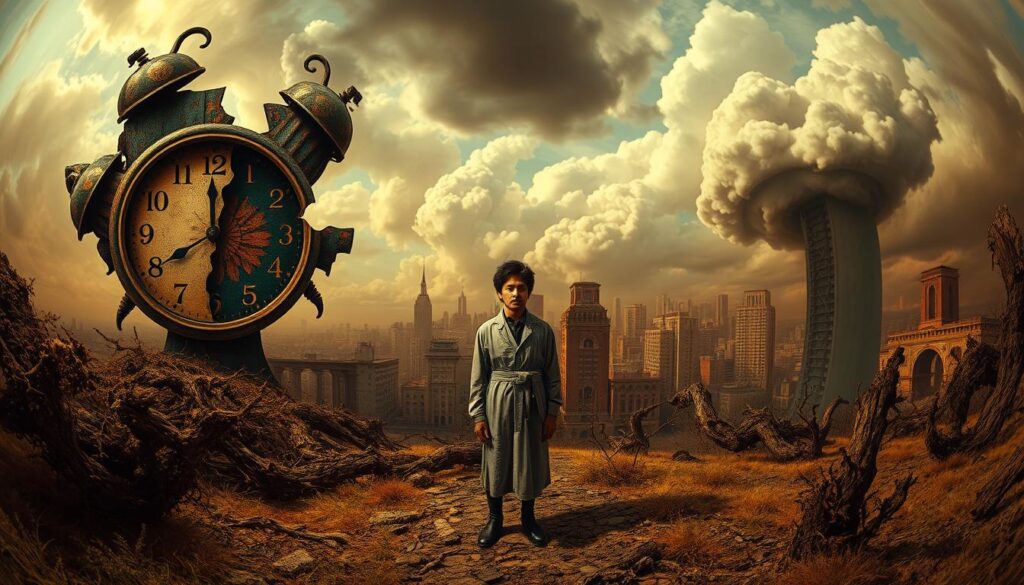
Frida Kahlo is the queen of personal art. Her work is not just trauma art; it’s a raw, open-wire medical chart of her life. A broken column replaces her spine. A thorn necklace pierces her throat, its pendant a dead hummingbird.
These symbols are her private code. The column speaks to her crippling accident. The thorns reflect a marriage that bled. To understand them, you almost need her biography. It’s art as self-exorcism.
Now, look at Max Ernst’s “Europe After the Rain II.” This isn’t one person’s nightmare. It’s a continent’s. The landscape is a monstrous, fossilized carcass. Strange growths erupt from cracked earth.
There’s no single biography here. Ernst channels archetypal dread—the fear of collapse, of nature’s revenge, of war’s aftermath. You don’t need to know his life. You just need to be human after the 20th century.
So, when does personal agony become public prophecy? It happens in the delicate alchemy between specific detail and open-ended form. Kahlo’s specific pain—her broken body—taps into the universal experience of physical suffering and vulnerability.
Ernst’s mythical ruin gives form to our collective anxiety about decay. The most powerful Surrealist movement works live in this tense, fertile borderland.
| Aspect | Personal Symbolism | Universal Symbolism |
|---|---|---|
| Source of Imagery | Artist’s biography, dreams, and private memories. | Myths, collective unconscious, and broad historical events. |
| Emotional Impact | Intimate, empathetic; feels like reading a private letter. | Awe-inspiring, prophetic; feels like recognizing a shared truth. |
| Artistic Examples | Frida Kahlo’s self-portraits, Dorothea Tanning’s domestic scenes. | Max Ernst’s decalcomania landscapes, Salvador Dalí’s paranoiac-critical forms. |
| Viewer Connection | Requires some context, builds connection through specific story. | Immediate, instinctual; resonates without explanation. |
This isn’t a contest. The personal doesn’t beat the universal, or vice versa. Great trauma art often does both. It uses the specific as a key to unlock the general. Kahlo’s detailed rendering of her own suffering makes it real, tangible. That tangibility then becomes a bridge to our own hidden aches.
Ernst works the other way. He starts with the vast, shapeless fear of an era. He then crystallizes it into a concrete, unforgettable image. That image becomes a landmark for our shared psyche.
The magic is in the balance. Too personal, and the work becomes a locked diary. Too universal, and it floats away as vague allegory. The surrealist masters knew this. They planted one foot in their own wreckage and the other in the dreamscape we all share.
How to Read Surrealist Artworks: A Collector’s Guide
Before you consider the auction estimate, think about this: can you tell the difference between a psychological wound and a visual pun? Looking at a Surrealist masterpiece is like eavesdropping on someone else’s nightmare. This guide isn’t about becoming an art historian overnight. It’s about getting a decoder ring for the subconscious.
Let’s move from passive viewing to active decoding. Follow these four steps to stop feeling confused and start seeing the method in the madness.
Step 1: Map the Violent Imagery. Don’t just note the monsters. Catalog the specific types of disruption. Is it dislocation (a torso floating away from its legs)? Penetration (sharp objects piercing soft forms)? Or mutation (a face melting into a landscape)?
This violent imagery is rarely gratuitous. It’s a direct line to the artist’s anxiety. A fragmented body might scream of personal trauma. A swarm of invasive objects could whisper of political paranoia. Your first job is to be a forensic analyst of the dream-crime scene.
Step 2: Interrogate the Symbolic Suspects. So you’ve spotted a clock, an eye, a burning giraffe. Now what? Ask each symbol three questions. Is it personal (a private reference from the artist’s life)? Is it cultural (a shared myth or religious icon)? Or is it art-historical (a riff on a painting by Goya or Bosch)?
A clock in a Dalí is a cultural cliché about time. A clock in a lesser-known Surrealist’s work might be a memory of a father’s pocket watch. Context is your best detective.
Step 3: Feel the Texture of the Anxiety. Not all dread is created equal. Is the mood one of cold, clinical paranoia? Think empty plazas and watchful eyes. Or is it a hot, visceral rage? Think of torn flesh and explosive color.
The palette tells a story. Muted grays and sickly greens often signal intellectual dread. Fiery reds and acidic yellows usually point toward raw, emotional terror. Is the brushstroke controlled and precise, or frantic and messy? The artist’s hand reveals their pulse.
Step 4: Anchor It in History. A painting from 1929 and one from 1948 are worlds apart. The inter-war pieces often hum with the tense anticipation of collapse. The post-war works frequently sit in the hollowed-out silence that comes after.
Was the artist fleeing Franco’s Spain? Living in occupied Paris? This isn’t just trivia. It’s the key that unlocks whether that distorted figure is a self-portrait or a portrait of a collapsing empire.
So, the next time you’re in front of a canvas full of biomorphic horror, don’t just ask, “What does it mean?” Ask, “Where is the violence? What do these symbols owe? How does this anxiety feel? And what world birthed it?”
You won’t get a neat answer. But you’ll start a fascinating conversation—with the art, the artist, and yourself. That’s a return on investment no auction house can quantify.
Curating Dream-Themed Exhibitions
Forget serene landscapes and polite portraits; the most compelling surrealist exhibitions dare to turn the gallery into a therapist’s couch for the public. The easy part is grouping art with obvious dream iconography. The high-stakes game—the real artistry—lies in weaving those pieces into a narrative that explores the dark underbelly of the subconscious. This is where curation transcends cataloging and becomes an act of psychological surrealism.
So, let’s put on our imaginary curator hats. The goal isn’t to explain the mystery away. It’s to deepen it. Think of thematic frameworks not as academic labels, but as emotional pathways. One could trace a chilling lineage of dread in a show titled “The Anatomy of Anxiety: From Chirico to Contemporary.” It would start with those haunting, empty piazzas and follow the thread through to modern digital art that makes your phone screen feel like a panic attack.
Another framework, “Shattered Vessels: The Body in Traumatic Surrealism,” would examine the violated, fragmented, or metamorphosing form. It’s a tour through the physical manifestation of psychic wounding. This approach creates a dialogue across decades, asking how different artists articulate similar traumas. The wall text here is key. It should provide context, not closure. A good label poses a question, points out a visual paradox, and then steps back.
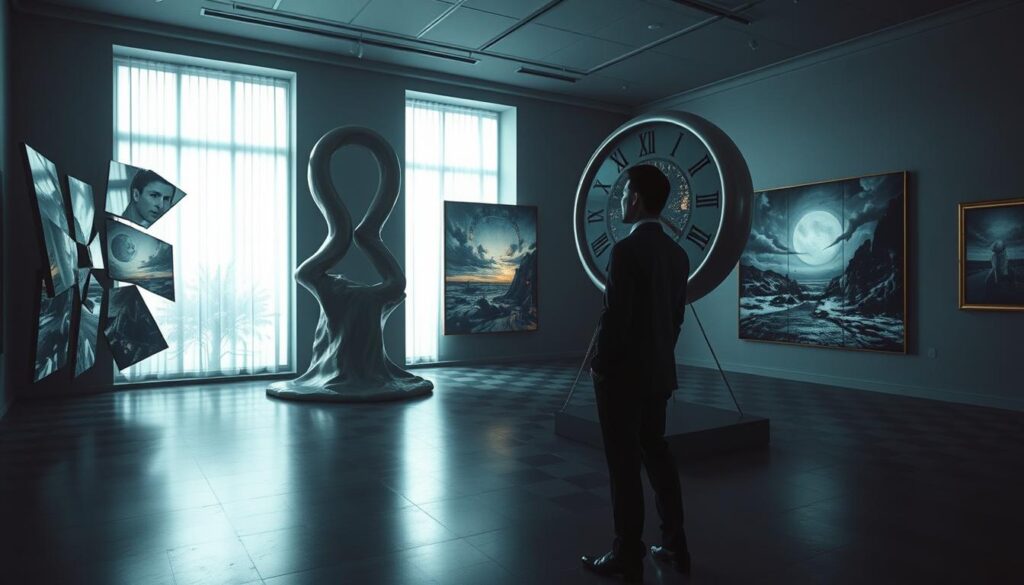
Lighting and sequencing are your primary tools for emotional manipulation. Do you want the unease to creep in slowly or hit the viewer like a door slamming shut in a dream? The delicate art of sequencing is knowing you don’t want to emotionally bludgeon the visitor in the first room. Or maybe, for a specific show, you absolutely do. That’s a curatorial choice as bold as any brushstroke.
This is psychological surrealism as an immersive experience. The curator becomes a designer of unease, using space the way a film director uses sound design. A long, narrowing corridor leading to a single, intense painting can amplify its power. A claustrophobic room filled with watchful, disembodied eyes creates a somatic response no essay can replicate.
The ultimate challenge is balance. You’re navigating the line between provocative and exploitative, between thoughtful discomfort and sheer shock. The best of these exhibitions leave visitors not with answers, but with a profound sense of recognition—a unsettling familiarity with the landscapes of their own inner worlds. That’s the quiet power of a well-curated dive into the dream logic of trauma.
Digital Age Interpretations of Classic Symbols
The surrealists of the 1920s painted their nightmares. Today, we see these nightmares on our screens. Classic symbols have been updated with a scary, pixelated twist. Our digital world is filled with cyber-warfare, data breaches, and endless scrolling.
Glitch art is our modern take on surrealist metamorphosis. It shows how digital files can break down and change. This isn’t just change—it’s a system failure. It’s a violent imagery of corrupted data and broken signals.
Deepfakes are a new kind of surrealist terror. They make videos of people saying things they never said. This is a psychological attack on truth and identity. The violent imagery here is a form of doubt.
Dalí’s clocks spoke to the anxiety of the early 20th century. Today, we face the infinite scroll of social media. It’s a never-ending loop that drains our attention. This is a violent imagery against our focus and sense of time.
Has painted paranoia evolved into digital dread? Yes, it has. The symbols have changed, but the mission remains the same. Surrealism mapped the unconscious. Today, our collective unconscious is filled with conspiracy theories and climate anxiety.
Artists using digital tools are mapping our new unconscious. They are unlocking the language of the unconscious for a generation that dreams in memes. The pixel has become the new brushstroke.
The buffer icon is the new symbol of wait. Our modern traumas have found new, pixelated symbols. They are just as disturbing and integrated into our lives as ever. The surrealists warned us about the monsters in our minds. The digital age shows us they’ve learned to code.
Conclusion: The Timeless Appeal of Dream Logic
So, why does this stuff grip us? In a world full of real violence, surreal art offers honesty. It shows our nightmares are real and valid.
This dream logic stays with us because it’s a powerful language. It talks to our subconscious, like Artaud’s dream-logic in cinema. It aims to capture the dream’s raw, emotional impact.
The nightmare has its own language, and Surrealism taught us to understand it. This art isn’t about finding answers. It’s about seeing the world with a clearer, more critical view.