
Wifredo Lam: When I Don’t Sleep, I Dream at the Museum of Modern Art in New York reframes modernism as a restless, diasporic, Afro-Caribbean force rather than a story centered only on Paris, Picasso, Cubism, or European Surrealism. On view from November 10, 2025, to April 11, 2026, the exhibition is the most extensive U.S. retrospective devoted to Wifredo Lam, the Cuban-born artist whose life moved through Spain, France, Cuba, Italy, anti-fascist politics, Surrealist circles, Afro-Caribbean cultural memory, and postcolonial self-definition. MoMA’s official exhibition page presents Lam as an artist who expanded modernism by making space for the depth and beauty of Black diasporic culture.
For thesurrealists.org, the exhibition matters because it shows modernism losing its clean European center. Lam’s work does not simply combine Cubist structure and Surrealist dream imagery. It unsettles both traditions by forcing them into contact with slavery, sugarcane, Afro-Cuban spirituality, colonial memory, exile, and racial hierarchy. His paintings make modernism feel Afro-Caribbean because they refuse to treat the Caribbean as an exotic background. They make it the ground from which modernist form must answer.
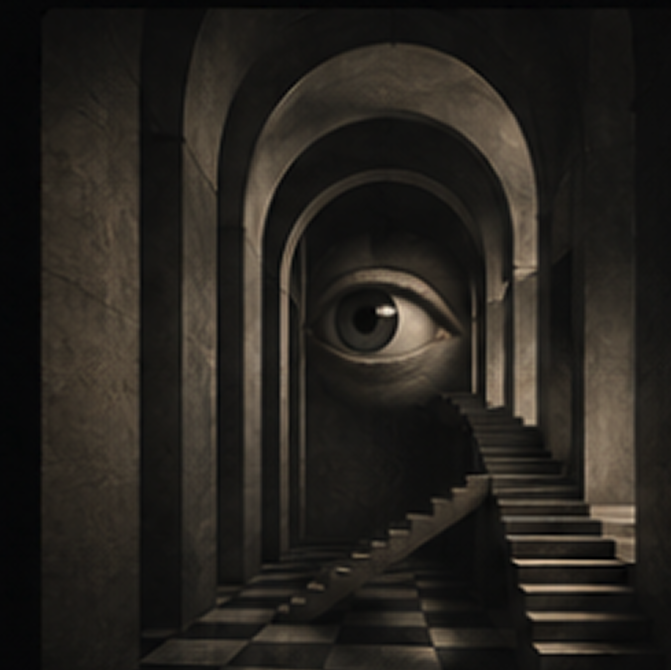
The title, When I Don’t Sleep, I Dream, suggests a state between vigilance and vision. Lam’s art often lives there. It is not sleep, fantasy, or escape. It is dream as pressure: a way to picture histories that official culture tries to smooth over.
Why MoMA’s Lam Retrospective Matters Now
MoMA’s retrospective arrives after decades in which Lam’s most famous work, La jungla (The Jungle), was admired yet often isolated from the full complexity of his career. The exhibition changes that by showing more than one masterpiece. It spans Lam’s early work in Spain, his political formation during the Spanish Civil War, his Paris encounters with Pablo Picasso and André Breton, his wartime Surrealist collaborations in Marseille, his return to Cuba in the early 1940s, and his later experiments in large-scale abstraction, printmaking, ceramics, and illustrated books.
The Wifredo Lam estate’s retrospective announcement says the exhibition includes more than 130 artworks from the 1920s to the 1970s, including paintings, large-scale works on paper, collaborative drawings, illustrated books, prints, ceramics, and archival material. That range matters because Lam is too often reduced to a single image, a single hybrid style, or a simplified bridge between Europe and Cuba.
The show is organized by Christophe Cherix, MoMA’s David Rockefeller Director, and Beverly Adams, The Estrellita Brodsky Curator of Latin American Art, with Damasia Lacroze and Eva Caston. That curatorial frame gives the exhibition a clear argument: Lam’s modernism was not peripheral. It was transnational, anti-colonial, formally ambitious, and central to the question of what twentieth-century modern art could become.
For readers interested in Surrealism’s international afterlives, this connects naturally with thesurrealists.org’s earlier article on the global journey of Surrealism. Lam shows that Surrealism did not merely travel outward from Europe. It was transformed by the places and histories it encountered.
How Lam Reworked European Modernism From The Caribbean
Lam’s biography helps explain why his modernism feels unsettled. Born in Sagua La Grande, Cuba, in 1902, he was of African and Chinese descent and left Cuba at age 21 to study painting in Madrid. He encountered European modern art directly, but not from a position of simple belonging. He lived through political violence, exile, anti-fascist struggle, and displacement before returning to the Caribbean after eighteen years abroad.
That return changed his work. MoMA frames Lam’s exile and return as the turning point that drove him to rethink his artistic project through Afro-Caribbean histories. The result was not a rejection of European modernism but a confrontation with its limits. Lam used Cubist fragmentation, Surrealist transformation, and modernist abstraction, yet he redirected those tools toward colonial memory and diasporic culture.
That redirection matters because European modernism often drew on African masks and non-Western objects while detaching them from living cultures. Lam’s work reverses that dynamic. He did not treat African-derived forms as formal inspiration alone. He brought them back into relation with spiritual systems, colonial labor, racial violence, and Afro-Cuban survival.
This is why Lam’s modernism feels Afro-Caribbean and unsettled at once. It does not allow modern art to remain a style. It turns style into a question: who gets to use these forms, what histories do they carry, and what happens when the colonized subject speaks through the visual language that European modernism had partially extracted?
Why “The Jungle” Still Disturbs The Modernist Canon
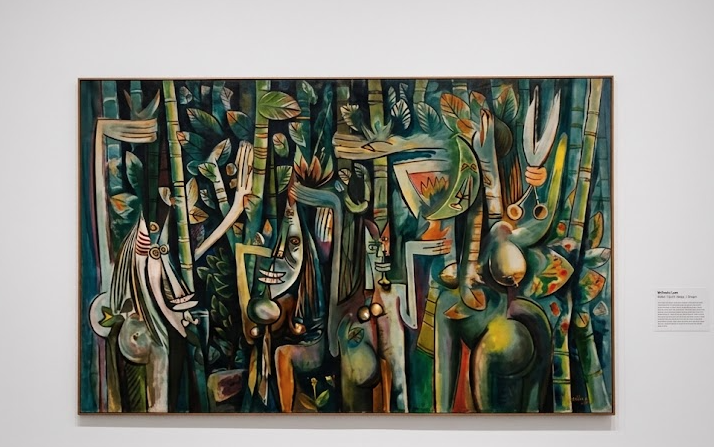
No discussion of Lam can avoid La jungla (The Jungle), painted in 1942–43 and held by MoMA. The museum’s collection entry for La jungla identifies the medium as oil and charcoal on paper mounted on canvas and describes its figures as having mask-like faces, handlike feet, elongated legs, and male and female attributes. It also notes that the figures appear within a Caribbean landscape of broad leaves, tropical fruit, and sugarcane, recalling Cuba’s history of slavery and indenture while signaling Afro-Caribbean resilience.
That description explains why the painting remains so powerful. It does not depict a jungle in a simple botanical sense. It stages a world where bodies, plants, spirits, tools, masks, and colonial memory merge. The sugarcane is crucial. It anchors the painting in plantation history rather than fantasy landscape. The hybrid figures do not merely look strange. They inhabit a field shaped by labor, extraction, and survival.
The Guardian’s feature on Lam’s MoMA retrospective describes The Jungle as a work that joins Cubism and Surrealism with colonial realities faced by African-Caribbean individuals. That is the core of its unsettling force. It makes European modernist language answer to the Caribbean.
The painting also resists one stable reading. It can feel lush, erotic, ritualistic, claustrophobic, comic, violent, and protective at once. Its figures seem both human and not human, both present and ancestral, both masked and revealed. This ambiguity is not confusion. It is Lam’s method. The work unsettles modernism by refusing to let the viewer decide whether the image is myth, memory, protest, dream, or history.
How Surrealism Changed In Lam’s Hands
Lam’s connection to Surrealism was direct. In Paris, he met André Breton and entered a circle of artists and writers who were interested in dreams, automatism, myth, poetry, and the irrational. During the Nazi occupation, after escaping to Marseille, Lam collaborated with Surrealists awaiting passage out of Europe. The estate’s retrospective page notes his line drawings for Breton’s Fata Morgana in 1941 and his participation in cadavre exquis and collective drawings.
Yet Lam’s Surrealism was never merely European. The dream in his work is not an abstract unconscious detached from history. It is shaped by forced migration, colonial structures, Afro-Cuban religion, anti-fascist politics, and diasporic identity. His art shifts Surrealism away from private fantasy and toward historical haunting.
That shift matters because Surrealism often claimed to free the imagination from rational control. Lam’s work asks what freedom means when the imagination itself has been shaped by empire. The dream is not innocent. It carries inherited violence, spiritual memory, and the pressure of being read through European categories.
This is why Lam’s images can feel both lyrical and tense. His hybrid bodies are not simple dream creatures. They are figures made from collision: African-derived forms, European modernist structure, Caribbean landscape, political exile, and personal displacement. Lam turns Surrealism into a language of return, but the return is not restful. It is unstable because the homeland itself has been altered by colonial history.
Why Afro-Caribbean Histories Are Central, Not Decorative
The phrase “Afro-Caribbean” should not be treated as a mood or aesthetic label in Lam’s work. It names a historical and cultural field. Cuba’s plantation economy, the forced migration of enslaved Africans, the survival of African-derived religious practices, Chinese indentured labor, and the ongoing hierarchies of race all shaped the world Lam returned to in the early 1940s.
Lam’s paintings do not illustrate those histories in a documentary way. Instead, they produce a symbolic world where forms carry pressure. Sugarcane becomes a sign of labor and extraction. Mask-like faces connect modernist form to African diasporic presence. Hybrid bodies resist fixed identity. Plant forms crowd the figures as if history itself has become vegetation.
That is why MoMA’s framing of Lam’s work as an “act of decolonization” matters. The phrase is not only a political slogan. It describes an artistic process. Lam decolonizes modernism by changing what its forms are allowed to mean. A Cubist body is no longer only a formal experiment. A Surrealist creature is no longer only a dream image. An abstracted mask is no longer a borrowed object. In Lam’s hands, each becomes a charged sign inside a Caribbean history.
This is also what makes the work unsettled. Lam does not offer easy cultural affirmation. His images are not celebratory posters of identity. They are tense, double-edged, and often difficult. They ask viewers to sit with the unresolved nature of diasporic modernity.
How The Exhibition Expands Lam Beyond One Masterpiece
A major strength of When I Don’t Sleep, I Dream is that it avoids making The Jungle the entire story. The retrospective includes early figurative works, political drawings, Surrealist collaborations, large works on paper, illustrated books, prints, ceramics, and later abstractions. This range matters because Lam’s career was not a single breakthrough followed by repetition.
The Guardian reports that the exhibition includes Grande Composition from 1949, described as Lam’s largest known painting and a major work that had long remained difficult to show because of its scale. The estate’s announcement also emphasizes that Grande Composition is on view for the first time since 1963. Its inclusion reminds viewers that Lam continued to develop after his Cuban breakthrough of the early 1940s.
That broader view changes the article’s SEO and cultural argument. Lam is not only the painter of The Jungle. He is a modern artist of movement, recurrence, return, abstraction, and restless experimentation. His later work may move farther from the dense Afro-Caribbean atmosphere of The Jungle, but it still carries the problem of form under pressure.
The Washington Post’s review of the MoMA exhibition argues that the show foregrounds Lam’s anti-colonial and Afro-Cuban affiliations while raising questions about how fully the exhibition addresses the emotional complexity of his colonial experience and Chinese heritage. That criticism is useful. It reminds readers that a major retrospective can expand a story while still leaving parts unresolved.
Why Lam’s Identity Makes The Modernist Story Harder
Lam’s identity cannot be flattened into one category. He was Cuban, Afro-descended, Chinese-descended, Spanish-trained, Paris-connected, Surrealist-adjacent, anti-fascist, Caribbean, European, and later based partly in Italy. His life resists a single national or stylistic frame.
That resistance is one reason MoMA and critics have described him as a transnational artist. The term matters because Lam’s work does not simply “fuse” influences in a decorative sense. It emerges from the historical difficulty of belonging across multiple worlds while being fully contained by none.
This difficulty is visible in the paintings. The figures often feel composite, unstable, and watchful. Bodies become plantlike, animal-like, mask-like, and architectural. Faces are present but unreadable. Limbs stretch into signs. Space feels dense rather than open. Lam’s modernism is unsettled because the self in his work is not a fixed portrait. It is a site of historical negotiation.
That quality makes the exhibition especially relevant now. Contemporary museums are reconsidering how modernism has been narrated, who has been placed at the center, and which artists were treated as derivative because they did not fit European categories. Lam’s work exposes the weakness of those categories. He was not outside modernism. He was changing its terms.
Why The Dream Is Political In Lam’s Art
The exhibition title, When I Don’t Sleep, I Dream, could sound private or poetic at first. In Lam’s case, the dream is political because it offers a way to picture histories that realism alone cannot hold. Colonial memory, spiritual survival, racial hierarchy, exile, and cultural hybridity do not always appear as literal scenes. They appear as atmosphere, pressure, transformation, and symbolic density.
Lam’s dream language is therefore not escapist. It is a method for showing how history enters the body and landscape. His hybrid figures make visible what official images often hide: the violence behind plantation economies, the persistence of African-derived cultural forms, and the psychological instability produced by colonial life.
This is where Lam’s work speaks most strongly to Surrealist visual culture. Surrealism becomes valuable not because it avoids reality, but because it can reveal reality’s hidden structure. Lam’s paintings turn dream imagery into historical critique. The strange body becomes a record of cultural pressure. The mask becomes a sign of survival rather than exoticism. The tropical landscape becomes a field of memory rather than scenery.
That is why the paintings still feel unsettled. They do not resolve the dream into a message. They keep the viewer inside the tension between beauty and violence, modernism and colonialism, spiritual presence and historical trauma.
How Lam Rewrites Modernism From The Edge Of The Canon
Lam’s MoMA retrospective is important because it asks viewers to rethink the map of modern art. The old map often runs from European avant-gardes outward, treating non-European or diasporic artists as recipients of influence. Lam forces a different model. He encountered European modernism, absorbed parts of it, challenged it, and returned it changed.
That change is visible in the way his work handles form. Cubist fragmentation becomes diasporic fragmentation. Surrealist transformation becomes spiritual and historical transformation. Modernist abstraction becomes a struggle over what can be seen, remembered, and freed from colonial interpretation.
This is why When I Don’t Sleep, I Dream feels so relevant after its closing date as well. The exhibition is not only an event on MoMA’s calendar. It is part of a larger correction in modern art history. Lam’s work shows that modernism was never a single European invention later exported to the world. It was made through movement, extraction, resistance, collaboration, and return.
For thesurrealists.org, that is the central lesson. Lam makes modernism feel Afro-Caribbean and unsettled because he refuses to let the dream remain detached from history. His paintings do not simply bring the Caribbean into modernism. They make modernism answer to the Caribbean.
Why Lam’s Unsettled Modernism Still Matters
Wifredo Lam’s art remains difficult because it does not offer the comfort of a clean category. He is a modernist, but not in a narrow European sense. He is linked to Surrealism, but not limited by Surrealism. He is Cuban, but not only national. He is Afro-Caribbean, but not reducible to cultural symbolism. He is political, but not propagandistic.
That complexity is the reason When I Don’t Sleep, I Dream matters. The exhibition shows Lam as an artist who carried multiple histories inside form. His paintings feel unsettled because they are built from unsettled worlds: colonial Cuba, wartime Europe, African diasporic memory, Chinese heritage, modernist ambition, and exile.
A dream can soften reality, but Lam’s dream hardens it into visible pressure. His figures stand in sugarcane, masks, limbs, spirits, and fractured space as if history has entered the body and will not leave. That is why his work continues to disturb the canon. It proves that modernism’s dream was never only European, never only formal, and never innocent.
In Lam’s world, the dream is awake. It watches, remembers, and refuses to settle.