
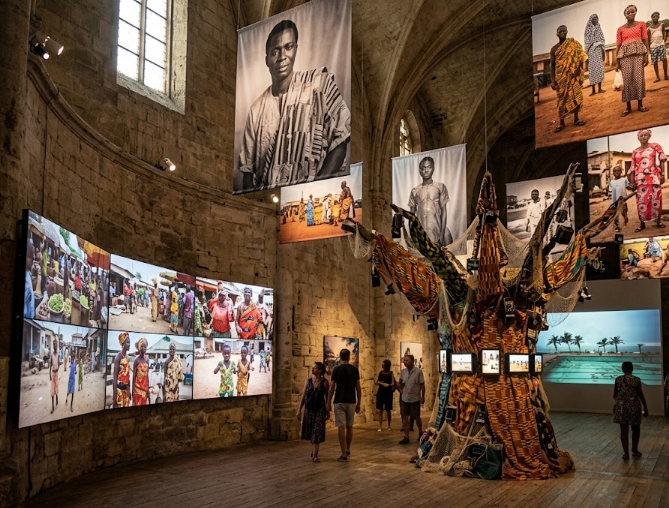
Ghana! Dreaming Independence, 1957–1976 turns the birth of a nation into a visual archive of hope, performance, print culture, and public self-invention. Presented as part of Les Rencontres d’Arles 2026 at the Palais de l’Archevêché in Arles, the exhibition is curated by Damarice Amao and produced by the festival in collaboration with the French Embassy in Ghana, the Création Africa program, and the James Barnor Foundation. The official Rencontres d’Arles Ghana exhibition page frames the show around the visual world that flourished during Ghana’s first two decades after independence.
For thesurrealists.org, this topic matters because national memory often behaves like a dream: selective, staged, hopeful, haunted, and repeatedly reconstructed through images. Ghana’s independence in 1957 was a political event, but it was also an image-making event. Photographs, books, portraits, press images, and public visual culture helped people picture what a new nation could become. Ghana! Dreaming Independence is not a Surrealist exhibition in the historical sense, yet it speaks to a Surrealism-adjacent question: how do images turn public reality into a shared dream of identity?
Why Ghana’s Independence Became A Visual Project
When Ghana became independent from Britain on March 6, 1957, it became the first sub-Saharan African country to break from colonial rule. That date became more than a political milestone. It became a visual beginning. A new nation needed ceremonies, portraits, newspapers, state imagery, public events, books, and photographs that could make independence visible.
The Rencontres d’Arles exhibition focuses on the period from 1957 to 1976, years when Ghana’s national self-image was being shaped through print and photographic culture. The show’s official framing emphasizes that this visual imagination flourished especially in books and printed matter during the early decades after independence. The related publication, Ghana! Rêver l’indépendance, 1957–1976, was released by Atelier EXB in 2026 in connection with the exhibition.
That print-culture focus is important. National identity does not live only in speeches or constitutions. It also lives in the repeatable image: the portrait, the magazine spread, the commemorative book, the public photograph, the studio pose, the industrial scene, the ceremonial body, the school uniform, the salute, the family image, and the page that carries those images outward.
This is where photography becomes dreamlike. A photograph appears to show what was there, yet it also organizes what a viewer is invited to believe. In a newly independent country, the camera can record the present while staging a possible future. It can make progress look visible. It can make citizenship feel embodied. It can make a political promise look like a shared image.
How Photography Helped Ghana Picture A New Nation
The Financial Times’ July 2026 coverage of Rencontres d’Arles described Ghana! Dreaming Independence 1957–76 as one of the festival’s central exhibitions, emphasizing how photography shaped Ghana’s growing self-image after independence. The report notes that Kwame Nkrumah, Ghana’s first prime minister and later president, supported photographic projects, including the photobook Ghana on the Move by American photographer Willis E. Bell. The FT’s Rencontres d’Arles 2026 report places the Ghana exhibition inside a wider festival conversation about truth, representation, colonial history, and image-making.
That context gives the exhibition its strongest critical charge. A postcolonial photograph is never only a picture. It can be evidence, propaganda, aspiration, family memory, archive, performance, or correction. In Ghana’s early independence decades, photography helped present the country as modern, organized, ambitious, and alive with social possibility.
The image of independence was not abstract. It appeared in the faces of workers, students, police officers, nurses, families, politicians, artists, and public crowds. It appeared in infrastructure, industry, ceremonies, and printed books. The camera did not simply document a country after independence. It helped build the visual language through which independence could be felt.
This is why Ghana! Dreaming Independence works for thesurrealists.org. The “dream” in the title is not fantasy detached from history. It is the dream of national becoming: a projected image of what collective life could mean after colonial rule. That dream was hopeful, but it was not simple. It carried ambition, pressure, doubt, and later nostalgia.
Why James Barnor’s Portraits Matter To The Dream
The collaboration with the James Barnor Foundation gives the exhibition a vital photographic anchor. James Barnor, born in Accra in 1929, is one of Ghana’s most important photographers, known for studio portraiture, photojournalism, and images that connect Ghanaian independence-era culture with the wider Black Atlantic world. His work is essential because it shows how national life appears through individual faces.
The FT report highlights Barnor’s portraits as images of a new generation of nation-builders, including figures such as a female police officer saluting, nurses in uniform, and young people posed with confidence. These are not neutral portraits. They show public identity being rehearsed in front of the camera. Clothing, posture, light, occupation, and gaze all become part of the national image.
That is what makes the photographs feel dreamlike rather than merely documentary. A portrait records a person, but it also projects a possible self. In the context of independence, the studio or public camera becomes a stage where the subject can appear as modern, dignified, professional, stylish, proud, and future-facing.
This connects naturally with thesurrealists.org’s earlier discussion of surrealist photography techniques, where the photographic image is treated as more than straightforward representation. Barnor’s images are not Surrealist experiments like photograms or solarization, but they share a core lesson: photography always alters reality by choosing how it appears.
Why Print Culture Turns Memory Into A Shared Object
One of the most useful angles in Ghana! Dreaming Independence is its attention to books and printed matter. Photography in a book behaves differently from photography on a gallery wall. A book sequences images. It builds rhythm. It turns national memory into something portable, repeatable, and held by readers.
The exhibition’s linked publication from Atelier EXB points to that structure. Listings for the book describe how Ghana’s visual imagination flourished in print culture during the first decades of independence and how contemporary artists revisit that visual legacy through hope, doubt, and nostalgia. The book-focused framing matters because postcolonial nation-building depended on circulation. Images had to move across readers, institutions, archives, schools, embassies, and families.
A photograph of a factory, a classroom, a road, a ceremony, or a studio sitter could become part of a national dream once it entered print. It could be reproduced, remembered, filed away, rediscovered, and reinterpreted decades later. The photograph’s meaning did not end when the shutter closed. It continued through publication and circulation.
This is where national memory becomes especially unstable. Printed images can preserve hope, but they can also preserve the official version of hope. They can show aspiration while hiding conflict. They can make progress look coherent even when the lived reality was uneven. A serious article should keep that tension alive. Ghana! Dreaming Independence is powerful because it does not ask viewers to treat early independence imagery as simple celebration. It asks them to see the dream, the construction of the dream, and the distance from which the dream is now viewed.
How Contemporary Artists Reopen The Independence Archive
The exhibition does not only look backward. It places historical photography and print culture in dialogue with contemporary artists, including figures such as Carlos Idun-Tawiah, whose work appears in the Rencontres d’Arles presentation. The official exhibition materials and related listings describe contemporary artists examining and illuminating the visual legacy of independence as something still active between doubt, hope, and nostalgia.
That contemporary layer is essential. A national archive does not remain fixed. Later artists return to it, question it, reframe it, and sometimes disturb its confidence. They ask what the images promised, what they excluded, what they made visible, and what they turned into myth.
This is where the “photographic dream” becomes more than a historical metaphor. Dreams return. They repeat. They change shape. A nation’s first images of itself can still affect later generations, even when political conditions have changed. Contemporary artists can treat the independence archive as inheritance, evidence, pressure, or unfinished material.
The result is not a clean story of past and present. It is a layered visual field. The 1957 moment becomes a living archive rather than a sealed anniversary. The exhibition asks viewers to see independence imagery as both historical document and imaginative resource.
Why The Arles Setting Changes The Meaning
The exhibition’s presence at Les Rencontres d’Arles matters because Arles is one of the world’s most important photography festivals. In 2026, reporting from the festival has emphasized questions of photographic truth, representation, postcolonial history, AI anxiety, science, belief, and image reliability. That wider program gives Ghana! Dreaming Independence a critical frame beyond Ghana alone.
A photography festival is not a neutral container. It shapes how images are received. In Arles, Ghana’s independence-era photographs appear within a global conversation about who gets represented, whose archives matter, and whether photography can still claim truth in a culture saturated with manipulated, generated, and contested images.
The FT described the 2026 festival as centered on anxieties about truth in photography, with exhibitions addressing colonial history, African representation, AI, UFO belief, and photographic experimentation. That context gives the Ghana show a sharper edge. It is not only about remembering the optimism of independence. It is also about asking how photography manufactures belief.
This is especially relevant to a Surrealism-focused audience. Surrealism has long been interested in the image that looks truthful but behaves strangely. Photography carries that paradox with unusual force. It can appear evidentiary while also staging desire, power, identity, and fantasy. Ghana! Dreaming Independence turns that paradox toward national memory.
Why The Exhibition Feels Dreamlike Without Escaping History
The title Dreaming Independence could be misunderstood if treated too softly. The dream of independence was not merely poetic. It was tied to colonial history, state formation, international politics, modernization, education, infrastructure, and the lived hopes of millions of people. The exhibition becomes powerful because it treats the dream as historical, visual, and emotional at once.
A dream can be sincere and constructed. It can be collective and unequal. It can create energy while hiding fractures. Ghana’s early independence imagery carried the force of possibility, but it also existed within real political and economic pressures. The show’s 1957–1976 time frame matters because it covers a charged period of national formation, optimism, difficulty, and changing political circumstances.
That complexity is what keeps the article from becoming a nostalgic celebration of vintage photographs. The stronger reading is more analytical: photography helped Ghana imagine itself, but every national image asks what is inside the frame and what is left outside it. A portrait of confidence can be true and staged. A book of progress can be inspiring and selective. A national archive can preserve memory and produce myth.
For thesurrealists.org, this is where the exhibition becomes especially rich. The surreal is not always about impossible objects or dream monsters. Sometimes it appears when public reality looks carefully staged, when a photograph holds both truth and projection, or when the future appears inside an image before it exists.
How National Memory Becomes A Photographic Dream
Ghana! Dreaming Independence turns national memory into a photographic dream because it shows how images helped a new country see itself into being. The exhibition gathers a visual world built from portraits, print culture, state ambition, public identity, and later artistic reflection. Its subject is not only Ghana’s independence, but the act of picturing independence.
That act remains powerful because photography sits between evidence and desire. A photograph can say, “This happened.” It can also say, “This is who we hope to become.” In the Ghanaian independence context, those two meanings often occupy the same frame.
The exhibition’s importance lies in that double force. It presents early independence imagery as a living archive rather than a closed national album. It gives viewers a way to think about Ghana’s visual modernity, the role of James Barnor and other image-makers, the influence of print culture, and the contemporary artists who continue to question and renew that legacy.
For readers of thesurrealists.org, the lesson is clear: national dreams are made of images. They are not less real because they are staged. They are more revealing because they show how communities imagine history before history settles. Ghana! Dreaming Independence makes that process visible, turning photography into a field where memory, hope, politics, and dream logic meet.