
Your dreams are stranger than a David Lynch film festival. And your go-to analysis is a half-remembered Freud quote from Psych 101.
We can do better, right? This is our manifesto. We’re moving away from simple, cigar-as-phallus readings.
I’m here to say that surrealism isn’t just weird art. It’s the most honest map of our unconscious mind. Every melting clock and lobster telephone holds meaning, not just random nonsense.
Think of me as your sarcastic guide through the museum of the bizarre. We’re going to learn this visual language.
This decoding is important. It’s not just about art history. It’s a direct link to the unconscious symbols that shape our thoughts, fears, and desires. It’s time to start a real conversation, not just rely on dream dictionaries.
So, grab your mental magnifying glass. We’re diving in.
The Art of Becoming
The surrealists didn’t invent the language of change; they just stole the dictionary from a two-thousand-year-old bestseller. Before Dali’s clocks melted, Ovid’s Metamorphoses was the original fan fiction for transformation. This isn’t just mythology. It’s the first great treatise on identity crisis, written in stunning, brutal allegory.
Think about it. A nymph named Daphne turns into a laurel tree to escape a god’s pursuit. A talented weaver named Arachne becomes the first spider. A beautiful youth named Narcissus wastes away gazing at his reflection. These aren’t just stories. They are the foundational code for our deepest anxieties about self, autonomy, and existence. Ovid was mapping the unconscious symbols of flux long before Freud had a couch.
So how did this classical “art of becoming” become the ultimate pre-internet meme? The surrealists, those masters of modern angst, saw Ovid’s playbook and recognized a kindred spirit. They repurposed his allegorical code to articulate the dizzying fractures of the 20th century. Where Ovid used gods and magic, they used dream logic and paint. The core language of symbolic art—the body in flux, the stable self dissolving—remained eerily the same.
We see this everywhere. Narcissus isn’t just a myth; he’s the patron saint of selfie culture, trapped in his own digital reflection. Daphne’s arboreal escape speaks to our modern desire to literally become one with our houseplants during a personal crisis. The surrealists simply ripped the cover off this ancient book and said, “Look. This is the only story. We are all in a state of becoming, or unbecoming.” They framed transformation not as a fantastical exception, but as the constant, unsettling rule.
| Ovidian Transformation | Surrealist Echo | Modern Parallel |
|---|---|---|
| Narcissus → Reflection | Magritte’s Not to Be Reproduced (man facing mirror) | The curated, fractured self of social media profiles |
| Daphne → Laurel Tree | Leonora Carrington’s human-animal-plant hybrids | “Plant parent” identity and biophilic design obsession |
| Arachne → Spider | Louise Bourgeois’s monumental Maman sculpture | The creative individual woven into the digital web |
| Echo → Disembodied Voice | Disembodied lips and ears in Dalí & Buñuel’s films | AI voices, podcasts, and the anxiety of being heard but not seen |
This table isn’t just a comparison. It’s evidence of a cultural DNA. The surrealists were the savvy translators, taking Ovid’s ancient symbolic art of crisis and rendering it in the vivid, jarring palette of the modern psyche. They understood that to talk about the chaos within, you sometimes need the oldest metaphors you can find. The unconscious symbols were already there, waiting in the ruins of Rome.
Dalí’s Melting Clocks and Fluid Reality
Let’s clear up a common myth: Dalí’s melting clocks are more than just a painting. The Persistence of Memory is a masterpiece of weirdness, so famous it’s often overlooked. My goal is to shed light on this iconic piece.
It’s not just about “clocks melting, how cool.” Dalí was exploring Einstein’s theory of relativity through art. He showed how time can warp and lose control when we’re anxious. This is the heart of his dream imagery.
Time becomes fluid, and anxiety takes shape. Those famous watches aren’t about sleep. They symbolize trauma. Dalí turned this feeling into a tangible form, giving us a unconscious symbol we can grasp.
The ants on the watch represent decay. It’s the feeling that everything, even time, is being eaten away. The empty landscape is more than a setting. It’s the fear of nothingness, a mind consumed by dread.
This painting is a complete guide to symbolism. Every part of it comes from Dalí’s subconscious. Understanding it reveals the secrets of surrealist art.
| Symbol in The Persistence of Memory | Literal Form | Symbolic Meaning & Unconscious Link |
|---|---|---|
| The Melting Clocks | Soft, drooping pocket watches | Time’s subjectivity; the fluidity of memory and perception in dreams and trauma |
| The Ants | Swarming insects on a gold watch | Decay, entropy, and the persistent anxiety of dissolution |
| The Barren Landscape | Desolate, rocky coast with a dead tree | Existential dread; the mind’s empty, anxious terrain |
| The Central Figure | Amorphous, fleshy creature lying prone | The dreaming self, vulnerable and dissolved by the subconscious |
Why is this image so important? It’s because Dalí turned complex thoughts into a single, unforgettable image. He showed us that the most powerful unconscious symbols are specific and full of anxiety.
This painting is like a cheat sheet for surrealism. It teaches us that dream imagery is a precise language. The clocks show us time is personal. The ants warn of decay. The landscape screams of isolation. Together, they form a powerful message from the psyche.
Dalí’s greatest achievement was making the intangible seem real. He didn’t just paint a dream. He gave the 20th century’s anxiety a shape, and we’ve been looking at it ever after.
Human-Animal Transformations in Surrealist Works
Ever felt like growling at a Monday meeting? That’s the surrealist language of human-animal transformation. It’s not about cheap horror. It’s a deep dive into identity, showing the blurred lines between human and beast.
Why do surrealists love hybrids? They were all about psychoanalysis. They saw our minds as a battle between civilized and primal. Turning humans into beasts or vice versa was their way of showing this conflict.
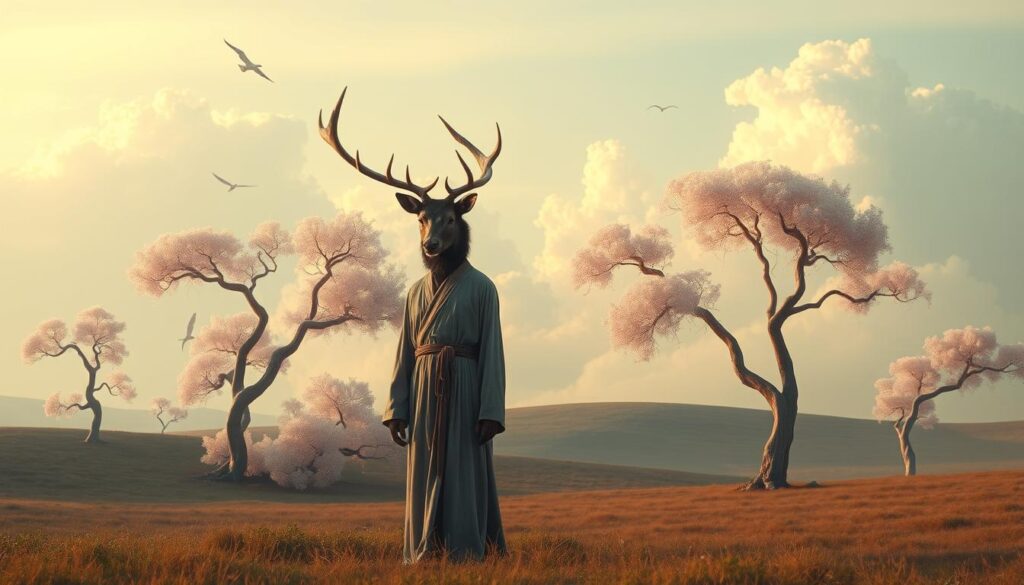
Leonora Carrington’s art is full of bird-women and horse-headed elders. These aren’t monsters. They’re evolved beings. Carrington’s bird-women aren’t running away; they’re transcending. They show a desire for freedom so strong, it changes their form.
Max Ernst looked at it differently. His frottage works show beastly textures in human forms. He showed that the animal is inside us, waiting to be found. It’s like a primal scream for intellectuals.
The Minotaur is another key figure. Surrealists like André Masson made it more than just a monster. It’s about repressed rage and getting lost in confusion. Think of it as a middle manager, trapped in its own maze.
This dream imagery hits us hard. It goes beyond logic and speaks to our deepest selves. The animal hybrid challenges our civilized masks. It asks if our daily actions are driven by instinct or just to please others.
The table below shows how these transformations are more than just weirdness. They’re critiques of our world.
| Artwork / Figure | Artist | Animal Hybrid | Core Symbolic Meaning |
|---|---|---|---|
| The Pomps of the Subsoil | Leonora Carrington | Human-Bird | Transcendence, intellectual flight, escape from earthly constraints. |
| The Elephant Celebes | Max Ernst | Machine-Animal-Human | The primal, instinctual core of modern industrial society. |
| Minotaur Series | André Masson | Human-Bull | Repressed violence, the duality of creation and destruction, existential confusion. |
| The Hunter (Catalan Landscape) | Joan Miró | Abstract Human-Bird-Beast | The playful, untamed subconscious breaking free from form. |
| Various Drawings | Dorothea Tanning | Human-Canine / Floral Beings | Domesticity transformed into the wild, feminine energy as both nurturing and feral. |
This collection of hybrids has a powerful message. Surrealists blurred the line between human and animal. They showed our animal side isn’t shameful. It’s a source of power and truth we ignore.
So, when you see a surrealist painting of a woman with a lion’s head, see more than just a strange creature. See a call to embrace our raw, instinctual selves. This is symbolic art at its core, using dream imagery to question our identity.
In the end, the human-animal hybrid is surrealism’s true self-portrait. It shows the beast in the boardroom, the bird in the cubicle, and the wild heart in every suit.
The Butterfly Effect: Symbols of Change and Growth
What if our love for the butterfly as a symbol of change is off the mark?
We adore the butterfly’s beauty and flight. But we ignore the messy middle. The caterpillar doesn’t just transform into a butterfly. It breaks down into a gooey soup before rebuilding itself.
Surrealists found the butterfly fascinating for its dark side. They saw it as a symbol of the turmoil of growing up. Artists like Remedios Varo showed the hard, transformative process. Their works often feature figures in strange machines, struggling through their own changes.
Here, clichés and deep art part ways. Hallmark focuses on the end goal. But Surrealism captures the messy, necessary breakdown to reach it. Maybe your midlife crisis is your psyche preparing for change?
The butterfly effect in unconscious symbols is real. A small dream image can lead to big changes. The butterfly guides us, showing that total breakdown might be needed for growth.
When you see a butterfly in Surrealist art, think of it as a guide. It shows the messy truth of growth. That’s the true power of symbolic art—it shares the whole story, not just the pretty parts.
Investment Opportunities in Metamorphosis-Themed Art
The surrealists used symbols, but today, people invest in art. Let’s look at where symbolic value meets real money.
In our changing world, art about change is more than just decoration. It reflects our culture. This makes it a stable investment. The idea is simple: art about change is deeply meaningful and often increases in value.
Investing in this theme is open to many. You can start with a rare Surrealist print. These pieces, filled with dream imagery, can sell for hundreds of thousands. Or, you might look at artists like Roberto Matta, who connect different art movements.
For a safe bet, go for famous artists like Ernst and Carrington. Their work is solid and appreciates over time. But, for a more exciting investment, look at new artists. They bring fresh views on change at lower prices.
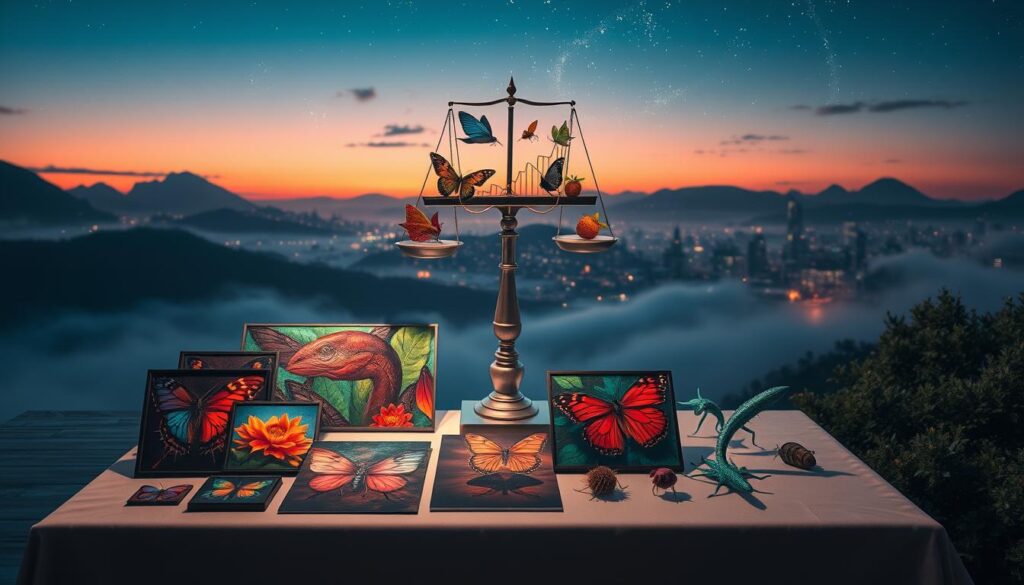
So, why invest in symbolic art about change? It’s because you’re investing in a story that keeps going. Art about change is not just a trend. It’s a record of our growth and evolution.
Contemporary Artists Exploring Transformation
Surrealism didn’t end with Dalí; it just got a software update. Today’s artists are like hackers, updating the dream imagery and unconscious symbols for our digital world.
Julie Curtiss is a prime example. Her paintings challenge the old surrealist views of women. She shows hair as a wild landscape and limbs in domestic scenes. It’s a shift from passive mystery to active power.
Miles Johnston also explores the mind’s glitches. His digital art shows faces and bodies in strange ways. It’s like Dalí’s melting clocks, but in digital form.
The connection between old and new surrealism is in the method, not the medium. Today’s artists use digital tools to uncover the unconscious. A glitch in a portrait is like a melting clock, showing the fluidity of reality.
This isn’t just homage; it’s evolution. Artists now see Freud’s ideas through today’s lens. The symbols and archetypes have changed, reflecting our world’s complexities.
Conclusion: Change as the Only Constant
So, what’s the final exhibit in our museum of the bizarre? We began with Ovid and ended up at Instagram, tracing a thread of radical change. The surrealists didn’t just paint weird pictures. They created a visual language for the chaos of our minds.
Their symbolic art gives shape to our most fluid thoughts. Those melting clocks and human-animal hybrids are more than strange images. They are maps of a mind in constant change. This is the power of dream symbolism surrealism. It turns the whispers of our unconscious symbols into something we can see and discuss.
In an age screaming for you to define a personal brand and stick to it, this art is the ultimate dissent. It shows that identity is not fixed. It is a butterfly, a morphing figure, a landscape that breathes. To engage with this work is to practice a vital intellectual rebellion.
Decoding this hidden language isn’t just an academic hobby. It’s a survival tool. Our external reality shifts faster than a Dalí landscape. To navigate it, we must first become fluent in the language of our own dreams. There, amidst the shifting symbols, we remember the oldest truth. The only thing you can truly count on is change.