
Dorothea Tanning never treated Surrealism as something that ended when the historical movement lost its center.
By the late 1980s, she was no longer the young American artist who had entered New York’s Surrealist orbit during the 1940s, exhibited alongside major European figures, married Max Ernst, and produced meticulously rendered dream interiors such as Eine Kleine Nachtmusik.
She was approaching 80, yet her work was becoming less fixed rather than more retrospective.
Watercolor, collage, torn paper, ink, fabric, photocopy, and fragments of earlier images increasingly interacted in works that seemed to form and dissolve simultaneously.
That late experimentation is the focus of a current exhibition at James Cope Gallery in Dallas, where Dorothea Tanning runs from August 29 through October 17, 2026. The Dorothea Tanning Foundation describes the presentation as concentrating on late works in watercolor and collage, including Reckless (1989).
These works reveal something important about Surrealism’s afterlife.
Surrealism did not have to survive as a recognizable style.
It could survive as a way of making reality unstable.
Tanning Never Believed Surrealism Belonged Only To The 1930s
Dorothea Tanning was born in Galesburg, Illinois, in 1910 and died in New York in 2012. Her career therefore stretched across almost the entire history of modern and contemporary art.
That longevity matters.
Tanning encountered Surrealism while it was still an active international network. She later watched it become an art-historical category.
She resisted being trapped inside that category.
In her 1989 essay “Some Parallels in Words and Pictures,” Tanning reflected on how Surrealism had encouraged her to go farther artistically without becoming a permanent label she had to obey. The Dorothea Tanning Foundation record preserves that late-career reflection.
Her point was not that Surrealism had stopped mattering.
The opposite was closer to the truth.
Its methods could remain active even after its familiar visual language disappeared.
The Dallas Exhibition Shows An Artist Still Experimenting At 79
The current James Cope exhibition opened on August 29, 2026, and continues through October 17. The gallery lists the exhibition on its current program.
The Foundation highlights Reckless (1989) among the works on view.
Tanning was 79 when she made it.
Nothing about that moment suggests an artist settling into repetition.
Her watercolors allow pigment to bleed, overlap, stain, and create edges that are not entirely predictable. Recognizable forms surface only briefly before slipping toward abstraction.
That uncertainty is important.
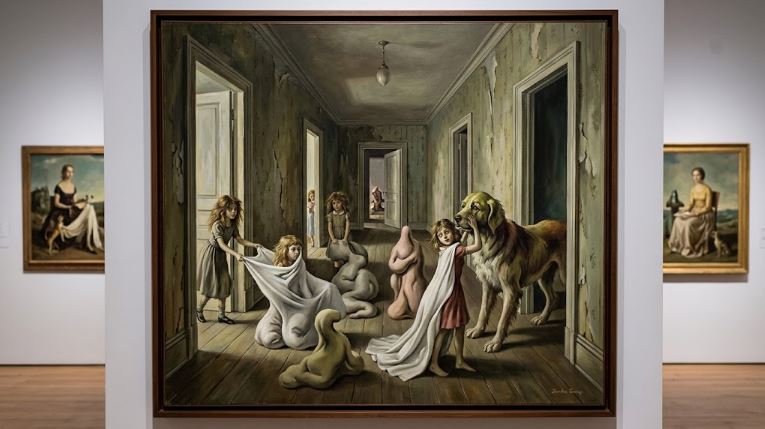
Earlier Tanning paintings often create impossible scenes with remarkable precision.
The late works make perception itself unstable.
Rather than painting a strange world clearly, she allows the image to remain in the process of becoming strange.
Watercolor Gave Tanning Less Control And More Possibility
Watercolor behaves differently from oil paint.
It spreads.
It stains.
It pools.
Edges can dissolve.
Pigment can move beyond an artist’s initial intention.
For Tanning, those qualities were useful.
They allowed the material to participate in the image.
Her late watercolors were not examples of automatic painting in the strict Surrealist sense. They were carefully developed works.
Yet the medium introduced a degree of uncertainty.
A stain could become a figure.
A body could dissolve back into color.
Empty space could become as active as painted form.
This tension between intention and accident kept alive one of Surrealism’s most important ideas: the artist does not always need complete control over what appears.
Reckless Belongs To A Larger 1989 Burst Of Activity
The year 1989 was especially active for Tanning.
Her Foundation chronology records exhibitions of collages and works on paper as well as paintings.
Works from that year included Dionysos SOS, Zealots, Rainy Day, Tango, Swarm, Between Lives, Reckless, and several works titled Message.
The titles themselves suggest action.
Reckless.
Swarm.
Tango.
Messages.
These are not static descriptions.
They imply movement, transmission, collision, and instability.
That vocabulary matches the appearance of the works.
The late Tanning gives viewers fewer fixed symbols and more visual events.
Her Figures Began Hovering Between Abstraction And Recognition
One of the biggest changes in Tanning’s late work is the weakening of clear figuration.
Her early paintings often contain recognizable doors, girls, interiors, flowers, animals, and furniture.
By the later decades, bodies and objects became increasingly fluid.
Kasmin Gallery’s 2024 exhibition Encyclopedia: The Late Collages of Dorothea Tanning described her later practice as moving between abstraction and figuration. The gallery’s late-collage research shows how fragments of bodies, animals, bicycles, household objects, and other recognizable forms could appear without stabilizing the entire image.
This is where Surrealism after Surrealism becomes especially visible.
The strange object no longer has to sit inside an impossible room.
The whole image becomes unstable.
Tanning Started Tearing Her Own Watercolors Apart
Tanning’s late collages pushed that instability even further.
She described tearing up her own watercolors and reassembling them.
That is a radical change in how a finished artwork can be understood.
The watercolor stops being an endpoint.
It becomes material.
Kasmin documented how she combined fragments of watercolor with fabric, tracing paper, photocopies, graphite, gouache, ink, pastel, and other papers.
Works such as Down, on Rivington (1988), L’Education sentimentale (1988), and Arcanum (1988) refuse clear divisions between painting and collage.
A painted image can be destroyed.
A fragment can become part of another work.
A previous composition can survive in altered form.
Surrealism remains present through recombination.
Her Late Work Turned Memory Into Material
This approach belongs to a longer Surrealist tradition of collage and unexpected association.
But Tanning added another layer.
She was recombining her own artistic past.
That makes the late collages partly about memory.
Earlier work becomes something physical that can be cut, torn, remembered, or transformed.
Instead of treating her career as a sequence of completed phases, Tanning made previous images available for reuse.
Readers interested in Surrealism’s broader experiments with paper can also explore thesurrealists.org’s article on why Surrealism needed paper more than canvas.
Tanning’s late practice shows how far that experimental logic could continue beyond the movement’s historical period.
Literature Became Increasingly Important
Tanning’s late visual art also developed alongside a major literary turn.
She published the memoir Birthday in 1986 and continued writing fiction and poetry.
That literary activity helps explain the titles and structures of her late works.
Images increasingly operate like fragments of language.
One shape suggests another.
Titles redirect interpretation.
Meaning changes depending on sequence.
The viewer partly reads the image while looking at it.
This becomes especially clear in late works carrying titles such as Arcanum, Udolpho, Otranto, Further Chaos, Table of Contents, and Worlds in Collision.
Several titles refer to Gothic literature.
Yet Tanning was not illustrating Gothic stories.
She was using literary memory as another material available for transformation.
Messages Replaced The Dream With Transmission
In 1990, Tanning presented Messages at Nahan Contemporary in New York.
Her chronology describes works involving bicycles and gorillas.
That pairing sounds characteristically Surrealist, but the idea of a “message” is more revealing.
A message travels.
Someone sends it.
Someone receives it.
Its meaning may shift along the way.
Tanning’s late images work similarly.
They send fragments without guaranteeing a single interpretation.
The viewer receives something incomplete.
Surrealism survives here less as dream interpretation and more as unstable communication.
Encyclopedia Made Collage Into A Larger System
Between 1990 and 1995, Tanning created the monumental five-panel work Encyclopedia.
The Dorothea Tanning Foundation’s record of Encyclopedia: I preserves her description of using torn translucent paper to build the composition.
The fact that she tore rather than carefully cut the paper matters.
A tear is partly controlled and partly determined by material resistance.
The artist guides the action.
The paper also decides where it breaks.
That balance between control and accident runs directly through Tanning’s late work.
The image is made intentionally, but not everything about its form is predetermined.
Surrealism Became A Procedure Rather Than A Look
Tanning’s late watercolors make it difficult to define Surrealism through familiar imagery.
There are fewer eerie rooms.
Fewer polished dream scenes.
No requirement for obvious Surrealist symbols.
Yet several deeper principles remain:
chance, metamorphosis, unexpected association, unstable bodies, disrupted narrative, erotic ambiguity, and weakened boundaries between inner and outer experience.
The style changes.
The procedure remains.
This may be the most important lesson of her late work.
Surrealism can survive after Surrealism when artists preserve its freedom rather than copy its appearance.
Tanning Outlived The Need To Look Surrealist
Tanning is still frequently introduced through early masterpieces such as Birthday (1942) or Eine Kleine Nachtmusik (1943).
Those works deserve their prominence, but they can make her relationship to Surrealism look narrower than it was.
Her late watercolors demonstrate that she could abandon the recognizable visual vocabulary of early Surrealism without abandoning its questions.
How much control should an artist surrender?
When does abstraction become a body?
Can a fragment carry memory?
Can language and image create meaning without resolving into one interpretation?
Can an artwork remain unfinished psychologically even when it is physically complete?
These questions remained active long after Breton’s original Surrealist group had become history.
Surrealism After Surrealism Was Not A Revival
Tanning’s late work should not be described as a revival of Surrealism.
She was not recreating the 1940s.
There was nothing to revive.
The underlying habits had remained with her.
This separates her work from retro-Surrealist imagery that simply repeats historical motifs.
Her late paintings and collages continue older questions under different conditions.
The dream becomes transformation.
The strange object becomes fragmentation.
The manifesto becomes working method.
The recognizable Surrealist scene disappears, but the image still refuses stability.
The 2026 Dallas Exhibition Makes The Late Work Harder To Ignore
The current exhibition at James Cope Gallery remains open through October 17, 2026.
Its focus on watercolor and collage arrives during a broader reassessment of Tanning’s later practice.
Kasmin devoted a 2024 exhibition specifically to her late collages, while the Dorothea Tanning Foundation continues to foreground works from the 1980s and 1990s in its archive and chronology.
This attention changes how her career looks.
Tanning was not simply an early Surrealist painter who continued working for decades.
Her late art belongs to the central argument of her career.
It demonstrates how Surrealist thinking could evolve without becoming nostalgic.
What Tanning’s Late Watercolors Reveal
Dorothea Tanning’s late watercolors show that Surrealism did not need its original movement structure to survive.
It did not even need to look like Surrealism.
By the late 1980s, Tanning could tear apart her own watercolors, reassemble fragments, add fabric and photocopies, let abstraction collide with recognizable imagery, and connect visual art increasingly with poetry and language.
The dream had become less important than transformation.
The strange object had become less important than the unstable image.
The manifesto had become less important than the method.
That is what Reckless and her other late works ultimately reveal.
Surrealism after Surrealism is not an afterlife made from repeated symbols.
It is a persistence of permission.
Permission for images to remain unresolved.
Permission for materials to misbehave.
Permission for chance to interrupt composition.
Permission for earlier work to be destroyed and rebuilt.
Permission for an artist to change without surrendering the questions that mattered at the beginning.
Tanning’s late watercolors do not look backward.
They reveal what happened when Surrealism stopped being merely a historical identity and became something more durable:
a way of keeping reality from settling into one final form.