
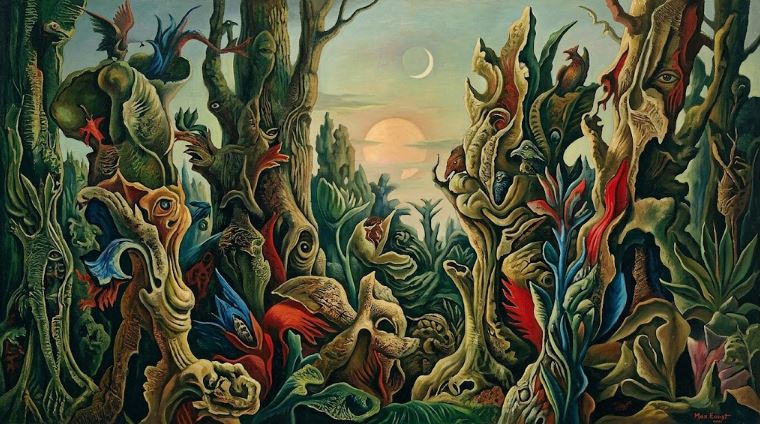
Max Ernst painted forests repeatedly, but he was rarely interested in landscape in the conventional sense.
His forests do not invite the viewer to admire nature from a safe distance. They close in. Trees harden into walls. Vegetation mutates into mineral structures. Horizons become uncertain. Suns hover like mechanical eyes. Birds, branches, rock, and organic matter seem to exchange identities.
That is why the upcoming Max Ernst: De Natura exhibition at the Domaine de Chaumont-sur-Loire feels particularly revealing.
Opening October 3, 2026, and running through February 28, 2027, the exhibition brings together around 30 paintings from the Centre Pompidou collection to mark the 50th anniversary of Ernst’s death in 1976. The Centre Pompidou exhibition program describes Ernst’s natural imagery as a mental territory in which vegetal, mineral, and imaginary forms exist without a clear hierarchy.
That description gets closer to the purpose of Ernst’s forests than the word “landscape” does.
They were not primarily pictures of places.
They were processes of transformation.
Ernst Turned Nature Into A Mental Territory
Max Ernst was born in Brühl, Germany, in 1891 and became a major figure first in Dada and then in Surrealism.
Nature had been part of his imagination long before the mature forest paintings.
His father, Philipp Ernst, was an amateur painter and a strict Catholic teacher. Ernst later recalled childhood experiences in wooded landscapes that mixed fascination, fear, religion, and fantasy.
Those memories mattered because Ernst’s forests rarely behave like neutral scenery.
They are psychological environments.
The Centre Pompidou’s framing of De Natura makes this explicit. The exhibition treats forests, gardens, organic structures, and mineral formations not simply as subjects but as states in which the outside world becomes entangled with imagination.
That distinction is important.
A traditional landscape painter observes a forest and organizes what is seen.
Ernst wanted to weaken the authority of observation itself.
Instead of deciding what a forest should look like, he developed techniques that allowed textures and accidents to suggest one.
Frottage Let The Forest Begin Without Him
One of Ernst’s most important breakthroughs came in 1925 with frottage.
The method involves placing paper over a textured surface—such as wood grain, leaves, fabric, or rough flooring—and rubbing across it with graphite or another drawing material.
The texture appears on the paper without being conventionally drawn.
MoMA’s Max Ernst biography identifies frottage as one of his major contributions to Surrealism because it reduced deliberate control and allowed unexpected images to emerge.
Ernst described himself as becoming almost a spectator to the birth of his own work.
That idea changed what nature could mean in an artwork.
Wood grain did not have to represent wood.
Its marks could become trees.
A rough plank might suggest bark, feathers, rock formations, architecture, or an entire forest.
The material generated possibilities before the artist fully determined them.
Nature stopped being something Ernst copied.
It became something that helped produce the image.
Forest And Sun Is More Like A System Than A View
MoMA’s Forest and Sun (1931) shows how strange this process could become.
The work is a graphite frottage on paper.
Across the image, dense vertical forms rise like an impenetrable barrier. Above them appears a circular sun.
The MoMA collection record identifies the work simply as a forest and sun, but the image hardly behaves like a normal woodland scene.
There is little inviting depth.
No path leads through it.
The trees are repetitive, compressed, almost architectural.
The sun looks less like atmospheric light than an abstract disk hovering behind the structure.
The forest becomes simultaneously natural and mechanical.
That ambiguity is central to Ernst.
His forests seem alive, but not comfortably biological.
They can look like machines that have learned to grow.
They can resemble walls built from vegetation.
They can feel ancient, prehistoric, industrial, or extraterrestrial.
Landscape becomes a category that keeps breaking apart.
Ernst’s Forests Resist Entry
Traditional European landscape painting often creates space for the eye to travel.
A road bends toward the horizon.
A river carries the viewer through the composition.
A valley opens.
Ernst frequently does the opposite.
His forests obstruct.
Dense vertical growth prevents easy passage.
Forms pile against one another.
The viewer encounters a barrier rather than an invitation.
This produces a psychological effect.
The forest becomes less a place to visit than something confronting the viewer.
Surrealism was deeply interested in spaces where ordinary orientation failed: dreams, deserted cities, strange interiors, deserts, caves, and forests.
Ernst’s woods belong to that tradition, but they are especially powerful because forests already occupy an ambiguous place in European culture.
They promise shelter.
They also conceal danger.
They can represent childhood, fairy tales, wilderness, sexuality, fear, and the unknown.
Ernst did not resolve those associations.
He intensified them.
Grattage Moved The Same Logic Onto Canvas
Frottage worked primarily through rubbing.
Ernst soon adapted similar principles to painting through grattage, a method involving scraping paint across textured surfaces.
The Metropolitan Museum of Art’s Max Ernst exhibition history identifies frottage and grattage among the experimental procedures that became inseparable from his Surrealist practice.
Instead of treating the painted surface as smooth and passive, Ernst made texture generate forms.
This is especially important for the forest paintings.
Trees could emerge from scraping.
Vegetation could be discovered inside a painted layer.
The artist no longer had to construct every branch deliberately.
Material accidents could create the initial structure.
The resulting image occupied an unstable territory between representation and abstraction.
The forest was recognizable.
Yet it seemed to have grown from the painting process itself.
Birds Above The Forest Makes Nature Look Manufactured
MoMA’s Birds above the Forest (1929) is one of the strongest examples.
Ernst began the painting by scraping pigment across the surface with a toothed plasterer’s comb.
According to the MoMA work record, he then layered darker greens, blues, and reds over the textured ground before adding and removing further pigment.
The final image suggests birds, butterflies, vegetation, and forest forms.
Yet none of those categories remains fully stable.
The trees look ribbed.
Organic forms resemble machinery.
The dark background feels cosmic rather than terrestrial.
The image does not represent nature from observation.
It behaves as if nature has been reconstructed from traces.
That is why Ernst’s forests often feel closer to biological experiments than conventional landscapes.
They do not show what nature looks like.
They ask what else nature could become.
The Forest Was Part Of Ernst’s Personal Mythology
MoMA notes that birds and forests feature prominently within Ernst’s personal mythology.
That phrase matters.
Ernst repeatedly developed private symbols rather than treating recurring motifs as neutral subjects.
His alter ego Loplop, often described as the “Bird Superior,” became one of the most famous.
Birds in Ernst’s art can function as creatures, identities, messengers, or transformations of the artist himself.
Forests behave similarly.
They are not one thing.
A forest may evoke childhood.
It may operate as a barrier.
It may become an unconscious environment.
It may suggest geological time.
It may absorb human and animal figures.
It may look like the world before categories have fully separated.
Calling these pictures landscapes risks making them sound too stable.
Ernst preferred instability.
The Forest Could Become Mineral
The title De Natura is especially appropriate because Ernst’s natural world rarely respects divisions between living and nonliving matter.
Plants can look like rocks.
Rocks can seem to grow.
Forests can resemble sediment.
Surfaces can suggest fossils.
The Centre Pompidou describes the exhibition as bringing vegetal, mineral, and imaginary forms together in a continuous poetic system.
That means Ernst’s nature does not operate through conventional classification.
Botany, geology, animal life, and fantasy overlap.
This is one reason his imagery still feels contemporary.
The distinction between organism and environment keeps weakening.
Things appear to be made from one another.
The forest is not a collection of individual trees.
It becomes a larger material process.
Histoire Naturelle Was A Natural History That Refused Science’s Order
In 1926, Ernst published Histoire Naturelle, a portfolio of frottage-based images.
The title translates as Natural History.
It sounds scientific.
The contents are anything but conventional.
Textures suggest strange plants, celestial bodies, animals, forests, and invented environments.
The title itself creates a productive contradiction.
Natural history traditionally classifies.
Ernst destabilizes classification.
His images repeatedly ask whether a form belongs to botany, geology, zoology, astronomy, or pure invention.
That refusal of fixed identity links his forest imagery to a much larger Surrealist project.
Surrealism challenged rational systems partly by making categories behave badly.
Readers interested in how paper itself became an experimental Surrealist laboratory can also explore thesurrealists.org’s article on why Surrealism needed paper more than canvas.
Ernst’s frottages demonstrate exactly why.
Paper could become a place where the world reorganized itself through contact.
Ernst Continued Returning To Forests Decades Later
The motif did not disappear after the 1920s and 1930s.
MoMA’s Forest at Dawn (La Forêt, à l’aube) (1958) shows Ernst returning to the subject decades later.
The lithograph presents a dense network of pale linear forms crossing a dark field.
A circular shape appears within the mesh.
The MoMA record dates the work to 1958, long after Ernst’s first frottage experiments.
The persistence matters.
Forest imagery was not merely a technical phase associated with early Surrealist automatism.
It remained one of the structures through which Ernst thought.
The forest could be continuously reconstructed because it was never simply a location.
It was a mental mechanism.
Touraine Changed The Meaning Of Nature Again
The setting of the 2026 exhibition adds another layer.
Ernst settled in Touraine in 1955, living at Huismes with artist Dorothea Tanning before later moving again.
The Centre Pompidou specifically connects De Natura with this regional history.
The exhibition at Chaumont-sur-Loire places paintings concerned with invented nature inside one of France’s most celebrated real landscapes.
That creates an unusual encounter.
Outside the museum: gardens, vegetation, the Loire, seasonal change.
Inside: Ernst’s forests, mineral forms, organisms, and invented natural systems.
The exhibition proposes that the visible landscape continues inward.
The actual Loire becomes psychological territory.
That is precisely the movement Ernst’s work repeatedly makes.
Observation begins with nature.
Imagination refuses to leave it unchanged.
Le Jardin De La France Makes Geography Bodily
One of the works associated with the Chaumont presentation is Le Jardin de la France (1962).
The Centre Pompidou’s collection record identifies the Loire itself among the painting’s represented elements.
Yet Ernst does not give viewers a straightforward geographical landscape.
The composition brings landscape, bodily form, allegory, and Surrealist transformation together.
The title refers to the traditional description of the Loire Valley as the Garden of France.
Ernst makes that phrase unstable.
Garden becomes body.
Geography becomes anatomy.
The external world becomes a mental and erotic construction.
Once again, landscape acts as raw material rather than final subject.
Why Max Ernst’s Forests Were Never Really Landscapes
Max Ernst: De Natura opens at the Domaine de Chaumont-sur-Loire on October 3, 2026, and continues through February 28, 2027 as part of the fourth edition of the AR(t]CHIPEL festival.
The timing is significant.
The exhibition marks 50 years since Ernst died in 1976, but it does not treat his natural imagery as a historical curiosity.
Instead, it reveals how consistently he rejected the stable distinction between external nature and internal imagination.
His forests are made from wood grain and memory.
They are biological and mechanical.
Vegetal and mineral.
Ancient and futuristic.
Observed and accidental.
Real and invented.
They block the viewer rather than welcoming one in.
They turn matter into image before the artist fully knows what that image will become.
A conventional landscape tells us where we are.
Ernst’s forests do something more unsettling.
They make us uncertain what kind of world we have entered.
That is why his forests were never really landscapes.
They were laboratories in which nature, matter, memory, chance, and the unconscious could continuously remake one another.