
Salvador Dalí became famous as a European Surrealist, but the version of Dalí that became a global cultural phenomenon was shaped just as decisively in the United States.
Paris gave him Surrealism. Spain gave him the landscapes, religion, memory, and personal mythology that remained embedded in his work. Yet New York, Hollywood, American magazines, department stores, museums, patrons, advertising, and mass entertainment taught Dalí how to turn himself into something larger than a painter.
That argument sits at the center of Dalí in America, the current exhibition at The Dalí Museum in St. Petersburg, Florida, on view from May 9 through October 18, 2026. Curated by Peter Tush, the exhibition brings together than 50 paintings, objects, and archival materials to examine how Dalí’s encounters with the United States changed both his artistic practice and public identity.
The museum’s Dalí in America exhibition describes the United States as a place where Dalí found an enthusiastic audience, expanded into film, advertising and design, and built relationships that shaped his career for decades.
The provocative question is whether Dalí simply conquered America—or whether America reinvented Dalí.
Dalí Arrived In America As A Surrealist
Dalí first visited the United States in 1934.
By then, he was already internationally associated with Surrealism. He had joined André Breton’s circle after his first Paris solo exhibition in 1929, and works such as The Persistence of Memory (1931) had established the soft watches, barren landscapes, distorted bodies, and dream logic now inseparable from his name.
America did not invent Dalí’s imagery.
What it gave him was scale.
The Dalí Museum notes that he initially came to the United States as an ambassador for Surrealism, but quickly discovered an audience fascinated not only by his paintings but also by his behavior and appearance.
The distinction became crucial.
In Europe, Dalí had been one provocative member of an avant-garde movement.
In America, he could become Dalí.
New York Understood That Dalí Himself Could Be The Artwork
Dalí’s American transformation accelerated because New York media culture rewarded spectacle.
His upturned moustache, theatrical pronouncements, publicity stunts, eccentric clothes, and carefully cultivated unpredictability became part of his artistic identity.
Dalí understood something unusually early: a modern artist could function as both creator and media image.
American newspapers and magazines amplified that possibility.
The Dalí Museum’s archive on Dalí’s magazine covers and advertisements notes that his relationship with American media expanded rapidly after his first 1934 visit.
By the end of that year, he had secured work with William Randolph Hearst’s The American Weekly. The publication reportedly had a print circulation estimated at roughly 60 million, giving Dalí access to an audience unimaginably larger than most gallery exhibitions.
During the 1940s and 1950s, he also worked with publications including Vogue, Harper’s Bazaar, The New Yorker,* and *Town & Country.
This was not a retreat from his visual language.
Dalí reused and adapted his familiar metamorphic bodies, flowers, landscapes, dream imagery, and Surrealist transformations for commercial media.
Instead of keeping avant-garde imagery separate from popular culture, he allowed each to feed the other.
A Department Store Window Became A Surrealist Battlefield
Department-store culture gave Dalí another stage.
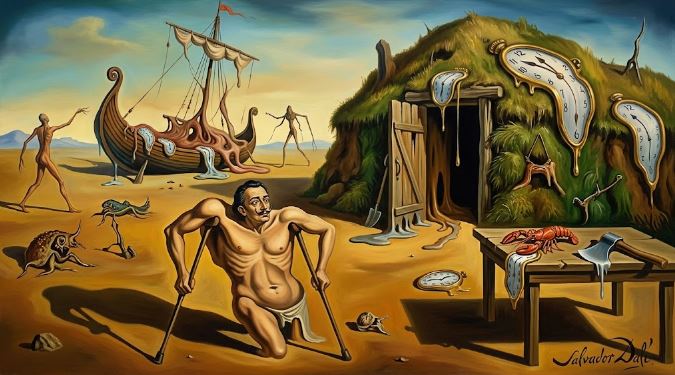
He created window displays for Bonwit Teller in New York, treating commercial space almost like installation art.
One display included a mannequin with a head made from roses, a lobster telephone, and other deliberately irrational elements.
In 1939, a dispute erupted after the store altered one of his displays.
Dalí reacted physically to the changes, and in the commotion a plate-glass window was broken. The incident led to his arrest, although the charges were subsequently dropped.
The Dalí Museum’s account of Gala and Dalí’s American years notes that the episode immediately generated front-page attention.
For another artist, an arrest over a department-store display might have been disastrous.
For Dalí, it reinforced the mythology.
The boundary between artwork, publicity stunt, commerce, and public performance became increasingly difficult to locate.
That ambiguity became central to his American persona.
The 1939 World’s Fair Let Dalí Build A Surrealist Environment
The 1939 New York World’s Fair offered an even larger experiment.
Dalí designed the Dream of Venus pavilion, an immersive environment combining architecture, performance, erotic spectacle, mannequins, aquatic imagery, and Surrealist transformation.
The pavilion was meant to overwhelm visitors rather than simply show them paintings.
Dalí proposed a façade featuring a huge fish-headed Aphrodite, but World’s Fair organizers rejected the design.
The Gala-Salvador Dalí Foundation explains in its history of Dalí’s transgressive Venus that the dispute helped prompt Dalí to publish his characteristically theatrical manifesto Declaration of the Independence of the Imagination and the Rights of Man to His Own Madness.
The conflict is revealing.
America gave Dalí enormous opportunities for spectacle.
It also forced him to negotiate with commercial organizers, censorship, mass audiences, and institutional expectations.
He was learning how far Surrealism could travel before someone tried to control it.
His Break With Breton Made America Even More Important
Dalí’s American rise happened while his relationship with the official Surrealist movement was collapsing.
André Breton and other Surrealists increasingly objected to Dalí’s politics, commercial ambitions, public behavior, and refusal to take the anti-fascist positions they expected from members of the group.
By 1939, Breton had definitively broken with him.
The Dalí Museum’s artist timeline identifies 1939 as the point at which Dalí’s relationship with Breton’s Surrealists effectively ended.
That chronology matters.
Just as Dalí was losing his institutional identity as a Surrealist in Europe, America was offering him another identity entirely.
He no longer needed Breton’s group to define his public significance.
Newspapers, magazines, museums, advertisers, patrons, filmmakers, and wealthy collectors could do that instead.
America made it possible for Dalí to outgrow the movement that had made him famous.
World War II Turned A Visit Into An Eight-Year American Chapter
The transformation became much deeper after 1940.
As war engulfed Europe, Dalí and Gala left for the United States.
They remained there until 1948.
The Dalí Museum describes this eight-year period as a decisive phase in which America served both as refuge and creative laboratory.
Dalí became immersed in American cultural life rather than merely visiting it.
He moved through New York society, worked on theatrical and cinematic projects, painted portraits of wealthy patrons, published books, collaborated with major commercial enterprises, and cultivated connections across art and entertainment.
The Gala-Salvador Dalí Foundation similarly distinguishes the Dalí who visited America during the 1930s from the Dalí who actually lived there during the 1940s.
Once resident in the country, he encountered American culture directly rather than through newspapers, collectors, and short stays.
The difference changed his scale of ambition.
Hollywood Offered Dalí A Mass Audience Surrealism Had Never Had
If New York transformed Dalí into a celebrity, Hollywood expanded his imagination across another medium.
During the 1940s, Dalí became involved with several major film projects.
His most famous completed Hollywood contribution came through Alfred Hitchcock’s Spellbound (1945).
Dalí designed imagery for the film’s dream sequence.
The Gala-Salvador Dalí Foundation explains in its history of Dalí and cinema that the finished sequence was significantly revised, leaving only portions of his original conception.
Even so, Spellbound brought Dalí’s towering eyes, distorted architecture, strange shadows, and psychologically charged spaces before a huge cinema audience.
Surrealist dream imagery no longer required an avant-garde gallery or experimental film club.
It could appear inside a Hollywood thriller starring Ingrid Bergman and Gregory Peck.
The potential audience had changed completely.
Walt Disney Took The Experiment Even Further
Dalí’s relationship with Walt Disney represented another unlikely American collaboration.
Disney invited Dalí to work on Destino near the end of 1945.
Dalí began an intensive period of work with animator John Hench in 1946, producing drawings, paintings, and storyboard ideas for a short film centered on love, time, and transformation.
The original production was abandoned before completion.
Decades later, Disney artists returned to the surviving material, and Destino was finally completed in 2003.
The Gala-Salvador Dalí Foundation’s history of the Dalí-Disney collaboration documents how the project brought two apparently different creative worlds together.
The partnership makes more sense when viewed through Dalí’s American reinvention.
Dalí increasingly rejected the notion that serious art had to avoid mass entertainment.
Hollywood animation, advertising, magazines, couture, photography, film, painting, and publicity could all become part of one expanded practice.
Gala Was Essential To The American Transformation
The American Dalí was not created by Salvador alone.
Gala Dalí played a critical role in managing contracts, galleries, money, patrons, scheduling, and commercial negotiations.
The Dalí Museum notes that by 1937, Gala was functioning substantially as Dalí’s business manager.
That role became increasingly important as the number and complexity of his projects expanded.
Dalí could cultivate the appearance of manic spontaneity partly because someone else was managing the machinery behind it.
America rewarded the Dalí persona.
Gala helped make that persona economically sustainable.
This complicates the myth of the solitary eccentric genius.
Dalí’s reinvention was also a carefully managed enterprise.
American Patrons Changed His Legacy
Among the relationships Dalí formed in the United States, few became more consequential than his friendship with A. Reynolds and Eleanor Morse.
The couple began collecting Dalí’s work during the 1940s and eventually assembled one of the world’s most important collections of his art.
Their holdings ultimately became the foundation of The Dalí Museum, which opened in St. Petersburg, Florida, in 1982 after an earlier museum established by the Morses in Ohio.
The current Dalí in America exhibition therefore has an unusual historical symmetry.
It examines Dalí’s American transformation inside an institution that exists partly because of relationships he forged during that same American chapter.
The museum today holds more than 2,400 works spanning his career and multiple media, according to its 2026 exhibition announcement.
America did not simply receive Dalí.
It became one of the principal custodians of his legacy.
Dalí Returned To Europe As A Different Kind Of Artist
Dalí and Gala returned to Spain in 1948.
By then, his artistic identity had changed.
He was no longer simply the young Surrealist responsible for melting watches and paranoiac imagery.
His interests were shifting toward Catholicism, Renaissance painting, nuclear physics, mathematics, optical effects, monumental history painting, and what he would later call Nuclear Mysticism.
It would be simplistic to credit America for every aspect of this transformation.
His return to Catholic tradition was profoundly connected to Spain and European art history.
The atomic age affected artists globally.
His fascination with old masters long predated his American exile.
Yet the scale of his postwar ambitions makes more sense after America.
Dalí had learned to think in terms of mass audiences, monumental spectacle, interdisciplinary production, celebrity culture, and enormous public gestures.
He did not abandon Europe.
He returned to it with a newly American sense of scale.
Dalí In America Changes The Familiar Story
The current St. Petersburg exhibition runs through October 18, 2026, and its importance lies in shifting attention away from the standard Dalí chronology.
The familiar story usually moves from Figueres to Madrid, Paris, Breton, Surrealism, and then the famous break with the movement.
America can appear almost as an eccentric detour.
Dalí in America suggests the opposite.
His first U.S. visit in 1934 opened a new cultural possibility.
New York turned his persona into media.
Hearst’s magazines gave him extraordinary circulation.
Bonwit Teller made retail space into spectacle.
The 1939 World’s Fair allowed him to experiment with immersive installation.
World War II turned America into an eight-year refuge.
MoMA institutionalized him.
Hollywood brought his imagery to mass cinema.
Hitchcock transformed his dream architecture into psychological spectacle.
Disney pushed him toward animation.
American patrons secured his legacy.
By the time Dalí returned to Europe in 1948, he had learned how to operate simultaneously as painter, designer, performer, celebrity, illustrator, filmmaker, advertiser, author, and brand.
Europe created the Surrealist Dalí.
America helped create the Dalí the world still recognizes.