
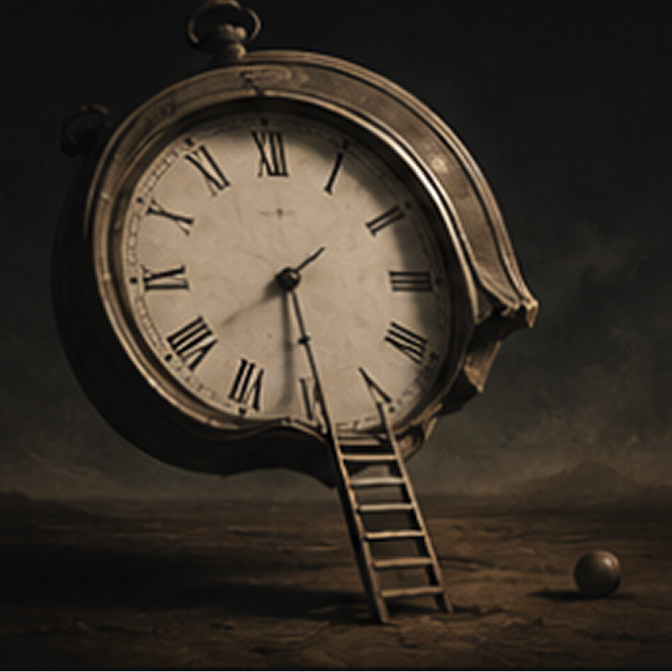
Surrealism wanted to escape the frame.
Elsa Schiaparelli gave it a body.
During the 1930s, while Salvador Dalí, Jean Cocteau, Man Ray and other avant-garde figures were destabilizing paintings, photographs, objects and language, Schiaparelli began applying similar strategies to dresses, hats, gloves, buttons, jewellery and perfume bottles. A shoe migrated from the foot to the head. A lobster appeared across the front of an evening dress. Quilted bones pushed outward from black fabric. Printed tears made an elegant gown look violently shredded. Two embroidered faces became a vase of roses when viewed together.
These were not simply Surrealist motifs pasted onto fashionable clothes.
Schiaparelli understood that clothing already possessed qualities Surrealism wanted: transformation, fetish, disguise, eroticism, bodily distortion and the possibility of making an everyday object suddenly seem irrational.
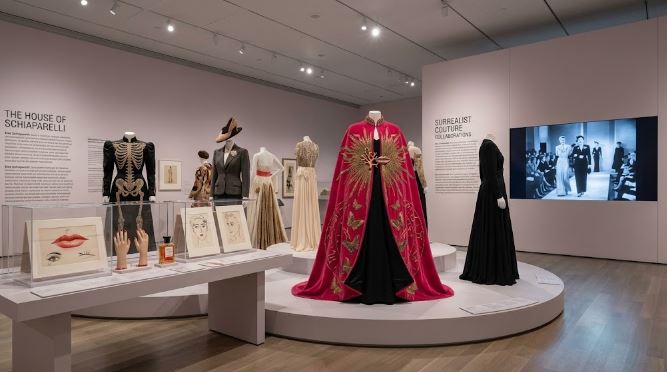
That achievement is receiving its most substantial British reassessment in Schiaparelli: Fashion Becomes Art at the Victoria and Albert Museum in London, the first UK exhibition devoted to Elsa Schiaparelli and the house she founded. The show spans the 1920s to the present, includes around 100 ensembles and 50 artworks, and remains open at V&A South Kensington through November 15, 2026. The V&A exhibition places Schiaparelli’s historical designs beside artworks, photographs, jewellery, archive material and contemporary creations under current Schiaparelli creative director Daniel Roseberry.
The exhibition makes one point especially clear.
Schiaparelli did not merely dress Surrealism.
She discovered that the dressed human body could become one of Surrealism’s most effective sites.
Schiaparelli Was Already Breaking Fashion Rules Before Dalí
Elsa Luisa Maria Schiaparelli was born in Rome on September 10, 1890.
Her route into fashion was unconventional. She lived in London, moved to New York during the First World War and eventually returned to Europe. In New York she encountered people connected to modern art, including Gabrielle Buffet-Picabia and Man Ray, experiences that exposed her to experimental artistic circles before she established herself as a couturier.
The V&A’s Schiaparelli timeline identifies her 1927 trompe-l’œil bow sweater as one of her first major breakthroughs.
The sweater looked as if a large scarf had been tied around the wearer’s neck.
It had not.
The bow was knitted into the surface.
That trick may seem modest beside the Skeleton Dress or Shoe Hat, but it reveals the mechanism that would define Schiaparelli’s career.
Clothing could lie.
A flat surface could pretend to contain another object.
Something functional could suddenly behave like an image.
Fashion could destabilize perception.
Surrealism would give Schiaparelli a larger language for a tendency she had already discovered.
Surrealism Made The Body An Ideal Place For Visual Mischief
Surrealists were fascinated by objects displaced from their normal contexts.
A familiar object becomes strange when its function changes.
A cup covered in fur no longer behaves like a cup.
A lobster attached to a telephone no longer behaves like food.
A shoe placed on a head stops being footwear.
Fashion makes this displacement unusually powerful because clothing is attached to the body.
A Surrealist painting can show an impossible body.
A Schiaparelli garment can turn the wearer’s actual body into the impossible image.
The V&A’s history of Surrealism and design emphasizes how fashion allowed Surrealist ideas about fetishism, erotic symbolism and displaced objects to enter everyday life.
Schiaparelli understood this instinctively.
A hat was not simply an accessory.
It could become an absurd sculpture.
A zipper could become decoration.
A button could look like an insect or object.
A pocket could pretend to be a drawer.
A dress could suggest the anatomy beneath the skin.
The wearer became both person and artwork.
Salvador Dalí Helped Her Turn Displacement Into Couture
Schiaparelli’s most famous Surrealist collaborations developed with Salvador Dalí during the second half of the 1930s.
Their partnership worked because both artists understood that absurdity becomes stronger when presented with complete seriousness.
One of their clearest examples is the Shoe Hat of 1937–38.
The design was inspired by a photograph in which Gala Dalí placed a shoe on Salvador Dalí’s head.
Schiaparelli transformed that joke into a wearable object: an upside-down high-heeled shoe mounted as a hat.
The V&A’s 2026 exhibition guide identifies Gala’s version as having a Shocking Pink velvet heel.
Nothing about the shoe itself is fantastical.
Only its location is wrong.
That is classic Surrealist displacement.
The object remains recognizable while its relationship with the body becomes irrational.
The Lobster Dress Turned Dinner Into Desire
The Lobster Dress of summer 1937 became another of Schiaparelli and Dalí’s defining collaborations.
The dress itself is relatively restrained: a white silk organza evening gown.
Then a large lobster crawls across the skirt.
According to the V&A, Dalí originally drew the lobster for Schiaparelli beachwear, and textile designer Paul Sache transferred the image onto silk. Dalí then proposed using it on a high-waisted dinner dress, positioning the crustacean prominently across the front.
The lobster already carried a charged symbolic role in Dalí’s work.
The V&A notes that he regarded lobsters as sexually suggestive. He reportedly even wanted real mayonnaise added to the dress, an intervention Schiaparelli did not adopt.
The resulting garment became especially famous after Wallis Simpson wore a version for photographs by Cecil Beaton in 1937, shortly before her marriage to the former King Edward VIII.
That context amplified the effect.
A woman at the center of an international royal scandal appeared wearing a couture dress with an enormous, suggestively positioned crustacean.
The image turned Surrealist provocation into society fashion.
The Lobster Also Shows How Ideas Moved Between Art And Fashion
The lobster did not remain attached to one medium.
Dalí’s Lobster Telephone followed in 1938.
The V&A’s current exhibition places the telephone in conversation with Schiaparelli’s dress, showing how motifs moved among painting, sculpture, fashion, photography and patronage.
That circulation matters.
Art history sometimes treats fashion collaborations as decorative side projects undertaken by major artists.
Schiaparelli’s work suggests something more complicated.
The dress did not merely reproduce a Dalí image.
Its meaning changed because someone could wear it.
The lobster moved with the body.
It appeared at social events.
It could be photographed.
The image entered public life rather than remaining a static object in a gallery.
Fashion made Surrealism mobile.
The Skeleton Dress Put The Body Outside The Body
The Skeleton Dress of 1938 may be the purest expression of Schiaparelli’s ability to make clothing disturb the boundary between body and garment.
Created with Dalí for the Summer 1938 Circus collection, the black dress uses a form of padded quilting known as trapunto.
Raised structures trace a spine, ribs, collarbones and hip bones across the garment.
The V&A’s study of the Skeleton Dress explains how padding and quilting create the illusion that bones are pushing outward through the fabric.
The effect reverses normal clothing logic.
Dress usually conceals anatomy.
Schiaparelli makes anatomy appear on the surface.
The wearer becomes both clothed and exposed.
Alive and skeletal.
Elegant and macabre.
Dalí could paint an impossible body.
Schiaparelli could make someone walk into a room wearing one.
The Tears Dress Made Violence Look Like Textile
The Tears Dress, also produced for the 1938 Circus collection, pushes that transformation in another direction.
At first glance, the dress appears damaged.
Its surface seems torn open.
Yet the damage is largely an illusion.
The V&A’s recent study of Schiaparelli and trompe-l’œil explains that the fabric was printed with illusionistic tears inspired by Dalí’s paintings of women wearing ripped clothing.
The accompanying veil makes the illusion more physical.
There, the tears become three-dimensional through actual cutting and layering.
The viewer encounters several realities at once.
Printed damage.
Real fabric.
Suggested flesh.
Couture construction.
The dress is intact and wounded simultaneously.
That tension turns clothing into something psychologically unstable.
Jean Cocteau Made A Woman’s Back Become Two Faces And A Vase
Dalí was not Schiaparelli’s only important artistic collaborator.
Her relationship with Jean Cocteau produced one of her most sophisticated experiments in visual ambiguity.
A 1937 evening coat currently highlighted by the V&A contains an embroidered design by Cocteau across the back.
Look one way and two faces appear in profile, seemingly moving toward a kiss.
Look differently and the negative space between them becomes a vase filled with roses.
The design operates through figure-ground reversal.
Neither image disappears entirely.
The viewer’s perception shifts between them.
The V&A’s recent study of the Schiaparelli-Cocteau coat explains that the intricate embroidery was produced by the renowned Maison Lesage.
This collaboration demonstrates how technically serious Schiaparelli’s visual jokes could be.
A Surrealist idea required extraordinary couture craftsmanship.
The illusion depended on precisely executed embroidery.
Clothes Could Become Furniture
Schiaparelli and Dalí also attacked the boundary between the body and the domestic interior.
The V&A’s 2026 exhibition includes material connected to Schiaparelli’s Bureau suit of Winter 1936.
The design used pockets resembling drawers, complete with hard plastic handles.
The wearer’s body becomes a piece of furniture.
The concept responded to Dalí’s fascination with bodies containing drawers, an image he explored in paintings and sculpture during the same period.
Again, fashion changes the idea.
A painted figure with drawers is an impossible image.
A person wearing drawer-like pockets makes that impossibility temporarily real.
The Surrealist object enters the street.
Schiaparelli Understood That Buttons Could Behave Like Tiny Sculptures
Not every Surrealist intervention required an entire dress.
Schiaparelli treated buttons, clasps, belts and zippers as independent opportunities for disruption.
The Metropolitan Museum of Art’s 1938 Pagan collection suit demonstrates this approach vividly.
Realistic plastic insects appear against delicate pink silk.
Leaf-shaped buttons extend the botanical imagery.
The juxtaposition between couture refinement and crawling bugs creates the momentary shock Schiaparelli valued.
The Met’s Schiaparelli belt from the same collection goes further, turning a realistic insect into the buckle.
The object is functional.
It is also unsettling.
This miniature scale mattered because Surrealism could hide inside conventional elegance.
A perfectly tailored suit might reveal its strangeness only when someone looked closely.
Man Ray Helped Turn Schiaparelli Herself Into An Avant-Garde Image
Schiaparelli’s place inside Surrealist culture was not limited to collaborations on garments.
She knew the movement’s artists socially and professionally.
Man Ray photographed Schiaparelli in 1933, and the V&A’s exhibition uses that portrait within its historical narrative.
Their connection had roots extending back to Schiaparelli’s New York years, when she encountered avant-garde circles before establishing her Paris fashion house.
The relationship matters because photography helped Schiaparelli’s fashion circulate as imagery.
Fashion is ephemeral on the body.
Photography stabilizes it.
Man Ray and other photographers understood how lighting, pose, cropping and visual distortion could transform clothing into something stranger than catalogue documentation.
That gave Surrealist fashion a second life as Surrealist photography.
Readers interested in how those photographic experiments changed modern visual culture can explore thesurrealists.org’s analysis of Man Ray and the camera, which provides useful context for the image-making environment surrounding Schiaparelli’s fashion.
Schiaparelli Made Fashion And Performance Difficult To Separate
Schiaparelli also designed for stage and screen and dressed prominent performers.
Her clients included Mae West, whose exaggerated hourglass silhouette became part of Schiaparelli’s visual imagination.
The relationship among fashion, celebrity and Surrealism reached another level through perfume packaging.
Schiaparelli used the outline of Mae West’s body as inspiration for a torso-shaped perfume bottle.
Dalí’s own fascination with West famously produced his Mae West Lips Sofa and related interior designs.
The body becomes furniture.
Furniture becomes a face.
A perfume bottle becomes a torso.
A garment becomes anatomy.
The repeated transformations show why fashion belonged so naturally within this network.
Surrealism did not want objects to stay in their assigned categories.
Neither did Schiaparelli.
The V&A Exhibition Shows That Materials Were Part Of The Experiment
The current exhibition also makes clear how adventurous Schiaparelli could be with materials.
She experimented with unusual textiles, synthetics, metallic surfaces, plastics and effects that could appear closer to industrial invention than conventional couture.
The V&A’s 2026 exhibition soundscape even incorporates recordings inspired by Schiaparelli’s unusual textiles, including crinkled tree-bark effects and cellophane, emphasizing how tactile her experiments could be.
The V&A soundscape project treats those materials as integral to understanding her relationship with the uncanny and absurd.
This detail matters because Surrealism in fashion was never only pictorial.
A strange material could make the body feel different.
Texture could become psychological.
Clothing could rustle, protrude, shine or resist conventional softness.
Schiaparelli made the wearer experience the artwork physically.
Surrealism Also Gave Schiaparelli A Way To Rethink Femininity
The female body occupied a complicated place within historical Surrealism.
Male Surrealists frequently represented women as muses, erotic objects, mysterious beings or gateways to unconscious experience.
Women artists working around the movement often complicated those roles.
Schiaparelli did something comparable through clothing.
Her designs did not erase glamour.
They weaponized it.
A woman could wear an elegant gown displaying bones.
She could place a shoe on her head.
She could carry insects across a couture jacket.
She could wear a lobster over the pelvis.
She could make her body theatrical without presenting it as conventionally beautiful.
The garment becomes a way to control the disturbance.
The wearer participates in the joke.
That agency helps explain why Schiaparelli’s clothes still feel more provocative than fashion that simply borrows Surrealist graphics.
Schiaparelli’s Legacy Is Not Just “Surreal Fashion”
Reducing Schiaparelli to eccentricity misses the larger point.
Her influence appears whenever fashion treats the body as a conceptual surface rather than merely a form to flatter.
Contemporary designers now routinely use exaggerated anatomy, trompe-l’œil, impossible accessories, sculptural silhouettes, ironic materials and visual contradictions.
Those strategies feel familiar partly because Schiaparelli helped normalize the idea that couture could contain them.
The modern House of Schiaparelli, under Daniel Roseberry, has deliberately revived that heritage through anatomical jewellery, sculptural bodices and hyperrealist decorative effects.
The V&A exhibition follows that history into the present rather than freezing Schiaparelli in the 1930s.
That contemporary continuity should not obscure the specificity of Elsa Schiaparelli’s original context.
She worked directly among Surrealist artists.
Her collaborations were not retro-style references.
They happened while Surrealism itself was evolving.
Why Schiaparelli Changed Surrealism As Much As Fashion
It is easy to describe Elsa Schiaparelli as the fashion designer who brought Surrealism into couture.
The relationship worked in both directions.
Fashion gave Surrealism something painting could not provide so easily:
a moving human surface.
The Shoe Hat made displacement wearable.
The Lobster Dress turned erotic symbolism into social spectacle.
The Skeleton Dress moved anatomy from beneath clothing onto its exterior.
The Tears Dress allowed illusionistic violence to travel across a real body.
The Cocteau coat made perception change as its wearer moved.
Buttons became sculpture.
Zippers became visual statements.
Gloves became bodily jokes.
Clothing became a space where image, object and person could merge.
That is why Schiaparelli: Fashion Becomes Art matters in 2026.
The V&A is not merely celebrating eccentric dresses from the interwar years. It is reconstructing a moment when the boundary between art and fashion became unusually unstable.
Schiaparelli recognized something fundamental about Surrealism.
Its ideas became more disruptive when they stopped staying inside paintings.
A lobster on canvas remains an image.
A lobster worn to dinner changes the room.