
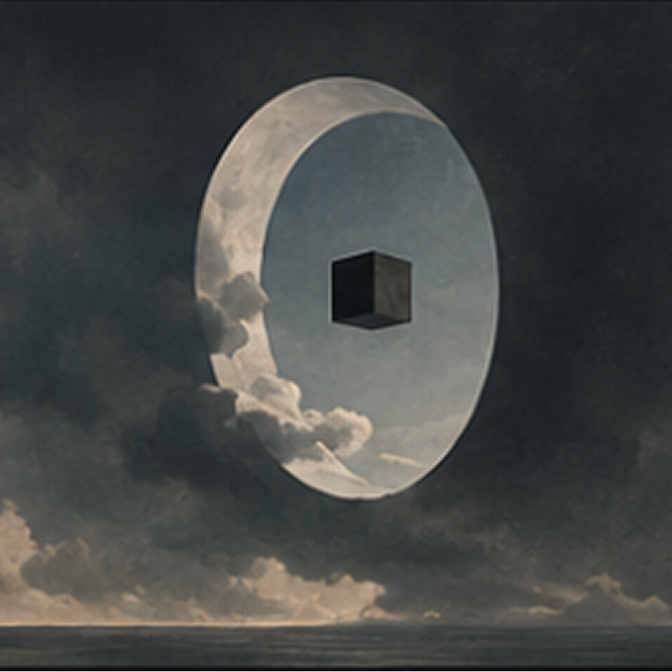
Surrealism is often remembered through paintings: Salvador Dalí’s hard-edged dreamscapes, René Magritte’s visual paradoxes, Yves Tanguy’s invented terrains, or Max Ernst’s strange forests and hybrid creatures. Yet many of the movement’s most consequential ideas emerged somewhere less monumental.
They happened on paper.
That is the argument behind Surrealism (on paper), which opened at Nagas in New York on September 2, 2026, and runs through October 24, 2026. The exhibition brings together works by Victor Brauner, Toyen, Leonor Fini, Max Walter Svanberg, Bona de Mandiargues, Myriam Bat-Yosef, Suzanne Van Damme, Reuben Mednikoff, and Grace Pailthorpe.
Nagas does not treat drawing as a lesser category beneath painting. Its Surrealism (on paper) exhibition presents paper as one of the movement’s primary experimental laboratories—a place where automatic drawing, collage, frottage, decalcomania, and the cadavre exquis could develop quickly, cheaply, and unpredictably.
That distinction changes how Surrealism looks.
Canvas often became the place where an image acquired permanence.
Paper was where Surrealists could risk losing control.
Paper Let Surrealism Move Faster Than Painting
Surrealism depended on speed more than its museum reputation sometimes suggests.
Psychic automatism, one of the movement’s defining ideas, was built around reducing the interference of conscious planning. André Breton’s 1924 Manifesto of Surrealism framed automatism as an attempt to allow thought to operate without ordinary rational censorship.
Drawing was ideally suited to that ambition.
A pen touches paper immediately.
There is little preparation.
No stretched canvas is necessary.
No elaborate layering needs to be planned.
A line can accelerate before the artist has time to decide what it represents.
André Masson’s Automatic Drawing (1924) remains one of the clearest examples. The Museum of Modern Art explains in its record of Masson’s automatic drawing that he began without a predetermined subject or composition, moving his pen rapidly until fragments of bodies and objects appeared within the network of lines.
The drawing did not eliminate conscious intervention.
Masson sometimes recognized emerging forms and developed them.
That tension between accident and recognition became central to Surrealist practice.
Paper made the tension visible.
A painting could conceal revisions beneath later layers.
A drawing often preserved hesitation, speed, interruption, pressure, and error.
For a movement interested in processes occurring before rational correction, those traces mattered.
New York’s Exhibition Treats Paper As A Method
The strongest idea in Surrealism (on paper) is that the medium connects artists who otherwise look remarkably different.
Nagas describes the exhibition as spanning roughly six decades, from the 1930s through the end of the 20th century.
That chronology matters.
The exhibition is not arguing that Surrealism maintained one recognizable visual style for sixty years.
It argues that experimental procedures survived.
Across different generations and geographies, artists continued using paper to test forms that might emerge through chance, intuitive movement, transformation, and collaborative invention.
The works assembled by Nagas make that range visible.
Toyen’s Untitled (1933) uses watercolor and ink.
Victor Brauner’s Sybille (1943) combines pastel and pencil.
Reuben Mednikoff’s Untitled (1946) and Grace Pailthorpe’s Untitled (1946) use watercolor.
Max Walter Svanberg’s Man’s Journey Towards the Millennial Kingdom (1943) uses graphite.
Leonor Fini’s small Face drawings reduce human identity to a few concentrated marks.
Bona de Mandiargues’ Cadavre Exquis (1998) extends one of Surrealism’s most famous collaborative procedures almost to the end of the century.
The materials vary.
The larger principle remains recognizable.
Paper becomes a surface where representation can become unstable before it becomes polished.
Toyen Shows Why Drawing Could Carry Trauma
Toyen makes an especially strong case for treating works on paper as finished Surrealist statements rather than preparatory exercises.
Born Marie Čermínová in Prague in 1902, Toyen became one of the central figures of Czech Surrealism. Alongside Jindřich Štyrský, Toyen developed close ties to André Breton’s Paris group and helped establish the Czechoslovak Surrealist Group in 1934.
Paper became crucial during the political violence of the late 1930s and 1940s.
Toyen created the drawing cycle The Shooting Gallery during 1939–1940, as Nazi occupation transformed daily life in Czechoslovakia.
MoMA’s research on Toyen’s wartime drawings explains how children’s objects—blocks, dolls, school materials, toys—become fragmented and threatening within barren landscapes.
The work is Surrealist without functioning as escapism.
Dreamlike transformation sharpens political anxiety.
Paper allowed Toyen to create images whose thin lines and empty spaces could communicate fragility with unusual intensity.
MoMA also holds a 1939 ink-on-paper drawing from The Shooting Gallery, demonstrating how little material was required to construct that psychological atmosphere.
The sheet is not a rehearsal for a painting.
The drawing is the event.
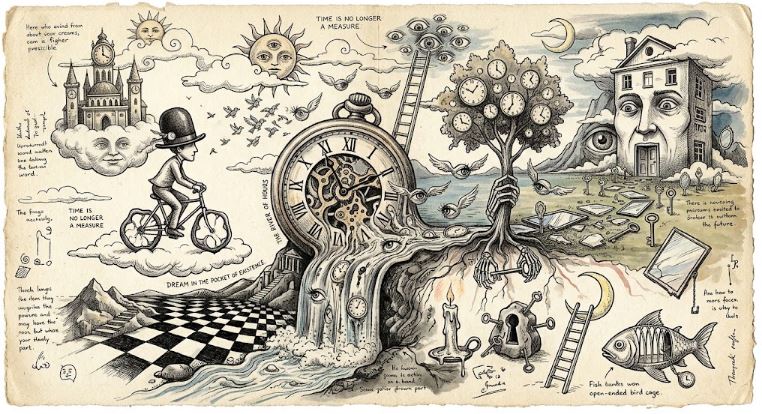
Max Ernst Turned The Paper Itself Into A Sensor
No Surrealist technique demonstrates paper’s experimental value more clearly than frottage.
Max Ernst developed the method in the 1920s.
He placed sheets of paper over textured surfaces and rubbed them with pencil or crayon. Floorboards, leaves, twine, mesh, rough materials, and other objects left unpredictable impressions.
The artist then responded to the textures.
MoMA’s Max Ernst Natural History portfolio, published in 1926, contains 34 collotypes based on frottage images. The museum explains that Ernst transformed the accidental textures into imagined landscapes, creatures, and objects.
Paper was essential.
It acted almost like a recording membrane.
The surface underneath supplied information that Ernst had not drawn deliberately.
His hand became partly responsive rather than fully commanding.
This mechanism aligned closely with Surrealist automatism.
Instead of asking the unconscious to guide an unplanned line, Ernst allowed physical reality itself to generate visual prompts.
Wood grain could suggest forests.
Scratches could become geological structures.
Leaves could produce strange organisms.
The artist still interpreted.
The starting point came from elsewhere.
Canvas could support experimental techniques too, but paper made this kind of contact unusually direct.
It could be pressed, folded, rubbed, cut, pasted, drawn across, or passed between participants.
The Exquisite Corpse Needed A Portable Surface
Surrealism was not always solitary.
One of its most recognizable games, the cadavre exquis, depended on several participants contributing to a work without seeing the complete image created by the others.
Paper made the process effortless.
A sheet could be folded.
One participant drew a section.
The paper was concealed and passed to someone else.
At the end, the folds opened to reveal a composite figure or text no single participant had controlled.
The method embodied one of Surrealism’s favorite contradictions.
Rules produced unpredictability.
The game was structured precisely so that authorship would become unstable.
That collaborative logic survives remarkably late in the Nagas exhibition through Bona de Mandiargues’ Cadavre Exquis (1998).
Its date is striking.
It appears more than seven decades after Breton’s first manifesto.
Nagas uses that chronological distance to argue that Surrealism’s continuity lies less in a recognizable style than in recurring procedures.
Hybrid bodies can change.
Materials can change.
Generations can change.
The experimental structure persists.
Paper is what made many of those structures portable enough to survive.
Grace Pailthorpe Treated Drawing Like Psychological Evidence
The inclusion of Grace Pailthorpe and Reuben Mednikoff pushes the exhibition toward another important dimension of Surrealist drawing: psychological investigation.
Pailthorpe was not trained initially as an artist.
Born in 1883, she worked as a surgeon and later became involved in psychological research. She and Mednikoff began producing and analyzing Surrealist imagery together during the 1930s.
Pailthorpe participated in the International Surrealist Exhibition in London in 1936.
Her approach was unusually explicit about psychoanalysis.
Tate’s account of Grace Pailthorpe’s Surrealist practice explains that she and Mednikoff analyzed each other’s paintings and drawings in an attempt to understand what they believed to be expressions of unconscious fantasy.
The pair treated images almost as psychological documents.
That makes paper particularly significant.
A quick drawing could preserve an intuitive gesture before reflection altered it.
Color, line, shape, and distortion could then become material for interpretation.
The Nagas exhibition places 1946 watercolors by both Pailthorpe and Mednikoff within the same broader experimental history as Toyen, Brauner, and Svanberg.
Their work demonstrates that Surrealist automatism was never one standardized procedure.
For some artists it was artistic liberation.
For Pailthorpe and Mednikoff, it also became a method of psychological inquiry.
Victor Brauner Used Paper To Build Prophetic Figures
Victor Brauner’s Sybille (1943) introduces another characteristic Surrealist figure: the prophet.
A sibyl traditionally possesses access to knowledge unavailable through ordinary perception.
That makes the subject almost perfectly suited to Surrealism.
Brauner, born in Romania in 1903, became associated with the Paris Surrealists in the 1930s. His imagery repeatedly included magical bodies, symbolic creatures, eyes, signs, and figures that seem to operate within invented systems of knowledge.
In Sybille, pastel and pencil allow a figure to emerge without the monumental physical presence associated with a large oil painting.
That intimacy changes the relationship between image and viewer.
Paper can feel private.
It resembles a notebook, diagram, manuscript, prediction, or personal record.
That quality suited artists fascinated by occult knowledge, private symbols, dreams, and coded systems.
The Surrealist image did not always need to confront viewers from a major canvas.
Sometimes it worked more effectively as something that seemed discovered inside a drawer.
Leonor Fini Makes A Face Almost Disappear
The small scale of Leonor Fini’s drawings in the exhibition is another reminder that Surrealist intensity does not require size.
Nagas lists Face at approximately 9 by 11 centimeters, while Face II measures roughly 11 by 8.5 centimeters.
They are tiny compared with museum-scale paintings.
Yet a face can become more psychologically unsettling when very little information remains.
Fini reduces identity toward line.
The viewer supplies the rest.
That process fits her broader fascination with metamorphosis, gender, masks, theatrical identity, and beings that seem to cross boundaries between human and nonhuman.
Paper encourages this compression.
A line does not have to describe skin.
It can indicate presence.
An eye can become a symbol rather than an anatomical feature.
Hair can become landscape.
The face can stop behaving like a portrait.
These drawings demonstrate why the exhibition’s title matters.
Surrealism “on paper” does not mean Surrealism transferred onto an inferior support.
It means Surrealism stripped closer to its mechanisms.
Paper Could Preserve Violence Without Monumentalizing It
Paper has another historical advantage.
It is vulnerable.
It tears.
It yellows.
It bends.
It can be folded into a pocket or hidden inside a book.
That fragility gave works on paper a different relationship to political crisis than monumental painting.
Toyen’s wartime drawings are one example.
Artists working under occupation or censorship could produce images without needing studios large enough for canvases.
Drawings could circulate privately.
Illustrations could enter books.
Prints could multiply.
Collage could transform existing printed matter into attacks on established meanings.
Surrealism’s relationship with publishing depended heavily on this portability.
Readers interested in how writing, books, and visual art intertwined within the movement can compare the New York exhibition with thesurrealists.org’s exploration of Surrealist poetry and literature.
Surrealism was never simply a painting movement.
Its ideas traveled through pages.
Paper Made Collage More Aggressive
Collage presented another challenge to traditional artistic skill.
Instead of creating every component from scratch, artists could cut existing images from newspapers, catalogues, scientific publications, novels, advertisements, or illustrations.
Then they could force unrelated fragments into new relationships.
Max Ernst pushed the process especially far.
MoMA notes that his later collage novels drew imagery from 19th- and early-20th-century pulp fiction, natural-history publications, and scientific journals.
The existing image came with one meaning.
Ernst supplied another through relocation.
Paper made that theft of context possible.
A Victorian illustration could become erotic.
A machine could become biological.
An interior could become threatening.
A respectable family scene could collapse into absurdity.
The Surrealist act occurred partly through scissors and glue.
That has consequences for how the movement should be remembered.
Technical mastery mattered to many Surrealists.
Yet Surrealism repeatedly proved that transformation could matter more than making an image from nothing.
Paper made appropriation, collision, and recombination physically easy.
Drawing Was Also A Way Around Artistic Hierarchy
The historical distinction between painting and drawing often treated drawing as subordinate.
A drawing might be a study.
A sketch could prepare the composition.
The canvas would become the finished work.
Surrealism complicated that hierarchy because spontaneity could be more valuable than finish.
If a drawing captured an unexpected association immediately, refining it into a polished painting could destroy the quality that made it interesting.
The Nagas exhibition states this directly: for many Surrealists, drawing became an autonomous form of expression rather than a preliminary stage.
That shift is especially important for artists whose work moved between multiple disciplines.
Toyen made paintings, drawings, books, and prints.
Fini worked across painting, drawing, theater, costume, and illustration.
Pailthorpe combined art with psychology.
Bona de Mandiargues worked within a later Surrealist generation in which inherited methods could be revisited without repeating the 1920s visually.
Paper could accommodate all those practices without demanding that they become one thing.
The Exhibition Also Rewrites Who Gets Remembered
The artist list itself deserves attention.
Victor Brauner, Toyen, and Leonor Fini are increasingly visible within current Surrealist scholarship.
Several other names remain less familiar to general audiences.
Suzanne Van Damme, Max Walter Svanberg, Myriam Bat-Yosef, Bona de Mandiargues, Grace Pailthorpe, and Reuben Mednikoff complicate the simplified canon dominated by Dalí, Magritte, Ernst, and Miró.
Paper helps expose those omissions because museum histories built around major paintings can reproduce market hierarchies.
Large canvases become trophies.
Drawings often remain in archives, private collections, works-on-paper departments, libraries, or storage.
A focused exhibition can reverse that hierarchy.
Suddenly the smaller object becomes primary evidence.
Nagas does not need to claim that every artist represented had equal historical influence.
The stronger point is that Surrealism’s experimental culture becomes harder to understand when scholarship follows only its most famous paintings.
Surrealism’s Books Confirm The Same Pattern
New York offers an interesting parallel in 2026.
MoMA’s forthcoming The Surrealist Book: Tomorrow Lives in Mirrors, opening October 4, 2026, similarly shifts attention away from canvas and toward paper-based formats.
MoMA describes Surrealist books as objects in which writers and artists transformed the bound volume into an experimental art form. The Surrealist Book exhibition includes André Breton, Claude Cahun, Paul Éluard, Salvador Dalí, Max Ernst, Toyen, and Unica Zürn.
The coincidence is revealing.
Two New York exhibitions in the same season ask audiences to look beyond the famous paintings.
Nagas focuses on drawings and works on paper.
MoMA turns toward books.
Together they suggest a different Surrealist history—one organized around portability, collaboration, publishing, experimentation, and reproducibility.
Canvas made Surrealism iconic.
Paper helped make it a movement.
Paper Was Cheap Enough To Fail On
One practical fact should not be romanticized away.
Paper was easier to waste.
That mattered enormously.
Experiment requires failure.
An artist attempting an unfamiliar technique on an expensive prepared canvas might feel pressure to rescue the result.
A sheet of paper could be abandoned.
Another could begin immediately.
That freedom supported procedures based on speed and uncertainty.
Automatic lines could go nowhere.
A rubbing could produce nothing useful.
A collage combination could fail.
An exquisite corpse might emerge as nonsense.
The failure cost less.
That does not make paper artistically modest.
It makes it structurally suited to experimentation.
Creative movements often develop fastest where mistakes remain affordable.
Surrealism understood this intuitively.
The Marks On Paper Preserve The Moment Control Slips
A finished painting can appear inevitable.
Every figure seems placed where it belongs.
Every color appears chosen.
Paper often resists that illusion.
One line crosses another.
A shape begins and changes direction.
Pressure increases.
Ink pools.
A wash spreads beyond its expected edge.
Another participant adds something incompatible.
The work retains evidence of becoming.
That quality is central to why Surrealism (on paper) matters.
The exhibition is not simply presenting smaller Surrealist artworks.
It is presenting evidence of processes.
Nagas describes hybrid beings, unstable landscapes, and prophetic figures appearing repeatedly across the six decades represented.
Those subjects are important.
The procedures that generated them may matter more.
Surrealism wanted to discover what happened when representation stopped obeying ordinary expectations.
Paper gave artists a place to test that question repeatedly.
Why Surrealism May Have Needed Paper More Than Canvas
The title of this argument should not be read literally.
Surrealism would be unimaginable without its paintings.
Dalí, Magritte, Tanguy, Ernst, Carrington, Varo, Lam, and many others used canvas to produce works that permanently altered modern visual culture.
Yet if the question is where Surrealism developed many of its most radical procedures, paper has a stronger claim than conventional museum narratives often acknowledge.
Automatic drawing needed speed.
Frottage needed physical contact.
Collage needed cutting and recombination.
The exquisite corpse needed folding and passing.
Book illustration needed reproducibility.
Wartime drawing needed portability.
Psychological experimentation needed immediacy.
Paper handled all of them.
That is what Nagas’ Surrealism (on paper) reveals so effectively in 2026.
The exhibition moves from Toyen’s 1933 watercolor and ink through Brauner’s 1943 Sybille, the 1946 works of Pailthorpe and Mednikoff, and onward to Bona de Mandiargues’ 1998 cadavre exquis.
More than sixty years separate some of those sheets.
The visual languages change.
The experimental impulse survives.
Canvas gave Surrealism some of its monuments.
Paper preserved its restlessness.
That may be why a movement obsessed with escaping conscious control returned to the sheet again and again.
On paper, Surrealism could make a mistake before anyone had time to stop it.
Sometimes that mistake became the discovery.