
René Magritte died in 1967, yet contemporary art still speaks his visual language with remarkable ease. An ordinary object appears where it should not. A word contradicts an image. A face disappears behind something mundane. Scale becomes unreliable. A familiar room suddenly behaves as if logic has slipped by half an inch.
Those strategies now feel so embedded in visual culture that it can be difficult to recognize how disruptive they once were.
That persistence is the subject of This Is Still Not a Pipe: The Afterlife of Magritte, opening at Gagosian Grosvenor Hill in London on September 24, 2026, and running through December 12, 2026. The exhibition brings together paintings, works on paper, sculpture, and photography from across Magritte’s career with works by contemporary artists from different generations, including pieces made specifically for the show.
The Gagosian exhibition is curated by Jasper Sharp and Bernard Lagrange in collaboration with Charly Herscovici, president of the Fondation Magritte, and other Magritte scholars.
Its title deliberately echoes The Treachery of Images (1929), Magritte’s famous painting of a pipe accompanied by the declaration Ceci n’est pas une pipe—“This is not a pipe.”
The joke has lasted nearly a century because it was never merely a joke.
Magritte understood that an image can look obvious while quietly destroying certainty.
Contemporary art has never stopped using that weapon.
The 2026 Exhibition Is About Influence Without Simple Imitation
Gagosian is not presenting Magritte as a style guide.
That distinction matters.
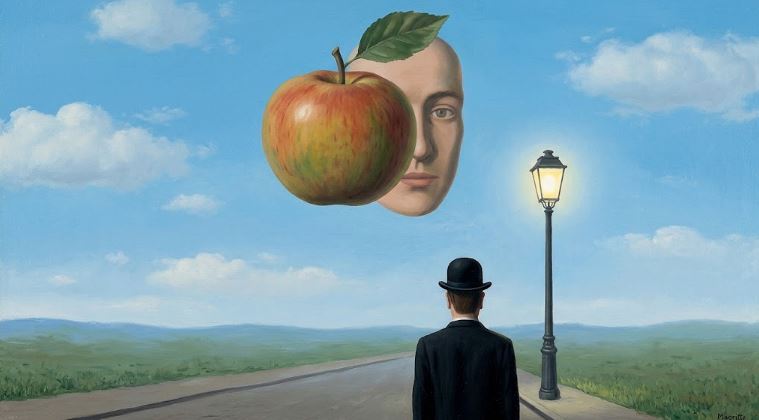
The artist’s bowler hats, apples, blue skies, pipes, clouds, curtains, and suited men are among the most recognizable motifs in 20th-century painting. Copying those objects would be easy.
Magritte’s deeper influence is harder to imitate because it lies in how he arranged relationships.
A pipe becomes a philosophical trap because the image and the sentence beneath it disagree.
A train emerging from a fireplace becomes disturbing because both objects remain completely recognizable.
An oversized apple inside a room makes architecture seem suddenly unreliable.
A cloud placed where an object should be forces viewers to question what belongs to the sky and what belongs to ordinary life.
Magritte rarely needed wild abstraction.
He destabilized reality by painting recognizable things too clearly.
That method gives This Is Still Not a Pipe its real subject.
The exhibition asks why artists continue returning to the mechanisms behind Magritte’s images rather than simply to their famous surfaces.
The Show Arrives Twenty Years After LACMA’s Landmark Magritte Exhibition
The timing is deliberate.
Gagosian’s exhibition marks 20 years since the Los Angeles County Museum of Art opened Magritte and Contemporary Art: The Treachery of Images on November 19, 2006.
That exhibition ran through March 4, 2007 and became the first major museum show devoted specifically to Magritte’s impact on postwar American and European artists.
According to LACMA’s exhibition archive, the museum brought together 68 paintings and drawings by Magritte and 68 works by 31 contemporary artists.
The contemporary roster included Richard Artschwager, John Baldessari, Vija Celmins, Robert Gober, Jasper Johns, Jeff Koons, Ed Ruscha, and Andy Warhol.
That list reveals how broad Magritte’s afterlife already looked two decades ago.
These artists did not belong to one movement.
Pop art, conceptual art, postmodernism, sculpture, photography, and language-based art all found something useful in Magritte.
Gagosian’s 2026 project revisits that question for a different generation.
As of the gallery’s latest official announcement, the complete contemporary artist list had not yet been publicly released. Gagosian has confirmed that several artists connected to the 2006 LACMA exhibition will reappear, alongside others being shown with Magritte for the first time.
That restraint is worth preserving.
The story is already compelling without inventing a roster before the gallery announces one.
Magritte Made Representation Itself Suspicious
The reason The Treachery of Images remains so effective is almost embarrassingly simple.
The painted pipe is not a pipe.
It is an image of one.
The sentence beneath it does not contradict reality.
It corrects the viewer.
LACMA’s collection record for The Treachery of Images identifies the work as a 1929 oil painting and one of the museum’s defining Magritte holdings.
Its importance lies in the gap between seeing and naming.
Viewers recognize the pipe immediately.
Language then interrupts that recognition.
What appeared obvious becomes unstable.
Magritte understood something that became central to later conceptual art: representation is not transparent.
Pictures do not simply deliver reality.
Words do not simply label reality.
Both systems construct meaning.
Once that assumption becomes visible, artists can begin manipulating it.
John Baldessari Understood Magritte’s Linguistic Trap
The 2006 LACMA exhibition made this connection especially clear through John Baldessari.
Baldessari built much of his career from tensions between photographs, captions, labels, judgments, and arbitrary visual systems.
LACMA’s historical Magritte Index points directly to Baldessari’s Wrong, in which a photograph of the artist standing beneath a palm tree appears with the word WRONG printed below it.
The word behaves like an authority.
Yet what exactly is wrong?
The composition?
The photograph?
The placement of the palm tree?
The idea that an image can be judged through one word?
That uncertainty belongs to Magritte’s lineage.
Baldessari even designed the installation for LACMA’s 2006 exhibition, turning the gallery itself into another conceptual encounter.
Magritte’s influence therefore extended beyond paintings hanging beside contemporary works.
His logic entered the exhibition architecture.
Magritte’s Ordinary Objects Were Never Ordinary
One reason Magritte remains difficult to exhaust is that he rarely required exotic material.
He preferred ordinary things.
Apples.
Pipes.
Hats.
Doors.
Windows.
Clouds.
Birds.
Chairs.
Rooms.
Men in suits.
The Museum of Modern Art’s major 2013–2014 exhibition Magritte: The Mystery of the Ordinary, 1926–1938 identified this strategy as central to his breakthrough Surrealist years.
MoMA’s exhibition history emphasizes techniques including displacement, transformation, metamorphosis, misnaming, and visions drawn from half-waking states.
These methods allowed Magritte to make familiar things behave incorrectly.
That incorrectness could be tiny.
An object might be too large.
Its label might be wrong.
Something normally hidden might become visible.
Two incompatible realities might occupy the same image.
The effect is powerful because the viewer knows what the world should look like.
Magritte changes only enough to make that knowledge unreliable.
The Philosopher’s Lamp Turns A Self-Portrait Into A Closed Loop
A central work in the 2026 Gagosian exhibition is La Lampe philosophique (The Philosopher’s Lamp) (1936).
The painting measures 50 by 66 centimeters and depicts a man whose elongated nose bends into the bowl of his own pipe.
Beside him, a candle behaves with comparable absurdity.
Gagosian identifies the painting as a conceptual self-portrait and links it to Magritte’s fascination with paradox and introspection.
The official exhibition page notes that Magritte interpreted the image as a philosopher becoming trapped inside his own mental system.
That idea remains strikingly contemporary.
The thinker is not liberated by thought.
He becomes enclosed by it.
The pipe, supposedly an object he controls, turns back toward him.
Subject and object collapse into one strange circuit.
Magritte transforms philosophy into physical comedy.
The joke works because the image also carries a darker suggestion: thought can become self-consuming.
The Painting Also Connects 1936, 2006, And 2026
The Philosopher’s Lamp is doing unusual historical work in the London exhibition.
It appeared in LACMA’s 2006–2007 Magritte exhibition.
Now it returns within Gagosian’s 2026 reassessment.
The painting also leads back another 70 years.
Magritte created it shortly before the International Surrealist Exhibition at the New Burlington Galleries in London in 1936, where a gouache of the same image appeared.
That event took place only a short distance from Gagosian’s present Grosvenor Hill gallery.
The 2026 exhibition therefore connects three different moments:
1936: Surrealism establishes itself dramatically in London.
2006: LACMA examines Magritte’s postwar influence.
2026: Gagosian asks what that influence looks like another generation later.
The recurrence is appropriate.
Magritte’s own art repeatedly reused motifs.
An image returned.
Its context changed.
Meaning changed with it.
The 1936 London Exhibition Helped Make Magritte International
The International Surrealist Exhibition opened in London in June 1936.
It brought Surrealism to British audiences on a scale that transformed the movement’s visibility.
Gagosian describes the exhibition as a watershed and credits it with helping establish Magritte’s international reputation.
The moment matters because Magritte was not yet the universally recognizable cultural figure he would become.
His imagery eventually migrated far beyond museum walls.
Advertising borrowed his dislocations.
Album covers borrowed his impossible spaces.
Fashion borrowed his concealments.
Photography borrowed his doubling.
Design borrowed his visual jokes.
Cinema borrowed the tension between polished surfaces and impossible situations.
Contemporary art absorbed all of it.
That expansion explains why Gagosian can plausibly describe an “afterlife” rather than merely an influence.
Magritte’s visual syntax escaped Surrealism.
Pop Art Recognized How Powerful A Familiar Image Could Become
Magritte and Pop art may initially seem opposed.
Magritte belonged to European Surrealism.
Pop artists responded to consumer imagery, celebrity, advertising, commodities, and mass reproduction.
Yet both understood the power of familiarity.
Andy Warhol could repeat an ordinary commercial object until it became strange.
Magritte could isolate an ordinary object until its meaning stopped feeling secure.
Both strategies depend on recognition.
The viewer must know what the object is before the artist can destabilize that knowledge.
LACMA’s 2006 exhibition placed Magritte into dialogue with Warhol precisely because influence does not require visual imitation.
The shared terrain lies in how commonplace images acquire conceptual pressure.
An apple can become more than fruit.
A soup can can become more than packaging.
The transformation occurs through context.
Conceptual Art Found An Even Deeper Magritte
Magritte’s connection to conceptual art may be stronger still.
Conceptual artists frequently ask viewers to distinguish between an object, an image of the object, a word naming the object, and the idea represented by those systems.
Magritte was investigating those separations decades earlier.
His paintings do not behave like philosophical illustrations.
They make philosophy happen visually.
The viewer experiences the contradiction before explaining it.
That is why The Treachery of Images remains so teachable without becoming exhausted.
The painting contains an immediate puzzle.
Then the puzzle expands.
If the picture of a pipe is not a pipe, what exactly does an image promise?
How does a word acquire authority over what we see?
Why does recognition feel more trustworthy than representation?
Magritte turns basic acts of looking into unstable intellectual territory.
Contemporary conceptual art continues working there.
Robert Gober Shows How An Object Can Become Psychologically Wrong
The 2006 LACMA show also included Robert Gober, whose sculptures frequently transform familiar domestic objects.
Sinks, doors, body fragments, drains, furniture, and architectural forms appear recognizable while refusing ordinary function.
The relationship to Magritte is structural.
A familiar thing appears.
Its familiarity becomes disturbing.
That is one of Magritte’s most durable inventions.
He did not need fantasy creatures to produce the uncanny.
A door could be enough.
A fireplace could be enough.
A shoe could be enough.
Gober’s sculptures demonstrate how effectively that logic could migrate out of painting.
Once Surrealism discovered that the everyday object could become psychologically unstable, later artists did not need to repeat Magritte’s imagery.
They only needed the principle.
Ed Ruscha Found Magritte Inside Language
Ed Ruscha represents another route through Magritte’s legacy.
Words occupy a central place in Ruscha’s paintings, drawings, books, and photographs.
They can function as language, image, graphic design, joke, and cultural artifact simultaneously.
Magritte had already made the relationship between words and pictures suspicious.
That connection matters because language in art rarely stays neutral once it enters the visual field.
A word can describe an image.
It can contradict it.
It can rename it.
It can dominate it.
It can become the image itself.
Magritte’s pipe demonstrated how quickly these systems can separate.
Later artists learned to make the separation the artwork.
Magritte’s Influence Reaches Beyond Contemporary Art
Gagosian’s 2026 framing extends the argument outside the art world.
The gallery notes Magritte’s impact on advertising, design, fashion, and music.
That cultural reach is easy to understand.
His images survive reproduction unusually well.
A floating apple remains legible when reduced.
A bowler-hatted silhouette works instantly.
A blue sky with white clouds can be moved into countless contexts.
A concealed face requires no specialist art-historical knowledge to create tension.
These motifs have become available to visual culture because their underlying ideas remain readable.
Yet ubiquity creates a danger.
Magritte can become decoration.
A floating object can look “Magritte-like” without reproducing the intellectual pressure that made his work effective.
The 2026 exhibition has an opportunity to separate motif from method.
That distinction is where its strongest art-historical value lies.
Magritte Was Surrealist Without Painting Like Dalí
Another reason his legacy feels contemporary is that Magritte demonstrates how diverse Surrealism actually was.
He joined the movement’s Parisian circle after moving there in 1927, but his paintings did not depend on the virtuoso dream illusionism associated with Salvador Dalí.
Magritte often painted with deliberate visual clarity.
The technique could appear almost impersonal.
That restraint made the impossible event more disturbing.
A realistic train emerges from an ordinary fireplace.
The viewer cannot dismiss the image as painterly chaos.
Every object looks legible.
Only the relationship is impossible.
Readers interested in another Surrealist who used technology and visual procedure rather than conventional dream painting can compare Magritte’s logic with Man Ray’s photographic innovations.
Both artists understood that reality did not need to disappear for Surrealism to begin.
It only needed to become unreliable.
Why Magritte Fits The Age Of Digital Images So Well
Magritte’s relevance has intensified in a culture saturated with images.
Digital life constantly forces people to distinguish representation from reality.
Images are cropped.
Filtered.
Reposted.
Captioned.
Generated.
Removed from context.
Combined with misleading text.
Presented as evidence.
Turned into memes.
Magritte’s central question—what exactly is the relationship between an image and the thing it claims to show?—has become less academic than it was in 1929.
This does not mean Magritte “predicted AI” or social media.
Such claims would flatten his historical context.
The stronger argument is that he identified a structural weakness in visual representation long before digital technology multiplied its consequences.
Images persuade because viewers recognize things quickly.
Magritte slowed that recognition down.
He made viewers notice the gap.
Contemporary visual culture keeps falling into the same gap.
Magritte’s Real Legacy Is A Method Of Doubt
The reason René Magritte still haunts contemporary art is not that artists remain obsessed with bowler hats.
It is that he developed an exceptionally durable method for making certainty fail.
He could take something universally recognizable and disconnect it from its normal relationship.
Object from scale.
Word from meaning.
Body from identity.
Interior from architecture.
Sky from location.
Image from reality.
Nothing had to become visually chaotic.
That calmness made the contradiction sharper.
The 2026 Gagosian exhibition arrives almost 90 years after Magritte participated in London’s landmark 1936 International Surrealist Exhibition, 20 years after LACMA’s major examination of his influence, and nearly six decades after his death.
The dates make his persistence difficult to dismiss as nostalgia.
Artists continue finding use in the problems he created.
This Is Still Not a Pipe therefore has a more interesting task than proving Magritte remains famous.
His fame is obvious.
The exhibition can show why his thinking still functions.
Every generation produces new technologies, new visual systems, and new claims about what images can tell us.
Magritte keeps interrupting those claims with the same quiet suspicion.
Look again.
The thing you recognize is not necessarily the thing you are seeing.
The picture is not the object.
The word is not the picture.
The familiar is not secure.
That is why Magritte still feels contemporary.
His paintings do not simply survive.
They keep teaching later artists how to make reality doubt itself.