
In 1924, Marcel Duchamp decided to bankrupt the casinos of Monte Carlo.
He did not plan to cheat. He planned to use pure mathematics to tame the chaotic spin of the roulette wheel. To fund this endeavor, he issued thirty shares of a satirical financial document, featuring a photograph of his own face lathered in shaving cream.
The project was part financial scheme, part performance art, and entirely obsessed with the concept of probability. Duchamp sought to prove that if an artist observed the chaos of the world closely enough, they could calculate its next move.
He failed to break the bank.
Yet, this obsessive experiment laid the groundwork for how the avant-garde would approach risk, games, and the fundamental tension between rational mathematics and unpredictable reality. The Surrealists would later build an entire philosophical framework around this tension. They understood that humanity’s deepest psychological impulses are often revealed exactly at the moment when a calculated risk goes wrong.
The Monte Carlo Bond and the Mathematics of Chance
Duchamp approached gambling with the cold, detached precision of an engineer.
He spent weeks studying roulette tables, documenting winning numbers, and developing an elaborate martingale betting system. His goal was not necessarily to win sudden, massive wealth. His goal was to achieve a mechanical equilibrium, a mathematical formula that would perfectly offset the inherent advantage of the casino.
He collaborated with Man Ray to create the Obligations pour la Roulette de Monte-Carlo.
These shares were sold to friends and collectors for 500 francs each, promising a 20 percent return. The Monte Carlo Bond, now preserved in the Museum of Modern Art, stands as a brilliant mockery of financial speculation. It turned the artist into a corporate entity and the casino into a laboratory for testing the limits of human foresight.
Duchamp did not see gambling as a vice.
He saw it as a battle between human intellect and the random physics of a spinning wooden wheel.
| Concept | The Gambler’s Approach | The Surrealist Approach |
| Objective | Financial accumulation and conquering the house edge. | Exploring the subconscious through unpredictability. |
| Methodology | Rigid mathematical systems and probability models. | Automatism, games, and loosening rational control. |
| View of Risk | A mathematical obstacle to be solved and minimized. | A necessary psychological rupture that reveals desire. |
Objective Chance Versus the Rational Algorithm
The Surrealist movement, led by André Breton, developed a slightly different relationship with probability.
Breton was fascinated by what he termed hasard objectif, or objective chance. This was the eerie, seemingly magical occurrence of coincidences in everyday life. For the Surrealists, an unexpected encounter on a Paris street or a bizarre sequence of rolling dice was not merely random. It was the universe mirroring the repressed desires of the unconscious mind.
Duchamp wanted to conquer chance through math. Breton wanted to surrender to it through poetry.
Both approaches share a fundamental fascination with predicting the unpredictable. Duchamp’s Monte Carlo experiments attempted to prove that human mathematics could eventually conquer the chaotic spin of a wheel. Today, that same desire to quantify the unpredictable drives a massive global industry. The algorithms and historical data sets that constantly adjust today’s NFL lines are simply the modern, hyper-capitalist evolution of Duchamp’s obsessive pursuit: the dream of putting a precise, rational number on an entirely uncertain future.
The medium has shifted from a wooden roulette wheel to a digital sportsbook.
The underlying psychological drive remains identical.
Man Ray, Chess, and the Architecture of Unpredictability
The Surrealist fascination with calculated risk naturally extended into board games.
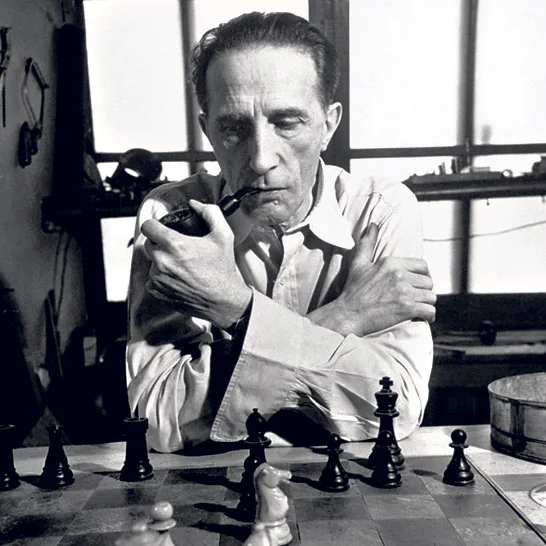
If roulette represented pure, blind luck, chess represented the ultimate theater of controlled strategy. Duchamp famously abandoned his traditional art career for several years to play competitive chess. He argued that while not all artists are chess players, all chess players are artists.
His collaborator, Man Ray, shared this obsession.
The Surrealist approach to chess turned the game into a machine for generating psychological friction. Man Ray designed abstract, geometric chess sets where the pieces were stripped of their medieval identities. A king was a pyramid. A knight was a carved scroll from a violin.
By altering the physical pieces, Man Ray subtly altered the cognitive experience of the player.
The rules of the game remained perfectly rigid. The psychological space within those rules became entirely unstable. This is the paradox that fascinated the avant-garde: imposing strict rules does not eliminate chaos. It merely builds a confined arena where human error, sudden inspiration, and unconscious impulse can be observed with absolute clarity.
The Subconscious Thrill of Risk
Duchamp’s roulette system eventually bored him.
He discovered that grinding out small, mathematically sound victories against the casino was tedious work. It lacked the sudden, violent thrill of genuine risk. Once he stripped the game of its mystery, it ceased to be a mechanism for artistic inquiry and became merely an administrative task.
The Surrealists understood that the human mind actually craves the unknown.
A perfectly predictable world leaves no room for dreams, desire, or the startling revelations of the subconscious. We build elaborate statistical models, financial bonds, and betting algorithms to convince ourselves that we are in control of tomorrow.
We construct the illusion of certainty.
Yet, whether we are standing over a green felt table in 1924 or analyzing a digital screen today, the art happens in the exact moment when the system fails, the unpredictable occurs, and we are reminded that reality is still entirely out of our hands.