
AI art exhibitions are changing the museum visit from a quiet encounter with fixed objects into a moving encounter with images that seem to think, mutate, respond, and remember. That shift is now visible across several major 2026 exhibitions, from DATALAND’s Machine Dreams: Rainforest in Los Angeles to The World Through AI at Schirn Kunsthalle Frankfurt and Dreaming Beyond AI: Portals Behind the Algorithm at ifa-Galerie Stuttgart. These shows do not all celebrate artificial intelligence in the same way. Some use machine learning to create sensory immersion; others examine the labor, politics, environmental cost, and hidden systems behind algorithmic culture.
For thesurrealists.org, the value is not in calling every AI image “surrealist.” That would flatten both AI art and Surrealism. The stronger question is why museums are starting to feel like dream machines: spaces where image, data, body, archive, and machine perception blur into experiences that feel uncannily close to the Surrealist obsession with dream logic, automatism, and unstable reality. The museum is no longer only displaying strange images. It is becoming the apparatus that produces them in real time.
Why AI Exhibitions Feel Dreamlike Instead Of Merely Digital
A traditional museum display usually asks visitors to look at an object that has already been made. AI art exhibitions often change that relationship. The work may be generated from data, altered by visitor interaction, shaped by sensors, or built from archives that a human viewer could never fully see at once. The result can feel less like a gallery and more like a controlled hallucination.
That is why the phrase “dream machine” fits the current moment. In historic Surrealism, the dream was not just subject matter. It was a method for breaking the authority of ordinary logic. André Breton’s Surrealist circle valued automatic writing, chance, collage, disorientation, and images that seemed to arrive from beyond conscious intention. AI art does not repeat that history directly, yet it raises a related question: what happens when an image appears to emerge from a system the viewer cannot fully inspect?
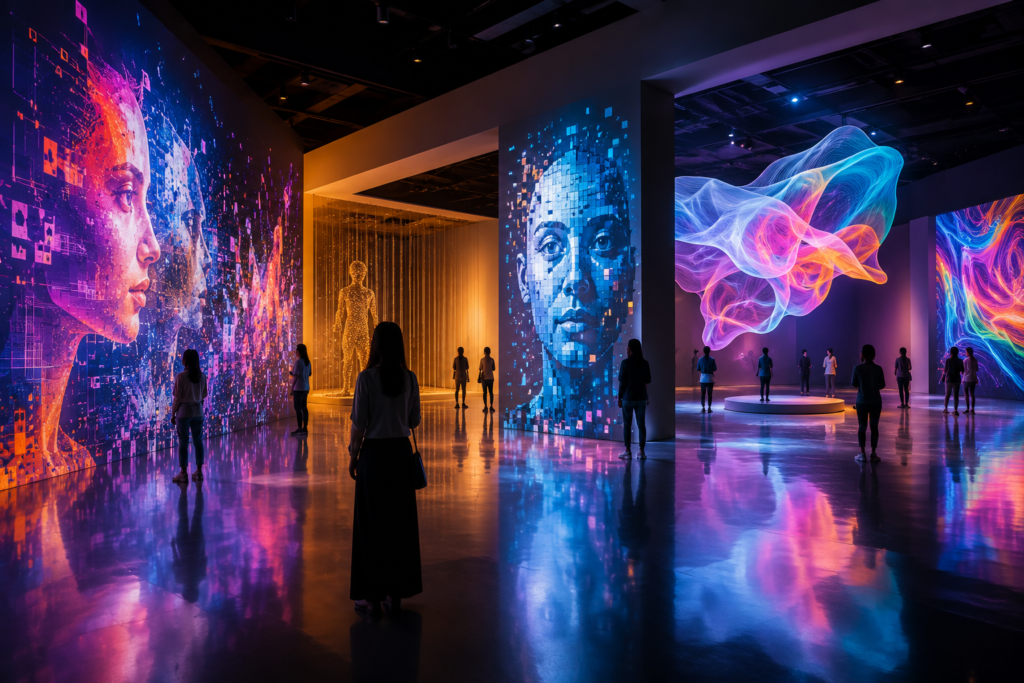
DATALAND’s inaugural exhibition, Machine Dreams: Rainforest, makes that question unusually literal. The Los Angeles museum describes the show as an immersive exploration of rainforest intelligence powered by Refik Anadol Studio’s Large Nature Model, an AI system trained on an ethically curated ecological archive combined with original fieldwork and direct observation of nature. DATALAND’s Machine Dreams: Rainforest page frames the exhibition through image, sound, scent, and interaction, rather than image alone.
This is not the dream canvas of Salvador Dalí or Max Ernst. It is a room-sized environment built from ecological data, projection, computation, and sensory design. The dreamlike effect comes from scale and responsiveness. Visitors do not simply read an image. They enter a system that translates rainforest information into a changing atmosphere.
How DATALAND Turns Data Into An Immersive Unconscious
DATALAND opened in downtown Los Angeles in June 2026 as a museum dedicated to AI arts. Its public identity is built around the idea that data can become “pigment” and that art can evolve in real time through human interaction and machine intelligence. The museum’s official DATALAND overview describes five multi-sensory galleries and positions the project as a place where human imagination meets machine creativity.
That language is ambitious, and it deserves careful reading. AI exhibitions often borrow the language of dreams, intelligence, nature, and feeling. Those words can create wonder, but they can also hide the technical and institutional choices behind the work. A rainforest dataset is not a rainforest. A generated environment is not ecological repair. An immersive gallery can make viewers feel connected to nature, yet the connection is mediated by servers, projection systems, software models, curatorial decisions, and sponsorship structures.
This tension is exactly why the exhibition belongs in a surrealist-adjacent discussion. Surrealism often made viewers distrust the surface of reality. DATALAND asks a modern version of that distrust: when a museum turns data into a living environment, what are we really seeing? A dream of nature? A machine’s statistical pattern? An artist’s authored vision? A technological spectacle? A new kind of landscape painting?
The answer may be all of these at once. That category instability is the point. AI art exhibitions are not only creating new images. They are changing the conditions under which images feel alive.
This connects naturally with thesurrealists.org’s earlier discussion of automatic drawing in Surrealism, where automatic methods were treated as ways to disturb conscious control. AI generation is not psychic automatism, but it has revived public fascination with images that seem to arrive from a process outside ordinary authorship.
Why Schirn’s “The World Through AI” Adds Political And Ecological Pressure
If DATALAND leans into sensory immersion, Schirn Kunsthalle Frankfurt’s The World Through AI gives the topic a broader critical frame. The exhibition runs from June 11 to September 20, 2026, and presents works from the last ten years that address the cognitive, political, and environmental dimensions of AI. Schirn’s The World Through AI page names artists and works including Holly Herndon and Mat Dryhurst, Hito Steyerl, Trevor Paglen, Kate Crawford and Vladan Joler, Joan Fontcuberta, and Grégory Chatonsky.
That list matters because AI art is not a single aesthetic. Some artists use machine learning to generate uncanny images. Others expose the human labor behind the illusion of automation. Some investigate surveillance, datasets, military vision, environmental cost, or the politics of classification. The dream machine is not always beautiful. It can be bureaucratic, extractive, predictive, and disciplinary.
Schirn’s exhibition also uses “time capsules” or small cabinets of curiosities to connect the present with the past. That curatorial choice is useful for a Surrealism-focused reader. The cabinet of curiosities has always had a dreamlike relationship to knowledge: part archive, part theater, part taxonomy, part fantasy. When AI enters that format, the museum can show how machine vision is tied to older habits of collecting, sorting, naming, and controlling the visible world.
The most convincing AI-art exhibitions in 2026 are not asking whether machines can make pretty pictures. They are asking how machine systems change perception. They make viewers feel the seduction of generated images and then push them to notice the structures underneath. A museum becomes a dream machine at the exact point where wonder and suspicion occupy the same room.
How “Dreaming Beyond AI” Moves Past Algorithmic Spectacle
The ifa-Galerie Stuttgart exhibition Dreaming Beyond AI: Portals Behind the Algorithm takes a different route. It opened in April 2026 and asks how people might reclaim time, relationships, and futures beyond algorithmic logic. The ifa press release for Dreaming Beyond AI describes eight artists from ifa residencies working across sound, video, AI images, and virtual reality to imagine care, resistance, and community.
That framing matters because it shifts the AI-art conversation away from spectacle alone. The dream is no longer just a generated image on a large wall. It becomes a social and political question. Who gets to dream beyond the systems that sort attention, filter information, generate images, and shape public life? Who is turned into data? Who is made invisible by the algorithm? Who can refuse the speed and logic of machine decision-making?
This is where AI exhibitions can become especially valuable for surrealist criticism. Historical Surrealism was never only about private dreams. It had political ambitions, anti-bourgeois instincts, and a desire to break the habits of rational order. The movement’s record is uneven, especially around gender, colonialism, and power, but its best methods still help viewers question what society calls normal.
Dreaming Beyond AI uses “portals” as a curatorial idea, and that word carries strong visual-culture force. A portal is not simply a screen. It is a threshold. It suggests passage between systems, bodies, memories, and possible futures. In an AI exhibition, that threshold can become a way to resist the closed logic of the black box. The visitor is asked not only to marvel at generated images, but to ask what kinds of life are possible outside algorithmic prediction.
Why The Museum Is Becoming Part Of The Artwork
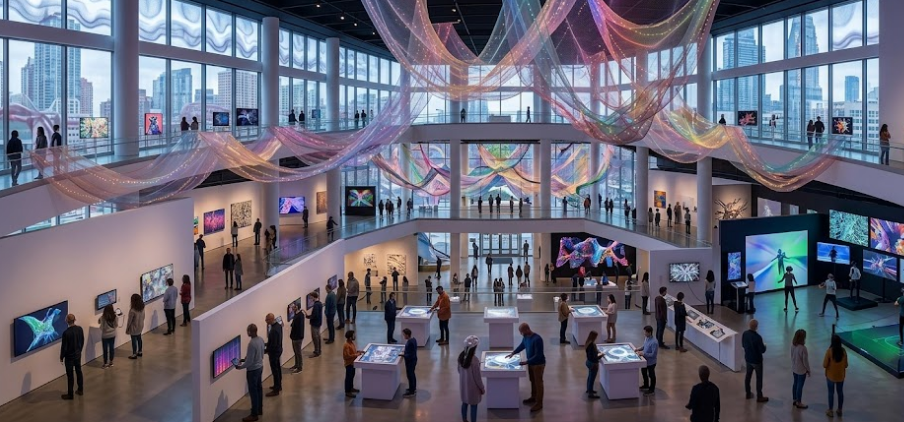
AI art changes the museum because the institution is no longer a neutral container. Projection systems, data pipelines, headphones, spatial sound, motion sensors, archive access, licensing agreements, and visitor interfaces all shape the artwork. The museum becomes part stage, part laboratory, part server room, part theater of perception.
That shift is not entirely new. Installation art, video art, light art, sound art, performance, and expanded cinema all challenged the idea that artworks must remain stable objects. AI exhibitions inherit those histories. What feels new in 2026 is the degree to which museums are presenting machine intelligence as a spatial experience rather than a technical topic.
The visitor’s role changes with it. In a painting gallery, the viewer’s body may affect interpretation, but not usually the painting itself. In many AI installations, the visitor may trigger, alter, or complete the work. Interaction can feel magical, yet it also introduces a problem: the more responsive the artwork becomes, the harder it may be to see where authorship sits.
The museum must then answer questions that used to sit outside the gallery wall. What datasets were used? Which artists, institutions, researchers, or platforms shaped the system? What labor supported the technology? What environmental costs are hidden behind the spectacle? What does visitor data do inside the installation? How much of the experience is live generation, and how much is designed simulation?
Strong exhibitions do not need to answer every technical question inside the room, but they do need to make the system legible enough for public trust. Otherwise the dream machine risks becoming a fog machine: beautiful, immersive, and difficult to question.
What AI Dream Machines Borrow From Surrealist Methods
AI art exhibitions feel close to Surrealism because they share several visual and psychological effects. They create images that seem familiar and alien at the same time. They collapse scale. They transform bodies, plants, landscapes, archives, and machines into unstable hybrids. They turn ordinary perception into an event.
Surrealist collage broke reality by cutting and recombining fragments. AI image systems often produce a similar shock through statistical recombination, though the process is technical rather than tactile. Surrealist automatism challenged conscious control. AI generation raises a new authorship question: how much control belongs to the artist, the model, the dataset, the interface, and the institution? Surrealist exhibitions made viewers feel that the everyday world contained hidden irrational forces. AI exhibitions suggest that contemporary life is already shaped by invisible systems reading, sorting, and predicting us.
The difference matters as much as the resemblance. Surrealism sought access to the unconscious. AI systems do not have an unconscious in the human sense. They model patterns from data. They do not dream as people dream. When museums use dream language around AI, the metaphor should be treated as a curatorial tool, not a literal claim.
That caution protects both art history and current criticism. AI exhibitions can be surreal without being Surrealist. They can use dreamlike environments without inheriting the full history of the Surrealist movement. They can extend questions about perception while also introducing new questions about computation, extraction, automation, and institutional power.
How AI Exhibitions Could Change Museum Trust
The next stage for AI art exhibitions will depend on trust as much as spectacle. Viewers may enjoy immersive rooms, shifting images, and responsive environments, but museums carry a public responsibility that entertainment venues do not. A museum that presents AI art should help visitors understand the difference between artistic metaphor and technical fact.
This is especially true when exhibitions use nature, memory, archives, or human emotion as source material. A show like Machine Dreams: Rainforest can create a powerful encounter with ecological imagery, but the museum experience should not be confused with environmental knowledge by itself. A show like The World Through AI can examine AI’s political and ecological dimensions, but its critical value depends on how clearly it connects artworks to real systems. A show like Dreaming Beyond AI can open alternative futures, but its force comes from making algorithmic life feel open to contestation rather than inevitable.
For thesurrealists.org readers, this is where the topic becomes more than a technology trend. Surrealism has always asked what reality hides under its official surface. AI art exhibitions ask a related question for the 2020s: what images are being made by systems we cannot fully see, and how are those systems changing what museums ask us to feel?
Why The Dream Machine Matters For Surrealist Visual Culture
AI art exhibitions are turning museums into dream machines because they combine spectacle, automation, sensory design, archive logic, and unstable authorship. They make viewers move through images rather than stand before them. They turn datasets into atmosphere. They make the museum feel less like a room of finished artworks and more like a site where perception is being manufactured.
That transformation deserves excitement and skepticism in equal measure. At their best, AI exhibitions can help audiences see the invisible systems shaping contemporary life. They can connect digital technology to older histories of collage, automatism, installation, cinema, and surrealist disorientation. They can make the museum feel alive without pretending that machines dream the way humans do.
At their weakest, they risk turning complexity into glow, data into décor, and ethics into branding. The strongest museums will be the ones that let visitors feel the dream and inspect the machine.