
Surrealism became international long before museums began describing it that way.
One reason was Peggy Guggenheim.
Before World War II transformed the geography of modern art, Guggenheim used a small London gallery to connect artists, collectors, writers, critics, and experimental movements moving between Paris, London, Scandinavia, Central Europe, and beyond.
Her gallery, Guggenheim Jeune, opened at 30 Cork Street in London in January 1938 and operated until June 1939.
That was only about 18 months.
Yet during that short period, Guggenheim staged more than 20 exhibitions, introduced British audiences to artists associated with Surrealism and abstraction, and developed relationships that would later help her build one of the defining collections of 20th-century modern art.
The importance of those years is being reconsidered through Peggy Guggenheim in London: The Making of a Collector, organized by the Peggy Guggenheim Collection and traveling from Venice to London’s Royal Academy of Arts.
The official Peggy Guggenheim Collection exhibition runs in Venice from April 25 through October 19, 2026, before opening at the Royal Academy on November 21, 2026, where it continues through March 14, 2027.
Its story reveals something larger than the making of one famous collection.
Guggenheim helped create the networks through which Surrealism stopped looking like a Parisian movement and started behaving like an international avant-garde.
London Became Her Laboratory
Peggy Guggenheim was born in New York in 1898, but by the 1920s she had entered European bohemian and avant-garde circles.
Paris brought her into contact with artists and writers who would later shape her understanding of modern art.
One of the most important was Marcel Duchamp.
Guggenheim later credited Duchamp with helping her distinguish between abstraction and Surrealism and introducing her to artists working across both fields.
Another important figure was Samuel Beckett, who encouraged her to focus on contemporary art because it was, in his formulation, a living art.
Those relationships mattered because Guggenheim did not enter the art world as a trained historian or curator.
She learned through artists.
When she opened Guggenheim Jeune at age 39, the gallery became a practical education in modernism.
It also became an international meeting point.
Jean Cocteau Opened The Door
The first exhibition at Guggenheim Jeune featured work by Jean Cocteau.
That choice immediately signaled that the gallery would not confine itself to conventional painting.
Cocteau moved between poetry, drawing, theatre, film, and the wider French avant-garde.
Soon afterward, Guggenheim presented Vasily Kandinsky’s first solo exhibition in Britain.
Kandinsky was not a Surrealist, but his presence beside artists associated with Surrealism shows what made Guggenheim’s program distinctive.
She was not building a gallery around one doctrine.
She was building bridges between competing avant-gardes.
Surrealism and abstraction often disagreed theoretically, but Guggenheim displayed both.
That decision allowed London audiences to see modern art as an international conversation rather than a sequence of isolated movements.
Guggenheim Jeune Gave Surrealists A London Platform
Surrealism already had an important British presence by 1938.
The International Surrealist Exhibition in London in 1936 had introduced a large audience to the movement, with participation from figures such as André Breton, Salvador Dalí, Paul Éluard, Man Ray, Max Ernst, Joan Miró, and British Surrealists.
Guggenheim Jeune helped turn that spectacular moment into something more sustained.
The gallery presented a solo exhibition by Yves Tanguy, whose empty landscapes and biomorphic forms had become central to French Surrealism.
It also gave a solo exhibition to Danish artist Rita Kernn-Larsen.
Kernn-Larsen is particularly significant because her inclusion demonstrates how quickly Surrealism was moving beyond its familiar French center.
She had studied with Fernand Léger in Paris and became associated with the Danish Surrealist scene.
Guggenheim gave her a platform in London.
Parisian ideas were moving through Scandinavian artists into British exhibition spaces under the direction of an American dealer.
That is international Surrealism in practice.
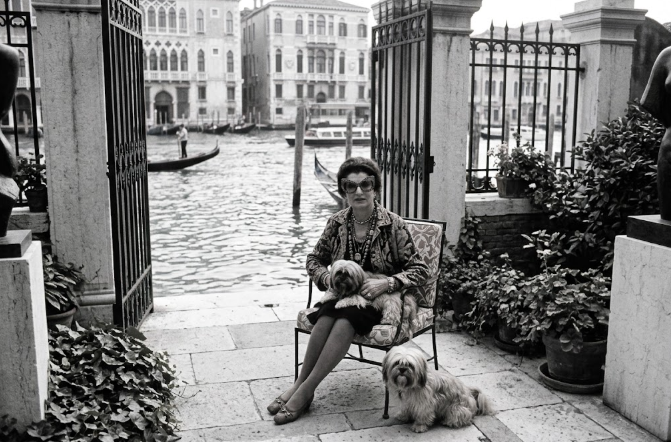
The Gallery Was More International Than Its Size Suggested
The Peggy Guggenheim Foundation archives document just how broad Guggenheim Jeune’s network became.
Artists shown at the gallery included Jean Arp, Constantin Brancusi, Sophie Taeuber-Arp, Alexander Calder, Henry Moore, Antoine Pevsner, Henri Laurens, and Raymond Duchamp-Villon, alongside artists connected more directly to Surrealism.
The list crosses national borders and artistic camps.
French.
British.
Swiss.
Romanian.
Russian.
American.
German-born and Austrian-born artists working across Europe.
That range matters because Surrealism’s internationalization did not happen only through manifestos.
It happened because people created physical spaces where artists from different countries could be seen together.
Guggenheim Jeune was one of those spaces.
The First British Collage Exhibition Made Experiment Itself The Subject
One of the gallery’s most important achievements was what the current 2026 exhibition identifies as the first group exhibition devoted to collage in the United Kingdom.
Collage had already transformed Cubism, Dada, and Surrealism.
For Surrealists in particular, it offered a method for breaking the logic of ordinary images.
An object could leave one context and appear in another.
A face could collide with machinery.
Victorian illustration could become erotic nightmare.
Advertising could mutate into dream.
Presenting collage as an exhibition category helped British audiences see experimental method rather than national identity as a connecting principle.
That is another reason Guggenheim’s gallery mattered internationally.
She created connections between artists based on what they were doing to images, not simply where they came from.
Sculpture Could Be Provocative Too
Guggenheim Jeune also staged a contemporary sculpture exhibition that generated controversy.
Even customs officials became involved in debates over whether some modern sculptures qualified as art or merely as manufactured objects.
The dispute sounds almost comic now, but it exposed a central problem of avant-garde culture.
Who decides what counts as art?
Surrealists had already destabilized that boundary through found objects, assemblage, altered commodities, and improbable combinations.
Duchamp’s earlier readymades had made the problem unavoidable.
Guggenheim’s gallery carried those disputes into a British commercial and institutional setting.
Modern art was not merely arriving from abroad.
It was forcing local institutions to reconsider their categories.
Marcel Duchamp Was More Than An Adviser
Duchamp’s role in Guggenheim’s development cannot be overstated.
He introduced her to artists, clarified competing modernist movements, and helped her navigate an avant-garde culture whose social networks could be as important as its manifestos.
This was especially important for Surrealism.
Breton’s movement operated through journals, exhibitions, friendships, expulsions, political alliances, private collections, and personal introductions.
Guggenheim entered that network socially before she mastered it institutionally.
Duchamp acted as a connector.
Guggenheim learned to become one herself.
That ability would later prove crucial when European artists fled war and fascism.
Women Were Already Part Of Her International Map
The history of Guggenheim Jeune also challenges the idea that prewar modernism consisted almost entirely of famous male artists.
Artists such as Rita Kernn-Larsen, Eileen Agar, Barbara Hepworth, and Sophie Taeuber-Arp were part of the wider environment reconstructed by the 2026 exhibition.
Their presence matters.
Surrealism has often been narrated through Breton, Dalí, Ernst, Magritte, and Miró.
Yet its international expansion depended on women as artists, dealers, patrons, photographers, writers, collectors, and organizers.
Guggenheim herself belonged to that infrastructure.
She did not make Surrealist paintings.
She created conditions under which Surrealist work could cross borders.
That kind of cultural labor is easy to underestimate because it does not produce a single iconic canvas.
Its effect appears in networks.
Her Gallery Closed Just As Europe Was Collapsing
Guggenheim Jeune closed in 1939.
By then, Europe was approaching catastrophe.
Rather than leaving the art world, Guggenheim planned something larger: a museum of modern art in London.
She worked with British critic Herbert Read on the project.
The museum did not materialize because World War II transformed the situation too quickly.
But Guggenheim began collecting aggressively.
Her ambitions shifted from temporary exhibitions toward building a permanent collection of contemporary art.
That collection would eventually include works by major figures connected to Surrealism, Cubism, abstraction, and other avant-garde movements.
The war did not end her international network.
It changed its destination.
War Pushed Surrealism Across The Atlantic
After Germany invaded France, many European avant-garde artists faced persecution, displacement, or exile.
Surrealism’s geographic center shifted dramatically.
Artists including André Breton, Max Ernst, André Masson, and others spent important wartime periods in the United States.
Guggenheim herself eventually returned to New York.
In 1942, she opened Art of This Century, one of the most important avant-garde galleries in wartime America.
That later story is often presented as Guggenheim’s defining achievement.
But the infrastructure behind it had been developed in London.
At Guggenheim Jeune, she had already learned how to move between artistic movements, national cultures, established figures, experimental artists, critics, and collectors.
London was rehearsal.
New York became the larger stage.
International Surrealism Was Built Through Exile And Connection
The war would eventually make internationalism unavoidable.
Artists moved because they had to.
Yet Guggenheim’s prewar activity shows that Surrealism had already become transnational before forced migration accelerated the process.
Artists were traveling between Paris, London, Copenhagen, Prague, Brussels, and other centers.
Dealers moved work across borders.
Exhibitions connected unfamiliar audiences to foreign artists.
Personal relationships carried ideas faster than institutions could formalize them.
This network would later extend into Mexico, the United States, and other regions.
For an example of how exile ultimately transformed Surrealism far beyond Europe, readers can explore thesurrealists.org’s verified feature on Remedios Varo’s science, magic, and enigmatic worlds.
Varo’s later career in Mexico demonstrates what happened when European Surrealist networks encountered radically different cultural environments.
Guggenheim’s London years belong to an earlier stage of that same international history.
Collecting Became Another Way To Build The Movement
Peggy Guggenheim did more than sell art.
She bought it.
That distinction matters.
Commercial galleries normally move works from artists to clients.
Guggenheim increasingly became the client herself.
She began assembling a collection that crossed artistic and national boundaries.
This changed her role from dealer to cultural intermediary.
A temporary exhibition disappears.
A collection preserves relationships between works.
By placing abstraction beside Surrealism and European artists beside British and American counterparts, Guggenheim eventually created a physical record of how interconnected modern art had become.
That record would survive the war.
The 2026 Exhibition Restores London To The Story
Peggy Guggenheim in London: The Making of a Collector runs at the Peggy Guggenheim Collection in Venice through October 19, 2026.
It then travels to the Royal Academy of Arts in London from November 21, 2026, through March 14, 2027, before continuing to the Guggenheim Museum in New York in 2027.
Curated by Gražina Subelytė and Simon Grant, the exhibition brings together roughly 100 works connected to Guggenheim Jeune and its period.
That reconstruction makes one point especially clear.
Guggenheim did not make Surrealism international by herself.
No single dealer could.
But she helped build the routes through which international Surrealism operated.
She gave artists platforms outside their home countries.
She put abstraction and Surrealism into the same conversations.
She connected London with Paris and wider European networks.
She learned from Duchamp, Beckett, artists, critics, and collectors.
Then, as Europe descended into war, she carried those connections onward.
Surrealism may have been proclaimed in Paris.
By 1939, people such as Peggy Guggenheim had already ensured that it could no longer belong to Paris alone.