
Brassaï: Secret Paris at Heide Museum of Modern Art in Melbourne turns night photography into a Surrealist city dream because it treats Paris after dark as more than a subject. The city becomes a stage of fog, lamps, graffiti, bodies, thresholds, mirrors, wet pavement, and social ambiguity. Running in the Heide Main Galleries from July 25 to November 15, 2026, the exhibition presents the most comprehensive survey of Brassaï yet seen in Australia, bringing together more than 150 vintage prints and focusing on his images of 1930s Paris by night.
For thesurrealists.org, this exhibition matters because Brassaï’s photographs sit at a crucial crossing point between documentary realism and Surrealist perception. He did not need to invent impossible creatures or theatrical dream scenes. Instead, he photographed the real city until it began to behave like a dream. A streetlamp became a moon. A café became a secret chamber. Graffiti became an unconscious language written on stone. Night made Paris look familiar and unknowable at the same time.
Heide’s official exhibition page frames the show around Brassaï’s iconic photographs of Paris and its people by night, his friendship with Pablo Picasso and other avant-garde figures, his experiments with Surrealism, and his hallmark graffiti photographs. That combination gives the exhibition its strongest argument: Brassaï’s Paris is not simply a historical city. It is a psychological city, built from darkness, chance, desire, and signs.
Why “Secret Paris” Feels Like A Surrealist City Dream
Brassaï, born Gyula Halász in 1899 in Brassó, then part of Hungary and now Brașov in Romania, moved to Paris in 1924 after studying in Budapest and Berlin. He first worked as a journalist, then turned increasingly toward photography. His chosen name, Brassaï, means “from Brassó,” turning his own artistic identity into a sign of displacement and reinvention.
That personal history matters because Brassaï looked at Paris as both insider and outsider. He knew the city intimately, yet he also approached it as someone alert to its surfaces, rituals, codes, and shadows. This gave his work a special tension. His photographs are documentary enough to preserve real streets and real people, but they are also dreamlike enough to make those streets feel symbolic.
Moderna Museet’s Brassaï exhibition page notes that he made his major breakthrough with Paris de nuit in 1933, after long nocturnal walks through Paris. The motifs included Notre-Dame, the Eiffel Tower, bars, dance halls, artists, workers, policemen, and petty thieves. That range is essential. Brassaï did not make a purified postcard Paris. He photographed a city where glamour, labor, crime, intimacy, architecture, and accident shared the same darkness.
The Surrealist quality comes from that collision. Paris does not become surreal by leaving reality. It becomes surreal when reality is seen under altered conditions: fog, lamp glow, night, reflection, desire, and the slow pressure of looking.
How Night Changed The Meaning Of The City
Night photography in Brassaï’s hands was not just a technical challenge. It was a way of changing what Paris could mean. Daylight organizes the city through work, traffic, monuments, commerce, and official visibility. Night loosens those structures. It turns architecture into silhouette, streets into corridors, windows into screens, and people into performers caught between public and private life.
That is why Brassaï’s Paris still feels modern. The city is not only a place. It is an image machine. Streetlights create scenes. Wet pavements double the world. Fog softens buildings until they look half-remembered. Figures appear at doorways, tables, bridges, and alleys as if they have stepped into a stage set. The city photographs itself through shadow.
This is where Brassaï’s work fits the broader history of Surrealist photography. Surrealism often used the camera to prove that ordinary reality was already unstable. The lens could find uncanny doubles, mannequins, masks, fragments, strange bodies, and accidental symbols in the everyday. Brassaï’s night photographs participate in that project, but with unusual restraint. He rarely needs tricks. The city provides the dream.
That makes Secret Paris especially valuable for readers interested in Surrealism in film and photography. Brassaï shows how the camera can turn observation into psychological atmosphere. The photograph records what was there, yet the resulting image feels as if it belongs to a private dream.
Why Brassaï’s Paris Was Secret Rather Than Hidden
The word “secret” is important. Brassaï’s Paris was not invisible. People lived, worked, desired, drank, danced, waited, and wandered there. The secret lay in how the city changed when seen without moral simplification. Brassaï photographed nightlife, lovers, cafés, brothels, dance halls, queer spaces, workers, criminals, and social outsiders with an eye that could be theatrical without becoming cruel.
That balance is one reason his photographs still matter. Many artists have used nightlife as spectacle. Brassaï made it feel intimate. He understood that night could reveal social realities that daylight kept separate or polite. Yet his images rarely reduce people to types. They often preserve a sense of interiority, even when the subjects appear posed or caught inside a public scene.
This is where the exhibition’s Surrealist angle becomes ethically interesting. Surrealism has often been fascinated by marginal spaces, erotic charge, urban wandering, and the strange life of the street. Brassaï shares those interests, but his best images do not treat the city’s people as props in an artist’s fantasy. They treat them as part of the city’s living intelligence.
The dream is social, not only private. Brassaï’s Paris dreams through its cafés, staircases, graffiti, street corners, and nocturnal economies. The city appears as a collective unconscious made visible in silver gelatin.
How Graffiti Became The City’s Unconscious Writing
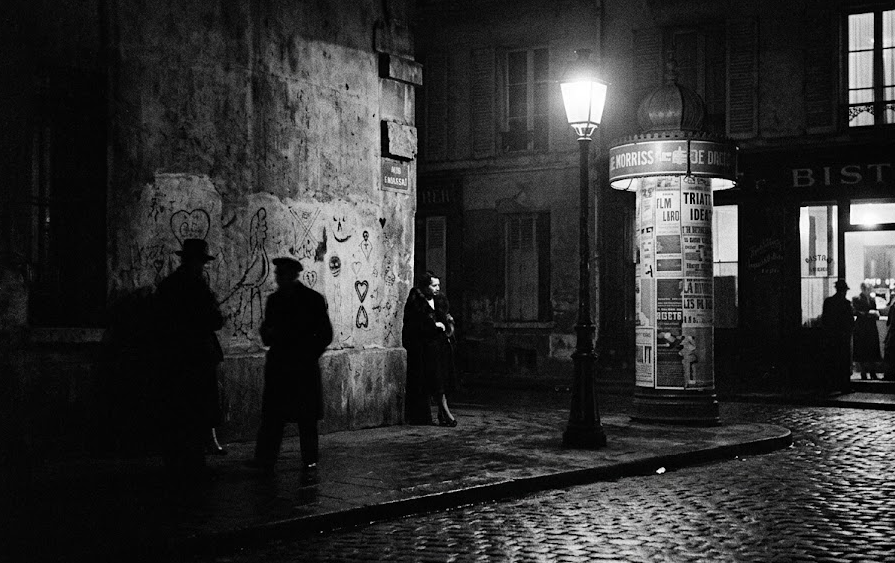
Brassaï’s graffiti photographs are central to the exhibition because they turn walls into psychological surfaces. Graffiti, for him, was not merely urban damage or casual marking. It was a language of anonymous desire, violence, humor, fear, memory, and play. A scratched face, crude figure, symbol, or carved mark could feel as charged as a drawing from a dream journal.
Heide highlights these graffiti photographs as one of Brassaï’s hallmarks. Moderna Museet also places graffiti among the three major themes of its 2026 Brassaï exhibition, alongside Parisian nightlife and portraits of artists. That matters because graffiti connects Brassaï directly to Surrealism’s interest in automatic marks, found images, and the irrational life of surfaces.
A city wall is supposed to be background. Brassaï makes it speak. In his photographs, graffiti becomes evidence that Paris is not only designed by architects, officials, and planners. It is also written by unknown hands. The wall holds jokes, wounds, signs, and fragments of fantasy. It becomes a public version of the unconscious.
This is one of Brassaï’s most Surrealist moves. He does not impose dream imagery onto Paris. He discovers dream imagery already scratched into the city. The camera becomes an act of reading.
Why Picasso And The Avant-Garde Matter To Brassaï’s Vision
Brassaï’s friendships with Picasso and other avant-garde figures are more than biographical decoration. They help explain the artistic world in which he learned to see the city as a field of forms, signs, masks, and transformations. Heide’s exhibition description specifically notes his friendship with Picasso and leading figures of the Parisian avant-garde, placing the photographs within a larger culture of modernist experiment.
Brassaï’s portraits of artists also show another side of his city. Paris after dark was not only a place of bars and streets. It was a network of studios, salons, cafés, conversations, and artistic mythmaking. The same city that produced modern painting also produced modern photography’s nocturnal imagination.
Yet Brassaï was not simply a photographer of famous people. His work is strongest when it refuses hierarchy between celebrity and anonymity. Picasso may belong to the avant-garde pantheon, but a lamplighter, dancer, lover, worker, or anonymous graffiti mark can carry equal visual force in Brassaï’s Paris. The city democratizes strangeness.
That is why his photographs feel different from straightforward art-world documentation. They turn the avant-garde outward. Surrealism is not only in the studio. It is in the street, on the wall, at the café table, in the fog, and in the fragile interval between seeing and being seen.
How Documentary Realism Becomes Dream Logic
Brassaï’s greatest strength may be his refusal to choose between realism and dream. His photographs do not abandon the documentary world. They intensify it. The street is real. The person is real. The bridge is real. The graffiti is real. Yet the image feels as if reality has been shifted half a step into another register.
That shift comes from light, framing, timing, and atmosphere. Night removes excess information. It lets the photographer isolate forms. A staircase becomes a diagonal of suspense. A bridge becomes a theatrical threshold. A café booth becomes a chamber of intimacy. A face half-lit by a lamp becomes an emblem of secrecy.
This is why Secret Paris works so well as an exhibition title. Brassaï’s photographs do not simply expose hidden content. They reveal that the visible city had always carried dream logic inside it. The camera does not create the secret. It recognizes it.
That recognition gives his work lasting importance. Modern viewers live in cities saturated with images, surveillance, screens, and night economies. Brassaï’s Paris belongs to another era, but its visual problem remains current: how can a camera show the strange life of a city without flattening it into information?
Why Brassaï’s Night Photography Still Feels Contemporary
Brassaï’s work feels contemporary because cities are still experienced through darkness, fragments, and partial visibility. The modern city is never fully knowable. It appears in reflections, windows, screens, rides, alleys, feeds, and passing encounters. Brassaï’s night photography anticipates that fractured urban experience without needing digital tools.
His images also challenge today’s speed. Many contemporary photographs are consumed quickly, as content. Brassaï asks for slow looking. His blacks are not empty. His shadows contain social worlds. His details reward attention. A viewer has to enter the photograph gradually, almost as one enters a street at night.
That slowness is part of the dream. The image does not tell everything at once. It withholds. It asks the viewer to notice the edge of a table, the posture of a figure, the glow of a lamp, the texture of a wall, the way fog changes distance. In this sense, Brassaï’s photographs train the eye against the quick consumption of images.
The Australian’s current coverage of the Heide exhibition reports that the show includes 156 hand-printed vintage photographs, rare books such as the original Paris de Nuit, and a short film that premiered at Cannes in 1956. Its Brassaï exhibition feature underscores how the exhibition links Brassaï’s nocturnal Paris to a wider artistic legacy. Even when viewed through a contemporary museum context in Melbourne, the photographs still feel like living urban myths.
How “Secret Paris” Reframes Surrealism Through The Street
The exhibition’s strongest art-historical value lies in its ability to reframe Surrealism through the street rather than the studio. Brassaï’s Surrealism is not a matter of invented fantasy. It is a way of perceiving the city’s existing strangeness. He finds the marvelous in street lamps, bars, graffiti, damp pavement, and nocturnal faces.
This matters because Surrealism is sometimes reduced to spectacular images: melting clocks, impossible rooms, theatrical bodies, and dream creatures. Brassaï offers a quieter but equally powerful alternative. His work suggests that Surrealism can be an ethics of attention. The artist does not always have to distort reality. Sometimes the artist has to wait until reality reveals its own distortion.
That idea fits the tradition of the flâneur, the urban wanderer who reads the city through movement. Brassaï’s walks through Paris were not neutral strolls. They were acts of visual excavation. He entered the city when official narratives softened and the unofficial city came forward.
In this way, Secret Paris turns photography into a form of dream archaeology. Every street image becomes a trace. Every wall mark becomes a sign. Every night scene becomes part of a larger city-mind.
Why The Exhibition Belongs On Thesurrealists.org
Brassaï: Secret Paris belongs on thesurrealists.org because it expands the site’s Surrealist frame beyond painting, manifesto, and dream symbolism. It shows how photography can make the real world feel uncanny without abandoning the real. It also connects Surrealism to urban life, queer nightlife, graffiti, modernist friendship, censorship, and the politics of looking.
The exhibition’s Melbourne context adds another layer. Heide Museum of Modern Art is presenting a European modernist photographer to Australian audiences in 2026, but the subject is not old nostalgia. It is the enduring question of how a city becomes image, memory, and myth. Brassaï’s Paris still speaks because every city has a secret version of itself: the one seen at night, from the corner of the eye, through signs that official daylight ignores.
Brassaï Secret Paris is not simply a photography exhibition. It is a study of how night photography turns urban reality into Surrealist visual culture. The show gives readers a fresh way to understand Brassaï as more than “the eye of Paris.” He was also one of the great readers of Paris: its walls, shadows, social codes, erotic margins, and dreamlike atmospheres.
Why Night Photography Becomes A City Dream
Brassaï’s achievement lies in making the city look awake inside its own sleep. His photographs do not show Paris resting. They show it transforming. The monuments remain, but the night rearranges their meaning. The streets remain, but fog and lamps make them theatrical. People remain themselves, but the camera catches them inside scenes that feel symbolic.
That is why Secret Paris turns night photography into a Surrealist city dream. It reveals the city as a place where realism and fantasy are not opposites. They are conditions of each other. The more closely Brassaï photographs the real Paris, the more dreamlike it becomes.
In the end, Brassaï’s secret is not that Paris had hidden corners. Every city has hidden corners. His secret is that photography could make those corners speak. Night gave him the atmosphere, but his eye gave the atmosphere form. Through Brassaï, Paris becomes a dream not because it escapes reality, but because it shows reality under the spell of darkness.