
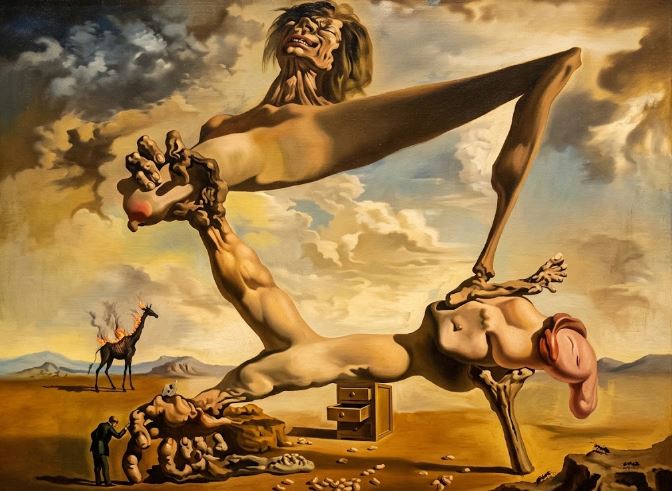
Salvador Dalí’s Soft Construction with Boiled Beans (Premonition of Civil War) (1936) still looks less like a political painting than a body destroying itself.
That is precisely why it remains so powerful.
A gigantic, mutilated figure twists across a barren Spanish landscape. One hand grips a breast. Another limb tears violently at the rest of the body. Flesh appears soft, stretched, decaying, and structurally impossible. The creature is both victim and aggressor.
There is no battlefield.
No uniform.
No flag.
No identifiable army.
Instead, Dalí turns civil conflict into anatomy.
That reading has become newly relevant because the Dalí Museum in St. Petersburg, Florida, is presenting the painting in A Body at War: Soft Construction with Boiled Beans (Premonition of Civil War) from October 29, 2026, through April 18, 2027.
The official Dalí Museum presentation brings the work to Florida on loan from the Philadelphia Museum of Art, 90 years after its creation, and places renewed emphasis on political division, self-destruction, and the painting’s relationship to Spanish artists including Francisco Goya and Pablo Picasso.
The timing is useful because Soft Construction is often reduced to a single claim: Dalí supposedly predicted the Spanish Civil War.
The painting is more complicated than prophecy.
It asks what happens when a country’s political violence is imagined as a body physically incapable of stopping itself.
Dalí Painted The Work Before The War Formally Began
The Spanish Civil War began in July 1936, after a military uprising against the elected Second Spanish Republic escalated into a devastating national conflict.
Dalí had already been working on Soft Construction with Boiled Beans in Paris.
The Philadelphia Museum of Art dates the painting to early 1936, before the outbreak of full-scale war.
That chronology has long contributed to the work’s reputation as prophetic.
But the word “premonition” needs caution.
Spain had already been experiencing deep political polarization, strikes, assassinations, revolutionary tensions, right-wing mobilization, and violent conflict before July.
Dalí was not painting from a peaceful vacuum.
The political body was already under strain.
The painting’s continuing force comes less from supernatural prediction than from its ability to visualize a society tearing itself apart before the destruction reached its worst stage.
The Monster Is Fighting Itself
The central figure is one of Dalí’s most brutal inventions.
The Philadelphia Museum of Art describes it as a grimacing colossus ripping itself apart above a sunbaked Spanish landscape.
Its anatomy refuses ordinary logic.
Limbs change orientation.
Hands swell grotesquely.
A breast appears where the viewer might expect another form.
The torso seems incomplete.
Parts of the body strain against other parts of the same body.
That is the key metaphor.
Civil war differs from conventional war because the enemy is internal.
Cities fight cities.
Neighbors fight neighbors.
Institutions split.
Families divide.
Citizens attack citizens who belong to the same country.
Dalí does not paint two monsters.
He paints one.
The creature becomes a political system whose opposing forces occupy the same flesh.
Dalí Made National Division Feel Physical
Political language often becomes abstract.
Polarization.
Factions.
Ideology.
Revolution.
Counterrevolution.
Dalí turns those concepts into something painfully bodily.
The monster does not merely disagree with itself.
It physically injures itself.
A hand becomes a weapon against the body to which it belongs.
The image therefore bypasses conventional political illustration.
Instead of explaining the Spanish crisis, Dalí makes the viewer feel its internal violence.
That is one reason the painting still feels contemporary.
Political division remains difficult to visualize until it becomes physical.
Dalí’s body supplies that image.
A divided country is not two clean halves.
It is one organism damaging itself while still remaining connected.
The Flesh Is Both Powerful And Rotten
Dalí’s technical precision makes the violence worse.
The figure is painted with the meticulous realism he developed during his mature Surrealist period.
That precision makes impossible anatomy feel disturbingly tangible.
The Philadelphia Museum describes a limp, phallic form hanging from the body as an example of Dalí’s recurring soft forms, which often suggested decay, instability, and putrefaction.
Softness mattered enormously to Dalí.
Hard forms imply stability.
Soft forms collapse.
Melt.
Sag.
Rot.
Lose structural certainty.
In Soft Construction, the political body has become physically unreliable.
Its flesh cannot maintain order.
The country does not merely suffer attack.
Its own structure seems to be decomposing.
The Beans Make The Horror Stranger
Then come the boiled beans.
They appear scattered across the foreground, absurdly small beside the giant mutilated body.
Their presence is almost comic.
That discomfort is deliberate.
The Philadelphia Museum of Art record for the painting notes how their bizarre difference in scale contributes to the dreamlike logic of the work.
Dalí often used ordinary objects to intensify irrational scenes.
Food can become erotic.
Domestic objects can become threatening.
Common things can acquire psychological charge simply because they appear where they do not belong.
The beans perform that function here.
They make the monumental horror coexist with the banal.
Civil catastrophe exists beside dinner.
That collision is characteristically Surrealist.
The Landscape Makes The Violence Spanish
Behind the monster lies an exposed landscape.
The ground is dry.
The horizon is distant.
The sky shifts between luminous blue and ominous clouds.
The environment helps locate the creature psychologically within Spain without turning the painting into a literal map.
Dalí had already developed a strong attachment to the landscape of Catalonia, particularly the dramatic terrain around Cadaqués and Portlligat.
His strange bodies frequently occupy similarly empty spaces.
In Soft Construction, emptiness becomes political.
There are no crowds.
No soldiers.
No city.
The body itself carries the whole conflict.
The result feels almost mythic.
Spain becomes less a geographic state than a wounded organism.
Freud Helped Dalí Turn Politics Into Psychology
Dalí’s Surrealism was deeply influenced by Sigmund Freud.
Rather than painting political conflict in conventional documentary form, he interpreted violence psychologically.
The Philadelphia Museum notes that a tiny image of Freud appears near the lower left of the painting, inspecting the enormous hand.
That detail is easy to miss.
Its implication is important.
Dalí treats national conflict almost like a psychological symptom.
Political violence becomes something to diagnose through fantasy, distortion, desire, fear, and unconscious imagery.
This approach distinguishes Soft Construction from explicitly propagandistic art.
Dalí is not presenting a manifesto.
He is staging a psychic catastrophe.
Goya Is An Important Ancestor
The Dalí Museum’s 2026 presentation explicitly encourages comparison with Francisco Goya.
The connection is strong.
Goya’s The Disasters of War prints transformed the violence of the Peninsular War into images of mutilation, execution, starvation, cruelty, and bodily vulnerability.
He did not romanticize war.
Dalí operates differently, but the body performs a comparable function.
Political history becomes flesh.
War is not represented as strategy.
It becomes dismemberment.
Goya’s bodies suffer from identifiable human violence.
Dalí’s monster carries the violence inside itself.
That difference makes civil war especially horrific.
There is no clear outside attacker.
Picasso Offers The Inevitable Comparison
The other unavoidable Spanish comparison is Pablo Picasso’s Guernica (1937).
Picasso created Guernica after the bombing of the Basque town on April 26, 1937, producing one of the most important anti-war paintings of the 20th century.
Dalí’s painting came earlier.
The two works also respond differently.
Picasso fractures a collective scene.
People scream.
Animals suffer.
Architecture collapses.
Dalí compresses conflict into one gigantic organism.
Picasso’s violence happens to a population.
Dalí’s violence happens inside a body.
Placed together, the paintings demonstrate two radically different ways modern art could confront the Spanish Civil War.
Dalí’s Political Position Was Much More Ambiguous
This is where the painting becomes difficult.
Dalí was not Picasso.
He did not become an unambiguous artistic spokesman for the Spanish Republic.
His political behavior remained controversial, and his later relationship with Francisco Franco’s Spain permanently complicates attempts to treat Soft Construction as straightforward anti-fascist protest.
That distinction matters.
A powerful image of civil violence does not automatically tell us exactly which political position the artist held.
Dalí often preferred provocation, psychological interpretation, and personal mythology to conventional political commitment.
The painting should therefore not be rewritten into a simple partisan document.
Its power lies partly in its ambiguity.
Dalí depicts Spain destroying itself.
He does not provide a political program for saving it.
The Title May Have Become More Prophetic After The Fact
The painting’s famous subtitle—Premonition of Civil War—has helped create the image of Dalí as someone who psychically foresaw the conflict.
Historical evidence makes that claim less secure.
Philadelphia Museum educational research notes that Dalí may have modified the title after the July uprising, emphasizing the supposedly prophetic quality of the image.
That possibility matters.
It does not weaken the painting.
It makes Dalí’s self-mythology more visible.
He was extraordinarily skilled at shaping his own public identity.
Prediction suited him.
The larger achievement remains intact even without supernatural foresight.
Dalí created a convincing image of political self-destruction before the war reached its full horror.
That is remarkable enough.
The Painting Also Shows What Surrealism Could Do With Politics
Surrealism is sometimes treated as an escape from political reality.
Soft Construction demonstrates the opposite.
Surrealist distortion can make politics more visceral.
An impossible body can express national fragmentation more forcefully than a conventional historical tableau.
Scale can exaggerate anxiety.
Soft anatomy can make institutions feel unstable.
A desert can become psychological space.
Food can become uncanny.
Dream logic can turn political division into something the viewer experiences physically.
Readers interested in another example of how Surrealism transformed reality through highly personal symbolic systems can explore thesurrealists.org’s verified article on Remedios Varo’s science, magic, and enigmatic worlds.
Varo’s imaginative universe developed differently, but both artists demonstrate how Surrealism could make invisible forces appear materially real.
Ninety Years Later, The Body Still Works
A Body at War remains at the Dalí Museum through April 18, 2027.
The special presentation gives viewers a rare chance to see one of the Philadelphia Museum of Art’s most important Dalí paintings outside its home collection.
Its relevance does not depend on pretending that 1936 and 2026 are politically identical.
They are not.
What remains powerful is the metaphor.
A society can imagine itself divided into opposing camps.
A civil war reveals the deeper truth that those camps still inhabit one political body.
Damage inflicted on the enemy becomes damage inflicted on the shared structure.
Dalí gave that contradiction a monstrous anatomy.
The result is not merely a painting about Spain in 1936.
It is an image of what political self-destruction looks like when ideology enters flesh.
The giant tears at itself.
The landscape watches.
The beans remain absurdly scattered below.
And the body never discovers a way to stop fighting itself.