
Marie Wilson spent the 1950s moving through places that now look central to postwar Surrealist history. She knew Wolfgang Paalen. She entered André Breton’s Paris circle. She developed an unusual form of automatism. She collaborated with the Greek poet Nanos Valaoritis. Her imagery drew together biomorphic abstraction, cosmology, ritual structures, occult interests, and visual traditions encountered on both sides of the Atlantic.
Yet New York never gave her a proper exhibition.
That changes in September 2026.
From September 24 through September 27, 2026, Gallery Wendi Norris will present Wilson at Independent 20th Century at Sotheby’s at The Breuer, marking her New York debut and first East Coast presentation. The Independent 20th Century presentation will include paintings and works on paper spanning the development of a visual language that began in Northern California, changed dramatically after Wilson reached Paris in 1952, and became increasingly symmetrical and cosmological over the following decades.
The phrase “vanished from New York” therefore needs qualification. Wilson did not disappear from an established New York career. Something stranger happened: an American artist who worked directly among European Surrealists, exhibited under Breton, and eventually entered the Museum of Modern Art’s collection reached New York as the subject of a focused presentation only after her death.
Wilson died in Athens in 2017.
Her New York debut arrives nine years later.
Marie Wilson Began Far From Paris
Wilson was born in 1922 in Cedarville, California, a small town in Modoc County near the Oregon and Nevada borders.
That Northern California origin matters because her art did not begin as an imitation of Parisian Surrealism.
She studied at Mills College in Oakland, completing her undergraduate art education in the 1940s, and continued at the University of California, Berkeley. Gallery Wendi Norris identifies both institutions as formative stops before Wilson entered the experimental Bay Area art culture that developed after World War II.
The Bay Area she encountered was already absorbing ideas that did not fit neatly into American Abstract Expressionism.
Artists were investigating mysticism, non-Western visual traditions, psychology, Zen Buddhism, new scientific theories, and the legacy of European Surrealism.
Wilson became close to the Greek-born artist Jean Varda and the British Surrealist Gordon Onslow Ford. Through those connections she entered the intellectual environment surrounding the Dynaton group.
The gallery’s Marie Wilson biography describes this Northern California milieu as one half of the foundation of her art, with European Surrealism providing the other.
That combination would define her career.
The Dynaton Circle Gave Surrealism A Californian Mutation
The Dynaton exhibition of 1951 at the San Francisco Museum of Art brought together work associated with Wolfgang Paalen, Gordon Onslow Ford, and Lee Mullican, among others.
Their ideas developed partly from Surrealism but moved toward different territory.
Psychic automatism remained important, yet so did cosmology, anthropology, physics, Indigenous art, Asian philosophy, and questions about consciousness that were not confined to Freudian theory.
Wilson did not exhibit in the 1951 Dynaton show.
She nevertheless entered its orbit almost immediately.
A February 2026 assessment of Wilson’s San Francisco exhibition noted how strongly her earliest surviving paintings from 1952–1954 reflect the Bay Area’s post-Surrealist environment. Artforum similarly described the Dynaton tendency as a distinctly Californian version of Surrealist thinking, interested in direct connections between mind and body but nourished by a far wider field of spiritual and scientific references than orthodox Parisian Surrealism.
This is one reason Wilson should not be presented simply as “an American who learned Surrealism from Breton.”
By the time she met Breton, she had already encountered a transformed version of the movement.
Wolfgang Paalen Took Her To Paris In 1952
Wilson’s career changed decisively in 1952.
She traveled to Paris with Wolfgang Paalen, the Austrian-born Surrealist painter and theorist whose own career had moved from Europe through Mexico and California.
Paalen introduced Wilson to André Breton.
The transition was extraordinary.
A painter who had been studying and working in Northern California suddenly found herself among artists and writers connected directly to the historical Surrealist movement.
Gallery Wendi Norris states that Wilson lived and worked among major European Surrealist figures and that Breton became an important supporter of her work.
Her move was not simply geographic.
Paris exposed Wilson to debates around automatism, occultism, symbolism, spiritual traditions, abstraction, and the future of Surrealism after World War II.
Yet Wilson never became stylistically obedient to Breton.
Her work remained difficult to categorize.
That difficulty may partly explain why she later slipped from familiar histories.
Breton Actually Exhibited Wilson
Wilson’s relationship with Breton was not a retrospective association invented to strengthen her market position.
There is documentary evidence of direct participation.
In 1955, Breton included Wilson in a group exhibition at L’Étoile Scellée, the Paris gallery closely associated with postwar Surrealism.
Writer Garrett Caples, reviewing Wilson’s 2026 San Francisco rediscovery, also notes that Breton owned at least one of her paintings. An unidentified Wilson work later appeared in the catalogue for the Centre Pompidou’s 1991 exhibition André Breton: La beauté convulsive.
The review documenting Wilson’s Breton connection makes the historical point especially important.
Wilson was not merely inspired by Surrealism.
Breton recognized her work during the period when the movement still existed as an active network.
That makes her later disappearance from mainstream accounts harder to explain as simple distance from the historical movement.
She had the connection.
What she lacked was sustained institutional visibility.
Her Art Did Not Look Like A Standard Bretonian Surrealism
One reason Wilson resists easy classification becomes apparent in paintings from the early 1950s.
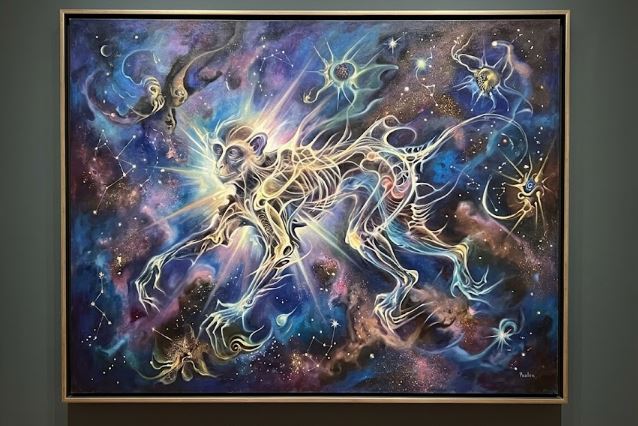
Works such as Milkyway Totem, Revelation in Colour, Cosmic Eye and Pale Crescent, and Movement Emerging from Clouds combine forms that can appear bodily, celestial, animal, vegetal, architectural, or ceremonial without resolving fully into any of them.
These are not Magritte-style visual riddles.
They are not Dalí’s sharply rendered dream narratives.
They are not straightforward descendants of Tanguy’s empty biomorphic landscapes either.
Wilson developed layered fields of dots, arcs, eyes, wings, grids, and expanding organic structures.
At times the paintings look almost like maps of an invisible cosmology.
At others they resemble masks or creatures seen midway through transformation.
This ambiguity helps explain why Artforum’s February 2026 response compared elements of Wilson’s work with Wifredo Lam, Agnes Pelton, Joan Miró, and Hilma af Klint.
Those comparisons describe affinities.
They do not define Wilson.
Her art belongs precisely in the spaces between those categories.
Wilson Developed A Strange Kind Of Deliberate Automatism
Classical Surrealist automatism often emphasized speed and reduced conscious control.
André Masson could move a pen rapidly across paper and respond to shapes after they appeared.
Wilson eventually developed something slower.
Her compositions frequently began near the center.
From an initial mark, she added corresponding forms around an expanding axis, constructing images that became increasingly symmetrical without beginning from a predetermined final design.
Wilson described her process as inventing the composition as she worked rather than starting with a complete idea.
The result presents a fascinating paradox.
Her mature paintings look meticulously controlled.
Their symmetry can seem almost architectural.
Yet the structure emerged incrementally.
One decision generated another.
Automatism became deliberate without becoming predetermined.
That makes Wilson unusually relevant to a broader understanding of Surrealist method.
She demonstrates that reduced planning did not necessarily have to look spontaneous.
An image could grow through intuitive decisions and still end with extraordinary formal precision.
Her Symmetry Was Not Simply Decorative
By the later 1950s, Wilson’s paintings increasingly organized themselves around central axes.
Forms appear to mirror one another.
Eyes multiply.
Wings spread outward.
Totemic structures rise vertically.
The compositions can resemble mandalas, ritual diagrams, masks, insects, cosmic beings, or invented spiritual machines.
Wilson’s imagery drew from a complicated mixture of sources.
The gallery identifies her interest in Indigenous American and pre-Columbian imagery, along with spiritual and occult traditions encountered through both the Californian and Parisian avant-gardes.
The Hellenic American Union, which later exhibited Wilson’s work in Greece, also emphasizes references to Mayan forms, Tibetan mandalas, Pacific Northwest visual traditions, insects, masks, and symbolic systems in her mature compositions. Its Marie Wilson overview describes the central symmetry of her art as a defining feature of the practice.
Those sources require careful handling today.
Wilson’s engagement with Indigenous and non-Western traditions emerged from a mid-century avant-garde culture that frequently treated such material as universal spiritual resources while paying less attention to cultural ownership, historical specificity, and colonial systems of collecting.
Recognizing those limits does not erase the work.
It makes its historical context clearer.
She Briefly Worked Around Picasso’s Studio
Wilson’s Paris years also placed her near figures who extended well beyond Surrealism.
The Hellenic American Union records that in 1954, she spent a brief period working at Pablo Picasso’s studio in Vallauris in southern France.
The episode should not be exaggerated into an apprenticeship.
Its significance lies in the density of Wilson’s artistic network during the 1950s.
She moved between European modernists, Surrealists, poets, and post-Surrealist thinkers at a time when those communities remained closely interconnected.
Wilson also encountered artists including figures linked to Breton’s circle while continuing to develop a language that refused to settle into one school.
For readers interested in how another artist used a different technical route to unsettle conventional representation, thesurrealists.org’s discussion of Man Ray’s photographic innovations shows how broadly Surrealist experimentation could extend beyond painting.
Wilson’s path was similarly hybrid.
Nanos Valaoritis Connected Poetry To Her Images
Wilson’s Paris life also brought her together with Nanos Valaoritis, the Greek poet, writer, and later major figure in Greek Surrealism.
Their relationship became both personal and collaborative.
In 1958, they produced Terre de Diamant, an artist-book project pairing Wilson’s 16 lithographs with 16 poetic texts by Valaoritis.
Academic research on the project describes it as a Surrealist collaboration shaped by occult and esoteric ideas circulating in postwar art.
The images already contain features that would become hallmarks of Wilson’s mature language: centralized forms, symbolic structures, mandala-like organization, and visual systems that appear halfway between organism and cosmology.
Wilson and Valaoritis married in 1960.
They soon moved to Greece.
That relocation would give Wilson another cultural home—and push her still farther from the American museum networks that might otherwise have sustained her reputation.
Greece Became Central To Her Life
Wilson spent much of the next phase of her career in Greece.
During the 1960s, she contributed art and writing to literary publications including Pali and Residu. Her images also appeared in connection with poets and writers including Andreas Embirikos, one of Greece’s foundational Surrealist figures.
Wilson therefore did not leave Surrealism when she left Paris.
She entered another branch of it.
Valaoritis himself had joined Breton’s Parisian circle during the 1950s and later became an important conduit between French and Greek Surrealist writing.
The couple’s intellectual life connected Paris, Athens, California, poetry, visual art, and postwar experiments with automatic creation.
That international movement enriched Wilson’s art.
It also made her difficult for national histories to claim.
Was she a Californian modernist?
An American Surrealist?
A post-Dynaton visionary?
A Paris-group participant?
An artist of Greek Surrealist circles?
The correct answer is that she crossed all of those categories.
Art history often rewards artists who fit one.
Wilson Returned To California—But New York Still Did Not Follow
Wilson and Valaoritis later returned to California, where Valaoritis taught at San Francisco State University.
Wilson continued producing paintings, drawings, lithographs, and ceramics across a career lasting approximately six decades.
Yet major American visibility remained sporadic.
One striking episode came in 1984, when poet and City Lights cofounder Lawrence Ferlinghetti presented Apparitions: The Mythical World of Marie Wilson at City Lights Bookstore in San Francisco.
Then the public trail became quieter again.
When Gallery Wendi Norris opened Marie Wilson: A Poet of Forms and Colors on January 20, 2026, it was her first major San Francisco solo exhibition since that 1984 presentation—more than four decades earlier.
The show ran through March 14 and included paintings and works on paper tracing five decades of Wilson’s development.
The San Francisco Chronicle’s 2026 reassessment described the exhibition as the reclamation of an overlooked Surrealist pioneer.
New York, however, still had not presented her independently.
MoMA Had Already Quietly Put Wilson Back Into The Story
An important institutional correction had begun before the 2026 exhibitions.
The Museum of Modern Art lists Wilson among the artists represented in Vital Signs: Artists and the Body, which ran from November 3, 2024, through February 22, 2025.
MoMA’s Marie Wilson artist record now identifies her as an American artist born in 1922 and deceased in 2017.
That appearance matters because it introduces Wilson into a museum collection and exhibition history much larger than the specialist Surrealist context in which she had often survived.
Yet one group-show appearance does not substitute for a focused reassessment.
Independent 20th Century offers something different.
It allows Wilson’s paintings to occupy sustained visual space.
Her New York Debut Comes At The Breuer
The setting adds another layer.
The fifth edition of Independent 20th Century will run from September 24 to September 27, 2026, for the first time at Sotheby’s at The Breuer, the Marcel Breuer building at 945 Madison Avenue.
The building opened in 1966 as the Whitney Museum of American Art.
It subsequently housed The Met Breuer from 2016 to 2020 and the Frick Collection from 2021 to 2024 before entering its current Sotheby’s chapter.
Independent’s 2026 fair announcement states that the edition includes 57 nominated exhibitors and works by more than 130 artists, with roughly 80 percent of presentations devoted to solo or two-person projects.
The fair’s stated mission is reassessment.
Wilson fits that agenda almost too perfectly.
An artist born in California in 1922, connected directly to Breton, active across several international Surrealist networks, and dead for nearly a decade will make her New York debut inside a building historically associated with defining American modern art.
That contradiction is the story.
The Ascent Shows How Far Wilson Had Moved By 1960
Gallery Wendi Norris is using The Ascent (1960) as a key image for the Independent presentation.
The painting demonstrates how dramatically Wilson’s visual language had evolved since the early 1950s.
The biomorphic uncertainty remains.
So does the cosmic feeling.
Yet the composition is more concentrated and ordered.
Forms rise through a central structure, giving the painting the quality of an invented diagram or ritual ascent.
It is difficult to decide whether the image represents a creature, architecture, spiritual anatomy, celestial movement, or all of them simultaneously.
That ambiguity is central to Wilson’s achievement.
She could make symmetry feel unstable.
Instead of using order to explain the image, she used order to deepen its mystery.
Why Her Work Was So Easy To Lose
Wilson’s long absence from major American art history probably has no single explanation.
Several factors overlap.
She spent much of her life outside New York, at a time when New York increasingly dominated postwar American art narratives.
She moved from California to Paris, Greece, and back across the Atlantic.
Her work occupied a space between Surrealism and visionary abstraction just as American art history became increasingly organized around Abstract Expressionism, Pop, Minimalism, and Conceptual art.
Her interest in spirituality and occult systems could also be dismissed by critical environments that preferred formalism.
Then there is gender.
Women connected to Surrealism have repeatedly required major historical reconstruction before receiving institutional treatment comparable to their male contemporaries.
The renewed prominence of Leonora Carrington, Remedios Varo, Alice Rahon, Dorothea Tanning, and others demonstrates how incomplete the older canon was.
Wilson’s rediscovery belongs to that process without being reducible to it.
She had another problem as well.
She was difficult to classify even among overlooked Surrealists.
Wilson Was Not Merely A Lost Woman From Breton’s Circle
The weakest way to rediscover Marie Wilson would be to make Breton the reason she matters.
His support is historically valuable.
His ownership of her work is useful evidence.
His inclusion of Wilson in a 1955 Paris exhibition confirms her direct relationship to the movement.
None of those facts explain the paintings.
Wilson’s real significance lies in what she did after moving through those networks.
She merged California’s Dynaton experiments with Parisian Surrealism.
She turned automatism into a slow construction of symmetry.
She combined cosmic and biomorphic imagery with structures resembling spiritual diagrams.
She moved between painting, drawing, lithography, ceramics, poetry, and publishing.
She carried those concerns through Paris, Athens, and California for decades.
Her story therefore changes Surrealism from two directions.
It expands the movement geographically.
It also expands what automatism could look like.
Why Marie Wilson Matters In 2026
The rediscovery has accelerated quickly.
MoMA included her in Vital Signs in 2024–2025.
Gallery Wendi Norris began representing her estate and opened A Poet of Forms and Colors in San Francisco in January 2026, her first major solo presentation there since 1984.
Artforum responded that February by placing Wilson’s work in conversation with Lam, Pelton, Miró, and af Klint.
The San Francisco Chronicle followed in March with a major reassessment of her overlooked position.
Now Independent 20th Century will bring Wilson to New York from September 24–27, 2026.
That sequence does not prove that art history has permanently corrected itself.
Rediscoveries can become temporary market moments.
The more important test will be what follows: museum acquisitions, scholarship, publications, conservation, exhibitions, and sustained comparison with the artists and networks through which Wilson actually worked.
Yet New York matters symbolically.
Wilson spent her life crossing some of the central routes of 20th-century experimental art without building a New York career.
Her work passed through Northern California’s postwar avant-garde, Paalen’s Dynaton orbit, Breton’s Paris, Picasso’s Vallauris environment, Greek Surrealist literary culture, and Ferlinghetti’s San Francisco.
New York remained strangely absent.
In September 2026, the city finally enters the story.
Marie Wilson did not vanish because her paintings lacked connections to Surrealist history.
She vanished because art history failed to follow all the places those connections led.
Independent 20th Century now offers New York a late opportunity to catch up.