

Gothic by Design: The Dawn of Architectural Draftsmanship turns medieval architecture into something more intimate than a cathedral façade. The exhibition at The Metropolitan Museum of Art in New York runs from April 13 to July 19, 2026, at The Met Fifth Avenue, Galleries 691–693, and brings together more than 90 works including drawings, prints, books, manuscripts, goldsmith work, architectural elements, sculpture, and painting. The Met’s official exhibition details frame the show around a simple but powerful idea: before Gothic towers rose into the sky, artists and master masons had to imagine them on parchment and paper.
For thesurrealists.org, the exhibition matters because it shows architecture before it becomes solid. Gothic design drawings are not Surrealist artworks, and the article should not pretend they are. Yet they carry a dreamlike force that Surrealism readers can recognize: impossible height, symbolic geometry, floating structures, visionary space, and the strange moment when a building exists first as an image of desire. Gothic by Design makes architecture feel like a medieval dream system because it reveals the hidden drawings that turned stone, light, proportion, faith, and fantasy into built form.
Why The Met’s Exhibition Makes Gothic Architecture Feel Newly Strange
Gothic architecture is usually encountered as monument: cathedrals, pointed arches, tracery, stained glass, ribbed vaults, spires, and vertical drama. The viewer sees the finished structure and feels its scale. Gothic by Design changes that order. It asks viewers to start with the plan, the line, the projection, the detail study, the template, and the measured imagination behind the final building.
The Met calls the exhibition the first of its kind to examine Gothic architectural drawings in an art-historical context. That point is important because these works have often been treated as technical evidence rather than visual culture. The museum’s Gothic by Design press release states that the exhibition features over 90 works and highlights the history of Gothic design practice, including collaborative practices, modular design, and the morphologies of form.
That shift turns the exhibition from an architecture show into a study of image-making. A medieval drawing was not only a construction aid. It was a place where scale could be imagined before it was possible, where geometry could become spiritual atmosphere, and where a building’s future body could be rehearsed in line.
This is why the show connects naturally with thesurrealists.org’s earlier writing on Surrealism in architecture. Gothic draftsmanship and Surrealist architecture belong to different histories, but both ask how imagined space can disturb ordinary perception before anyone enters a room.
How Medieval Drawings Turned Stone Into Thought
The exhibition’s strongest idea is that Gothic architecture did not begin with stone. It began with systems of thought made visible. A pointed arch, a tower, a window, or a vault had to be organized through geometry, proportion, measurement, and craft knowledge before it could become a structure. The drawing made that invisible intelligence shareable.
The Met notes that between the 13th and 16th centuries, drawings and later prints on parchment and paper became significant to the stylistic evolution of Gothic architecture and art. The show includes drawings and prints alongside objects, architectural elements, sculpture, and painting, which helps viewers see how the Gothic design language moved across scale and material.
That movement across scale is what makes the exhibition feel almost dreamlike. A cathedral-sized idea could appear on a sheet. A tiny ornamental detail could echo a massive façade. A goldsmith’s object could borrow architectural language from a church. A drawing could compress a building’s vertical ambition into a surface small enough to study by hand.
This is not fantasy in the modern sense. It is controlled imagination. Gothic drawing depended on discipline, calculation, and shared workshop knowledge. Yet the result still feels uncanny because the drawings reveal architecture in a half-born state. They are neither pure idea nor finished building. They are thresholds.
For a Surrealism-focused reader, that threshold matters. The image is powerful because it shows a reality that does not exist yet, but is already organizing belief, labor, and perception. The medieval draftsperson did not draw a dream for private pleasure. He drew a dream that could become stone.
Why Gothic Geometry Feels Like A Spiritual Machine
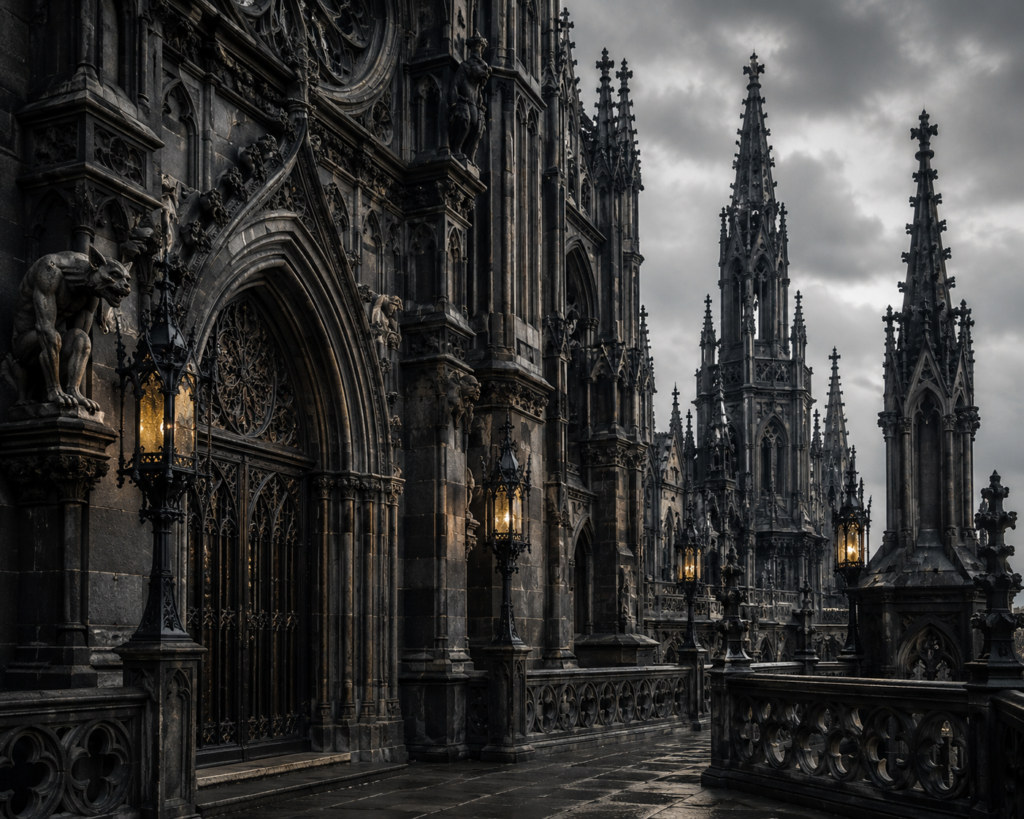
Gothic architecture often feels supernatural because it turns engineering into transcendence. Height, light, pointed arches, and vaulting systems create the sensation that stone has become weightless. The Met’s exhibition helps explain why that feeling was not accidental. It came from design methods, measurements, projections, and accumulated technical knowledge.
The museum’s press materials describe how the final gallery explores Gothic design principles and their legacy through floor plans, vaulting plans, sections, analytical studies, and assembly drawings. These works show geometry, systems of measurement, proportion, and instructions for masons, carpenters, and metalsmiths.
That technical foundation does not reduce the mystery. It sharpens it. Gothic architecture feels like a medieval dream system because its dream was rule-bound. The line had to obey measurement. The vault had to stand. The spire had to carry weight and meaning. The window had to hold glass and light. The structure had to perform both physically and symbolically.
That combination makes Gothic design different from a loose fantasy image. It is a machine for producing awe. The architecture teaches the body to look up. It turns vertical space into spiritual pressure. It makes light feel designed rather than merely present. A cathedral does not only house belief; it shapes perception so belief can feel spatial.
In that sense, Gothic by Design reveals the hidden mechanics behind wonder. The dream is not destroyed by seeing the drawing. The dream becomes more impressive because the viewer can see how much intelligence it required.
How The Exhibition Reframes The Medieval Architect
One of the exhibition’s most valuable effects is that it brings individual design intelligence back into view. Gothic buildings can seem anonymous because many were produced across generations by workshops, masons, patrons, and shifting teams of laborers. The Met’s press release notes that Gothic architecture is rarely discussed as the product of the innovative contributions of individual architects, even though the design legacy survives in preparatory drawings and prints.
That point changes the viewer’s relationship to the period. A cathedral is not only an anonymous expression of faith or civic power. It is also the result of decision-making: how to organize mass, how to shape a portal, how to repeat a motif, how to translate geometry into ornament, how to communicate instructions across a building site.
The exhibition’s curator, Femke Speelberg, from The Met’s Department of Drawings and Prints, frames the show around little-known yet often monumental masterpieces of the Gothic era and their continued relevance to identity, legacy building, artistic development, creative exploration, and design wit.
That language matters because it shifts Gothic design away from the stereotype of rigid medieval anonymity. These drawings show experimentation. They show problem-solving. They show artists testing how a form could migrate from church architecture into precious objects, sculpture, and other works. The medieval designer becomes less like a shadowy craftsperson and more like a visual thinker operating inside a complex system.
Why Small Drawings Can Hold Monumental Space
A key fascination of Gothic by Design is scale. The exhibition presents drawings that may be physically small compared with the buildings they imagine, yet conceptually vast. A design on parchment can hold a tower, a portal, a vault, or a façade. The page becomes a compressed cathedral.
This compression gives the works their dreamlike charge. Dreams often make impossible transitions between scale: a room becomes a city, a body becomes a landscape, a doorway becomes a world. Gothic drawings do something more disciplined but visually related. They condense massive architectural ambition into lines, measurements, and projections that can be carried, stored, copied, and studied.
The Met notes that some Gothic architectural designs were monumental in size and highly detailed, while others helped communicate specific elements for active building sites. Some oversized drawings may have survived because they were too unwieldy for frequent practical use.
That survival changes their status. A drawing made for design practice can become an art object centuries later. A sheet once tied to construction can now be read as evidence of imagination, ambition, and visual culture. The museum setting gives viewers a chance to see medieval architecture not only as finished stone but as a record of thought.
Why Gothic Design Still Speaks To Modern Visual Culture
This is where the article’s “medieval dream system” idea becomes precise. The dream is not irrational. It is organized through draftsmanship. It moves from mind to line, line to workshop, workshop to structure, and structure to collective memory.
Gothic architecture has never belonged only to the Middle Ages. Its forms return through revival architecture, fantasy illustration, cinema, horror imagery, fashion, video games, album covers, and contemporary design. The pointed arch and the vaulted interior still signal mystery, height, fear, sanctity, romance, and the supernatural.
Gothic by Design helps explain why those forms remain powerful. They were not casual decorations. They were systems for organizing attention. Gothic design taught viewers how to experience space as vertical, luminous, layered, and symbolic. The drawings in the exhibition reveal the visual grammar behind that effect.
The show also points toward the future. The Met’s press release states that a contemporary contribution from ETH Zurich addresses the potential of Gothic design principles for sustainable construction, and that structural engineers have found Gothic principles relevant to future sustainable architecture.
That connection matters because it prevents the exhibition from becoming nostalgia. Gothic design is not presented only as a dead style. It is treated as a historical knowledge system with continuing implications for structure, material thinking, geometry, and environmental design. The medieval drawing becomes more than an archive object. It becomes a source for rethinking how design knowledge travels across time.
For a modern visual-culture site, this is the strongest angle. Gothic architecture still feels dreamlike because it fused image, belief, engineering, and bodily experience. Contemporary culture keeps borrowing its atmosphere, but Gothic by Design asks viewers to look deeper than atmosphere and study the intelligence behind the mood.
How Architecture Becomes A Dream Before It Becomes A Building
The most compelling lesson of Gothic by Design is that architecture begins as a controlled act of imagination. Before a cathedral changes a skyline, it changes a surface. Before stone rises, a line tests the idea. Before light pours through a window, a drawing decides how the window might exist.
That process makes the exhibition valuable for readers interested in Surrealism, even though the show is rooted in medieval art history. Surrealism taught modern viewers to question the boundary between image and reality. Gothic draftsmanship shows an earlier, more disciplined version of that boundary crossing. A drawing becomes a building. A geometric system becomes awe. A page becomes vertical space.
The exhibition also reminds viewers that dreamlike art does not always look chaotic. Sometimes the dream is measured. Sometimes it is ruled with compass and straightedge. Sometimes it depends on proportion, workshop knowledge, and engineering. Gothic architecture feels supernatural precisely because its visual wonder rests on technical control.
That is why Gothic by Design makes architecture feel like a medieval dream system. It reveals the hidden stage where imagination, craft, mathematics, faith, and ambition met before stone made them public. The cathedral may be the final image, but the drawing is where the dream learned how to stand.