

The mix of visionary drawings and new building ideas has always fascinated both artists and architects. Early surrealists, like Giorgio de Chirico, created eerie scenes with mysterious figures and dark squares. Their work did more than just look good; it connected art and buildings in a deep way.
De Chirico’s empty arcades and long shadows inspired not just painters but also builders. His dreamlike cities started a new way to think about space. This idea is seen in Paul Delvaux’s work, which adds mystery and depth.
M.C. Escher’s strange buildings make us rethink space. Movies like The Cabinet of Dr. Caligari show how weird places can show our inner thoughts. Dario Argento’s films, like Suspiria, use big, odd sets to confuse and amaze us.
These creative explorations show that dream spaces can really touch our feelings. They push against normal ideas of space and show what our places can say. As we explore this history, we see how it shapes today’s architects.
Early Intersections Furniture Objects and Interiors from Surrealist Circles
The 1930s were a key time for surrealist architecture. Artists started turning their abstract ideas into real spaces and objects. This was seen at the Exposition Internationale du Surréalisme in Paris in 1938.
The exhibition made the gallery feel like a different world. It mixed art and architecture in a new way. Marcel Duchamp’s coal sacks and Salvador Dalí’s Rainy Taxi changed how we see space.
Later, Dalí’s Dream of Venus pavilion at the 1939 New York World’s Fair showed more of this trend. It was a funhouse that made visitors feel off-balance. It used strange shapes and mixed things up, showing the surreal side of life.
Joseph Cornell’s shadow boxes were another example of surrealist architecture. These small worlds mixed furniture, sculpture, and stories. They turned everyday things into art, making viewers think differently.
Old cabinets of curiosities also played a big role. Sir John Soane’s Museum in London is a great example. It’s a 19th-century house filled with strange objects. It shows how the past can be surreal, even before the movement started.
These early works show that surrealism architecture design can be small and big. Spaces and objects can change how we see the world. They make us think in new ways.
These early steps set the stage for more surrealist design. They showed how art and objects can talk to each other. This conversation inspires architects and designers today. For more on surrealism’s impact, check out Freud’s influence on surrealism.
Postwar Influence Situationists Archigram and Speculative Paper Architecture
After the war, surrealism deeply influenced architecture and design. The postwar era saw the rise of groups like the Situationist International. They changed how people saw cities, viewing them as emotional landscapes.
The Situationists, born from postwar Europe’s ruins, introduced psychogeography and dérive. These ideas encouraged exploring cities based on personal feelings. This mirrors the idea of dream spaces, where buildings connect with our subconscious.
Constant Nieuwenhuys’s New Babylon is a key example from this time. It’s a city that moves, with areas that people can change freely. This design shows the surreal dream of transforming everyday life through space.
The British Archigram group also made a mark with their futuristic designs. They created buildings that defy logic, like walking cities and plug-in homes. Their work shows the endless possibilities of architecture, inspired by surrealism.
Books like the Gothic novel also shaped these architectural movements. They show how buildings can reflect our inner worlds. Works like Castle of Otranto and Gormenghast are examples of this.
Frances Yates’s work on memory palaces connects to surrealism. She suggests that the most surreal buildings are in our minds. These mental spaces show how architecture can be more than just shelter.
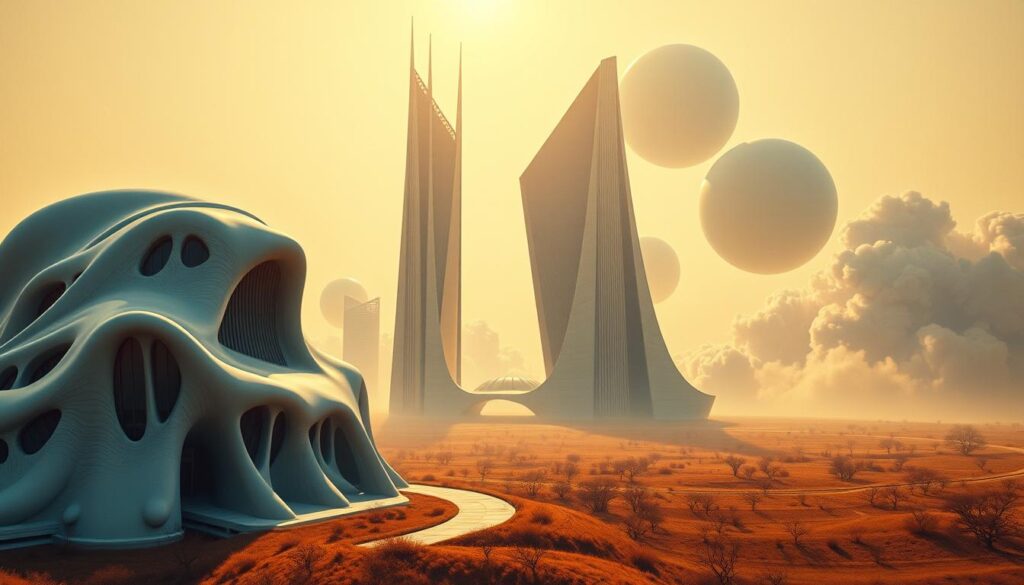
Materializing Dreams Case Studies of Buildings with Surrealist DNA Facades Circulation and Symbols
Case studies of surrealist architecture show how dreams can become real buildings. Salvador Dalí’s Crisalida pavilion is a prime example of biomorphic design. It was built for the 1958 American Medical Association convention in San Francisco.
The pavilion looks like a sixty-foot-long chrysalis. It’s made from parachute silk over a lattice. Twenty-four air blowers inflate and deflate the silk, making it seem like it’s breathing.
Visitors walked through a journey inside the pavilion. They saw Dalí’s symbols like tense limbs and flowers. This journey went from anxiety to peace, ending with the image of butterflies.
Other buildings also show surrealist DNA. For example, Frederick Kiesler’s Endless House was never built but proposed a continuous form. It aimed to blend floor, wall, and ceiling, challenging traditional architecture.
These examples show surrealism architecture design is more than just pictures. It changes how we experience space with its unique forms and symbols. Exploring these buildings helps us understand how surrealist ideas can be brought to life in real spaces.
Product and Furniture Design Humor Metamorphosis and the Uncanny in Objects
In the world of surrealism architecture design, product and furniture design is truly unique. It combines humor, transformation, and the uncanny, shaking up what we think of as normal. Salvador Dalí’s work shows how the ordinary can become truly extraordinary.
Dalí’s creative method was inspired by studies on the art of the mentally ill. He believed every shape has its own meaning, leading to designs that are open to interpretation. This is seen in pieces like the Mae West Lips Sofa, made with Edward James. It turns a human face into furniture, making us see things in a new light.
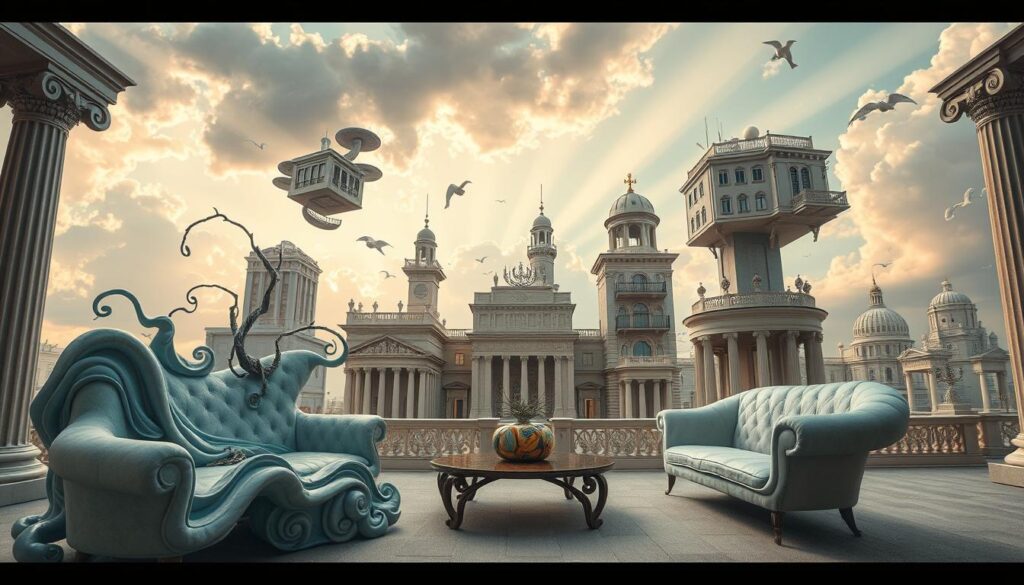
Meret Oppenheim’s Object, a fur-covered teacup, saucer, and spoon, is another great example. It was shown at the 1936 Exposition Surréaliste d’Objets. It uses unexpected materials for everyday items, making us feel uneasy and question our usual views.
These designs show a postmodern fantasy world where objects can be many things at once. A phone might look like a lobster, and a table could be shaped like a woman. It’s not just about being funny; it’s about exploring how objects connect our conscious and subconscious thoughts.
- Humor: Surrealist design often includes playful elements that make us think.
- Metamorphosis: Objects change into unexpected shapes, challenging how we use them.
- The Uncanny: Familiar items are shown in strange ways, causing strong feelings.
Surrealist product design is a way to change how we see our world. These strange objects can make us see things differently, showing the hidden sides of our culture. For more on surrealism and design, check out this link.
Exhibition Design Curatorial Spaces That Embody Dream Logic
Curatorial spaces are like canvases for surrealism, showing dream logic through creative design. They go beyond usual gallery setups, turning places into full experiences. This makes viewers see art in a new, intense way, like in surrealist works.
The 1938 Exposition Internationale du Surréalisme in Paris’s Galerie Beaux-Arts is a great example. André Breton and Paul Éluard organized it, with Marcel Duchamp playing a big role. They made the whole gallery into a piece of art. Duchamp even hung twelve hundred coal sacks from the ceiling, making art viewing different.
Salvador Dalí’s Rainy Taxi was at the entrance, adding to the surreal feel. Visitors had to use flashlights because of the dark, making the mystery deeper. This show was a big step for surrealist art, showing how important space is in art.
The 1942 First Papers of Surrealism in New York also made a big mark. Duchamp used sixteen miles of twine to block views, making people see things differently. This showed how surrealism wants to break art rules.
The 1961 Paul Klee show at Stockholm’s Moderna Museet was special. Carlo Derkert designed the catalogue with unique cardboard covers and posters. Years later, Stellan Mörner’s notes showed debates on surrealism’s start, with Klee and de Chirico at the center.
These shows show how curatorial spaces, designed like surrealist art, tell stories through space. They create a dream-like feeling, pulling viewers into the art itself.
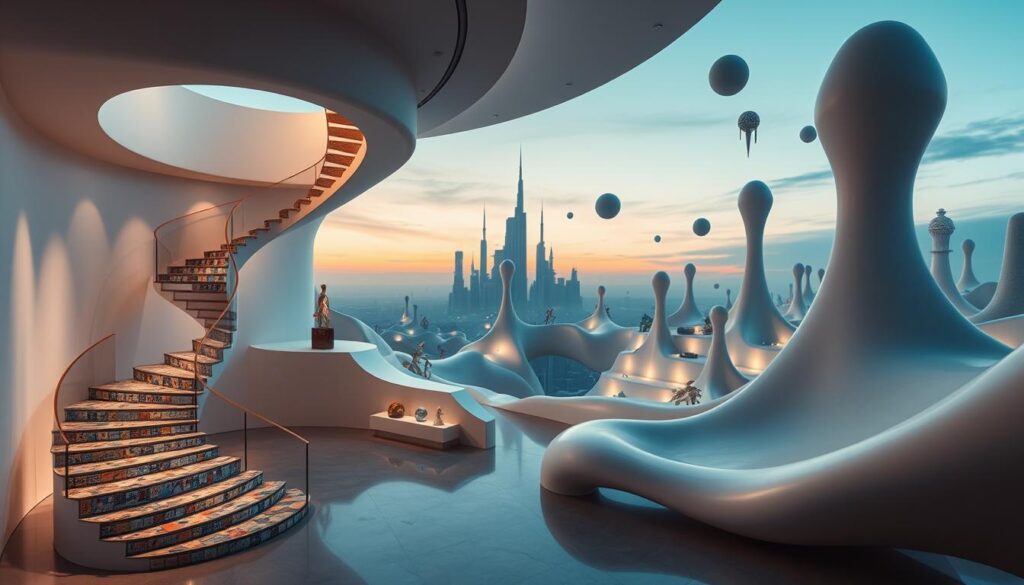
Digital Visualization VR AR Collages and Parametric Echoes of Automatism
Digital tools have changed how architects design spaces. Virtual reality (VR) and augmented reality (AR) let them create new environments. These technologies open up new ways to explore surrealist architecture.
The Tardis from Doctor Who is a great example of surrealist design. It’s a police box that’s bigger inside than outside. This idea is like the fantastical worlds in Lewis Carroll’s “Alice” books. In these stories, Alice finds herself in strange, changing spaces.
Today’s digital tools help architects design spaces that break the rules of geometry. In these virtual worlds, size and gravity can change based on how you look at them. This idea is similar to what surrealist painters did on canvas.
Augmented reality can add surrealist touches to real cities. This creates a mix of old and new, like André Breton wanted. Architects can now add surrealist touches without building anything new.
Parametric design software is also key in this change. It uses algorithms to create designs that reflect automatism. Here, designers set rules but let computers fill in the details.
Today’s architects are taking Max Ernst’s collages into three-dimensional designs. They mix different parts to create spaces that look right but can’t exist. This shows that surrealist architecture is not just history but an ongoing exploration of technology and space.
Ethics and Sustainability Surreal Forms with Responsible Materials and Energy
The mix of surreal architecture and green design brings new ideas to modern design. It shows how surrealism’s creativity can meet the need for caring for our planet.
The La Sirena group looked into famous surreal buildings like Cheval’s Ideal Palace and Rodia’s Watts Towers. They found that these buildings use recycled materials, showing how sustainable design can be done.
Surrealism loves big ideas and change, while green design focuses on saving resources and lasting longer. But, they can work together. The idea of ruins, found by the La Sirena group, fits with using old buildings in new ways. This keeps energy in the buildings and saves resources.
Facteur Cheval’s Ideal Palace and Simon Rodia’s Watts Towers show that big dreams don’t need to waste resources. They were made from old materials, showing creativity without harming the environment.
Today, architects use ideas from surrealism but with green materials like wood and recycled stone. This way, they make buildings that are good for the planet and look amazing.
The idea of beauty in unexpected ways, from surrealism, is now in green buildings. This shows that green buildings can be as exciting as they are good for the planet.
These dream spaces, made with care for the planet, show that surreal architecture can help protect our environment. They show us how to build places that are both creative and caring for our world.
Visiting Guide Global Buildings Museums Hotels and Boutiques to Experience
For those interested in surrealism architecture design, a special guide awaits. It shows key places around the world where surrealism comes to life in buildings.
In the United States, the Winchester Mystery House in San Jose, California, is a must-see. Built from 1884 to 1922, it has endless staircases and doors that open to walls. Its creator, Sarah Winchester, thought this would confuse spirits.
The Dallas Museum of Art also has a special exhibit. It features over 100 works by famous surrealists like Salvador Dalí. This gives a peek into the art that inspired surreal architecture.
In Mexico, Las Pozas in Xilitla is a unique spot. It was made by Edward James, blending architecture with nature. It’s a place where art and the outdoors meet.
Barcelona, Spain, is known for its surreal architecture. Antoni Gaudí’s Casa Batlló and Sagrada Família show off organic shapes and fluid spaces. They show how Catalan modernism and surrealism share ideas.
Today, hotels and boutiques are also inspired by surrealism. They offer a chance to see surreal ideas in everyday places. You can find hotels with fun interiors and boutiques that play with space.
This guide includes tips for visiting and deep insights into each place. It’s perfect for design fans or anyone curious about surrealism architecture design.
Collector Pathway Design Editions Prototypes and Documentation
Collecting surrealism architecture design is a unique journey into postmodern fantasy. It lets enthusiasts explore works that blend art, architecture, and furniture. Collectors and curators face the challenge of acquiring and preserving these complex objects.
Penny Slinger’s 1977 book, An Exorcism, shows how documentation can create an immersive experience. Its haunting images capture surrealism’s essence, like Francesca Woodman’s ghostly self-portraits. These works challenge what we think of as collectibles, encouraging collectors to value the ephemeral nature of surrealist art.
The market for surrealist design editions includes rare furniture by artists like Salvador Dalí and Meret Oppenheim. Architectural models and prototypes are visions that never came to be. Original drawings are the starting points of these ideas. Publications, like the 1961 Paul Klee exhibition catalogue, can turn a piece into a collectible.
Archival finds, like Stellan Mörner’s handwritten notes, deepen our understanding of surrealist networks. Collectors must prioritize documentation to keep these artistic legacies alive. This way, the essence of surrealism architecture design is preserved for future generations.
Collecting surrealism is about valuing the conceptual and the material. It demands a keen eye and an appreciation for the fusion of art and design. With proper authentication and care, collectors can create collections that honor surrealism’s innovative spirit.