
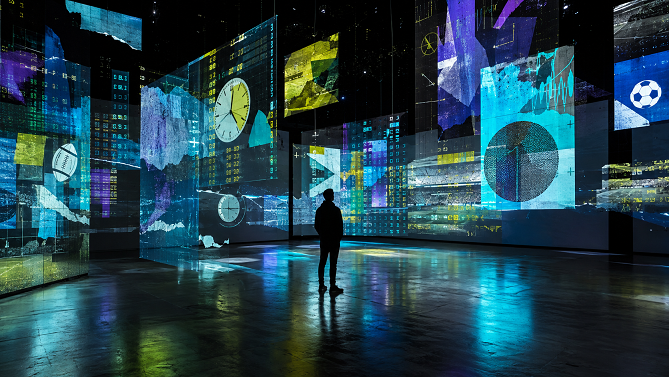
A live sports odds board appears to offer order. Teams occupy rows, markets sit in columns, start times establish sequence, and numbers seem to convert uncertain events into measurable possibilities. Yet the longer the screen remains open, the less stable that order becomes. Prices move, markets pause, figures flash, games change status, and events taking place in separate cities become compressed into one continuously revised visual field.
Viewed through an art-historical lens, a live sports odds board can resemble a digital surrealist collage. Baseball scores, basketball totals, football spreads, hockey moneylines, timestamps, abbreviations, and colored indicators appear beside one another without sharing a physical setting. The interface joins distant stadiums and incompatible moments into a single surface governed by chance, information, and expectation.
This comparison does not make an odds board a work of Surrealism in the historical sense, nor does it turn wagering into an artistic practice. It reveals how a familiar data interface produces some of the visual and psychological conditions that fascinated Dada and Surrealist artists: unlikely juxtapositions, unstable meanings, interrupted time, automatic change, and the uneasy desire to impose structure on events that remain uncertain.
The connection is especially relevant in the United States, where sports-betting interfaces have become a prominent part of digital sports culture. The American Gaming Association reported that regulated U.S. sports-betting revenue reached approximately $16.9 billion in 2025, rising by more than 22 percent from the previous year. That commercial expansion has placed odds, probabilities, and live market movement before a much larger public, turning what was once specialized information into a recognizable visual language.
The Odds Board Functions Like A Continuously Reassembled Collage
Collage joins materials that originally belonged to separate contexts. A printed advertisement can sit beside a photograph, a fragment of newspaper text, a drawing, or a piece of patterned paper. Meaning emerges from the collision between those elements rather than from any single fragment.
A sports odds board follows a related visual logic. One row may refer to a baseball game in New York. The next may describe a tennis match in Montreal, a soccer fixture in Los Angeles, or a preseason football game in Ohio. Each event carries its own location, duration, rules, participants, and emotional context. The interface strips those events down to compressed signs and places them in a standardized grid.
Team names become abbreviations. Athletic performance becomes a numerical price. A scheduled contest becomes a clock icon or start time. An injury report, pitching change, scoring run, weather delay, or lineup announcement may produce a visible adjustment without appearing directly on the screen.
This resembles collage because the interface depends on fragments. The viewer rarely receives the entire story behind a number. Instead, the board presents partial evidence arranged for fast comparison.
The Museum of Modern Art describes Surrealism as a movement that used unexpected combinations, automatic methods, dream imagery, and uncanny objects to challenge rational habits of perception. Its artists did not merely depict impossible scenes. They rearranged familiar materials until ordinary relationships became unstable.
A live odds display performs a commercial and informational version of that rearrangement. It turns recognizable sports into abstract relationships between numbers, time, and competing expectations. The result is practical, but its visual effect can still feel strange: dozens of unfolding human contests reduced to a luminous field of signs.
Chance Appears Controlled Even When It Is Not
Chance occupied a complicated place in Dada and Surrealist practice. Artists used random placement, automatic drawing, frottage, found objects, and collaborative games to interrupt deliberate composition. Yet chance rarely removed the artist completely. It provided a starting condition that could later be selected, revised, or framed.
Jean Arp’s Untitled (Squares Arranged According to the Laws of Chance) from 1917 remains one of the clearest examples. Arp described such arrangements as operating automatically and without will, though curatorial analysis has noted that conscious decisions still shaped the completed composition. Chance opened the process, but choice determined what viewers finally encountered.
The same tension exists on an odds board. The numbers appear to describe uncertainty objectively, yet they are not random decorations. They emerge from models, market activity, injuries, historical performance, operator exposure, real-time data, and changing information. Human decisions and automated systems coexist behind the display.
This creates an illusion of controlled chance. The interface gives uncertainty a precise visual form, often extending to decimal points, positive and negative signs, color changes, and tightly aligned columns. Precision makes the screen feel authoritative even though the event itself has not been resolved.
Surrealist artists frequently questioned the authority of rational systems. André Breton’s 1924 Manifesto of Surrealism called for methods that could move beyond the control of reason and make room for involuntary thought. An odds board seems to move in the opposite direction by converting uncertainty into calculation. Yet its constant fluctuations expose the limits of that calculation. Every update admits that the previous arrangement was temporary.
The board becomes a machine for repeatedly stating certainty and withdrawing it.
Live Updates Produce A Distorted Experience Of Time
A traditional scoreboard records what has happened. A live odds board mixes what has happened with what might happen next.
That combination creates several forms of time on the same screen. A final score belongs to completed time. An in-progress game belongs to unfolding time. A scheduled event belongs to anticipated time. A suspended market belongs to interrupted time. A rapidly changing number reflects a calculation about a future that has not arrived.
Surrealist images often disrupt chronological order. Memories, dreams, desires, and present observation may occupy one composition without clear separation. Objects from different environments appear together, and familiar spaces lose their normal sequence.
The odds interface creates a comparable temporal compression through data rather than dream imagery. An NFL game scheduled for Sunday may appear beside an MLB game underway on Thursday and an NBA futures market extending months into the future. The screen does not treat those periods as separate experiences. It converts them into neighboring rows.
Live betting intensifies this distortion. Regulators describe in-play markets as fast-moving environments in which prices are continuously amended according to information and liabilities. The UK Gambling Commission notes that operators use real-time sports data to revise prices, suspend markets, and settle outcomes. It also warns that broadcast delays can leave some viewers with older information than people at the venue or others receiving faster data.
Latency introduces a nearly surreal split between versions of the present. A spectator inside a stadium may witness a goal before a streaming viewer sees the play. An operator’s feed may register the event before a television broadcast reaches a household. For a few seconds, several different “nows” coexist.
The board reflects whichever version of the present reaches its system first. A market disappears, a number changes, and only later does the viewer understand why. Cause and effect appear in reverse order.
Numbers Become Images Before They Become Meaning
A person reading an odds board does not process every figure with equal attention. Certain numbers become visual anchors. Positive and negative signs create directional tension. Repeated decimals form patterns. Bright colors indicate movement. Blank spaces and suspended markets interrupt the grid.
The numbers function as images before they function as complete information.
This quality has precedents in twentieth-century art. Dadaists and Surrealists incorporated newspaper fragments, commercial typography, diagrams, tickets, labels, maps, and machine-produced text into compositions. Such materials carried literal meaning, but their placement, scale, and repetition gave them a second life as shapes.
Joan Miró’s 1933 drawing-collages combined postcards, sandpaper, printed paper, and drawn lines. MoMA curator Anne Umland has explained that these works can look spontaneous even though registration marks reveal careful adjustment. Miró constructed the appearance of chance.
A digital sports board performs a related reversal. It is carefully engineered to look immediate. The grid, typography, spacing, and color system are controlled, yet the contents continually change. Design creates the stable stage upon which instability can appear.
A row may briefly form an accidental composition: repeated minus signs, mirrored scores, matching totals, and alternating colors. Moments later, the pattern disappears. No designer planned that exact arrangement. It emerges from the interaction between the interface and live events.
This makes the board an ephemeral image. It cannot be experienced in exactly the same form twice.
The Grid Tries To Discipline An Unpredictable Event
The grid is one of modern design’s strongest symbols of order. It separates information, creates hierarchy, and permits rapid comparison. On an odds board, every team and market receives a designated place.
Sport resists that discipline.
A ball takes an unexpected bounce. A player leaves with an injury. Weather changes the pace of a game. A referee reviews a decision. A coach alters a lineup. A crowd changes the emotional temperature of the event. None of these experiences fits neatly inside a numerical cell.
The board responds by revising the grid rather than abandoning it. Values change, but the structure remains. This is why the interface can feel psychologically reassuring. It suggests that uncertainty can always be returned to a row and column.
Surrealist works often produce the opposite sensation. They place ordinary objects inside apparently coherent spaces, then introduce contradictions that the setting cannot resolve. René Magritte used polished realism to present impossible relationships. Max Ernst transformed rubbed textures into fantastical creatures and environments through frottage. The disciplined surface made the irrational intrusion more forceful.
An odds board derives similar tension from the contrast between rigid design and unstable content. Its orderly frame does not eliminate uncertainty. It makes uncertainty visible as movement within a system.
The result resembles a control panel for events that cannot be fully controlled.
The Interface Turns Spectators Into Pattern Readers
Sports spectators have always searched for patterns. Fans notice momentum, repetition, rivalry histories, player tendencies, weather conditions, and emotional shifts. Odds boards formalize that instinct by presenting numerical patterns as a second layer over the game.
This changes the act of looking.
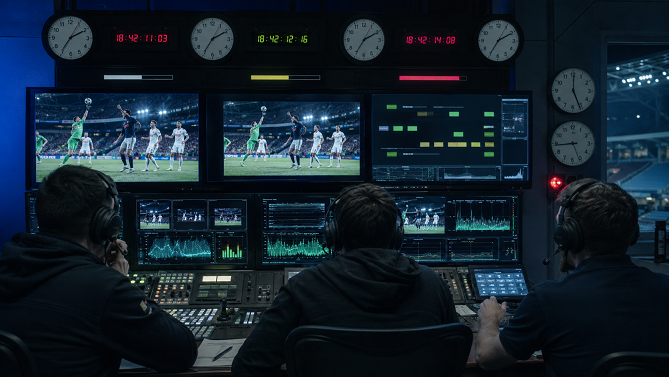
The viewer may move between the broadcast and the board, comparing athletic action with numerical response. A touchdown becomes both a physical event and a price movement. A pitching change becomes both a strategic choice and a market adjustment. The game develops a shadow image made of numbers.
Surrealism frequently relied on doubles, reflections, shadows, and alternative realities. The ordinary world remained present, but another system appeared beside it. The odds board creates a data double of sport. It does not reproduce the sound of a crowd, the speed of a runner, or the pressure felt by an athlete. It translates those experiences into shifting probabilities.
That translation is incomplete, and the incompleteness matters. The board can encourage viewers to mistake numerical movement for total knowledge. Yet a price cannot contain every emotional, physical, or tactical condition affecting a contest.
Responsible interpretation requires recognizing the screen as a constructed representation. It is neither the event itself nor a promise about the outcome. Current regulatory guidance for in-play betting stresses that users may not possess the latest information and can be disadvantaged by delayed broadcasts, slower connectivity, or faster data available elsewhere.
The interface’s visual clarity should not be confused with certainty.
Why This Digital Collage Belongs In A Surrealist Discussion
Live sports odds boards were not designed as artworks. They are commercial data interfaces built to organize information and facilitate wagering. Calling them surrealist without qualification would erase the historical ambitions, political tensions, artistic methods, and unconscious exploration that shaped Surrealism.
The useful comparison lies elsewhere.
Odds boards show how contemporary digital culture routinely creates visual experiences once associated with experimental art. They combine unrelated places, collapse multiple periods, transform language into fragments, allow automated systems to reshape compositions, and present unstable relationships inside an authoritative frame.
They reveal how chance has become designed.
In historical Surrealism, chance could interrupt rational control and open unexpected associations. On a live sports board, chance is continuously measured, priced, displayed, and reformatted. The uncertain event does not sit outside the system. It supplies the system with motion.
That shift says something larger about contemporary life. Weather maps, financial dashboards, election forecasts, social-media trends, delivery trackers, and sports odds all promise to make unfolding events legible. Each interface compresses a changing world into symbols that can be scanned quickly.
The screen offers knowledge, yet it can never freeze the conditions it represents.
A live sports odds board resembles a digital surrealist collage because it stages that contradiction in plain sight. It is rigid and unstable, calculated and unpredictable, immediate and delayed, informative and incomplete. Its numbers continually claim to organize chance, then rearrange themselves when chance refuses to stay organized.