
Imagine a movie where logic is thrown out the window and dreams take over. This was the dream of the surrealist cinema movement starting in the 1920s. Pioneers sought to skip traditional stories and hit the subconscious mind straight on.
The visual shake-up began with Germaine Dulac’s The Seashell and the Clergyman. Soon, Man Ray and others joined the journey. The movement hit its peak with Luis Buñuel and Salvador Dalí’s Un Chien Andalou. Buñuel then pushed boundaries with his first sound film.
These early works created a new visual language. They used shock cuts, enigmatic symbols, and scenes that didn’t quite fit. The aim was to capture the odd flow of dreams and desires.
Grasping this early history is key. It reveals how a few bold movies reshaped art. Their disruptive techniques keep inspiring artists and filmmakers globally today.
Language of surrealist cinema: discontinuity, shock cut, symbolism
Surrealist directors saw themselves as tools to explore the human mind. They used film to map the unseen parts of our psyche. It wasn’t about making weird pictures. It was about creating a new way to see and understand.
This new language is like how our minds work when we dream. It’s about breaking free from logic and reaching the subconscious. Three main techniques make up this language: discontinuity editing, the shock cut, and fluid symbolism.
Discontinuity editing breaks the rules of film. It skips around in time and space without reason. Things appear and disappear without explanation.
This method is like a dream. It makes us feel lost and amazed, just like in a dream.
The shock cut is even more jarring. It suddenly switches between two images. A calm scene can turn into something scary in an instant.
This shock is like the twists in dreams. It quickly changes how we feel. It’s a powerful and lasting experience.
Symbolism in surrealist films is not fixed. A clock might mean many things, not just time. Symbols are personal and change based on the filmmaker’s subconscious.
They invite viewers to interpret them in their own way. It’s a personal journey into the film’s world.
| Technique | Primary Purpose | Cinematic Effect | Connection to Subconscious |
|---|---|---|---|
| Discontinuity Editing | Break linear time and spatial logic | Creates confusion, wonder, and narrative fragmentation | Mimics the non-sequential, illogical flow of dreams |
| Shock Cut | Generate visceral, irrational juxtaposition | Delivers a jarring, emotional impact on the viewer | Replicates the sudden, shocking shifts in dream content |
| Fluid Symbolism | Communicate through personal, subconscious imagery | Encourages open-ended, personal interpretation | Acts as a direct pipeline to individual psychic material |
These methods connect to Surrealism’s core idea: automatism. André Breton saw Surrealists as recording instruments. This idea came from scientific methods.
Just like a seismograph records the earth, filmmakers record the mind. The strange and disturbing parts are real. They show the unseen workings of our minds.
Every surrealist film is like a documented dream sequence. It’s an attempt to capture the invisible. This makes each film a unique exploration of the subconscious.
Understanding this language is key to making or analyzing surrealist films. It’s not just about seeing strange images. It’s about understanding the method behind the marvel.
Pre‑production: concept mapping and dream logs
Effective surrealist filmmaking starts before cameras roll. Two key tools are a concept map and a dream log. These tools help uncover the subconscious, moving away from traditional storylines. They gather raw, irrational material that will be the heart of your film.
Begin by exploring your characters’ inner worlds. Look into their deepest fears, desires, and thoughts. This depth makes a dream sequence feel eerily real. It’s about capturing emotional truth from the unconscious.
History proves the power of this method. Luis Buñuel and Salvador Dalí made Un Chien Andalou from their dreams. The Surrealist Bureau of Research also used dream accounts as primary material. They saw dreams as a way to reveal powerful symbols.
The concept map is your first tool. It’s a visual web of ideas, symbols, and emotions. Don’t look for logical connections. Instead, link a melting clock to anxiety and a crawling hand. It helps organize your film’s symbolic language.
The dream log is your second tool. Keep a notebook by your bed to record dreams. Write down every image, plot twist, and emotion. This practice gathers genuinely irrational content that’s hard to invent.
Concept mapping gives structure to chaos, while the dream log provides raw material. Together, they turn subconscious whispers into a solid foundation. This collection becomes your source for scenes, props, and emotions.
| Tool | Primary Purpose | Key Output | Best For |
|---|---|---|---|
| Concept Mapping | To visually organize irrational connections and symbolic motifs. | A non-linear diagram linking images, themes, and emotions. | Filmmakers who think visually and need to see thematic relationships. |
| Dream Log | To harvest authentic imagery and narrative disjunctions from the subconscious. | A written record of raw dream content, emotions, and bizarre sequences. | Anyone seeking original, unfiltered material that defies conscious logic. |
| Combined Use | To create a curated reservoir of potent creative material. | A foundational “mood board” and symbol bank for the entire project. | Building the unique, psychological world essential for surrealist film. |
The goal isn’t a script but a collection of powerful ideas. When you start production, this collection will guide your choices. Your dream sequence ideas will have a solid, if strange, foundation.
Production: lighting, makeup/props for the uncanny, in‑camera effects
Making the uncanny on screen is all about hands-on work. It involves lighting, props, and in-camera techniques. This process turns abstract ideas into real, yet strange, visuals. The goal is to create a scene that distorts the audience’s sense of reality.
Lighting sets the mood and feel of the film. Surrealist scenes often have clear light and dark shadows. Bright light makes objects seem unnatural, like in a dream. On the other hand, deep shadows add mystery and hint at hidden meanings.
Choosing and making uncanny props is key to surrealist scenes. It’s about taking familiar objects and putting them in strange places. Think of Man Ray’s *L’Etoile de Mer* or Buñuel’s *Un Chien Andalou*. These objects carry deep meanings and challenge our understanding of reality.
Good uncanny props are simple yet jarring. It’s about placing common items in odd places. A moss-covered typewriter, a bread clock, or a teacup with gears can be very unsettling. This jarring contrast is a key surrealist technique.
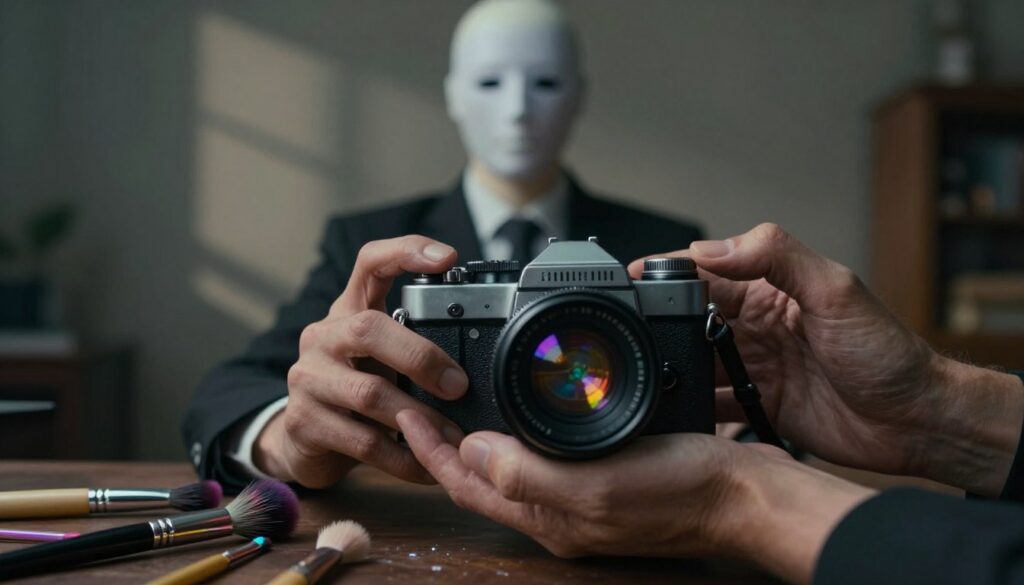
Makeup and costumes also aim for a subtle strangeness. A face that’s too perfect, skin that looks unreal, or a costume that doesn’t fit can create unease. The goal is to make something disconcertingly real by being physically present.
Visual effects in surrealist films often use in-camera techniques. This approach gives a raw, authentic feel that’s more believable.
- Double Exposure: Layering two images in-camera creates ghosts, visions, and the sensation of overlapping realities.
- Forced Perspective: Manipulating scale on set makes actors interact with giant or tiny objects, building impossible spaces.
- Slow Motion: Altering time emphasizes the weight of a gesture or makes a mundane action feel ritualistic and strange.
These in-camera effects are recorded directly onto the film or sensor. They capture the surreal moment during production. This creates a cohesive, tangible world for the actors and crew. The result is a dreamlike landscape that feels authentically bizarre, not a digitally added afterthought.
Ultimately, surrealist production is about commitment to the physical. It’s the glow of a practical light, the texture of a modified object, and the magic captured in-lens. This collaborative craft builds a world that challenges perception from the inside out.
Post: montage strategies, jump cuts, sound/image mismatch
In the editing suite, the surrealist filmmaker’s vision comes to life. This is where raw footage is shaped into an experience that defies logic. The aim is not to tell a straightforward story. Instead, it’s to evoke a feeling, a memory, or a dream.
Three key techniques are used: non‑linear montage, jarring jump cuts, and sound disjunction. These methods create a unique experience for the viewer.
Germaine Dulac and Luis Buñuel were pioneers in this field. They used montage to create collisions, not continuity. They employed “displacement shots” to make unexpected connections. For example, a shot of a cloud might cut to a shot of a pillow. This is non‑linear montage.
Imagine building a poem with images. Each shot is a word. The order is based on rhythm and feeling, not grammar. Source 3 suggests using “nonlinear narratives” to create disorientation. This method forces the viewer to find their own connections in the chaos.
A jump cut is a key tool in this approach. It’s an abrupt transition between two similar shots. It creates a jarring, stuttering effect. In a surrealist film, a character’s face might jump forward in space without moving. This breaks the flow of reality and creates a visceral feeling of unease.
Sound disjunction is another powerful tool. It’s when the audio track contradicts or ironically comments on the image. What you see does not match what you hear. Source 3 notes using “unconventional sound choices” to create “strange audiovisual experiences.”
A classic example is in Buñuel’s L’Age d’Or. Source 1 points to the irrational use of sound, like a toilet flush placed against a scene of romantic passion. This mismatch is not a mistake. It is a calculated attack on cinematic convention. It fractures reality and can provoke laughter, disgust, or profound confusion.
You can use sound disjunction in many ways. Soothing music might play over a violent image. A calm conversation might be heard over a frantic, chaotic scene. The disconnect creates a powerful cognitive dissonance. The viewer’s brain struggles to reconcile the two inputs. This struggle is exactly where surrealist meaning takes root.
The table below contrasts traditional editing goals with surrealist montage strategies:
| Editing Element | Traditional Goal | Surrealist Strategy | Intended Effect |
|---|---|---|---|
| Narrative Flow | Clear, chronological progression. | Non-linear montage based on emotion or symbol. | Disorientation; poetic resonance. |
| Transitions | Smooth cuts (e.g., match on action) to hide edits. | Visible jump cuts and abrupt shifts. | Shock; reminder of the film’s constructed nature. |
| Sound Relationship | Audio supports and clarifies the image (synchrony). | Sound disjunction where audio contradicts the image. | Cognitive dissonance; ironic commentary. |
| Pacing | Rhythm serves the story’s tension and release. | Erratic, dream-like pacing with lingering or sudden cuts. | Unsettling, unpredictable emotional journey. |
Mastering this post-production philosophy means changing your core question. Instead of asking, “Does this move the story forward?” ask, “Does this create a subconscious impact?” Edit for the gut, not the mind. Use non‑linear montage to connect images that feel right together, even if they don’t make sense. Use jump cuts to puncture complacency. Use sound disjunction to tear apart the expected union of sight and sound.
When you do this, you stop building a window into a fictional world. You start building a mirror for the viewer’s own psyche. The final film becomes less of a story and more of an experience—one that lingers long after the screen goes dark.
Classroom short‑film assignment with rubric
This assignment brings Surrealist film to life for students and self-learners. It’s not just watching; it’s creating. You’ll learn key techniques by doing.
The task is to make a 2-to-5-minute film inspired by Surrealism. It’s not about a story. It’s about evoking feelings, memories, or ideas from deep within.
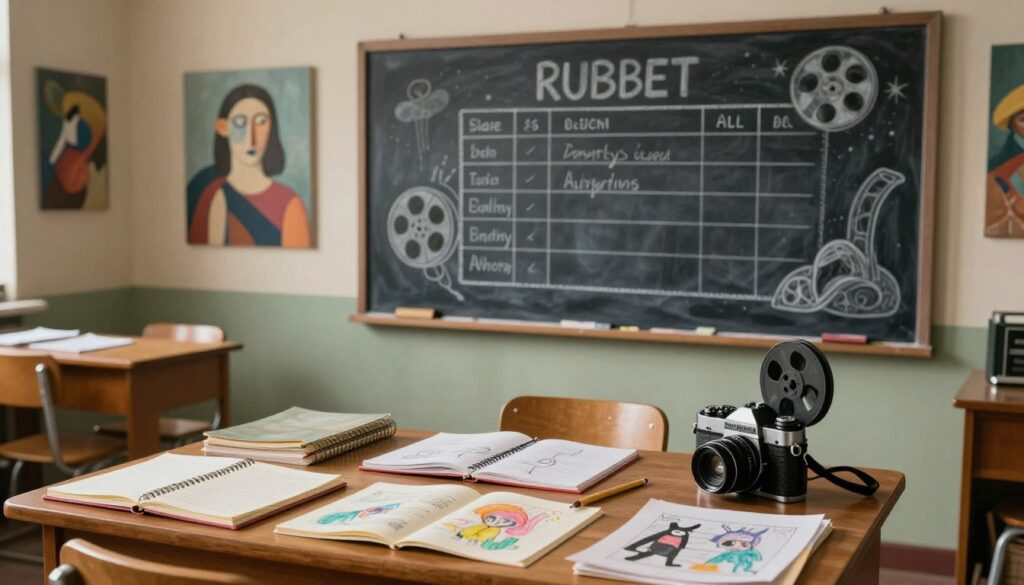
Use at least three key techniques in your project. This makes sure it’s more than just weird.
- Irrational Juxtaposition: Mix images or objects that don’t go together.
- Creation of the Uncanny: Make familiar things seem odd with lighting, props, or makeup.
- Discontinuity Editing: Use jump cuts to mess with time and space.
- Sound/Image Mismatch: Add audio that changes how you see the visuals.
A clear rubric is key for creativity and fair grading. It helps teachers and self-learners assess their work.
The rubric below checks if you’ve used Surrealist techniques well and if your film moves you.
| Evaluation Criteria | Excellent (4) | Proficient (3) | Developing (2) |
|---|---|---|---|
| Irrational Juxtaposition | Juxtapositions are original, striking, and challenge what you think is normal. | Juxtapositions are clear and surprise you, creating a sense of unease. | Juxtapositions are there, but they’re not that surprising or impactful. |
| Uncanny Atmosphere | The film makes you feel uneasy, mysterious, or like you’re dreaming. | The atmosphere is set, with moments that feel odd. | It tries, but the feeling is more forced than real. |
| Innovation in Sound/Image | The sound and visuals are mismatched, adding depth or confusion. | The sound contrasts with or enhances the image well. | The sound and image are too straightforward, lacking surprise. |
| Subconscious Theme | A strong emotional core or idea is shown without needing to explain it. | A theme or emotion is there, tying the film together. | The film feels like a collection of images without a clear idea. |
This rubric makes abstract ideas concrete. Don’t be afraid to try new things. The best discoveries often come from mistakes. For solo creators, use this to critique your work like a teacher.
This short-film assignment is a chance to put the language of shock, symbol, and dream into action. It’s a great way to end our journey together.
Rights and fair‑use notes for screening clips
Before you play that famous scene, knowing about fair use is key. It helps you avoid legal trouble. This guide makes copyright law easy for teachers, workshop leaders, and festival organizers to understand. You can share the magic of surrealist films confidently and ethically.
Copyright law protects creators, but there are exceptions for education in the U.S. Fair use is your strongest ally. It lets you use copyrighted material without permission for things like teaching, scholarship, and criticism.
- Purpose and character of the use: Uses for education or critique are better than commercial ones.
- Nature of the copyrighted work: Using clips from published, factual films is more fair than unpublished, creative ones.
- Amount and substantiality used: Use only what you need to make your point. A short clip is better than a long one.
- Effect on the market: Your use shouldn’t make people less likely to buy or license the full film.
In classrooms, focus is key. Show a clip, explain it, and discuss. This approach is clearly educational. Always give credit to the filmmaker and source.
Another safe option is the public domain. Works without copyright are free to use. Many early surrealist films are in the public domain in the U.S. The Internet Archive and Prelinger Archives are great resources.
If fair use is unsure or your use is outside a classroom (like a festival), licensing is safer. Many services offer affordable, legally cleared clips for education.
| Source Type | Best For | Key Considerations |
|---|---|---|
| Public Domain Repositories | Historical analysis, classic film studies, zero-budget projects. | Verify copyright status for your country. Quality of digitized copies can vary. |
| Educational Clip Libraries (e.g., Kanopy, Swank) | Guaranteed legal access, high-quality clips, contemporary films. | Often require institutional subscription. Rights are usually for educational screening only. |
| Direct Licensing from Distributors | Specific, hard-to-find clips, public screenings, festival use. | Can be costly and time-consuming. Start the process well in advance of your event. |
Follow these tips to stay safe. First, look for public domain and fair use options. Second, document your fair use reasons for each clip. Third, if unsure for a public event, get a license or use other materials.
Understanding these rules lets you create rich, multimedia lessons without worry. By respecting creators’ rights, you teach your students about integrity. And you make sure these important films stay available for future teachers.
Critique framework: psychoanalytic and formal lenses
The psychoanalytic and formal lenses help us understand Surrealist works better. They turn a confusing film into a text we can read and interpret.
Think of them as tools that work together. One looks through the imagery to the mind behind it. The other looks at the craft that made the experience. Together, they give us a complete view.
The Psychoanalytic Lens: Decoding the Dream
This approach sees film as a visual dream. Surrealists were inspired by Freud’s subconscious theories. Films like Un Chien Andalou show this influence.
The psychoanalytic lens asks: what hidden desires, fears, or conflicts is this film showing? It tries to understand the symbolism on screen. Key ideas it explores include:
- Desire and Repression: What wants are expressed or violently suppressed?
- The Uncanny: How does the familiar become strangely unsettling?
- Dream Logic: How does the narrative follow the illogical rules of a dream?
- Symbolic Objects: What might a crawling ant, a severed hand, or a floating eye represent psychologically?
When using this lens, ask yourself questions. What might this character’s obsession symbolize? How does this shocking image relate to a repressed wish? This lens connects bizarre images to universal human psychology.
The formal lens, on the other hand, looks at the how. It focuses on the film’s construction. This is a critique of technique, structure, and cinematic choices.
This lens breaks down how the film’s technical elements create its unique effect. It separates the “what” from the “how it’s made.” A formal analysis might focus on:
- Editing Patterns: The use of shock cuts, jump cuts, and disruptive montage.
- Visual Composition: Unusual camera angles, lighting that creates deep shadows, or unbalanced frames.
- Sound Design: The mismatch between sound and image, use of silence, or jarring musical cues.
- In-Camera Effects: How practical effects, makeup, or props create the uncanny look.
Here, your questions become technical. Why did the editor choose this jarring cut? How does the distorted soundscape affect your sense of reality? This lens appreciates Surrealist film as a deliberate construction.
Putting the Lenses to Work
The true power of this critique framework comes from using both views together. A formal observation about a rapid editing sequence can support a psychoanalytic point about fragmented memory.
For example, analyzing a character’s psychology (psychoanalytic) is deepened by noting how close-ups and eerie sound design (formal lens) isolate them. This dual approach transforms passive viewing into active, insightful analysis.
It provides a structured way to discuss even the most bizarre film. You move from saying “that was weird” to explaining how and why it creates its powerful, unsettling effect.
Distribution: festivals, classroom showcases, archives
Distribution for Surrealist cinema needs a new approach. Move away from mainstream channels to places that love artistic risk. Your film is ready. Now, find an audience that loves the unexpected and deep symbolism.
This path is similar yet different from the past. Early Surrealist films faced bans and scandals. Today, there are new ways to share your unique work.
Mainstream festivals often want clear stories. Your film needs a special place. Look for festivals that celebrate the unusual and the avant-garde.
These festivals attract people who love new ideas. Do your homework. Find festivals known for surreal and abstract films.
- Submit to festivals with “experimental” or “avant-garde” categories.
- Choose smaller, curator-driven events where your film can shine.
- In your application, talk about your film’s unique style and themes.
This focused effort connects you with people who truly appreciate your work.
Organizing Impactful Classroom or Gallery Showcases
Academic and artistic spaces are great for sharing your film. A classroom screening can start important discussions. It can teach about film, art, and psychology.
Work with film or art departments at universities. Add a talk and Q&A to make viewers think deeply.
Gallery showcases treat film as art. Looping the film lets viewers fully experience its dreamlike quality. This honors the uncanny atmosphere you created.
These showcases lead to meaningful conversations and feedback. You won’t find this elsewhere.
Preserving in Digital Archives
Distribution also means preserving your work. Digital archives dedicated to artistic films keep your work alive. They’re different from YouTube, focusing on preservation.
These archives make your film easy to find for researchers and students. Submitting to an archive shows your film is part of a larger conversation.
It joins a historical line, like the early works that started the genre. For more on this, check out resources from modern Surrealist artists and scholars here.
Finding Your Right Audience
It’s not about reaching everyone. Find the right audience for your film. Whether through festivals, discussions, or archives, each path shows Surrealist cinema’s importance.
Your film challenges viewers. Place it where they’re ready for that challenge. This ensures your vision reaches those who see the world in new ways.
Filmography and open resources
Your journey into Surrealist cinema doesn’t have to stop here. A curated filmography can guide you deeper. Start with the foundational works from the 1920s and 30s.
Must-see films include Luis Buñuel and Salvador Dalí’s Un Chien Andalou and L’Age d’Or. Jean Cocteau‘s The Blood of a Poet is a key piece of poetic filmmaking. For a wider view, check out the movement’s beginnings through detailed archives.
Modern masters also leave their mark. David Lynch’s Eraserhead and Mulholland Drive are essential. Don’t forget David Cronenberg, Alejandro Iñárritu, and Jan Švankmajer.
Many films are available for free. The Internet Archive and YouTube have public domain classics. JSTOR has critical essays. The Criterion Channel offers restored prints.
Use this list to begin your journey. Let these films challenge and inspire you. The world of dream logic on screen is waiting for you.