
Arnold Böcklin painted Isle of the Dead decades before André Breton published the first Manifesto of Surrealism in 1924. Yet few 19th-century landscapes haunted the Surrealist imagination so persistently.
The painting offers no recognizable country, historical event, or complete narrative. A small boat approaches a rocky island crowded with dark cypress trees. A white-shrouded figure stands behind what appears to be a coffin. Tomb-like openings have been cut into the cliffs, but the island reveals nothing about who is buried there or what awaits the passengers.
It resembles a real destination while refusing to exist on any reliable map.
That contradiction will receive renewed attention during Böcklin’s bicentenary. Böcklin: Beyond the Myth opens at Berlin’s Alte Nationalgalerie on March 19, 2027, and runs through August 1, 2027. The Berlin Böcklin exhibition will bring together approximately 150 works and examine the extraordinary reception history surrounding the Swiss Symbolist.
A related presentation follows at Kunstmuseum Basel from September 4, 2027, through January 23, 2028. Its planned reunion of the four surviving versions of Isle of the Dead will make comparison possible on an unprecedented scale.
The exhibition project reveals why the picture mattered so much to Surrealism. Böcklin did not merely paint death. He created an environment in which landscape, architecture, memory, mourning, and dream became impossible to separate.
The Painting Began As A Place To Dream
Böcklin was born in Basel on October 19, 1827, and trained as a landscape painter before spending substantial periods in Italy.
The first version of Isle of the Dead emerged in Florence in 1880. While Böcklin was still working on it, the recently widowed Marie Berna visited his studio and asked him to paint a “picture to dream over.”
Böcklin produced another version for her, adding the small boat, coffin, and white-clad mourner that became central to the composition’s identity.
That origin explains why the painting feels emotionally specific without illustrating a recognizable story.
It is connected to grief, but not restricted to one person’s bereavement.
The boat could be carrying anyone.
The island could hold everyone.
Böcklin transformed private mourning into a destination that viewers could enter psychologically.
The Island Feels Real Because It Was Built From Memories
Isle of the Dead does not depict one identifiable location.
Museum research has connected its visual language with several places Böcklin knew or may have remembered: the Castello Aragonese near Ischia, the cemetery island of San Michele in Venice, Italian coastal architecture, and Etruscan rock tombs.
Böcklin fused these impressions rather than documenting any one of them.
That fusion is essential to the painting’s uncanny effect.
The cliffs look geologically plausible. The cypress trees resemble vegetation traditionally associated with cemeteries and mourning. The architecture appears ancient enough to carry history but too simplified to belong to one civilization.
The island seems remembered from somewhere the viewer has never visited.
Surrealists would later pursue this exact sensation: the recognition of something that cannot be placed.
Five Versions Turned One Image Into A Recurring Dream
Böcklin painted five versions between 1880 and 1886.
Four survive today in collections in Basel, New York, Berlin, and Leipzig. The fifth was destroyed during World War II.
The repeated composition strengthens the work’s dreamlike quality. This was not one landscape fixed permanently on canvas. Böcklin returned to it, altering the light, color, architecture, vegetation, and relationship between the island and its visitors.
The image behaves like a recurring dream whose basic structure remains stable while its atmosphere changes.
The 1883 Berlin version became especially important to the motif’s public fame. Commissioned by art dealer Fritz Gurlitt, it circulated widely through prints and photographs, including an engraving by Max Klinger.
Reproduction turned the island into a shared cultural memory.
People who had never seen the original painting could still feel that they knew the place.
The Painting Is A Landscape With No Safe Viewing Position
Traditional landscape painting often gives viewers a stable place from which to observe nature.
A road or river draws the eye into the distance. Mountains establish scale. Open sky offers visual release.
Isle of the Dead denies that comfort.
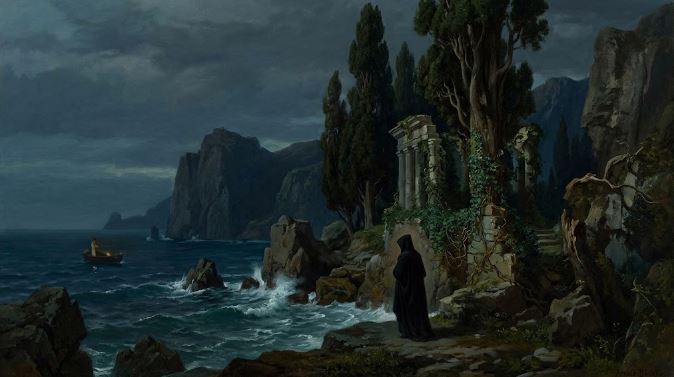
The viewer seems to approach from the water, close to the position occupied by the boat. There is no broad panorama and no clear route back.
The island’s cliffs enclose its interior. The cypress trees block the sky. Tomb openings suggest depth without revealing what lies inside.
Even the boat’s destination remains uncertain. A narrow landing appears possible, but the composition does not show what happens after arrival.
The landscape therefore behaves less like scenery than a threshold.
It places the viewer between departure and entry, life and death, visibility and concealment.
That unresolved position would become central to Surrealist space.
Giorgio De Chirico Inherited The Psychological Architecture
Giorgio de Chirico encountered Böcklin’s art while studying in Munich during the early 20th century.
The influence became foundational to his Metaphysical paintings.
De Chirico’s empty piazzas, deep shadows, classical architecture, distant trains, and isolated figures do not copy Isle of the Dead. They inherit its method.
Architecture becomes psychological.
A place can appear clear, solid, and carefully constructed while remaining impossible to explain.
The town square in de Chirico’s paintings operates much like Böcklin’s island. It looks accessible but feels sealed. It contains familiar things but refuses ordinary life.
De Chirico then became one of the most important precursors to Breton’s Surrealism.
Böcklin’s haunted landscape therefore entered the movement partly through an intermediary: Symbolism shaped Metaphysical painting, which helped shape Surrealism.
Max Ernst Turned The Island Into A Forest
Max Ernst found another route into Böcklin’s landscape.
Kunstmuseum Basel has previously paired the first version of Isle of the Dead with Ernst’s The Large Forest (1927), highlighting the visual and psychological relationship between them.
In Ernst’s painting, towering trees become an almost impenetrable wall. A circular celestial form rises behind the forest, casting an eerie light over an environment that feels simultaneously vegetal, mineral, and architectural.
Böcklin’s cypress trees enclose an island of death.
Ernst’s forest becomes the enclosure itself.
Readers can follow that transformation further in thesurrealists.org’s live feature on Max Ernst’s psychological forests.
Ernst demonstrates why Isle of the Dead mattered beyond its subject. Böcklin showed that nature could operate as a mental structure rather than a neutral view.
Dalí Made The Inheritance Explicit
Salvador Dalí also recognized Böcklin as a major predecessor.
In 1932, he created The True Painting of “The Isle of the Dead” by Arnold Böcklin at the Hour of the Angelus, openly transforming Böcklin’s motif through his own developing visual language.
The title is revealing.
Dalí does not present his work as a casual homage. He claims to reveal the “true” painting, as though Böcklin’s island contained another image waiting to be released.
That attitude is profoundly Surrealist.
The original artwork becomes latent material.
A previous artist supplies the visible image; the Surrealist uncovers its supposedly hidden psychological reality.
Böcklin’s landscape therefore functions less like an influence to be imitated than a dream to be reinterpreted.
The Painting Makes Death Feel Architectural
Death in Isle of the Dead is not represented through a corpse, skeleton, battlefield, or religious judgment.
It appears as architecture.
Cliffs become walls.
Tombs become openings.
Cypress trees become columns.
The island resembles a natural formation, a cemetery, a fortress, and a temple simultaneously.
This is one reason the image avoids becoming conventional funerary art.
It does not tell viewers what death means.
It constructs a place where death seems to exist.
Surrealists were fascinated by similar spatial transformations. Rooms could represent desire. Streets could become anxiety. Forests could embody the unconscious. Deserts could function as psychic emptiness.
Böcklin anticipated that tradition by making mourning inhabitable.
Its Silence Is More Disturbing Than Explicit Horror
Nothing visibly attacks the travelers.
The water remains calm. The boat advances slowly. The trees do not move. The white figure does not gesture.
That silence is what makes the painting menacing.
The viewer expects revelation but receives stillness.
Surrealist art would repeatedly exploit the same strategy. An image does not need violence or grotesque anatomy to produce dread. Sometimes an ordinary-looking scene becomes disturbing because it withholds the event that would explain it.
Böcklin turns waiting into atmosphere.
The image exists permanently before arrival.
The boat never docks.
The coffin never enters the tomb.
The mourner never turns around.
The painting remains caught in an endless approach.
Reproduction Helped It Enter The Collective Unconscious
The popularity of Isle of the Dead depended partly on reproduction.
Prints and photographs circulated widely across German-speaking Europe around the turn of the century. The composition also inspired music, literature, theater, cinema, and later visual art.
This circulation gave the painting a life beyond its original versions.
It became less like one artwork and more like a reusable mental location.
That helped make it ideal for Surrealism.
Breton’s movement was interested in images that seemed to possess collective psychological force—images capable of returning through dreams, associations, chance encounters, and cultural memory.
By the 1920s, Böcklin’s island was already such an image.
The Surrealists did not need to discover it in a secluded museum.
It had already entered popular imagination.
The 2027 Reunion Will Show That The Island Was Never Fixed
The Kunstmuseum Basel bicentennial exhibition plans to unite the four surviving versions of Isle of the Dead.
That comparison should reveal how unstable the supposedly iconic composition really is.
Color shifts.
Light changes.
The cliffs become more or less imposing.
The boat’s relationship to the island changes.
The versions carry different emotional temperatures even though the basic imagery remains recognizable.
Seeing them together will make the work look less like a single masterpiece and more like an evolving psychological experiment.
Böcklin kept returning to the island because one version could not exhaust it.
Surrealism inherited that same refusal of final meaning.
The Island Never Needed To Be Surrealist
Arnold Böcklin died in Fiesole in 1901, more than two decades before Surrealism’s formal beginning.
He was a Symbolist, not a Surrealist.
That distinction should remain intact.
Yet Isle of the Dead supplied later artists with several ideas that Surrealism would make central: impossible familiarity, psychological landscape, ambiguous narrative, dreamlike architecture, unresolved symbolism, and the transformation of ordinary nature into an interior world.
De Chirico inherited its silence.
Ernst inherited its enclosing vegetation.
Dalí inherited its dream potential.
What they shared was not one style but one recognition: a landscape could represent far more than a place.
It could become a destination created entirely from fear, memory, desire, and uncertainty.
That is why Isle of the Dead became Surrealism’s favorite haunted landscape.
It already looked like a dream before the movement had learned how to name one.