
Marcel Duchamp was never comfortably contained by Surrealism.
He was associated with it, exhibited with its artists, designed some of its most influential exhibitions, and helped establish ideas that Surrealists eagerly adopted. Yet he remained independent of André Breton’s movement and had already begun dismantling conventional definitions of art years before Breton published the first Manifesto of Surrealism in 1924.
That independence is precisely why Duchamp’s Surrealist legacy became larger than Surrealism itself.
The question has fresh relevance with Marcel Duchamp, now at the Philadelphia Museum of Art through January 31, 2027. The exhibition opened on October 10, 2026, after an earlier presentation at the Museum of Modern Art in New York.
The Philadelphia Duchamp retrospective presents more than 300 works across painting, sculpture, photography, film, printed matter, exhibition design, and the objects Duchamp called readymades. It is the first major U.S. retrospective dedicated to him in more than 50 years.
That breadth makes one fact difficult to ignore.
Duchamp did not simply influence Surrealism.
He helped invent ways of thinking about authorship, objects, exhibitions, identity, chance, and ideas that continued through Conceptual art, installation, Pop, performance, institutional critique, and much of contemporary art.
Duchamp Was Already Breaking Art Before Surrealism Arrived
Duchamp was born in Blainville-Crevon, France, in 1887.
Early in his career he worked through Impressionist, Post-Impressionist, and Cubist influences. His Nude Descending a Staircase (No. 2) (1912) made him notorious after appearing at the 1913 Armory Show in New York.
Yet Duchamp soon became dissatisfied with what he called purely “retinal” art—art directed primarily toward visual pleasure.
He wanted art to operate through ideas.
This decision pushed him away from conventional painting and toward one of the most consequential inventions in modern art: the readymade.
Instead of making an object from scratch, Duchamp could select something already manufactured and reposition it as art.
That simple shift transformed authorship itself.
The Readymade Gave Surrealism A New Kind Of Object
In 1913, Duchamp mounted a bicycle wheel on a stool.
In 1915, he selected a snow shovel and titled it In Advance of the Broken Arm.
Then came Fountain (1917): a manufactured urinal submitted under the name R. Mutt to the Society of Independent Artists exhibition in New York.
The object was rejected.
The argument it created never disappeared.
What makes an artwork?
Craft?
Beauty?
Originality?
Intention?
Selection?
Context?
The Museum of Modern Art’s history of Duchamp’s readymades emphasizes how radically they shifted attention from the artist’s technical skill toward the artist’s conceptual choice.
Surrealists would transform this logic into something more psychologically charged.
Found objects became objects of desire.
Ordinary commodities could acquire erotic, dreamlike, or disturbing meanings simply through displacement and juxtaposition.
Duchamp helped establish the mechanism before the Surrealists turned it into a movement strategy.
Chance Entered Duchamp’s Art Early
Duchamp also weakened artistic control through chance.
His 3 Standard Stoppages (1913–14) began with three meter-long threads dropped from a fixed height.
Their accidental curves became templates.
The gesture sounds modest, but the principle was radical.
The artist establishes conditions.
Chance determines part of the result.
Surrealists would later use comparable strategies in automatic writing, automatic drawing, exquisite corpse games, frottage, decalcomania, and other procedures designed to weaken rational control.
Duchamp was not practicing Bretonian psychic automatism.
He was asking a related question earlier:
What happens when the artist stops controlling everything?
That question continued far beyond Surrealism.
Rrose Sélavy Made Identity Another Artistic Material
Duchamp’s experiments were not limited to objects.
Around 1920, he developed the female alter ego Rrose Sélavy, whose name appeared on artworks and photographs and became part of his creative identity.
Man Ray famously photographed Duchamp as Rrose.
The gesture disturbed expectations surrounding gender, authorship, persona, and artistic identity.
Again, Duchamp did not turn the idea into a fixed doctrine.
He treated identity almost like a readymade.
Something could be adopted.
Renamed.
Performed.
Repositioned.
Later generations of performance and conceptual artists would take similar questions much further.
The significance of Rrose Sélavy therefore exceeds Surrealism’s own fascination with masks, doubles, sexuality, and unstable identity.
Breton Wanted Duchamp Even When Duchamp Kept His Distance
André Breton recognized Duchamp’s importance.
By the 1930s, Surrealists regarded his earlier experiments as major precedents for their own attack on conventional artistic values.
Yet Duchamp repeatedly avoided becoming a conventional movement member.
That distance matters.
He could work with the Surrealists without allowing their manifestos to determine his practice.
He participated in exhibitions.
He contributed ideas.
He maintained close relationships with Breton, Man Ray, Max Ernst, and others.
But Duchamp remained Duchamp.
That made him unusually valuable.
Movements tend to develop rules.
Duchamp specialized in making rules unstable.
The 1938 Exhibition Turned Surrealism Into An Environment
One of Duchamp’s most consequential contributions to Surrealism did not involve making a conventional artwork at all.
It involved designing an exhibition.
For the Exposition Internationale du Surréalisme in Paris in 1938, Breton and Paul Éluard asked Duchamp to help transform the Galerie Beaux-Arts.
Duchamp served as what was called the exhibition’s “generator-arbitrator.”
He covered the ceiling with approximately 1,200 coal sacks.
The gallery was darkened.
Visitors used flashlights.
A brazier supplied another source of illumination.
Revolving doors appeared inside the galleries.
A corridor contained mannequins altered by participating Surrealists.
The exhibition stopped behaving like a neutral room containing autonomous artworks.
The room itself became the artwork’s psychological machinery.
That was a major shift.
Today, immersive exhibition design feels commonplace.
In 1938, making spectators physically negotiate darkness, objects, movement, atmosphere, and disorientation was remarkably radical.
First Papers Of Surrealism Made Looking Physically Difficult
Duchamp repeated the experiment in New York.
In 1942, Breton asked him to design First Papers of Surrealism, an exhibition held at the Whitelaw Reid Mansion in Manhattan.
The title referred ironically to immigration paperwork—a charged reference because many European artists had recently fled war and fascism.
Duchamp filled the exhibition space with an enormous web of string.
The installation obstructed normal movement and sightlines.
Visitors could not simply walk into a gallery and look calmly at pictures.
The act of viewing became difficult.
That gesture anticipates installation art and environments in which spectators must physically encounter an artwork rather than merely stand in front of it.
Duchamp was turning exhibition design into conceptual practice.
The Large Glass Made Interpretation Part Of The Artwork
Duchamp’s The Bride Stripped Bare by Her Bachelors, Even (The Large Glass), created between 1915 and 1923, occupies another important territory between object, image, machine, diagram, erotic puzzle, and conceptual system.
The work contains a “Bride” above and a group of “Bachelors” below.
Its internal machinery suggests desire without offering a straightforward narrative.
Chance entered the work physically when the glass cracked during transportation. Duchamp chose to accept the cracks rather than erase them.
Again, uncertainty became productive.
Viewers must construct relationships among fragments.
Meaning never fully stabilizes.
That openness would become crucial to later conceptual practices in which the artwork functions less like a finished statement and more like a system requiring interpretation.
Box In A Valise Turned The Artist Into His Own Museum
Between 1935 and 1941, Duchamp developed Box in a Valise, a portable collection of miniature reproductions of his own work.
A museum inside a suitcase.
The idea now feels uncannily contemporary.
Duchamp reproduced his own works, miniaturized them, rearranged their hierarchy, and created an archive that could travel independently of the originals.
Original versus copy becomes unstable.
Museum versus object becomes unstable.
Artist versus curator becomes unstable.
The work anticipates later questions about reproduction, archives, artist books, portable exhibitions, and the authority institutions exercise when deciding how art should be organized.
Duchamp was not only producing works.
He was editing his own history.
Surrealism Needed Duchamp’s Irreverence
Surrealism benefited enormously from this attitude.
Breton’s movement was revolutionary, but movements can eventually become orthodox.
Duchamp’s skepticism operated differently.
He distrusted artistic seriousness whenever it hardened into convention.
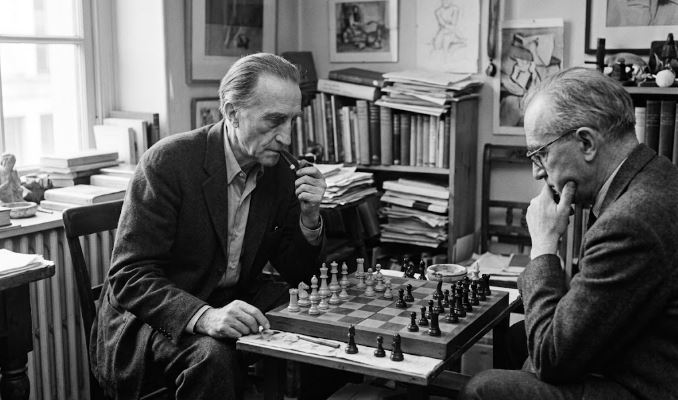
Chess became as important to him as producing art.
Language games interrupted visual interpretation.
Puns disrupted stable meaning.
Copies could be treated almost like originals.
An ordinary urinal could destabilize an exhibition.
Duchamp’s contribution to Surrealism therefore came partly from his refusal to behave like a loyal Surrealist.
He kept open the possibility that even the avant-garde could become predictable.
His Influence Escaped Surrealism Completely
The strongest evidence that Duchamp’s legacy became larger than Surrealism appears after World War II.
Artists associated with Conceptual art, Pop, Minimalism, performance, Fluxus, Neo-Dada, installation, and institutional critique repeatedly returned to questions Duchamp had already posed.
Robert Rauschenberg and Jasper Johns treated everyday materials and cultural signs as artistic material.
Andy Warhol complicated originality through mechanical reproduction.
Conceptual artists pushed the idea that the concept could outweigh the handmade object.
Performance artists destabilized the boundary between artist and artwork.
Institutional critique questioned how museums determine artistic value.
None of these developments can be credited to Duchamp alone.
But his questions remained extraordinarily durable.
The readymade did not produce one new style.
It produced a permanent problem.
Étant Donnés Proved He Had Never Really Stopped
For years, Duchamp cultivated the impression that he had largely abandoned art for chess.
Meanwhile, in secret, he was constructing Étant donnés: 1° la chute d’eau, 2° le gaz d’éclairage… between 1946 and 1966.
The installation can only be viewed through holes in a wooden door.
Beyond them lies an unsettling scene involving a nude female figure, landscape, waterfall, and gas lamp.
The spectator becomes a voyeur.
Looking itself becomes part of the artwork.
The work also demonstrates that Duchamp’s relationship with eroticism, mystery, and psychologically unstable environments continued long after the historical high point of Surrealism.
He had not abandoned those concerns.
He had rebuilt them on his own terms.
Independence Is What Made His Surrealist Legacy So Large
The Philadelphia retrospective describes Duchamp as associated across his career with Cubism, Dada, and Surrealism while emphasizing that his continual reinvention makes him impossible to categorize under any single label.
That may be the best way to understand him.
Duchamp did not belong completely to Surrealism.
Surrealism belonged partly to Duchamp.
It absorbed his chance procedures.
His found objects.
His humor.
His erotic puzzles.
His unstable identities.
His contempt for inherited artistic categories.
His ability to make exhibition space psychologically active.
Yet those ideas continued traveling after Surrealism ceased functioning as a coherent movement.
Readers interested in an artist who took another route through Surrealist possibility can explore thesurrealists.org’s verified article on Remedios Varo’s science, magic, and enigmatic worlds.
Varo built elaborate imagined universes.
Duchamp increasingly questioned whether an artist needed to build a conventional artwork at all.
Both demonstrate why Surrealism’s history becomes richer when membership stops being the only measure of influence.
The 2026 Retrospective Makes The Scale Of His Afterlife Visible
Marcel Duchamp remains at the Philadelphia Museum of Art through January 31, 2027.
Organized with the Museum of Modern Art, the retrospective brings together more than 300 works across roughly six decades.
The scale is appropriate because Duchamp’s legacy is difficult to locate in one object.
It exists in questions.
Can selection be creation?
Can chance be an artistic collaborator?
Can an exhibition become an artwork?
Can identity be performed?
Can a copy retain artistic force?
Can an ordinary object become art because someone changes its context?
Can an artwork exist primarily as an idea?
Surrealism embraced many of those possibilities.
Contemporary art inherited even more of them.
That is why Duchamp’s Surrealist legacy became bigger than Surrealism itself.
He did not give the movement another recognizable style.
He helped make style less important than the question of what art could be.