
Automatic drawing sounds almost passive.
Let the hand move. Suppress conscious planning. Allow a line to wander across the paper until forms begin to emerge.
For André Masson, however, automatism was rarely peaceful.
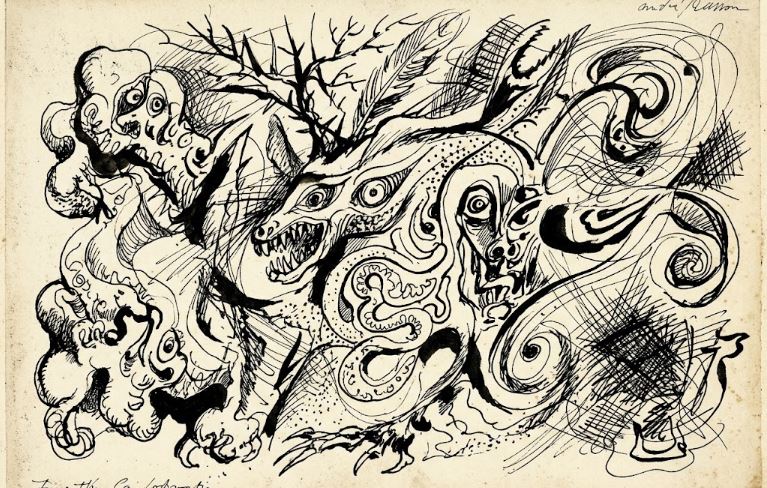
His lines collide, split, knot, mutate, and produce fragments of bodies. Fish attack one another. Animals become entangled with humans. Sand sticks unpredictably to glue. Violence, eroticism, death, metamorphosis, and physical movement repeatedly break through the supposed spontaneity of the process.
That intensity is especially relevant in 2026 because André Masson: Les mots de tes couleurs is on view at the Maison Elsa Triolet-Aragon in Saint-Arnoult-en-Yvelines, France, from September 5 through November 29, 2026.
The official André Masson exhibition describes him as a major Surrealist and close friend of Louis Aragon, emphasizing his exploration of automatism, free gesture, and a visual language in which line and color acquire a simultaneously vital, violent, and poetic energy.
That description gets to the heart of Masson’s importance.
He did not merely translate André Breton’s idea of psychic automatism into drawing.
He made automatism bodily.
Masson Was Exploring Automatic Drawing Before Surrealism Fully Formed
André-Aimé-René Masson was born in Balagny-sur-Thérain, France, on January 4, 1896.
He trained in Brussels and Paris before World War I interrupted his artistic development.
Masson entered the French infantry and experienced some of the war’s most destructive fighting. In April 1917, he was gravely wounded in the chest and endured a difficult physical and psychological recovery.
That experience matters when looking at his later images.
Masson’s art repeatedly returns to combat, dismemberment, predation, sacrifice, death, and bodies undergoing transformation.
Violence was not an abstract intellectual subject for him.
It had entered his life physically.
After returning to Paris, Masson worked through a period influenced by Cubism. By 1923, however, he had begun experimenting with drawings made rapidly and without a predetermined composition.
André Breton’s first Manifesto of Surrealism would not appear until 1924.
Masson’s automatic experiments therefore developed at almost the same moment Surrealism itself was being formulated.
Breton Saw In Masson A Visual Equivalent To Automatic Writing
Breton’s definition of Surrealism placed psychic automatism near the movement’s center.
Writers were supposed to weaken rational censorship and allow thought to flow with minimal conscious control.
But translating that principle into visual art posed a problem.
Writing could move rapidly.
Painting usually required preparation.
Colors had to be mixed.
A canvas encouraged compositional decisions.
Drawing offered a faster route.
Masson allowed his pen to move quickly across paper without deciding beforehand what the finished image should represent.
Curving lines intersected.
Shapes appeared.
Anatomical fragments emerged.
Objects surfaced inside networks of marks.
Only then might Masson strengthen a suggested figure.
The process was therefore never completely unconscious.
Chance opened the image.
Masson reacted to what chance produced.
His Automatic Lines Were Already Full Of Bodies
This is where Masson’s version of automatism differs from the popular idea of effortless doodling.
His lines repeatedly produce anatomical tension.
Limbs emerge and disappear.
Bodies collide.
Forms become simultaneously vegetal, animal, and human.
The line itself seems nervous.
It moves quickly enough to imply that thought is struggling to keep up with the hand.
That speed creates physical tension.
Masson’s drawing does not merely represent energy.
The marks record the movement that produced them.
This distinction became enormously important later in 20th-century painting.
A finished picture could reveal not only an image but also the bodily action of making it.
World War I Never Entirely Left The Work
Masson’s wartime injury provides important context for the violence that appears throughout his Surrealist period.
He had experienced mechanized warfare directly.
Later paintings and drawings repeatedly contain scenes of predation, death, mutilation, massacres, and struggle.
That does not mean every violent form should be interpreted literally as a war memory.
Masson’s imagery also drew upon mythology, sexuality, philosophy, nature, and ideas about creation and destruction.
But violence remained structurally important.
Bodies in Masson rarely feel completely secure.
Forms generate one another and destroy one another.
Creation and disintegration can happen in the same image.
Automatism gave those contradictions room to appear before conscious composition could organize them neatly.
Battle Of Fishes Turned Chance Into Combat
Masson’s Battle of Fishes (1926) provides one of the clearest examples.
The work, now in the Museum of Modern Art in New York, is made from sand, gesso, oil, pencil, and charcoal on canvas.
Masson began by applying gesso freely and throwing sand across the surface.
He removed what did not adhere.
The random contours left behind suggested possible forms.
From them, he developed an image of sharp-toothed fish locked in violent underwater struggle.
The Museum of Modern Art’s Battle of Fishes record emphasizes that these contours emerged through the partially uncontrolled process before Masson rapidly developed the imagery.
This changes how the violence should be understood.
Masson did not begin by carefully sketching fighting fish.
Material accident came first.
Aggression emerged from it.
Sand Made Automatism Physical
Masson’s sand paintings of 1926–27 represent one of his most important technical breakthroughs.
Automatic drawing had liberated the line.
Sand allowed him to extend that freedom onto canvas.
He applied adhesive without fully controlling its path and scattered sand over the surface.
Gravity participated.
Texture participated.
The uneven behavior of the glue participated.
The artist no longer determined every mark.
Chance had become material.
That process made automatism more physical than automatic writing could ever be.
Masson was no longer simply allowing his hand to move freely.
He was throwing matter.
The canvas recorded gesture, accident, resistance, and gravity.
Surrealism had become an event happening between body and material.
Lancelot Shows Chance Becoming Image
Masson’s Lancelot (1927) provides another example of this transition.
The painting combines oil and sand.
The Centre Pompidou has described Masson’s early sand works as an attempt at immediate, unpremeditated expression in response to Breton’s call for psychic automatism.
Yet the works were not completely random.
Masson watched what the adhesive and sand produced.
Then he responded.
Chance generated possibilities rather than finished compositions.
This dialogue between accident and recognition became one of automatism’s most important principles.
An artist does not simply switch consciousness off.
The artist creates conditions in which something unexpected can happen, then reacts before rational control completely closes the opening.
Violence Was Also Erotic
Masson’s physicality cannot be separated from eroticism.
Sexual forms repeatedly merge with wounds, plants, animals, and weapons.
Desire rarely appears calm.
It is tied to hunger, struggle, penetration, metamorphosis, and vulnerability.
This combination gives his work a particular emotional temperature.
The body is not represented as stable anatomy.
It behaves like an unstable field of forces.
That instability helps explain why Masson’s drawings could feel more radical than polished dream painting.
A carefully rendered Surrealist scene can depict an impossible event.
Masson’s automatism often makes the drawing itself feel unstable.
The Rue Blomet Studio Was A Laboratory
During the early 1920s, Masson’s studio at 45 rue Blomet in Paris became an important gathering place.
Joan Miró occupied a neighboring studio.
Visitors and friends included writers and artists such as Michel Leiris, Georges Limbour, Antonin Artaud, and later figures associated with Breton’s emerging group.
The atmosphere mattered.
Surrealism did not grow only from published manifestos.
It developed through conversations, experiments, arguments, friendships, games, poetry, and collective attempts to escape established artistic habits.
Masson’s practice already favored exactly that kind of instability.
He joined Breton’s Surrealist group in 1924 and participated in the first Surrealist exhibition at Galerie Pierre in 1925.
But his relationship with Bretonian orthodoxy would never remain comfortable.
Masson Was Too Restless For Pure Doctrine
Masson distanced himself from Breton’s group toward the end of the 1920s.
He disliked the movement’s increasingly rigid intellectual and political discipline.
That friction is significant because Masson’s greatest contribution to automatism was precisely his refusal to make it a formula.
If automatic drawing became another prescribed Surrealist style, it would contradict its own purpose.
Masson wanted uncertainty.
He wanted risk.
His technique needed the possibility of failure.
That helps explain why he repeatedly returned to automatic processes while refusing to remain permanently inside Breton’s organizational structure.
Surrealism gave automatism its theory.
Masson made it restless.
Automatism Could Produce Figures Rather Than Abstraction
It is also important that Masson’s automatic work did not necessarily end in abstraction.
Unexpected figures frequently appeared.
A line suggested an arm.
Another became a bird.
A cluster of forms turned into combat.
This made automatism a process of recognition as much as production.
The eye searches disorder for meaning.
That process resembles the experience of seeing figures in clouds or faces in irregular surfaces.
Surrealists valued exactly this instability between perception and projection.
Readers interested in how works on paper became laboratories for these kinds of Surrealist experiments can explore thesurrealists.org’s article on why Surrealism needed paper more than canvas.
Masson’s automatic drawings demonstrate why paper could be so important: the medium allowed thought, gesture, and image to collide almost instantaneously.
His Technique Anticipated Gestural Painting
Masson’s influence did not end with historical Surrealism.
His emphasis on movement, chance, bodily action, and material unpredictability anticipated important developments in postwar painting.
This became particularly significant when Masson lived in the United States during World War II.
American artists were increasingly exposed to European Surrealist ideas about automatism.
The relationship between Masson’s sand paintings and later Abstract Expressionism has been repeatedly discussed by museums and historians.
The connection should not be simplified into a straight line from Masson to Jackson Pollock.
But the shared principle is unmistakable.
The act of making can become part of the artwork’s meaning.
Throwing, dripping, scattering, sweeping, and rapid mark-making transform painting from careful image construction into physical behavior.
Masson had already been testing that possibility in the 1920s.
Automatic Drawing Was Never Really Passive
This is why calling Masson’s work “automatic” can be misleading.
The word suggests that the artist disappears.
Masson’s art does the opposite.
His body becomes unusually present.
The hand accelerates.
The line records hesitation and impact.
Sand reveals where matter landed.
Gesture becomes evidence.
Violence emerges from both image and process.
Automatism therefore does not erase the artist.
It weakens one kind of control so that other forces can become visible.
Memory.
Instinct.
Fear.
Desire.
Chance.
Physical momentum.
Material resistance.
The 2026 Exhibition Returns Attention To Gesture
André Masson: Les mots de tes couleurs runs at the Maison Elsa Triolet-Aragon through November 29, 2026.
Its title comes from Louis Aragon’s 1976 “Cantate à André Masson”, and the exhibition emphasizes the long friendship between the writer and artist.
More importantly, it returns attention to Masson’s free gesture.
That matters because automatism can become too intellectual when described only through Breton’s theories.
Masson’s contribution was physical.
He made the unconscious scratch, collide, bleed, scatter, and struggle across the surface.
His automatic drawings were not quiet transcripts from an invisible mind.
They were confrontations between hand, memory, accident, material, and image.
That is why Masson remains crucial to Surrealism.
Breton defined psychic automatism.
Masson gave it muscles.