
Wolfgang Paalen and Alice Rahon spent thirteen years married, crossed continents together, entered André Breton’s Surrealist circle, traveled through the Pacific Northwest, settled in Mexico City and helped push Surrealism into territories far beyond Paris. Yet art history has rarely allowed their work to occupy the same room.
That changes on September 10, 2026, when Gallery Wendi Norris in San Francisco opens Wolfgang Paalen and Alice Rahon: Worlds Gone and to Come. Running through October 24, the exhibition is the first two-person show devoted to their work together. Rare paintings and works on paper place Paalen’s smoke-generated abstractions beside Rahon’s textured, sand-infused paintings, making visible connections that biographies have often obscured. The Gallery Wendi Norris exhibition focuses substantially on the period of their marriage from 1934 to 1947 while allowing their artistic differences to remain intact.
The timing carries another historical resonance. On the exhibition’s opening night, the San Francisco Museum of Modern Art will host “Unsung Surrealists: Wolfgang Paalen and Alice Rahon,” a conversation between Stanford professor Alexander Nemerov and curator Megan Kincaid. SFMOMA has deep ties to both artists: Rahon received a solo exhibition there in 1945, while Paalen became central to the museum’s 1951 presentation of the experimental Dynaton circle.
What makes this reunion significant is not that Paalen and Rahon can finally be repackaged as an art-world romance. It is that seeing their paintings together exposes how Surrealism itself changed through marriage, migration, Mexico, material experimentation and the circulation of ideas between artists who influenced one another without producing the same kind of art.
They Met In Paris But Their Shared Story Did Not Stay There
Alice Rahon was born Alice Marie Yvonne Philppot in Chenecey-Buillon, France, in 1904. Wolfgang Paalen was born in Vienna in 1905. They met in Paris in 1931, when both were in their twenties and moving through the city’s experimental artistic circles.
Paalen initially worked near abstraction. He joined Abstraction-Création in 1933 before becoming involved with the Surrealists in 1935. Rahon came to Surrealism through poetry. André Breton admired her writing, and she published three poetry collections before painting became her dominant medium.
They married in 1934.
That chronology already complicates the common tendency to treat Rahon as a secondary figure in Paalen’s biography. She was not simply the wife of a Surrealist painter. She was a published poet operating within the same avant-garde network, with friendships and intellectual relationships of her own.
The current exhibition deliberately restores that parallel development.
Gallery Wendi Norris describes Paalen as Surrealism’s “philosopher of the possible,” emphasizing his theoretical ambitions. Rahon’s paintings, by contrast, retain something of poetry’s compressed suggestiveness. Landscape, color and material seem to imply events without explaining them.
Their methods diverged.
Their questions often touched.
That makes the relationship more revealing than a story of influence flowing in one direction.
Paalen Made Smoke Into A Form Of Automatism
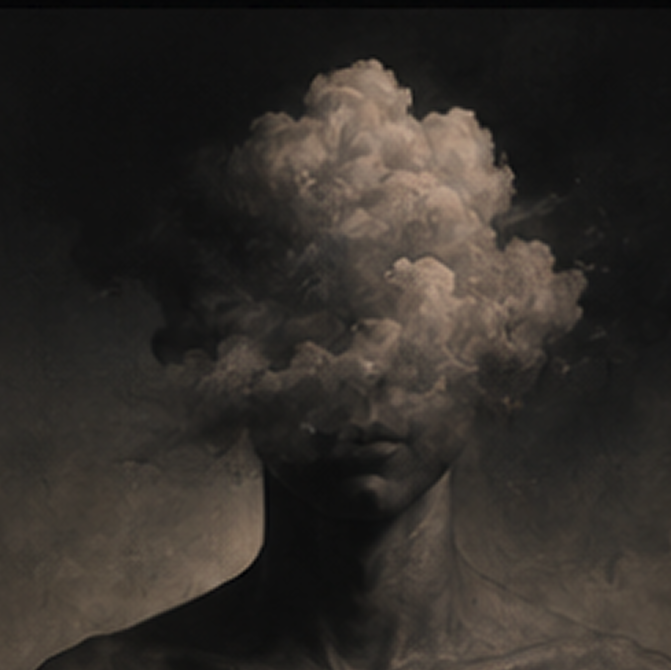
Paalen’s most famous technical innovation came through fumage.
Instead of beginning every passage of an image with brush and pigment, he exposed surfaces to candle smoke. Soot accumulated unpredictably, producing dark traces from which forms could emerge.
Paalen described the process as a kind of “dictation by candle.”
The phrase links fumage directly to Surrealist automatism. André Breton and other Surrealists had experimented with automatic writing and drawing as methods for weakening conscious control. Paalen introduced combustion into that problem.
The artist could position the flame.
He could move the surface.
He could respond to the result.
He could not precisely instruct the smoke where to settle.
Gallery Wendi Norris’s exhibition centers partly on Paysage totémique (1937), an important fumage painting whose layered imagery emerged during the period of Paalen and Rahon’s marriage. The work demonstrates why fumage was more than an attractive texture. Smoke gives the surface forms that hover between geological structures, weather systems and imagined beings.
Paalen then interprets the accident.
That partnership between intention and unpredictability places his work firmly inside Surrealism’s experiments with chance.
It also creates an unexpected parallel with Rahon.
She did not imitate fumage.
She developed another kind of material landscape.
Rahon Turned Poetry Into Painted Terrain
Rahon began exhibiting paintings around 1940, after the couple had left Europe.
Her transition from poetry to painting did not mean abandoning poetic thinking.
Mexico’s Instituto Nacional de Bellas Artes y Literatura emphasized that continuity again in May 2026, when it presented Christine Frérot’s book Alice Rahon: un destino mexicano. INBAL describes Rahon’s mature work as intimate and difficult to classify, with “the poetry of images” replacing the poetry of words. The official Alice Rahon publication announcement places her alongside Leonora Carrington and Remedios Varo as a major contributor to modern art in Mexico.
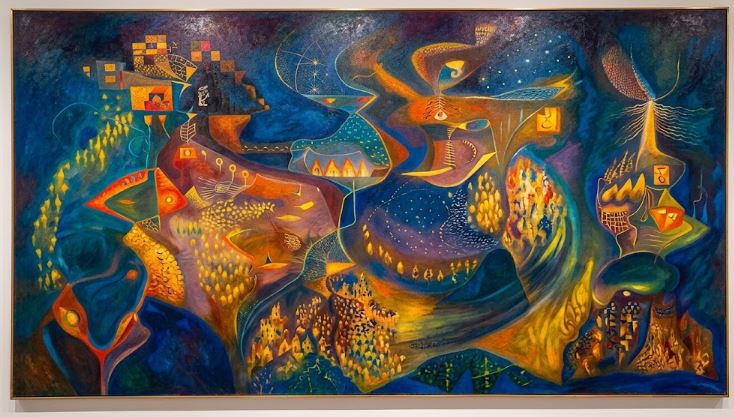
Rahon’s surfaces could incorporate sand and other textured materials, turning paintings into something between image and terrain.
That physicality matters in Worlds Gone and to Come.
Seen beside Paalen’s smoke, Rahon’s sand changes how both practices look.
One artist allows airborne soot to generate forms.
The other builds surfaces that seem sedimentary.
Smoke rises.
Sand settles.
Both make matter participate in the image.
Yet the emotional character is different. Paalen’s paintings can feel cosmic, theoretical or anthropological. Rahon’s often appear more intimate and lyrical. A landscape can become memory rather than territory.
Gallery founder Wendi Norris has described Rahon as the more poetic of the pair and Paalen as more anthropological in orientation.
Putting those differences beside each other prevents the exhibition from turning marriage into stylistic sameness.
Their 1939 Journey Changed What Surrealism Could Mean
In 1939, Paalen and Rahon left Europe with photographer and collector Eva Sulzer.
Their journey took them through Alaska, Canada and the Pacific Northwest before they continued toward Mexico. The Franz Mayer Museum, which preserves Paalen’s archive and a significant body of his work, records that the trip was motivated partly by an interest in landscape and Indigenous art along the northwest coast.
They arrived in Mexico on September 7, 1939, days after the outbreak of the Second World War.
Frida Kahlo, Diego Rivera and architect Juan O’Gorman met them at the airport. The Franz Mayer Museum’s Paalen chronology documents how quickly Paalen became involved in Mexico’s Surrealist and anti-fascist artistic networks.
The move proved decisive for both artists.
Mexico was not simply a place where European Surrealism relocated during wartime.
It changed the movement.
Paalen became increasingly interested in anthropology, ethnography, speculative physics and questions surrounding non-European art. Rahon found subjects in Mexico’s landscapes, celebrations, colors, natural forms and urban spaces.
Their adopted environment entered their work differently.
That distinction matters when considering them together.
Paalen increasingly tried to construct theories large enough to connect art with science, ancient cultures and cosmic structures.
Rahon allowed landscape and memory to remain more elusive.
Two artists could travel through the same geography and produce radically different worlds from it.
Mexico Made Rahon A Painter
The move to Mexico is particularly significant in Rahon’s story.
She had already established herself as a poet in France. Painting became central after the migration.
INBAL’s 2026 reassessment stresses that Mexico gave Rahon a new artistic language. Her images absorbed open landscapes, abundant vegetation, crowded cities and popular festivities without turning those elements into literal ethnographic illustration.
She did not set out to “represent Mexico” as a national image.
Instead, environmental and cultural experiences entered a more personal visual system.
That distinction places Rahon in productive conversation with other women connected to Surrealism in Mexico, including Leonora Carrington and Remedios Varo. Readers interested in how migration transformed another European-born artist can compare Rahon’s trajectory with thesurrealists.org’s examination of Remedios Varo’s science, magic, and enigmatic worlds.
Varo built elaborate imaginary machines and ritual spaces.
Rahon often moved further toward abstraction.
Their careers nevertheless demonstrate the same larger correction to Surrealist history: Mexico was not peripheral to the movement’s development.
For several major artists, it became the place where their strongest artistic identities emerged.
Paalen Helped Organize Surrealism In Mexico—Then Challenged It
Paalen’s relationship with Surrealism became increasingly complicated after settling in Mexico.
On May 17, 1940, he participated with César Moro and André Breton in organizing the International Exhibition of Surrealism at Inés Amor’s Galería de Arte Mexicano. Works by international artists including Max Ernst, René Magritte, Man Ray, Joan Miró and Picasso appeared alongside artists working in Mexico.
Paalen was helping institutionalize Surrealism in his adopted country.
Within a few years, he was questioning some of its foundations.
In 1942, he launched the journal DYN in Mexico. The publication ran for six issues through 1944 and became a vehicle for rethinking Surrealism through anthropology, ethnography, physics and discussions of non-European art.
The Franz Mayer Museum’s history of Paalen describes DYN as an alternative to established Surrealist ideas and a project seeking connections between modern art and disciplines outside conventional European aesthetics.
This shift gives Paalen a peculiar place in the movement.
He helped spread Surrealism.
Then he attempted to move beyond its dogmas.
That restlessness later contributed to the ideas surrounding Dynaton, the Bay Area circle involving Paalen, Gordon Onslow Ford and Lee Mullican.
Its name came from the Greek term for “the possible.”
Possibility had become Paalen’s central subject.
Rahon Was Building Her Own American Museum History
Paalen’s theoretical reputation can overshadow how quickly Rahon established institutional recognition in the United States.
SFMOMA presented Paintings and Drawings by Alice Rahon Paalen from October 16 through December 16, 1945.
This was not an incidental appearance.
The exhibition sold works, attracted positive critical notice and contributed to the museum’s unusually strong record of presenting women modernists during its early decades.
The 2026 Paalen–Rahon project returns to San Francisco partly because that history already exists there.
On September 10, SFMOMA’s Thursday Night program will revisit the pair’s connections to the museum. The timing places Rahon’s 1945 exhibition beside the 75th anniversary of the 1951 Dynaton presentation associated with Paalen.
Their Bay Area histories followed different paths.
Rahon arrived through paintings.
Paalen arrived through paintings, theory and collective experimentation.
The new exhibition finally allows those paths to intersect retrospectively.
Their Marriage Ended Before Their Artistic Experiments Did
Paalen and Rahon divorced in 1947.
A romantic reading of Worlds Gone and to Come could easily turn that fact into the ending.
Artistically, it is not.
Gallery Wendi Norris includes works created after the separation, which allows visitors to see where shared experience ended and individual development continued.
That curatorial decision is important.
Couples exhibitions can accidentally make two artists look as though their work only matters through intimacy with each other.
Rahon and Paalen deserve the opposite treatment.
Their marriage provided companionship, travel, artistic exchange and entry into overlapping cultural networks.
Neither career belongs entirely to the marriage.
After separating, Paalen moved to California, married artist Luchita Hurtado, participated in Dynaton and eventually returned to Mexico. He died near Taxco in 1959.
Rahon remained in Mexico, where she continued painting for decades. She died in Mexico City in 1987.
The years after 1947 reveal what each artist carried forward independently.
The couple matters.
The individual artists matter more.
Why Alice Rahon Has Been Easier To Forget
The question of historical recognition is uneven between the two.
Paalen has never been a household name on the level of Dalí or Magritte, yet his fumage technique, DYN journal and theoretical work gave scholars multiple ways to recover him.
Rahon’s position has been more precarious.
She moved between poetry and painting.
She worked in Mexico but was born in France.
Her images moved between Surrealism and abstraction.
Her biography was frequently written through the more institutionally established figure she married.
That combination made her difficult to fit into simplified art-historical categories.
The renewed attention in 2026 suggests that this is changing.
INBAL’s publication of Alice Rahon: un destino mexicano in May treats her as an artist whose place in Mexican modernism deserves independent study. Gallery Wendi Norris now puts her work beside Paalen’s without positioning it as supporting material.
The pattern is becoming clearer.
Rahon is moving from footnote to subject.
Seeing Them Together Changes Paalen Too
Recovering Rahon does more than give an overlooked woman artist overdue visibility.
It changes Paalen.
His work has often been approached through theory: automatism, anthropology, quantum speculation, Indigenous art, DYN, Dynaton and his arguments with established Surrealist thinking.
Those subjects matter.
Seen beside Rahon, Paalen becomes material again.
Smoke matters.
Color matters.
Landscape matters.
The physical experience of traveling through the Pacific Northwest and Mexico matters.
The new exhibition offers a chance to look at the paintings before turning them immediately into diagrams of his philosophy.
Rahon’s work encourages that change.
Her paintings insist on sensation, texture and poetic association.
Placed beside them, Paalen’s cosmic theories begin to look less like abstract propositions and more like attempts to explain experiences his paintings were already producing materially.
The pairing benefits both artists.
Why Worlds Gone And To Come Matters Now
The title comes from Paalen’s 1951 writing on painting as an inner space in which ordinary measurements cease to work and the mind can perceive both microscopic and cosmic structures.
Yet “worlds gone and to come” fits the couple’s history almost too well.
The world they left behind was Europe on the edge of war.
The world they entered included Alaska, British Columbia, California and Mexico.
The world they helped construct linked European Surrealism with Mexican modernism, Indigenous visual cultures, abstraction, poetry, anthropology and new artistic communities along the Pacific coast.
Their marriage formed one bridge between those worlds.
It was never the only one.
That is what makes the first Paalen–Rahon two-person exhibition so valuable in 2026. Art history often separates artists into individual careers for understandable reasons, then loses sight of the human networks through which ideas actually move.
Putting Paalen and Rahon together reveals exchange.
Keeping their differences visible reveals independence.
Surrealism becomes more complicated in the process.
It stops looking like a Parisian movement exported intact to Mexico and begins to look like something transformed by travel, intimacy, disagreement, materials and adopted landscapes.
Wolfgang Paalen and Alice Rahon were not forgotten in exactly the same way.
Paalen became known as a theorist who pushed Surrealism toward something else.
Rahon too often remained the poet-painter at the edge of better-known stories.
Worlds Gone and to Come corrects both distortions by doing something surprisingly simple.
It lets their work meet again.
Not as husband and wife first.
As two artists who changed when they encountered the same worlds—and changed those worlds differently.