
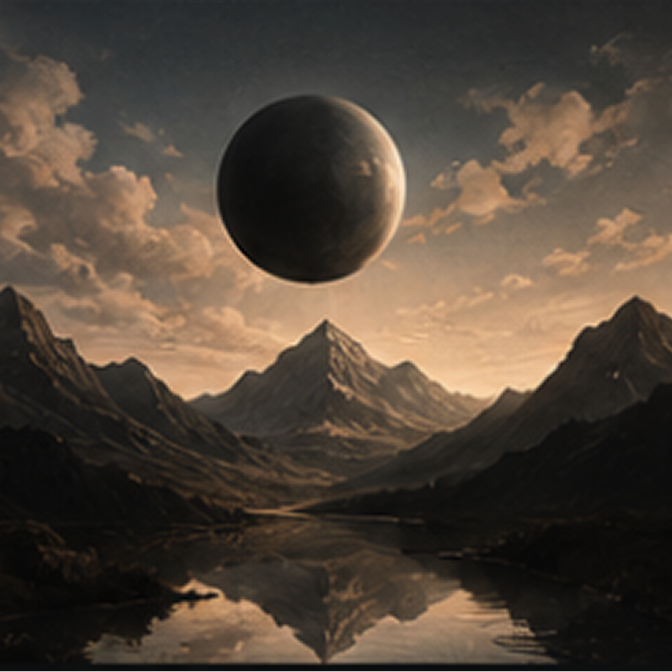
Abstract Surrealism started in the 1940s. It mixed traditional Surrealism with non-representational art. Artists used abstract shapes and colors to reach the subconscious.
This change was a big step in avant-garde art. It let artists show complex emotions and thoughts.
Thinkers like Sigmund Freud and Carl Jung were big influences. Their ideas on the unconscious mind and archetypes inspired artists. They created works that felt and experienced, not just shown.
The World War II backdrop was key. The war’s chaos made old ways of art seem weak. Artists moved to the United States, sharing ideas that led to Abstract Expressionism.
Key Artists and Their Works
Abstract Surrealism was shaped by many key artists. Each brought their own style and techniques. Roberto Matta was a pioneer. He explored the inner self through his art.
Matta was born in Chile in 1911. He mixed architecture with surrealist ideas. His work was fluid and organic, pushing art’s limits.
Matta’s work inspired artists like Jackson Pollock and Robert Motherwell. His art made viewers think deeply about themselves. It connected European Surrealism with American Abstract Expressionism.
Arshile Gorky was a bridge between European Surrealism and American Abstract Expressionism. He used automatic drawing and abstract forms. His art was both spontaneous and layered, deeply moving.
Wolfgang Paalen used fumage to create abstract marks with candle smoke. This method opened up new ways to express art. Paalen’s work showed the movement’s love for experimentation.
André Masson used automatic drawings and sand paintings. He threw sand on glue-covered canvas, embracing chance. His art showed the Surrealist love for the unexpected.
Joan Miró and Yves Tanguy also made important contributions. Miró’s late work was abstract, using signs like crescents and dots. Tanguy’s landscapes were mysterious, inviting viewers to think about existence.
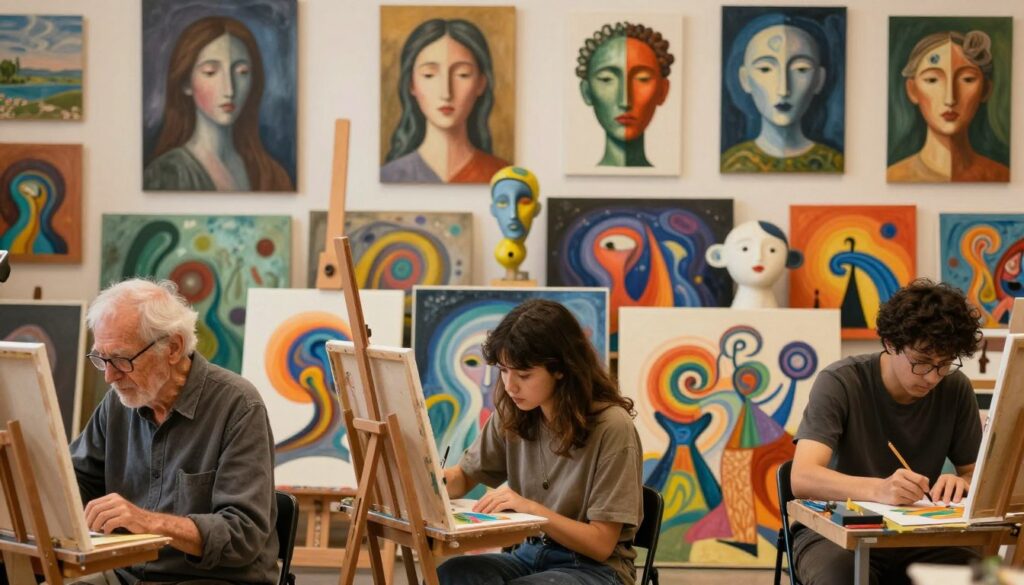
In summary, artists like Matta, Gorky, Paalen, Masson, Miró, and Tanguy changed art. Their work defined Abstract Surrealism and inspired future artists. They left a lasting impact on abstract art.
Techniques and Philosophies
In Abstract Surrealism, many techniques and philosophies come together. Automatism, a key method, is borrowed from traditional Surrealism. Artists make marks without thinking, letting their hands move freely. This shows what’s in their subconscious, like free association in psychoanalysis.
Biomorphic shapes are another big part of this movement. These shapes look like living things but aren’t drawn as such. They remind us of nature, making us think about life and existence.
Expressive color is also very important. Artists use bright, unusual colors to make us feel something. For example, neon greens and deep purples are used to stir emotions, not just to describe things.
The idea of spatial ambiguity is also key. Shapes seem to float in space, without clear backgrounds. This makes the art feel dreamlike and grabs our attention.
Layering shapes adds to the art’s depth. Each time we look, we see something new. This makes us think and feel more connected to the art.
Using different textures adds a new layer to the art. Artists might use sand or glue, making the art feel more real. Some art even includes text, adding another way to understand it.
The ideas behind Abstract Surrealism come from Sigmund Freud and Carl Jung. Their thoughts on the unconscious mind shape the art. André Breton’s Surrealist Manifesto of 1924 talks about expressing thoughts freely, without thinking too much.
| Technique | Description | Philosophical Influence |
|---|---|---|
| Automatism | Spontaneous mark-making revealing subconscious impulses | Freudian free association |
| Biomorphic Shapes | Organic forms suggesting living entities | Connection to nature and primordial existence |
| Expressive Color | Vivid color combinations provoking emotional responses | Symbolic representation of feelings |
| Spatial Ambiguity | Forms floating in indeterminate spaces | Challenge to traditional perspective |
| Layering | Complex compositions inviting multiple interpretations | Engagement and interaction with the viewer |
Impact on the Abstract Art Movement
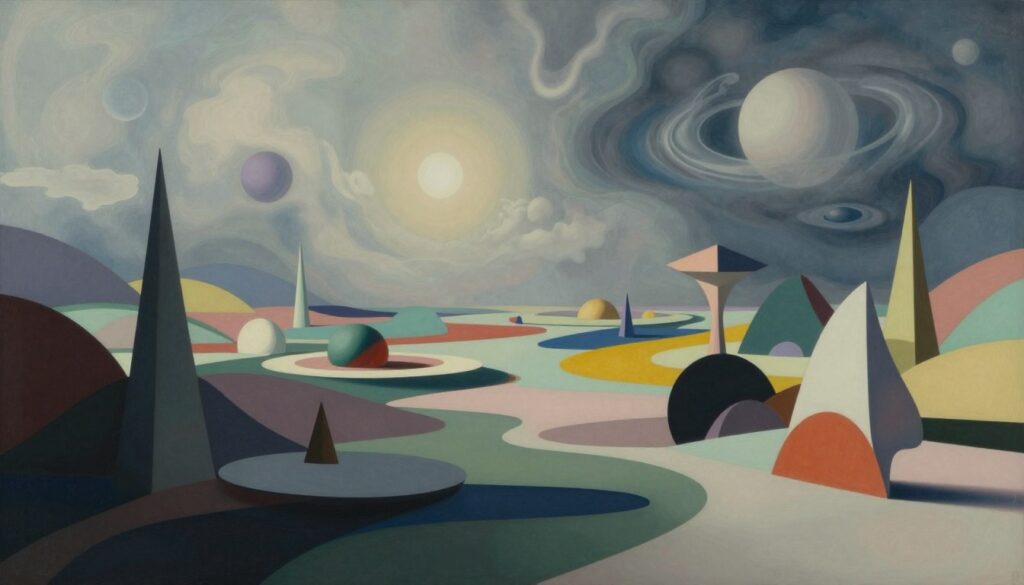
The link between Abstract Surrealism and the Abstract Art Movement is deep and changing. It was a key link between European Surrealism and the American abstract movements that came after. A big moment was in 1939 when Roberto Matta moved to New York, escaping World War II. His studio became a place where young American painters could explore new ideas, away from the usual American Scene painting and Social Realism.
Artists like Jackson Pollock, Arshile Gorky, Robert Motherwell, and William Baziotes visited Matta’s studio. They would later be known as the first Abstract Expressionists. Matta helped them by encouraging them to use automatic techniques and see painting as a way to reach the unconscious.
Jackson Pollock was greatly influenced by Matta’s way of using space and automatism. Matta’s method of letting paint flow freely across the canvas inspired Pollock’s drip paintings. Robert Motherwell also learned from Matta about surrealist automatic techniques, which were key to his work.
This exploration led to a big change in the art world. The artists inspired by Matta showed that abstract forms could carry deep meanings. This expanded what people thought of as “art” in the mid-20th century.
To show the differences between these movements, here are some comparisons:
| Movement | Characteristics | Focus |
|---|---|---|
| Abstract Surrealism | Organic, fluid, biomorphic forms | Connection to the subconscious and dream imagery |
| Geometric Abstraction | Strict shapes and mathematical precision | Structural clarity and order |
| Abstract Expressionism | Physical gesture and the act of painting | Emotional expression and spontaneity |
In conclusion, Abstract Surrealism was key in shaping the Abstract Art Movement. It connected European Surrealism with American abstraction, leading to a global abstract language in mid-20th century art. This movement changed the techniques and ideas of future artists and how we see art today. For more on this, check out this article.
Analysis of Significant Artworks
Roberto Matta’s work is key to understanding Abstract Surrealism. His piece, “The Earth is a Man” (1942), combines landscapes with human anatomy. This blend shows how life is always changing and connected.
“The Disasters of Mysticism” (1942) shows Matta’s bold brushwork. It reflects the turmoil of his time. The mix of sharp and soft shapes talks about the chaos of World War II.
“The Question Qui” (1957) focuses on politics. It shows how society affects us. This piece reminds us of the power of outside forces on our identity.
“Psychological Morphology” (1939) is an early work by Matta. It explores the mind’s hidden workings. The colors and shapes bring life to the art, making the unseen seen.
Matta’s art changed the art world and gave us deep insights into the human mind. His work continues to inspire, exploring the depths of Abstract Surrealism.