
Surrealism has always loved hybrids.
Human bodies merge with animals. Machines become organic. Plants behave like minds. Objects acquire irrational lives of their own.
In the work of Czech sculptor Anna Hulačová, those old Surrealist instincts return under very different pressure.
The hybrid is no longer only psychological.
It is ecological.
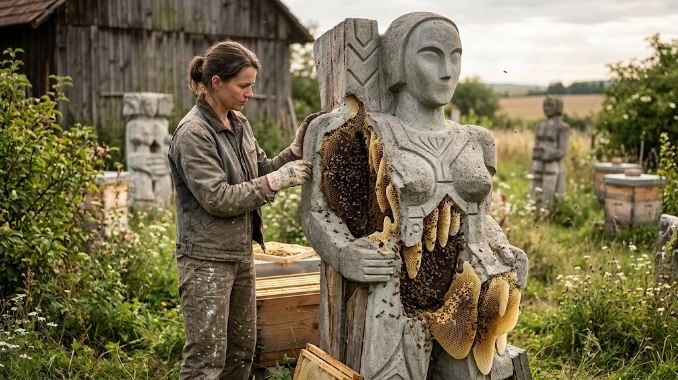
Her sculptures combine concrete, carved wood, graphite, ceramics, plants, machinery, human anatomy, and real honeycomb constructed by living bees. The results can look like workers from a forgotten Socialist monument, creatures from 1950s science fiction, agricultural machinery, religious relics, or organisms evolving after an environmental collapse.
That tension drives Anna Hulačová: Abundantia, on view at the SCHIRN Kunsthalle Frankfurt from October 1, 2026, through January 10, 2027.
The official SCHIRN exhibition identifies Surrealism, Socialist Realism, and Czech folk art among Hulačová’s influences while emphasizing her ecofeminist examination of biodiversity loss, insect decline, and industrial agriculture.
Hulačová is not a historical Surrealist.
Her work is more interesting than that label would allow.
She demonstrates what Surrealist metamorphosis can look like when the central anxiety is no longer only the unconscious mind, but the increasingly unstable relationship between humans, machines, labor, and the natural world.
Bees Are Not Just Symbols In Hulačová’s Art
Artists have used bees symbolically for centuries.
They can represent fertility.
Industry.
Order.
Immortality.
Community.
Divine organization.
Hulačová goes further.
She works with actual bee colonies.
She designs cavities inside sculptures, places the works where bees can enter them, and allows the insects to decide whether they will build honeycomb inside.
That distinction changes everything.
The bee is not simply represented by the artist.
It becomes a participant.
In a 2026 interview with Sculpture magazine, Hulačová explained that she has incorporated bees into her sculptures for more than a decade. The process remains deliberately uncertain because the colony decides whether a particular hollow space is attractive enough to occupy.
That means part of the finished sculpture lies outside the artist’s control.
The bees become co-producers.
That Loss Of Control Feels Surprisingly Surrealist
Historical Surrealism repeatedly searched for ways to weaken conscious artistic control.
Automatic drawing allowed the hand to move before rational planning intervened.
Max Ernst used frottage and grattage to let textures generate unexpected forms.
André Masson scattered sand onto adhesive surfaces.
Óscar Domínguez used decalcomania to produce images through pressure and accident.
Hulačová’s bees introduce another kind of unpredictability.
She creates the conditions.
Another organism completes part of the work.
This is not automatism in the historical Bretonian sense.
The bees are not instruments of the artist’s unconscious.
Their behavior has biological causes entirely independent of her intentions.
That difference makes the process especially contemporary.
The artwork no longer asks only what happens when the artist gives up control.
It asks what happens when human authorship has to share space with another species.
Honeycomb Turns Sculpture Into Anatomy
Hulačová often places honeycomb where a viewer expects organs.
In works such as Calf Bearer (2025), honeycomb occupies cavities in concrete bodies.
Elsewhere it can appear like lungs, entrails, or an internal structure growing inside an artificial shell.
That imagery is distinctly uncanny.
Concrete suggests permanence, architecture, industry, and human construction.
Honeycomb suggests collective biological labor.
One material is poured.
The other is built cell by cell by insects.
When they meet, the distinction between machine, body, building, and hive becomes unstable.
This is precisely the kind of categorical confusion Surrealism has historically exploited.
But Hulačová gives the instability an ecological meaning.
The question is no longer simply, “What strange creature is this?”
It becomes, “Where does the human-built world end and the living world begin?”
Alien Bees Makes The Hybrid Explicit
The SCHIRN exhibition includes Hulačová’s Alien Bees from 2021 and 2026.
The insect-like sculptures have humanoid characteristics and recall science-fiction imagery, particularly mid-20th-century visions of aliens and mutants.
They are funny enough to resist simple horror.
They are also uncomfortable.
Humans frequently talk about insects as though they belong to an entirely different world.
Yet human survival depends heavily on ecological systems in which insects perform essential roles.
By making bees look simultaneously alien and human, Hulačová reverses the perspective.
Perhaps the alien creature is not the insect.
Perhaps it is the industrial human society that has become detached from the ecosystems sustaining it.
The Surrealist hybrid becomes an ecological accusation.
Her Childhood On A Farm Matters
Hulačová was born in 1984 in Sušice, then Czechoslovakia, and grew up on a farm.
That background is essential to understanding why agriculture in her art does not function as picturesque rural nostalgia.
She knows farming as labor.
Her sculptures include workers, tools, crops, livestock, machines, and repetitive physical activity.
Agriculture appears as a meeting point between human need, technological intervention, animal life, and environmental pressure.
This is where Socialist Realism becomes another crucial influence.
Socialist-era public imagery often idealized agricultural workers as heroic producers.
Hulačová borrows elements of that visual language but makes it unstable.
Workers can look partly mechanical.
Faces disappear.
Hands become exaggerated or absent.
Bodies fuse with tools and animals.
Heroic productivity turns uncanny.
Abundantia Questions What “Abundance” Really Costs
The title Abundantia refers to the Roman personification of prosperity and abundance.
Traditionally, Abundantia carries the cornucopia, a horn that pours out seemingly endless wealth.
Hulačová uses that idea critically.
Modern consumers also encounter abundance as though it appears magically.
Flowers wait in supermarkets.
Food arrives packaged.
Products appear on shelves.
The labor, soil, transportation, water, insect life, fossil energy, and environmental costs behind that abundance often remain hidden.
Hulačová makes those systems visible again.
Her Bouquet (2024) combines honeycomb with a machine-like concrete base and vegetal forms.
The sculpture can initially look celebratory.
Then its industrial structure becomes harder to ignore.
A bouquet is not simply “nature.”
It is also cultivation, labor, distribution, refrigeration, transport, commerce, and ecological extraction.
The cornucopia has infrastructure.
Ecofeminism Changes The Meaning Of The Worker
The SCHIRN explicitly frames Hulačová’s exhibition through an ecofeminist perspective.
That matters because her female workers occupy a complicated position.
They are productive bodies.
Agricultural bodies.
Mechanical bodies.
Biological bodies.
Sometimes they resemble idealized laborers from Socialist Realism.
Sometimes they seem exhausted by the systems they inhabit.
Ecofeminist criticism has often examined the parallel ways industrial economies can treat both environmental resources and forms of human labor as endlessly available.
Hulačová translates that tension into sculpture.
The worker becomes almost machine-like.
Nature becomes productive infrastructure.
Bees become laborers.
The difference is that the bees do not participate according to human economic rules.
They retain their own biological agency.
Take A Deep Breath Turns Honeycomb Into Lungs
A particularly revealing 2026 work is Take A Deep Breath.
During preparation for the Frankfurt exhibition, Hulačová constructed a wooden human chest whose interior contains honeycomb resembling the lobes of lungs.
Carved branches extend the association toward trees and oxygen.
The connections multiply.
Human lungs.
Tree respiration.
Bee architecture.
Wood.
Wax.
Breathing.
Ecological dependency.
The sculpture does not present nature as scenery surrounding the human body.
Nature appears inside it.
That inversion feels deeply connected to Surrealist metamorphosis.
Yet the transformation is grounded in ecological reality.
Human bodies genuinely cannot exist independently of forests, insects, soil, atmosphere, and other organisms.
The impossible image reveals an actual dependency.
Ancient Bugonia Adds Another Layer
Hulačová’s bee imagery also draws on the ancient idea of bugonia.
Greek and Roman traditions included beliefs that bees could arise spontaneously from the carcasses of dead cattle.
The belief was biologically false.
Symbolically, however, it linked death with regeneration.
Hulačová returns to that ancient myth in works where honeycomb seems to grow from animal or human bodies.
Her To Eternity (2024), for example, incorporates a cow’s head from which honeycomb emerges.
The image links corpse and colony.
Death and continuation.
Animal body and insect architecture.
Ancient myth becomes environmental allegory.
In an age of biodiversity loss, the idea of renewal cannot remain comfortably mythical.
Regeneration requires actual living systems.
Concrete Makes Nature Look Trapped
One of Hulačová’s most effective material contrasts is between honeycomb and concrete.
Concrete represents one of civilization’s most important building materials.
It also carries enormous associations with industrialization, infrastructure, urban expansion, and monumentality.
Honeycomb is lighter.
Fragile.
Temporary.
Biological.
Yet inside Hulačová’s sculptures, the bees sometimes appear to reclaim the rigid human structure from within.
Honeycomb colonizes empty cavities.
Life enters architecture.
That reversal gives the work an almost post-human quality.
The sculpture seems to ask what happens when human systems stop controlling every surface.
Nature does not return as untouched wilderness.
It returns through cracks, hollows, abandoned spaces, and collaborations.
Czech Folk Art Keeps The Future Connected To The Past
Hulačová’s imagery does not rely only on futurism.
Czech folk traditions remain another important source.
Wood carving.
Agricultural imagery.
Decorative patterns.
Craft techniques.
Rural mythology.
These coexist with science-fiction forms and concrete machines.
Past and future therefore appear in the same object.
That collision matters because environmental questions are frequently framed as technological problems requiring entirely new solutions.
Hulačová complicates that assumption.
Older agricultural knowledge, craft, myth, communal labor, and biological cycles remain present beside machinery.
She does not suggest simply returning to an idealized past.
Her sculptures are too strange for nostalgia.
Instead, they ask which relationships with nature have been forgotten as productivity became more industrialized.
Surrealism’s Old Hybrids Acquire New Urgency
Historical Surrealists loved hybrid creatures because they destabilized identity.
Human and animal.
Machine and flesh.
Plant and body.
Living and artificial.
Those combinations often emerged through dreams, sexuality, mythology, or the unconscious.
Hulačová retains the hybrid but changes the urgency.
Her mixtures point toward actual ecological entanglement.
Humans really are dependent on insects.
Agriculture really does combine biology and machinery.
Industrial systems really do transform landscapes.
Bodies really do contain materials that ultimately return to ecological cycles.
The strange creature stops being pure fantasy.
It becomes a diagram of relationships modern society prefers not to see.
Readers interested in another artist who used Surrealist hybridity to construct an intensely personal world can explore thesurrealists.org’s verified article on Remedios Varo’s science, magic, and enigmatic worlds.
Varo’s machines belong to another period and another imaginative system, but the comparison is useful: both artists blur mechanical and organic worlds without treating either category as stable.
The Bees Make Authorship Ecological Too
Perhaps Hulačová’s most radical move is not visual at all.
It concerns authorship.
Western art history traditionally places the individual artist at the center.
The artist conceives.
The artist makes.
The artwork bears the artist’s name.
Hulačová complicates that structure by letting bees physically produce part of the object.
She remains the artist.
She constructs the situation.
She chooses the materials and exhibition context.
But she cannot dictate every cell of honeycomb.
The colony retains agency.
This makes ecology part of the artwork’s production rather than merely its subject.
The bees do not illustrate collaboration.
They collaborate.
Surrealism Feels Ecological Because Reality Has Changed
Anna Hulačová: Abundantia remains at the SCHIRN Kunsthalle Frankfurt through January 10, 2027.
The exhibition is curated by Martina Weinhart, with Theresa Dettinger as curatorial assistant, and is Hulačová’s first solo exhibition in Germany.
Its Surrealist influence should not be mistaken for movement membership.
Hulačová belongs to a contemporary world shaped by climate anxiety, biodiversity loss, industrial agriculture, automation, feminist theory, science fiction, and renewed questions about the boundary between human and nonhuman life.
Yet Surrealism remains useful because it developed such a powerful language for collapsing categories.
Hulačová makes that language ecological.
Concrete becomes body.
Honeycomb becomes lung.
Worker becomes machine.
Bee becomes collaborator.
Agriculture becomes science fiction.
The hybrid is no longer simply an image from the unconscious.
It is a reminder that human life was hybrid all along.