
Leonora Carrington’s images never treated the mind as a private room with a locked door. Her drawings, paintings, stories, animals, hybrid figures, and theatrical interiors made psychic life feel spatial: a house, a clinic, a dream chamber, a ritual stage, a corridor between fear and invention. That is why Leonora Carrington: The Symptomatic Surreal at Freud Museum London feels so charged. The exhibition, extended through August 10, 2026, presents drawings from Carrington’s Santander sketchbooks, made during a period of wartime collapse, exile, confinement, and artistic transformation.
The show gains sharper force after Villa Pilar, a 1940 painting linked to Carrington’s time at the Morales sanatorium in Santander, joined the exhibition from July 1 to August 10, 2026. Freud Museum’s official exhibition details describe the project as the first institutional exhibition dedicated to these Santander sketchbook drawings. For readers of thesurrealists.org, that framing matters. Carrington’s work does not simply illustrate psychoanalysis. It turns psychoanalysis into a visual architecture, where symptoms, dreams, rooms, bodies, animals, and memories share the same unstable floor.
Why The Freud Museum Setting Changes The Exhibition
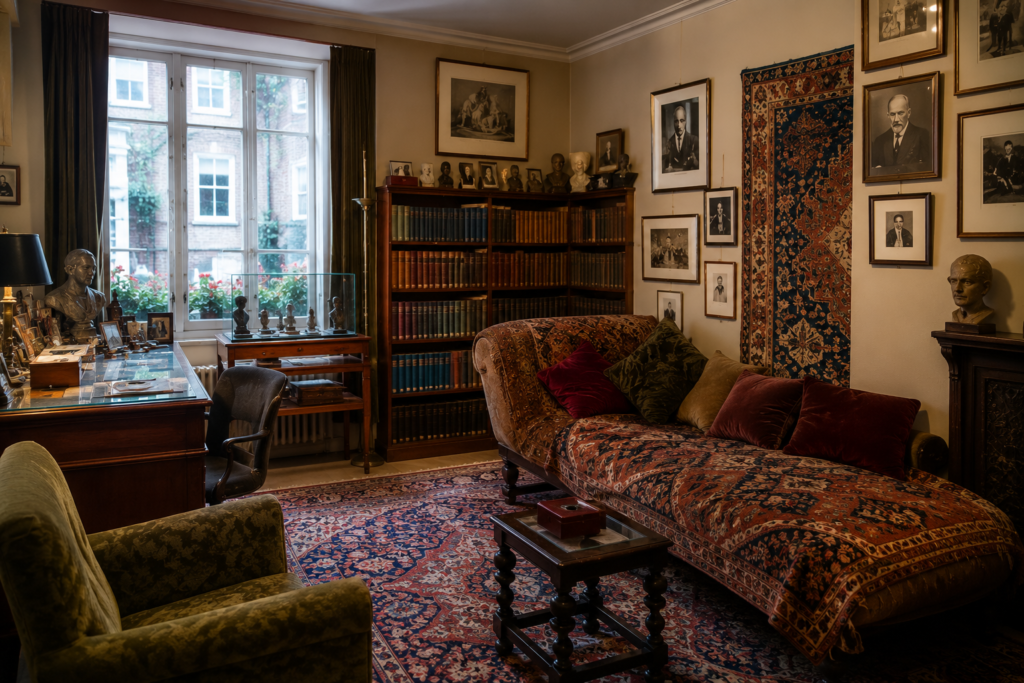
The Freud Museum is not a neutral white-cube space. It is the former London home of Sigmund Freud, the founder of psychoanalysis, and a place already charged with dreams, case histories, exile, objects, and interpretation. Placing Carrington’s Santander drawings there changes how the work speaks. The museum becomes part of the argument.
Carrington’s relationship to psychoanalysis was never simple submission. Surrealism drew heavily from Freud’s writing on dreams, desire, repression, and the unconscious, yet many artists associated with the movement transformed those ideas into something Freud himself did not fully endorse. Carrington pushed further. Her images often resist the clinical habit of turning psychic distress into a case file. They convert mental rupture into visual language.
That makes the exhibition space feel almost like a double stage. On one side is Freud’s historical world of analysis, interpretation, and psychic structure. On the other side is Carrington’s world of horses, hyenas, mythic bodies, enclosed rooms, alchemical symbols, and self-made cosmology. The viewer stands between them.
A useful internal companion is thesurrealists.org’s earlier piece on Freud’s influence on Surrealism, which explains why Surrealist artists treated the unconscious as more than a medical subject. Carrington’s Freud Museum exhibition gives that history a physical setting: psychoanalysis becomes a house filled with drawings that do not behave like diagnoses.
How The Santander Sketchbooks Reframe Wartime Carrington
The Santander sketchbooks come from one of the most difficult chapters of Carrington’s life. Born in Lancashire in 1917, Carrington became associated with the Surrealist circle in Europe and later developed a long, influential career in Mexico. During the Second World War, after the arrest of Max Ernst in France and her own flight from Nazi-occupied Europe, she experienced a severe crisis and was confined in Spain.
It would be easy to flatten that history into tragedy. The stronger reading is more careful: the Santander material shows an artist building images under extreme pressure, not a passive subject being explained by illness. Freud Museum’s exhibition asks viewers to look at the drawings as works of invention, not symptoms waiting for an expert to translate them.
The phrase “symptomatic surreal” is powerful for that reason. It does not ask the viewer to separate art from psychic disturbance. It asks how a symptom can become image, how an image can become resistance, and how a drawn figure can hold what ordinary language cannot carry.
This distinction matters in Carrington’s case. For decades, women associated with Surrealism were too often reduced to muses, lovers, patients, or biographical footnotes. Carrington’s Santander drawings resist that treatment. They show the mind making forms under pressure. They do not invite pity. They ask for sustained looking.
Why “Villa Pilar” Makes The Exhibition Feel Newly Unstable
The arrival of Villa Pilar gives the Freud Museum exhibition a new center of gravity. The painting, made in 1940, was connected to Carrington’s stay at the Morales sanatorium and remained outside public view for decades. The Art Newspaper’s report on the rediscovered Villa Pilar painting notes that the work was created during her treatment in Spain and would be shown publicly at the Freud Museum in July 2026.
That rediscovery changes the exhibition’s emotional architecture. Sketchbooks often feel intimate, provisional, and close to the hand. A painting carries a different public weight. When Villa Pilar enters the room, the viewer sees how Carrington’s drawn world could gather itself into a more finished, haunted image.
The title matters too. Villa Pilar suggests a place. A building. A named site. In Carrington’s visual world, a house is rarely just a house. It can become a mind, a trap, a theater, a body, a memory chamber, or an underworld. That is why the painting fits the exhibition’s larger question: how can psychoanalysis feel architectural?
The Freud Museum setting strengthens that question. Freud’s house already carries rooms layered with meaning: study, library, couch, collection, archive, refuge. Carrington’s Villa Pilar places another charged interior inside that space. The result feels less like an exhibition of artworks on walls and more like a sequence of psychic rooms placed inside one another.
How Carrington Turns The Symptom Into A Surrealist Method
Surrealism often valued the irrational, the dream, the accident, the uncanny object, and the sudden collision of unrelated forms. Carrington used those tools, yet she gave them a different tone. Her images do not simply shock reason for theatrical effect. They create symbolic systems where animals, women, architecture, food, alchemy, and ritual interact with their own internal logic.
That is why psychoanalysis feels different in her work. Freud’s method often sought interpretation: what does the dream mean, what desire is hidden, what memory returns? Carrington’s images do not always submit to that model. They seem to know they are being watched by systems of explanation, then slip away into myth, humor, menace, and transformation.
A symptom, in clinical terms, can be read as a sign of distress. Carrington’s art turns that sign into an engine of form. The symptom becomes a drawing. The drawing becomes a room. The room becomes a world. That process is why the exhibition’s title feels so exact. The “symptomatic” does not reduce the art. It describes how the art converts pressure into structure.
This is especially useful for understanding Carrington’s difference from better-known male Surrealists. Salvador Dalí often staged the unconscious as spectacle. André Breton often framed Surrealism through theory and manifesto. Max Ernst explored collage, frottage, and strange landscapes with a different kind of experimental logic. Carrington built worlds where psychic experience, female agency, animal presence, and mythic time meet inside the same image.
Why The Exhibition Pushes Against The “Mad Woman” Shortcut
Writing about Carrington requires care. Her confinement, crisis, and wartime trauma are part of the record, but they should not become the whole frame. The lazy version of the story turns Carrington into the “mad Surrealist woman,” a label that repeats the very structures her art resists.
The Freud Museum exhibition gives a better path. By gathering the Santander drawings and presenting Villa Pilar within a psychoanalytic site, it lets viewers face the difficult material without turning Carrington into a spectacle of suffering. The work can speak as art, not as evidence for a diagnosis.
The Guardian’s recent reporting on the public showing of Villa Pilar places the painting within the wartime context of Carrington’s flight from France, her confinement in Spain, and the larger afterlife of her Surrealist reputation. That context matters, yet the article’s real art-historical value lies in prompting viewers to return to the works themselves.
Carrington’s images challenge the viewer to ask who has the authority to interpret psychic experience. Doctor, critic, lover, curator, biographer, and viewer all arrive with frameworks. Her work keeps shifting under those frameworks. It turns classification into part of the drama.
How Psychoanalysis Becomes A Room Of Images
The strongest idea behind The Symptomatic Surreal is that psychoanalysis can become spatial. The exhibition turns Freud’s former home into a place where Carrington’s images make psychic life visible as architecture. Sketchbook pages become thresholds. Villa Pilar becomes a charged building. The museum becomes a layered interior where dreams and art history meet.
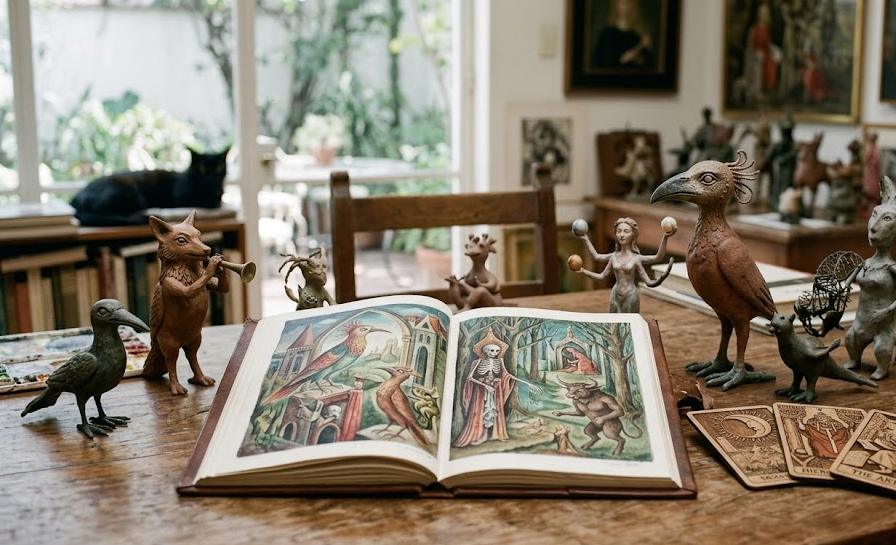
This spatial feeling is central to Carrington’s work. She often created scenes that look like rooms but behave like rituals. Tables become altars. Animals become guides. Walls seem porous. Figures appear half-human, half-mythic, half-secret. Interior space becomes a way to show psychic transition.
That is why the exhibition can appeal strongly to Surrealism readers. Surrealist art often asks viewers to doubt the room they are standing in. Carrington goes further by making the room itself think. Her interiors feel alive with forces that cannot be reduced to décor, narrative, or symbol. They seem to organize anxiety, rebellion, memory, and transformation into visual space.
Psychoanalysis, in this exhibition, is not only a theory about the mind. It becomes an environment. The viewer moves through a house associated with Freud and encounters Carrington’s drawings as if they were rooms inside another room. That layered structure makes the exhibition feel uncanny before any single image is explained.
Why Carrington Still Changes The Surrealist Canon
Carrington’s growing institutional attention reflects a broader correction in Surrealist history. Women connected to Surrealism are no longer being discussed only as companions to male artists. Their works now reshape the movement’s central questions. Carrington is essential to that correction because her art expands Surrealism beyond dream illustration and into mythic systems of thought.
The Santander sketchbooks are especially valuable because they show a phase of artistic formation linked to crisis, exile, and confinement, yet still marked by invention. They do not fit the neat timeline of youthful rebellion, Parisian Surrealism, Mexican maturity, and late recognition. They interrupt that story.
That interruption is useful. Art history often prefers smooth development. Carrington’s work is jagged. It moves through rupture, escape, rebirth, humor, occult systems, fiction, feminism, and animal transformation. A show like The Symptomatic Surreal helps viewers see that her Surrealism was not a style she adopted. It was a method for surviving and remaking reality.
Freud Museum’s exhibition therefore matters beyond the biography of one artist. It shows how Surrealism itself changes when viewed through Carrington’s wartime drawings. The unconscious is no longer just a Freudian source of symbols. It becomes a contested space where a woman artist refuses to be interpreted into silence.
What The Exhibition Reveals About The Future Of Surrealist Looking
The Symptomatic Surreal makes psychoanalysis feel like an exhibition space because it turns interpretation into something the viewer physically inhabits. The drawings are not simply placed in Freud’s house. They activate it. They make the museum feel like a mind with rooms, echoes, locked doors, symbolic animals, and traces of flight.
That is why the exhibition feels current in 2026. Contemporary audiences are deeply aware of trauma language, mental-health framing, institutional power, gendered biography, and the ethics of looking at personal crisis. Carrington’s work asks for a response that is neither clinical nor sensational. It asks for attention to form.
Her Santander drawings and Villa Pilar remain unsettling because they do not separate psychic suffering from artistic intelligence. They show an artist turning pressure into image, enclosure into architecture, and diagnosis into a private visual grammar. The Freud Museum gives that grammar a charged setting, but Carrington’s work refuses to stay contained by the setting.
For thesurrealists.org readers, the lasting value is clear: Carrington makes the unconscious feel built, inhabited, and resistant. Psychoanalysis becomes less a theory on the wall than a house full of images that will not explain themselves away.