
Salvador Dalí understood America as more than a destination. He treated it as a theater of reinvention, publicity, scale, money, celebrity, and spectacle. That is the central force behind Dalí in America, the 2026 exhibition at The Dalí Museum in St. Petersburg, Florida. The show runs from May 9 to October 18, 2026, and presents paintings, drawings, photographs, archival materials, and ephemeral objects from the museum’s collection, library, and archives. The Dalí Museum’s official exhibition page frames the show around Dalí’s discovery of what he called a “New World” filled with possibility.
For thesurrealists.org readers, the exhibition matters because it reframes Dalí’s American years as a Surrealist performance of national myth. America did not simply receive Dalí. It gave him a stage large enough for his persona, his commercial instincts, his wartime displacement, and his belief that art could invade popular culture. The American Dream, in Dalí’s hands, became stranger than optimism. It became a mirror in which self-invention, desire, capitalism, fantasy, and media all appeared at once.
Why America Became Dalí’s Surrealist Stage
Dalí first visited the United States in 1934, arriving as one of Surrealism’s most theatrical ambassadors. By then, his reputation was already tied to precision painting, dream imagery, erotic symbolism, and the paranoiac-critical method. America gave those elements a different public life. It offered museums, collectors, department stores, magazines, film culture, wealthy patrons, and an audience ready to treat eccentricity as news.
The Dalí Museum’s press release for Dalí in America states that the exhibition includes more than 50 paintings, objects, and archival materials and was organized in connection with the United States’ 250th anniversary. The museum presents the show as an exploration of how Dalí’s relationship with the country shaped both his own public image and the American imagination. The Dalí Museums press release gives the exhibition its strongest factual base.
That anniversary frame matters. The “American Dream” is usually described through mobility, success, freedom, and reinvention. Dalí recognized those ideas, but he did not treat them politely. His version of America was theatrical, unstable, and self-conscious. The country became a place where identity could be performed at maximum volume. In that sense, America suited Dalí’s Surrealism. It already had its own dream machinery: Hollywood, advertising, celebrity culture, patriotic mythology, skyscrapers, and consumer desire.
This is why the exhibition works as more than a biographical show. It asks how a European Surrealist artist translated American ambition into image, performance, and persona. Dalí’s America was not a calm refuge from Surrealism. It was one of the places where Surrealism learned how to become public spectacle.
How The American Dream Became A Visual Performance
Dalí’s relationship with America cannot be separated from performance. He did not merely make paintings and wait for interpretation. He turned himself into a living artwork: mustache, pose, interview style, staged entrances, shocking gestures, and calculated self-mythology. In America, those tactics found a media environment prepared to amplify them.
That media environment changed how Surrealism circulated. In Paris, Surrealism had been tied to manifestos, journals, poetry, painting, political disputes, erotic scandal, and anti-bourgeois provocation. In the United States, Dalí pushed Surrealism into department-store windows, fashion, magazines, film projects, lectures, and commercial collaborations. The dream image was no longer confined to the gallery. It could appear in publicity, design, retail display, and mass entertainment.
That expansion is risky to evaluate. Some critics have treated Dalí’s American period as a compromise with commerce. Others see it as proof of his ability to understand modern media before many of his peers. The stronger reading holds both points together. Dalí’s American career shows how Surrealism could be absorbed by spectacle and still disturb it from within.
That tension links directly to earlier thesurrealists.org coverage of Dalí’s surrealist imagery, where his persona and visual symbolism are inseparable from his larger art-historical force. In Dalí in America, that persona becomes part of the exhibition’s subject rather than background decoration.
Why New York, Hollywood, And Wartime Exile Matter
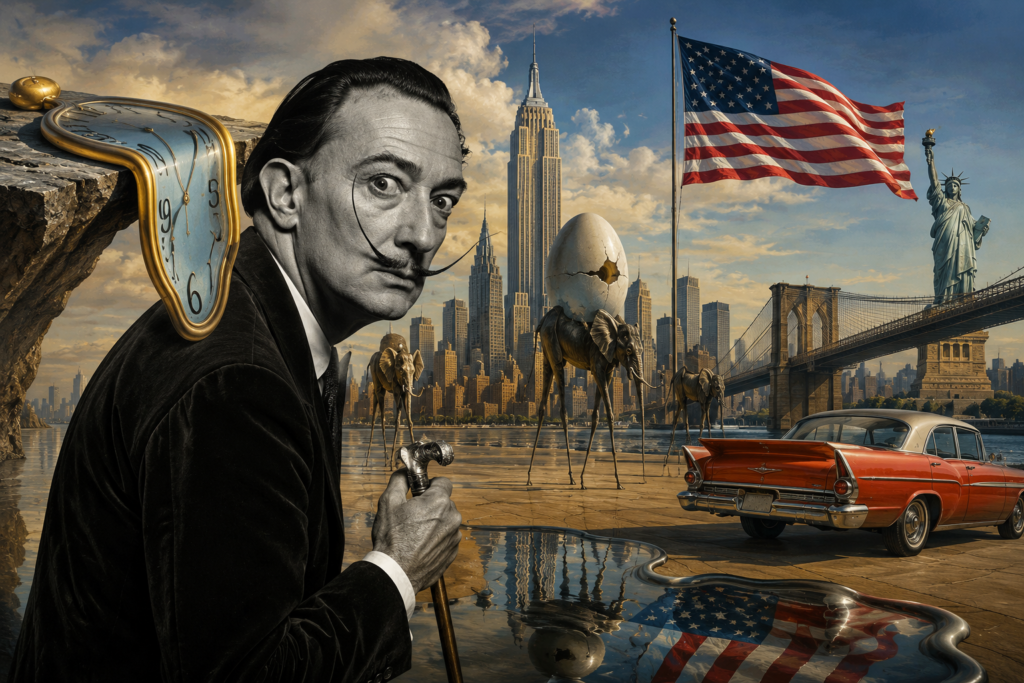
Dalí’s American story is not only about fame. It is tied to the upheaval of the 1930s and 1940s, when Europe’s political crisis changed the movement of artists, collectors, dealers, and ideas. The United States became a refuge, market, and stage for many European artists during the Second World War. Dalí’s years in America must be seen against that broader displacement.
The Dalí Museum’s exhibition description notes that the show includes archival and ephemeral material, not only finished artworks. That choice matters because Dalí’s American identity was assembled through documents, photographs, performances, relationships, publications, and public appearances as much as through painting. A painting can show dream imagery. An archive can show how that dream entered institutions, newspapers, collectors’ homes, and public memory.
New York gave Dalí a platform for cultural visibility. Hollywood gave him access to cinematic fantasy. American collectors gave him financial and institutional support. Publicity gave him oxygen. In return, Dalí gave America a version of Surrealism that could be outrageous, elegant, comic, disturbing, and saleable at once.
That mixture explains why the American Dream fits the subject so well. Dalí’s America was a place where invention could become career strategy. He understood that modern identity was no longer built only in the studio. It was built across newspapers, photographs, interviews, exhibitions, patrons, and spectacle. He did not hide that process. He made it part of the work.
How Dalí Turned National Myth Into Surrealist Theater
America loves scale, and Dalí loved exaggeration. That shared appetite helps explain why the exhibition’s title feels so effective. Dalí in America suggests a geographic story, but the deeper subject is theatrical transformation. The country becomes a stage; Dalí becomes a performer; the American Dream becomes a set piece.
This does not mean Dalí simply celebrated America. His art often makes desire look unstable. Objects soften, bodies distort, landscapes stretch, symbols repeat, and time itself becomes unreliable. When that imagination meets American optimism, the result is not simple admiration. It is a dream staged under bright lights.
That is why the exhibition can speak to current readers. America’s public image has always depended on performance: national celebration, consumer display, celebrity reinvention, political theater, and technological promise. Dalí understood those mechanisms early. He saw that modern culture was becoming image-driven, and he treated that condition as a Surrealist opportunity.
Recent coverage from WUSF described the exhibition as presenting America as a canvas for Dalí’s imagination and noted the museum’s emphasis on paintings, drawings, photographs, and ephemeral materials. The report reinforces the idea that Dalí’s American years were not a side chapter, but a major platform for the artist’s public identity. The WUSF feature on Dalí and American culture adds useful regional context around the St. Petersburg exhibition.
Why Commerce Did Not End Dalí’s Surrealism
Dalí’s comfort with commerce has long made him difficult for critics. Surrealism began with anti-bourgeois energy, revolutionary language, and suspicion toward conventional success. Dalí, by contrast, seemed willing to work with fashion, advertising, retail display, and the market. That made him look suspect to those who wanted Surrealism to remain purely oppositional.
Yet America complicates that judgment. Dalí’s commercial activity can be read as capitulation, but it can also be read as infiltration. He entered the systems that shaped modern desire and filled them with irrational imagery. A department-store display, a magazine feature, or a Hollywood collaboration could become an extension of the Surrealist stage.
The difference between compromise and strategy is hard to fix in one answer. That uncertainty is part of the story. Dalí’s American period forces art history to ask whether Surrealism loses its force when it becomes popular, or whether popularity creates another arena for dream logic to spread.
The Dalí Museum’s Dalí in America does not need to settle that debate. Its value lies in presenting the materials that let viewers see the problem clearly. Paintings, photographs, archival pieces, and public traces can show how Dalí’s image moved through American culture. The exhibition invites a harder question than whether Dalí “sold out.” It asks how modern art changes when publicity becomes one of its materials.
What “Dalí In America” Reveals About Surrealism’s Public Life
Surrealism is often remembered through private dream images: closed eyes, unconscious desire, strange landscapes, symbolic objects, and interior fear. Dalí’s American story expands that frame. It shows Surrealism entering public space, mass media, and national fantasy.
That public life matters because it helped shape the afterlife of the movement. Many people encountered Surrealism not through Breton’s manifestos or Parisian journals, but through Dalí’s celebrity, reproductions of his paintings, television appearances, museum exhibitions, and commercial imagery. His American career helped turn Surrealism into a visual language recognized far beyond the avant-garde.
That broad recognition came at a cost. When Surrealism becomes too familiar, it risks becoming a style of weirdness rather than a method of disruption. Melting clocks, long shadows, desert spaces, and eccentric gestures can become decorative shorthand. A strong exhibition must pull those signs back into history.
Dalí in America has the opportunity to do that by showing the machinery behind the icon. The archive can reveal how an artist became a public figure, how a movement entered American culture, and how the dream of reinvention became both subject and strategy. For readers interested in Surrealism, that machinery may be just as fascinating as the paintings themselves.
Why The American Dream Looks Different Through Dalí
The American Dream promises reinvention, but Dalí makes reinvention look uncanny. He shows that self-creation can be theatrical, unstable, and haunted by desire. His American persona was not a simple mask covering the “real” artist. It was part of his artistic system.
That is why the exhibition’s timing during the United States’ 250th anniversary is meaningful. National anniversaries often encourage clean narratives. Dalí interrupts clean narratives. His work suggests that a nation’s dreams are made from fantasy, fear, appetite, performance, myth, and distortion. He turns celebration into a stage where the audience can see the props.
This angle gives thesurrealists.org a strong critical path. The article does not have to present Dalí as either a genius seduced by America or a cynic exploiting it. The more interesting point is that Dalí understood America as a dream-producing culture. He recognized its talent for spectacle and inserted himself into it with unusual precision.
A recent Spectrum Bay News 9 segment reported curator Peter Tush describing America as the platform that helped create the Dalí most audiences now recognize. That statement fits the exhibition’s larger claim: America did not merely host Dalí. It helped shape the public form of Dalí.
How Dalí’s American Stage Still Shapes Surrealist Culture
Dalí’s American years still matter because current visual culture looks more Dalinian than many viewers realize. Celebrity identity, branded eccentricity, immersive spectacle, media performance, luxury fantasy, viral gestures, and dreamlike advertising all echo the conditions Dalí learned to use. He was not the only artist to understand those conditions, but he remains one of the clearest examples of Surrealism meeting mass visibility.
That makes Dalí in America useful for modern readers. It shows that Surrealism’s afterlife cannot be separated from the systems that spread it. Museums, magazines, collectors, cities, cinema, advertising, and public performance all helped turn Dalí into a cultural force. His American Dream was not peaceful. It was staged, lit, monetized, mythologized, and made strange.
For thesurrealists.org, the strongest takeaway is that America did not dilute Dalí’s Surrealism into mere celebrity. It exposed one of the movement’s unresolved questions: can a dream remain disruptive after it becomes famous? Dalí’s answer was to make fame itself part of the dream.
The American Dream, seen through Dalí, becomes a Surrealist stage because it turns desire into performance. It lets the self become costume, the nation become scenery, and the marketplace become theater. Dalí recognized that stage and stepped onto it with full awareness. The exhibition matters because it shows how carefully he played the part, and how strange the dream still looks.