

What’s funny about a lobster telephone? Or a clock that melts like cheese?
The surrealist project was about unleashing the unconscious. But I’m drawn to its wicked sense of humor. It’s like an inside joke with the universe.
This isn’t just about listing jokes. We’re diving deep into the art. Artists like Dalí and Magritte used absurd scenes as a precision tool. They exposed the cracks in our reality.
Imagine it as smart, intellectual comedy. The jokes often reveal deep truths about desire, society, or being human. This playful way was a bold form of commentary. It’s just as powerful today.
Confronting Violence Through Art
If surrealist humor was a cocktail, it’d be a mix of laughter and bitter irony. This drink leaves a metallic taste of violence. The laughter from before stops here. This art wasn’t just for fun; it was a sharp critique.
For the surrealists, irony was both a shield and a weapon. It let them face the era’s brutality head-on. They turned chaos into art, mixing horror and satire.
Max Ernst’s collages are a prime example. They show dismembered bodies and creatures in a way that’s more satirical than scary. The irony is clear. Is that figure a monster or a critique of power?
This art is like gallows humor, made with paint and plaster. It’s a way to face the unfaceable by mirroring it. The surrealists asked, “What do you do when reality is absurd?” They showed us to reflect that absurdity back, with irony.
Looking at this art, you might smile nervously or look away. That’s the goal. It forces you to confront the violence in our world. It doesn’t solve problems but offers a new way to see them.
World War Influence on Surrealist Violence Themes
World War I and II changed more than just maps. They deeply affected the art world, leading to a surge in absurd art. The surrealists worked in this changed atmosphere. Their art was filled with the smells of war and trauma.
Imagine trying to show a world where machines like the machine gun and gas chambers were created. You can’t just show it. You have to show the opposite. Their art showed broken bodies, like those from war, in strange ways. It wasn’t just symbols; it was a report from a broken mind.
André Masson is a great example. He fought in the trenches. His “automatic drawing” was more than a technique. It was a sign of his mind’s state. His lines were like shell shock, moving fast to escape memories.
This absurd art was a raw scream. It wasn’t just a choice made in a Parisian café. It was a true reflection of a world gone mad. Artists used classic beauty to show its failure. This failure led to the Somme and Auschwitz.
The surrealists made nightmares real. They gave shape to the fear that had no shape. They asked a hard question. If our world produces such horrors, how sane are we?
| Artist | War Experience | Key Artwork (Post-War) | Manifestation of ‘Absurd’ |
|---|---|---|---|
| André Masson | Combat veteran, WWI | Battle of Fishes (1927) | Automatic drawing; chaotic, violent line work depicting fragmented bodies. |
| Max Ernst | Served in WWI; lived through WWII occupation | Europe After the Rain (1940-42) | Dystopian, eroded landscapes; use of frottage to evoke ruin. |
| Salvador Dalí | Fled WWII in Europe | Soft Construction with Boiled Beans (Premonition of Civil War) (1936) | Biological morphing and disintegration of the human form. |
| Leonora Carrington | Psychological trauma from WWII events | Down Below (1940s) | Hybrid creatures & personal mythology reflecting psychological breakdown. |
The table above is more than a list. It’s a report from the front lines of culture. Each artist showed violence in their own way. Masson through gesture, Ernst through landscape, Dalí through detail. But all showed a deep, screaming absurdity.
This absurd art was the only honest response. When the world is a joke with no punchline, art becomes the uncomfortable laugh. The surrealists showed us a broken mirror. We’re all wincing at the reflection.
Hans Bellmer’s Dolls and the Aesthetics of Destruction
The term “surrealist humor” is seen in Hans Bellmer’s work. His “Poupées” are unsettling, making you feel uneasy. They are a dark joke, showing the uncanny side of Surrealism.
His dolls are a satire of beauty. They show the body as a place of rebellion. Limbs are twisted, and torsos have extra hips. This mocks the idea of perfect beauty.
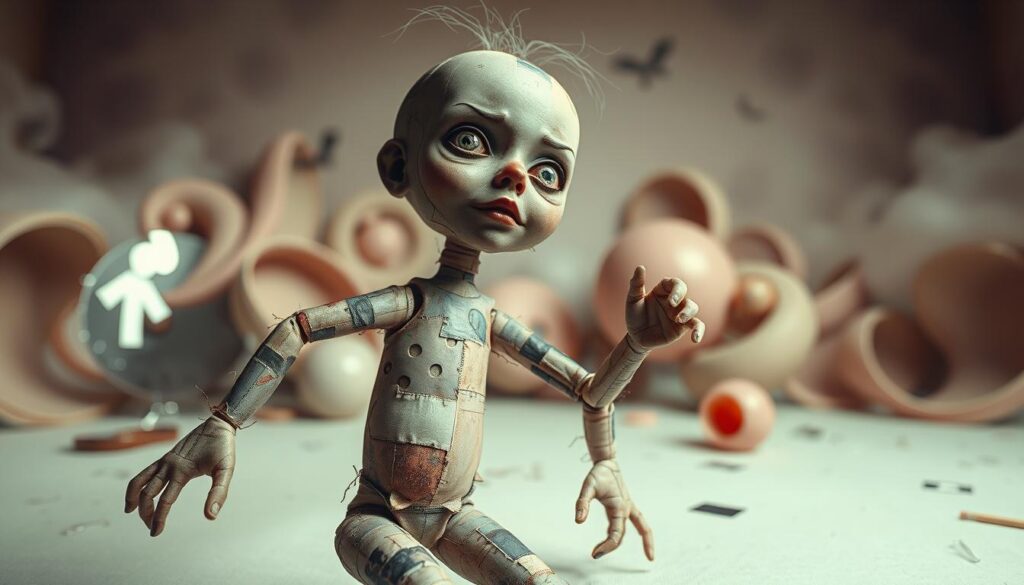
The humor in Bellmer’s work is in its absurdity. A leg where an arm should be is comical. His surrealist humor is unsettling, showing a truth about desire and control.
Bellmer challenged cultural ideals in his work. He showed how these ideals are flawed.
| The Cultural Ideal | Bellmer’s Subversion | The Satirical Point |
|---|---|---|
| Symmetrical, whole, decorative form | Disarticulated, fragmented, dysfunctional anatomy | Mocks the very notion of a “perfect” or usable body. |
| Passive, idealized femininity | Aggressively sexualized, grotesque, and ambiguous figures | Parodies societal obsessions with controlling the female form. |
| An object that obeys its creator | A creation that rebels, implying violation and chaos | Critiques paternal, artistic, and political domination. |
| Comfort, familiarity, aspiration | Unease, revulsion, morbid fascination | Forces a confrontation with our own repressed desires and fears. |
Bellmer’s work is not just disturbing. It’s a serious critique. His dolls show the body as a battleground. This connects to Dada’s principles of shock and absurdity. It shows the joke is on us for believing in simplicity.
Psychological Trauma and Artistic Catharsis
Artwork is more than just images; it’s a symbolic space to heal deep wounds. The surrealist project is like a triage unit, using the absurd and violent to heal. These elements are not just styles but tools for healing.
Irony symbolism plays a key role here. A scream, a melting clock, or an eye without a face are not random. They are messages from the unconscious. These symbols both reveal and protect the trauma, creating a silent yet powerful expression.
Artistic catharsis is complex and dark. It’s like a surgery without anesthesia. The surrealists tackled modern life’s pain, turning it into art. The canvas was both a confession booth and an operating table.
Frida Kahlo’s work is a prime example. She didn’t call herself a surrealist, but her art was deeply connected. Her self-portraits, like The Broken Column and The Two Fridas, show her pain and survival. Her art is a powerful expression of irony symbolism.
For the surrealists, humor was a way to cope. They laughed at the absurdity of life. This shift from exploitation to therapy is key. Therapy tries to heal, even with absurd methods.
This process is complex and personal. It raises questions about the line between therapy and spectacle. The answer depends on the artist’s intent and the viewer’s experience.
Irony symbolism creates a safe space. It lets both the artist and the viewer engage with difficult content without being overwhelmed. The symbol acts as a buffer, helping us process the unprocessable.
The catharsis is not always complete. Sometimes, the art just shows the scream. But in showing the terror, there is power. Naming the monster under the bed weakens its hold. The irony is that once named, the monster loses some of its power. The symbolism helps us reclaim our inner world.
Controversial Exhibitions and Censorship Issues
The history of surrealism is filled with more than just paint and ink. It’s also marked by police reports and angry editorials. This art never aimed for a simple nod from critics. It sought a strong reaction, like outrage or confusion.
The exhibition space became a battleground. Here, the absurd clashed with the orderly.
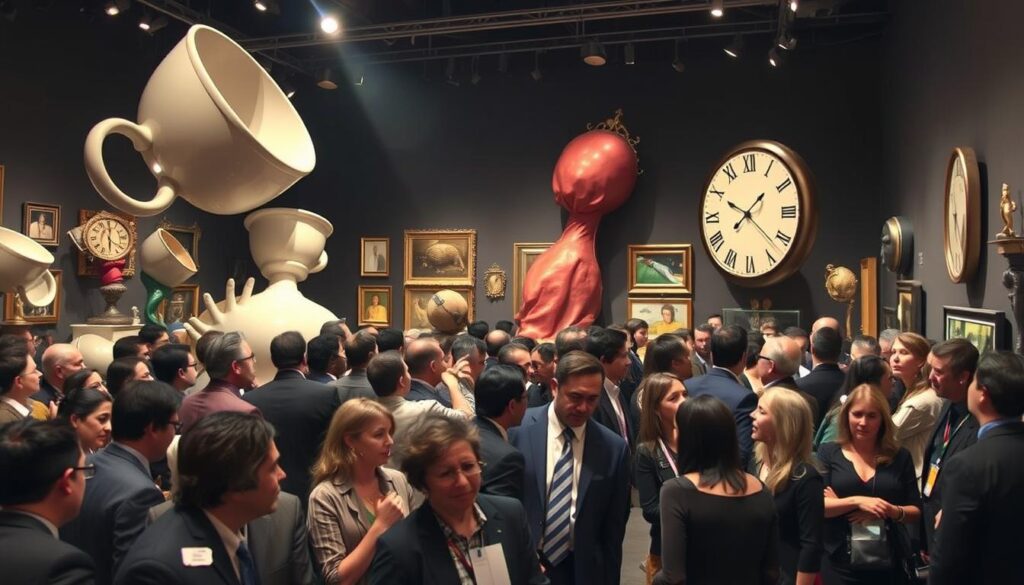
In 1938, Paris hosted the International Surrealist Exhibition. Visitors found a space filled with coal sacks and a pond with lilies. A taxi dripping with rain, with a mannequin and a live performer inside, stood as the main attraction. It was an immersive, disorienting experience that caused a minor riot.
Today, museums face similar challenges. They deal with protests, funding threats, and social media backlash over offensive works. A sculpture might be removed, or a painting covered. This happens when works are seen as violating bodies, challenging politics, or blaspheming religions.
Why does absurd art always spark controversy? It’s not just about offending taste. It’s about challenging logic. This art dismantles the rational frameworks that power structures rely on for control. It smuggles challenging ideas into the mainstream, disguised as silliness.
The clash between intent and perception is where the drama happens. An artist might see a fragmented doll as a critique of fascism. A public official might see it as obscene. This gap is where censorship thrives. A look at the legal boundaries of satire shows how this ambiguity challenges norms and laws.
Controversies over works that play with religious iconography are common. The offense isn’t just about disrespect. It’s about the power of humor and incongruity applied to sacred symbols. The absurd art piece doesn’t argue theology. It simply adds a mustache to a monolithic idea and laughs. For systems built on authority, that laugh is subversive.
Every time a controversial piece is shrouded or removed, surrealism’s core function is fulfilled. It disturbs the comfortable. The controversy is the artwork extending its reach. It shows that the initial shockwave from those early Parisian exhibitions is ongoing. The censors, in their haste to restore order, only prove how necessary this art is.
Collecting Challenging Art: Ethical Considerations
Buying art that challenges the status quo is a complex issue. It raises questions about whether it’s different from owning war trophies. The art’s value shifts from a powerful statement to a luxury item, making things very complicated.
The core issue is the commercialization of pain. When someone rich buys art that reflects trauma or anger, are they preserving history or just showing off? The role of the collector and consumer becomes blurred. Does the art’s impact change when it moves from a raw studio to a fancy room?
This shift in power is ironic. Art meant to challenge norms can become a conversation piece at parties. It’s framed, insured, and loses its edge. This is a powerful surrealist humor: how easily money can tame dissent.
So, what’s the collector’s or the museum’s duty? Is it just about owning the art, or is there a bigger responsibility?
- Contextualization: Does the collector let the art’s story be told, or does it just decorate?
- Education: Is the art used to discuss its themes, or is it valued only for looks or money?
- Preservation vs. Exploitation: Is saving the art from obscurity right, or does it just profit from pain?
The debate goes beyond beauty. It dives into morality, taste, and the strange world of prestige. Collecting challenging art is a delicate balance. It can be about complicity or stewardship. The surrealist humor lies in seeing which path you choose.
Therapeutic Art vs. Exploitation: Critical Debates
The surrealists’ love for violence sparks a debate today: when does art help and when does it exploit? This isn’t just a topic for art history classes. It’s a big question for anyone who has seen a Bellmer doll or a Max Ernst frottage and felt a strange thrill. Critics are divided on this issue.
Some see surrealism as a way to release pent-up emotions. They think the violent images are like a necessary surgery for society. They believe art can be a form of exorcism, a brave act of revealing the unconscious.
Others disagree, calling it just a shock tactic. They think it’s like setting off fireworks in a library, seeking a cheap thrill. They wonder if showing violence really helps process it, or if it just rehearses it, maybe even glorifies it.
The answer isn’t just in the images themselves. It’s in the artist’s intent, the context, and how they execute it. Goya’s “Disasters of War” is a good example. Its raw, disturbing images are meant to shock and testify, not to entertain. The context was the brutal Peninsular War, and the execution is stark, without any beauty that might soften the horror.
This leads to a key irony symbolism. The artist’s tools, like brushes and cameras, can heal or hurt. They can document trauma or make it seem appealing. This shows the power and danger of art.
The use of symbolism in Surrealist art is critical here. A broken doll can mean many things, like the shattering of the self or a provocation. It’s all about how deep the symbol connects to real human experiences versus being used for shock value.
So, what should art do? Should it comfort us or confront us? The surrealists chose to confront, believing that art that only comforts is in denial. They saw art as a way to wake up and face our fears.
This choice to confront is key for a healthy society. Art that deals with darkness keeps us awake and aware. The debate shows art’s importance. If we stop arguing, art loses its power.
Conclusion: The Necessity of Difficult Art
After exploring from lobsters to dolls, what do we think about surrealist art? The surrealists didn’t just create art for history’s sake. They mixed humor, absurdity, and violence in a unique way.
They showed us how to deal with a messy world. In today’s world of perfect social media and algorithms, we need difficult art more than ever. It challenges us to see things differently.
This art doesn’t let us ignore the truth. It uses irony and absurdity to reveal truths. It finds beauty in the broken, like Hans Bellmer’s unsettling dolls.
It tackles tough subjects like violence and trauma. It turns these into something we can talk about openly. It also makes us think about ethics, censorship, and the right to show certain art.
Difficult art doesn’t give us easy answers. It makes us face hard questions. It shows that laughter can be a strong way to stand up against the world.
The surrealist legacy is its ability to wake us up. It makes us pay attention to the chaos around us. It finds meaning in a joke that stays with us long after the lights go out.