

Surrealism was never just about paintings in galleries. It was a cultural virus. Its most powerful way to spread was through exhibitions.
This story isn’t about old artifacts. It’s about a living tradition that changed how we see art. How did a group of avant-garde artists from the 1920s influence everything from your Instagram to today’s museum shows?
We’re exploring a line of curated chaos. It goes from Parisian galleries to our digital dreams. To understand the surrealist legacy, start with our guide on understanding the Surrealism art movement.
So, get ready. We’re revealing the exhibition’s role in constant change.
1. What Makes an Exhibition “Surrealist”?
The ghost of Surrealism haunts many a modern exhibition. But how do we know it’s truly there? Is it just a Salvador Dalí poster in the gift shop? A room full of melting clocks doesn’t make a Surrealist show. That’s just merchandising.
The real thing is far more insidious and intellectually thrilling. I see a Surrealist exhibition as a psychic space. Logic is left at the door. Chronology is thrown out the window.
The goal is to induce a state—call it dreamlike, disorienting, or deliciously unhinged. The visitor’s experience, their emotional and subconscious reaction, becomes the primary artwork. The paintings and sculptures are merely actors in a larger, irrational play.
So, what’s in the Surrealist exhibition DNA? We’re looking for three core tactics. First, irrational juxtaposition: placing utterly unrelated items together to spark unexpected connections. A sewing machine next to an umbrella on a dissecting table, as Lautréamont poetically prescribed.
Second, environmental immersion. The gallery isn’t a neutral white cube; it’s transformed into a street, a cavern, or a collective unconscious. You don’t just view the art; you are inside it. Third, the theatrical use of objects. Mannequins, masks, and found items are not merely displayed; they are staged as characters in a silent, bizarre drama.
When these elements fuse, the result is an oneiric tableaux where the familiar becomes strange. The floor might feel uneven. Sounds may echo from unseen sources. A sense of déjà vu or profound disquiet takes hold.
This is the blueprint for countless modern exhibitions that prioritize vibe over timeline, experience over education. It’s the difference between reading a map and getting poetically lost.
To crystallize the distinction, let’s pit the traditional against the Surrealist. The table below isn’t just a comparison; it’s our decoder ring.
| Exhibition Element | Traditional Exhibition | Surrealist Exhibition |
|---|---|---|
| Narrative Logic | Linear, historical, or biographical. It tells a story with a beginning, middle, and end. | Associative, dreamlike, and non-linear. It follows the logic of the unconscious, not the history book. |
| Environment | Neutral “white cube” designed to not distract from the individual artwork. | An active, immersive installation. The space itself is a key component of the art. |
| Treatment of Objects | Artworks are sacred, isolated, and presented for contemplative study. | Objects are props in a larger scene. They are often modified, combined, or staged theatrically. |
| Audience Role | Observer and learner. The goal is understanding and appreciation. | Participant in a psychological experiment. The goal is sensation, confusion, or revelation. |
| Temporal Experience | Progressive. You move forward through time or development. | Collapsed or cyclical. Time feels suspended, like in a dream or a recurring thought. |
So, a true Surrealist exhibition is an engineered psychic event. It uses juxtaposition, immersion, and theatricality not as decoration, but as deliberate tools to bypass rational thought. These are the criteria—our litmus test for the movement’s long shadow in modern exhibitions. When you walk into a show and feel the ground of reality subtly shift, you’re not just seeing art. You’re visiting a ghost.
2. The Foundational Shows: Birth of a Disruptive Tradition
Modern art installations seem edgy, but Surrealists started much earlier. They didn’t just break the fourth wall; they tore down the gallery. These two shows laid a radical blueprint, not for pretty pictures but for a philosophical riot.
Understanding these chaotic beginnings is key to grasping the surrealist legacy in modern art.
2.1. The 1938 International Surrealist Exhibition: A Street Inside a Gallery
In 1938, Paris saw a change. The Galerie Beaux-Arts became something illogical. Visitors found a street, not just a painting of one. It was a real Parisian backstreet, complete with 1,200 coal sacks, a pond, and coffee smells.
Was it art or a prank? It was a reality takeover. Curators turned the gallery into a dream or nightmare. You didn’t just look at art; you walked through it.
The goal was to disorient. By mixing the mundane with the sacred, they challenged where art belongs. They showed art is life’s messy, irrational parts. This single act became a key part of the surrealist legacy.
2.2. War and Exile: The 1942 “First Papers of Surrealism” in New York
By 1942, the world was at war. Many Surrealist artists fled to New York. They showed “First Papers of Surrealism” in a vacant mansion. This was a labyrinth, not a gallery.
Imagine viewing paintings by Miró or Ernst while avoiding a web of string. The string wasn’t just decoration; it was a barrier. It mocked the usual gallery experience.
The web symbolized war’s chaos. It forced visitors to interact with the space. The art wasn’t just on walls; it was the whole experience. This show injected pure Surrealism into American art.
| Dimension | 1938 International Surrealist Exhibition (Paris) | 1942 “First Papers of Surrealism” (New York) |
|---|---|---|
| Location & Context | Galerie Beaux-Arts, pre-WWII Paris. A statement from the movement’s heart. | Vacant mansion, WWII New York. A show of exile and cultural transplantation. |
| Signature Curatorial Stunt | An indoor street with mud, coal sacks, and a pond. | A labyrinthine web of string obstructing the artwork. |
| Primary Sensory Assault | Smell, touch, and atmosphere. An immersive, dirty environment. | Sight and movement. A visual and physical barrier to navigation. |
| Philosophical Intent | To collapse the boundary between street life and art space; to bring the irrational inside. | To manifest dislocation and obstruction; to make the viewer’s body part of the art. |
| Immediate Impact | Scandalized Paris. Proved an exhibition could be a unified, shocking environment. | Bewildered New York. Introduced a new, experiential model to the American avant-garde. |
These exhibitions were more than shows. They were manifestos in space, mud, and string. They changed the curator’s role from hanging paintings to creating experiences. Every immersive installation today owes a debt to these foundational shows. They showed that an exhibition can be the most powerful artwork, a core part of the surrealist legacy.
3. Signature Tactics: The Tools of Surrealist Display
The surrealist manifesto was just the start. These tactics were the real blueprints for building it. They were weird, wonderful, and full of disruption. To understand the contemporary influence, look beyond the art. See the environment, the jarring collisions, and the treated human form.
3.1. Environmental Immersion and Irrational Juxtaposition
Surrealists didn’t just want you to look at art. They wanted you to feel it, often uncomfortably. They aimed for immersion, but not the calm kind. It was about diving into the irrational.
They turned galleries into strange landscapes. This taught a key lesson: context matters a lot. Putting everyday objects in sacred spaces could be more powerful than art itself. This idea shapes today’s marketing and theater.
3.1.1. Dalí’s Rainy Taxi and the Sack of Coal
Salvador Dalí’s 1938 piece, Rainy Taxi, was a scene, not just a sculpture. It had a taxi with a snail-covered mannequin inside, getting wet.
The goal wasn’t beauty. It was to shock rational thinking. Nearby, Marcel Duchamp’s simple sack of coal hung from the ceiling. Together, they sparked a conversation between shock and simplicity.
3.2. The Body as Object: Mannequins, Masks, and Live Performance
Surrealists were fascinated by the human form, but only as something to manipulate. They used mannequins, often with strange props, instead of live models.
They mixed up the line between person and object, alive and not alive. This made viewers question what they were seeing. Was it art, or was art watching them?
Live performers, often frozen or doing repetitive acts, took this further. The body became a sculpture, a part of the scene. The contemporary influence is clear. It’s in today’s fashion shows and performance art.
| Surrealist Tactic | Core Purpose | Modern Echo |
|---|---|---|
| Environmental Immersion | To overwhelm rational senses and create a total, dreamlike world. | Immersive theater (Punchdrunk), branded experiential pop-ups. |
| Irrational Juxtaposition | To disrupt logical expectations and spark unconscious connections. | Postmodern retail design, music video aesthetics, meme culture. |
| Mannequin as Object | To dehumanize the form, making it a site for symbolic projection. | Avant-garde fashion displays, CGI digital models. |
| Live Body as Prop | To blur performer/audience boundaries and create living sculpture. | Performance art, interactive museum installations. |
These weren’t just tricks. They were a new way for artists to work. Surrealists showed everyone to think in spaces, not just on surfaces. They made exhibition design a key art form, a legacy for today’s curators.
4. From Niche to Norm: Post-War Dissemination and Influence
When Surrealism won, it looked like a big MoMA show and a watered-down surrealist legacy. The post-war era didn’t end the dream. It just made it more mainstream and part of the cultural scene.
At places like New York’s Museum of Modern Art, we see this clearly. MoMA’s shows, like “Fantastic Art, Dada, Surrealism” (1936), made the movement’s wild energy into a neat story. The crazy became a chapter in a book. The shocking was framed and explained.
This love from big institutions made things less intense. The wild, real experiences of early shows turned into choices to be studied, not felt. Surrealism’s edge was toned down into a style that sold well. It went from shock to schlock, or at least, to something chic.
This is the big paradox of this time. Making Surrealism more mainstream and tame helped it last. By becoming “art history,” its ideas about the unconscious and mixing things up got into all sorts of creative work. The avant-garde might have felt watered down, but its ideas were everywhere. This phase was key for the surrealist legacy to become a basic part of art, not just a historical note.
| Key Aspect | Pre-War Surrealism (Radical) | Post-War Surrealism (Institutionalized) |
|---|---|---|
| Primary Goal | To disrupt perception and challenge bourgeois norms. | To educate, historicize, and integrate into the art world. |
| Curatorial Approach | Environmental, immersive, and often chaotic. | Thematic, orderly, and focused on individual masterpieces. |
| Audience Relationship | Participant in an unsettling experience. | Viewer of a curated historical narrative. |
| Economic Model | Often anti-commercial, collective, and ephemeral. | Aligned with the gallery/museum market and permanent collections. |
This big change set the stage for what came next. It made Surrealism safe for design, ads, and college papers. But it also led to a backlash. When an idea becomes a big institution, the next rebels wonder: where’s the revolution? The wide acceptance we see today is why the surrealist legacy is both powerful and debated.
5. Legacy in Motion: Surrealism’s Dialogue with Later Movements
Surrealism was like the rebellious teenager of the art world. Its influence didn’t fade with age; it just changed its look. The movement’s goal to upset rational order didn’t stop after World War II. Instead, it went underground, evolving into the heart of every major art movement that followed.
This isn’t just vague inspiration. It’s a direct, often cheeky, conversation across decades. To understand this contemporary influence, we must listen to two key conversations. One with the bold pop artists and another with the immersive installation wizards.
5.1. Pop Art and the Commercial Grotesque
Pop Art looked at Surrealism’s love for the “found object” and asked, “What if we found it at the supermarket?” The surrealists searched flea markets for oddities. Artists like Claes Oldenburg took department store items and made them huge and soft.
His giant hamburger is more than a sculpture; it’s the commercial grotesque.
Think about it. Both movements loved putting strange things together. Dalí put a lobster on a telephone, while Andy Warhol put a hundred soup cans on a wall. The effect is the same—a hypnotic, unsettling repetition that makes you question reality.
Warhol’s factory was the surrealist salon for the TV age. The contemporary influence is clear: Pop Art took Surrealism’s weirdness and gave it a price tag.
5.2. Installation Art’s Debt to Surrealist Environments
Forget hanging a painting on a wall. The surrealists wanted you to walk into their world. Their 1938 exhibition, with its coal-filled sacks and pond, was a prototype. Today, Yayoi Kusama’s Infinity Rooms or Anish Kapoor’s bottomless voids are direct heirs to that idea.
Installation art’s goal is to create a complete world. This was written in Surrealist manifestos. The movement taught artists to treat a room as a canvas for experience, not just display.
When you stand in a mirrored room dotted with lights, you’re part of a direct lineage. The surrealist environment was the blueprint. Our modern immersive experiences are the sprawling metropolis built upon it.
The table below shows how key Surrealist tactics were adopted and adapted, proving this dialogue was anything but one-sided.
| Surrealist Principle | Pop Art Twist | Installation Art Echo |
|---|---|---|
| Irrational Juxtaposition | Consumer goods at absurd scale (Oldenburg’s giant clothespin) | Overwhelming sensory environments (Kusama’s polka-dot rooms) |
| The Found Object | Mass-produced items as high art (Warhol’s Brillo Boxes) | Readymade materials defining a space (Tara Donovan’s tape installations) |
| Dream Logic & Repetition | Repetition as commercial mantra (Warhol’s Marilyn diptych) | Pattern and recursion creating new realities (Rafael Lozano-Hemmer’s pulse lights) |
| Environmental Immersion | Storefronts as gallery spaces (Oldenburg’s The Store) | Entire architectural volumes transformed (Kapoor’s Descension) |
This isn’t just art history gossip. It’s evidence of a viral idea. Surrealism gave the playbook for challenging perception itself. Whether through Pop’s ironic consumerism or Installation’s bodily immersion, its contemporary influence remains the foundation of experiential art. The dialogue is ongoing, and Surrealism is always talking.
6. Escaping the Museum: Surrealism in Popular Culture
Surrealism didn’t just change art; it took over popular culture. It managed to break free from museums. Today, its style is everywhere, mixing weirdness, desire, and disruption. You see it in ads before your coffee and in movies on Friday nights.
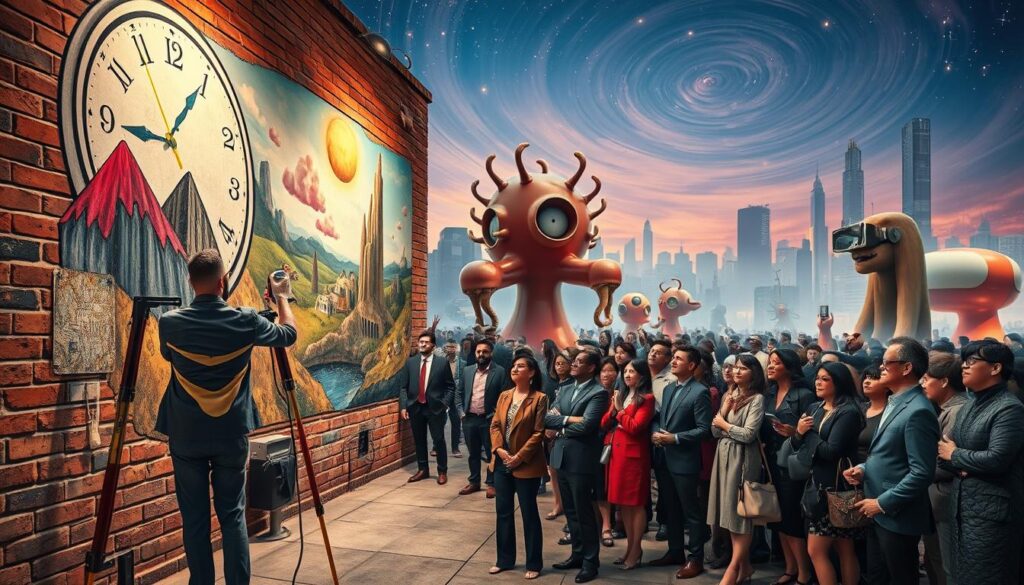
It’s big in two areas: movies and fashion. Surrealism’s contemporary influence is so deep, we often miss it. It just feels right.
6.1. The Cinematic Dream Logic of David Lynch and Alejandro Jodorowsky
Forget Dali’s watches. David Lynch is the true Surrealist dream master. In Eraserhead, a man lives in a dark world with a strange baby. A singer sings from inside a radiator. It’s pure Surrealism for today’s movies.
Lynch plays with stories like dreams. He doesn’t worry about cause and effect. His work is all about strange mixes and scary feelings. Alejandro Jodorowsky’s The Holy Mountain is full of symbols, weird bodies, and spiritual jokes. It’s like a live show.
They showed us that weird, symbol-filled stories can win fans. Now, anything that feels off-kilter is called “Lynchian.”
6.2. Fashion Runways and Advertising as Surrealist Tableaux
Look at your clothes or a fashion show. Alexander McQueen didn’t make clothes; he created dark stories. Models walked through storms or surrounded by moths. It was like stepping into a Surrealist show.
Schiaparelli keeps this tradition alive with gold organs and fake jewelry. Their shows are Surrealist scenes. They sell dreams, not just clothes.
Ads have been using Surrealism for decades. Perfume ads are the best example. A woman floats in a champagne glass. A man walks through melting clocks. They use Surrealism to sell desire.
| Medium | Key Examples | Surrealist Tactics Used | Contemporary Influence |
|---|---|---|---|
| Film & Television | David Lynch’s Twin Peaks, Jodorowsky’s The Holy Mountain | Dream logic, irrational juxtaposition, symbolic disruption | Defined “weird” aesthetic in indie & genre film; normalized non-linear storytelling. |
| High Fashion | Alexander McQueen (S/S 1999), Schiaparelli (Couture 2023) | Environmental immersion, body as object/mannequin, live performance | Turned runway shows into narrative spectacles; blurred art/commerce line. |
| Advertising | Chanel No. 5, Gucci campaigns | Visual paradox, impossible landscapes, fetishistic objects | Made surreal imagery the default for selling luxury, beauty, and aspiration. |
The table shows Surrealism’s lasting impact. It didn’t fade; it found a new platform. Its visual rebellion drives culture, from art to malls. That’s how you know it’s won. It becomes invisible.
7. The New Frontier: Digital and Virtual Surrealist Spaces
If André Breton were alive today, he’d probably be obsessed with your TikTok feed. He wanted to tap into the unconscious mind and find the marvelous in everyday life. Now, our digital lives serve that purpose on a global scale.
The gallery’s white cube has been replaced by the infinite scroll and the virtual headset. This isn’t a dilution of the movement; it’s its logical, terrifying evolution.
The dream has found new hardware. We carry pocket-sized portals to the irrational. Curators and artists have noticed. The most compelling modern exhibitions exploring surrealist themes are no longer bound by physical walls. They exist in code, in virtual reality, and in the chaotic streams of social media.
Before we dive into headsets, consider the most pervasive surrealist engine: the algorithm. Your social media feed is a masterpiece of irrational juxtaposition. A cat video sits next to geopolitical analysis. A meme about existential dread follows an ad for laundry detergent. This is the algorithmic unconscious at work, serving us a curated dream-logic we didn’t ask for but can’t look away from.
7.1. Curating the Algorithmic Unconscious: Online Exhibitions and VR
So, is your “For You” page a surrealist exhibition? In spirit, absolutely. Intentional digital curation takes this further. Online-only exhibitions began as necessities but have matured into distinct art forms. Institutions like the Google Arts & Culture platform host shows where Salvador Dalí’s clocks can melt across your screen, defying physics without the cost of shipping a painting.
These digital spaces allow for experiences impossible in reality. You can walk through a M.C. Escher drawing. You can shrink to the size of a teacup in a virtual dollhouse. The viewer becomes an active participant in the dream. This interactivity is key. It transforms passive observation into embodied exploration, fulfilling the surrealist desire to live within the marvelous.
Virtual Reality (VR) is the ultimate tool for this. Artists are building entire worlds governed by surrealist principles. In VR, you can:
- Float in a sky filled with giant, whispering ears.
- Navigate a library where books breathe and pages turn into butterflies.
- Confront a self-portrait that changes based on your heartbeat.
These are not gimmicks. They are the direct descendants of the 1938 exhibition’s “Surrealist Street.” They create total environmental immersion. The difference is that the environment is now made of pixels, not papier-mâché. This shift opens surrealism to global audiences, making these modern exhibitions accessible from any living room.
The commercial art world is paying attention. Auction houses host VR previews. Galleries sell NFTs of animated, dreamlike artworks. The line between the avant-garde and the digital marketplace is blurring, creating a new kind of surrealist bazaar. It’s chaotic, often contradictory, and utterly fascinating.
This digital frontier ensures the surrealist spirit remains vital. It proves that the desire to disrupt reality, to find poetry in the illogical, is human, not historical. The tools have changed from paint and collage to code and headsets, but the mission is the same. The next great surrealist exhibition might not have a physical address. Its URL, though, will be unforgettable.
8. The Curatorial Revolution: Lasting Changes to Exhibition Practice
If you’ve ever walked into a modern exhibition and felt like you stepped into a mood or an idea, thank a Surrealist. The movement’s most profound victory wasn’t just in the art it produced, but in the blueprint it left for how to present art itself. Before Surrealism, curation was often a scholarly affair—a polite, chronological march of “isms” and masters. After? Curators became experience designers, architects of emotion, and weavers of irrational connections.
This shift is the quiet, backroom revolution that changed everything. It moved the power from the historian’s timeline to the poet’s metaphor. Let’s dissect how this curatorial DNA, spliced from Surrealist experiments, now runs through the veins of contemporary museum practice.
8.1. Thematic Curation Over Linear History
Surrealism delivered the killing blow to the idea that a show must be a dutiful timeline. Why arrange art by birth date when you can arrange it by dream logic? The movement’s legacy is the now-standard practice of thematic curation. This approach groups works from wildly different eras and mediums based on a shared concept, feeling, or philosophical question.
Think about it. A contemporary show might place a haunting Renaissance portrait next to a glitchy digital video piece, united by the theme of “Melancholy.” A Baroque decaying fruit might dialogue with a modern sculpture about consumer waste. This intellectual collage is pure Surrealist juxtaposition, just applied to art history itself. The curator is no longer a librarian but a psychoanalyst, drawing out hidden connections from the collective unconscious of art.
This method makes art feel immediate and relevant. It tells us that human anxieties and joys—love, fear, decay, wonder—are timeless. The linear narrative of progress is replaced by a web of eternal themes. It’s a more engaging, and frankly, more honest way to look at culture.
8.2. Prioritizing Audience Experience and Emotional Response
If thematic curation changed the *what*, Surrealism’s focus on immersion changed the *how*. Those early, disorienting shows weren’t designed for passive viewing. They were engineered for visceral impact. Today’s emphasis on designing for an audience’s emotional and sensory journey is a direct inheritance.
The modern blockbuster is a masterclass in this. It’s not just about seeing great art; it’s about the journey. The lighting, soundscapes, room sequencing, and interactive elements are all carefully orchestrated. This is the legacy of walking down that simulated Parisian street in 1938 or navigating the string labyrinth in 1942. The goal is to make you *feel* something before you even *understand* it.
Curators now ask: What is the emotional arc of this show? Where do we place the moment of awe? When should the viewer feel claustrophobic or liberated? This audience-centric design turns a visit from an educational task into a personal experience. Every Instagrammable room, every atmospheric soundtrack in a modern exhibition owes a debt to the Surrealist revolt against the dry, academic hang.
| Aspect | The Old Paradigm (Pre-Surrealist) | The Surrealist-Inspired Paradigm |
|---|---|---|
| Primary Narrative | Chronological, linear art history. | Thematic, emotional, or conceptual links. |
| Audience Role | Passive observer and student. | Active participant on a sensory journey. |
| Space Design | Neutral “white cube” to not distract from the art. | An immersive environment that is part of the artwork. |
| Selection Logic | By movement, nationality, or technical mastery. | By poetic affinity, subconscious resonance, or disruptive dialogue. |
| Success Metric | Scholarly approval and comprehensiveness. | Audience emotional impact and memorable experience. |
So, the next time you’re in a museum, look past the art on the walls. Look at the space between them. The rhythm of the rooms, the unexpected pairings, the very feeling in the air—that’s the Surrealist curator’s hand, guiding us through a revolution in how we see.
9. Modern Manifestations: Exhibitions That Channel the Surrealist Spirit
The Surrealist movement has evolved from a bold statement to a key tool in modern exhibitions. Today’s top shows don’t just display art; they create immersive experiences. They tap into the dream logic the Surrealists introduced. But does this institutional recognition tame the Surrealist spirit, or does it just give it a new, polished stage?
Let’s examine two recent examples to see how the surrealist legacy is handled today.
9.1. Tate Modern’s “Surrealism Beyond Borders” (2021-2022)
Tate Modern’s “Surrealism Beyond Borders” was a thought-provoking show. It aimed to broaden our view of Surrealism, showing it wasn’t just a Parisian movement. Instead, it explored networks from Cairo to Tokyo, and Mexico City to Prague.
The show was well-curated, but it felt like an autopsy of the original, chaotic Surrealist shows. The original shows were provocative and often offensive. Tate’s version was beautifully organized, with perfect lighting and clear explanations.
9.1.1. Decentralizing the Narrative
This exhibition’s best move was decentering Paris. It turned the familiar narrative upside down. We saw how artists in the Caribbean used automatism to process colonial trauma. We also saw Japanese Surrealists blending folklore with Freud.
This wasn’t just about being politically correct. It was a genuine expansion of the surrealist legacy. The show asked us to consider the “marvelous” in places like Martinique, not just Montmartre. The answer was compelling, showing the movement’s core technique could thrive anywhere.
Yet, the museum setting creates a paradox. Can a museum ever truly be Surrealist? Tate’s clean, chronological halls are the opposite of the chaotic, immersive salle. The surrealist legacy is celebrated, but is its disruptive spirit safely tamed? The exhibition felt like a well-argued thesis, not a live experiment.
9.2. The Venice Biennale’s Frequent Surrealist Inclinations
If Tate’s approach is academic, the Venice Biennale is its id-driven counterpart. Walking through the Giardini or the Arsenale, you’ll find Surrealism is the default for ambitious, global art today. National pavilions compete to create the most dreamlike, carnival-like scenes.
Think of it as the international art world’s shared language. It’s a language of:
- Hybrid bodies: Sculptures merging human, animal, and machine.
- Psychic archaeology: Installations that feel like excavated memories.
- Ritual without religion: Performances invoking obscure, personal mythologies.
These modern exhibitions aren’t labeled “Surrealist.” They don’t need to be. The aesthetic has been fully absorbed. A pavilion might feature a forest of singing, mechanical trees. Another might submerge you in a room of slowly melting wax monuments. The effect is pure, unadulterated depaysement—the feeling of being unhomed.
The Biennale shows the movement’s ultimate victory and dilution. Its tactics are now the common currency for signaling “profundity” on the world stage. The surrealist legacy is so pervasive, it’s almost invisible. It’s the water the contemporary art fish swims in. The question isn’t whether an exhibition is Surrealist. It’s how skillfully it uses the grammar.
Together, Tate and Venice show two paths. One meticulously historicizes and expands the canon. The other instinctively performs its tricks in real-time. Both prove the surrealist legacy is not a relic. It’s a living, breathing template for the most engaging modern exhibitions we have.
10. Contested Legacy: Criticism, Commercialization, and Relevance
No artistic revolution ages without some stains on its manifesto. The surrealist legacy is a brilliant, fractured mirror. It shows boundless creativity and ugly truths we can’t ignore.
To engage with it honestly today means holding contradictory ideas. It’s the beauty of a Dali melting clock and the discomfort of his often grotesque, subjugated female forms.
The movement’s “liberation of the unconscious” was a boys’-club affair. The female form was often seen as a passive object of mystery or terror. Its fascination with “primitive” art often veered into exoticism, plundering non-Western cultures for aesthetic shock without critical context.
Then came the sell-out. Or should we say, the luxurious assimilation? The tactics meant to subvert bourgeois taste were catnip for luxury marketing. Now, a disembodied lip floats not in a Magritte painting, but in a perfume ad. A Schiaparelli lobster telephone is reborn as a $2,000 handbag.
This leads to the spectacle problem. When every department store window and Instagram feed employs dream logic for clicks, do the original methods lose their bite? The mannequin, once a potent symbol of dehumanization, can now feel like a tired prop.
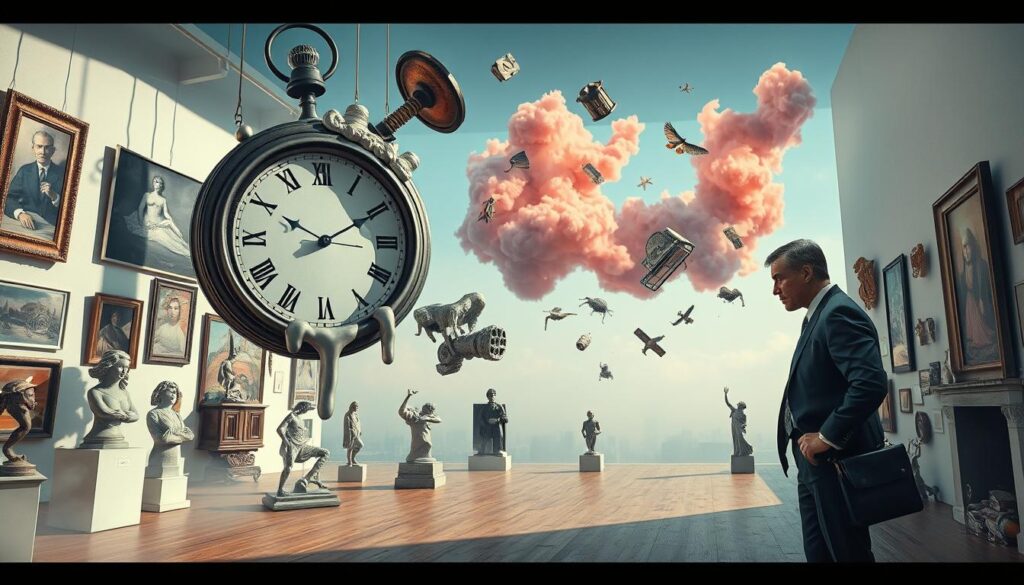
So, we arrive at the hard question. In an age of algorithmically-generated weirdness and deepfake nightmares, does the original surrealist shock hold power? Perhaps its power has shifted. The true jolt now isn’t from a boiled lobster on a telephone. It’s from confronting the movement’s own demons—its misogyny, its colonial borrowings—and from spotting its hollowed-out, commercialized ghost in a chic boutique.
This critical engagement is not the end of the surrealist legacy. It’s its maturation. A legacy that cannot withstand scrutiny is a dead one. The enduring relevance lies precisely in this tension. It challenges us to separate revolutionary method from dated ideology, to reclaim disruptive spirit from commercial gloss.
The dream wasn’t pure. Acknowledging that doesn’t ruin it. It makes the whole, messy, contradictory history infinitely more interesting.
11. The Enduring surrealist exhibitions legacy
The true surrealist exhibitions legacy isn’t in museum catalogs. It’s in how we now expect art to engage, disturb, and transform us. Think about it. When you walk into a big show, you hope for more than just pretty pictures.
You want an experience. This desire comes from the surrealist movement.
What started as a challenge to rational gallery walls has become a key blueprint. The movement’s shift from a niche to mainstream is a major art history twist. The artists who filled rooms with coal sacks or string were not just decorating.
They were setting new rules for art and space. They challenged our views on art, space, and our minds.
The heart of this surrealist legacy is a powerful idea. It sees an exhibition as a way to trigger our minds. It’s a challenge to our reality.
This idea focuses on feeling over history and on being part of the art. It turns viewers into active parts of a living art piece.
Today’s cultural moments feel familiar because of this. Fashion runways become dystopian dreams. Instagram filters turn faces into Dalí portraits. Video games follow dream logic.
These aren’t just tributes. They show the surrealist idea is in our visual culture. The artists and poets of 1920s Paris set the stage for today’s weirdness.
The table below shows how these ideas became common:
| Surrealist Innovation | Core Principle | Modern Echo |
|---|---|---|
| Environmental Immersion (e.g., the 1938 “Street”) | The exhibition space is an artwork itself. | Instagrammable museum installations and immersive Van Gogh experiences. |
| Irrational Juxtaposition | Meaning arises from collision, not curation. | Algorithmic social media feeds and postmodern film editing. |
| Audience as Participant | Viewer completion is essential to the work. | Interactive digital art and choose-your-own-adventure storytelling. |
| Challenge to Consensus Reality | Art’s job is to question perception. | VR environments and deepfake media that blur truth and fiction. |
The surrealist victory wasn’t just getting into the canon. It was changing our imagination. Their methods for challenging logic are now used to grab our attention.
To understand this evolution is to see the surrealist influence in modern culture. For more on the surrealist ethos, their ideas are fascinating. Their surrealist exhibitions legacy lives on because it changed how we see art.
12. Conclusion
So, where does this leave us? The real victory of Surrealism wasn’t just a painting. It was the bold idea that galleries can change our minds, like dreams.
This legacy is alive and well. It’s the secret code behind much of what we see today. Its contemporary influence is clear, from the deep worlds of installation art to the shocking surprises of TikTok.
We’re living in a world shaped by Surrealism. Our politics are like theater, full of surprises. Our online spaces are like dreams, shaped by algorithms. Learning about Surrealism’s impact is more than just art history. It’s a guide for understanding our world.
The next generation will create their own exhibitions, online and offline. They’ll use the lessons of Surrealism to change the world. The street and the gallery are now one, everywhere we look.